Spice Comparisons · Comparison
Tarragon vs. Rosemary: A Tender Anise Herb and a Resinous Hardy One
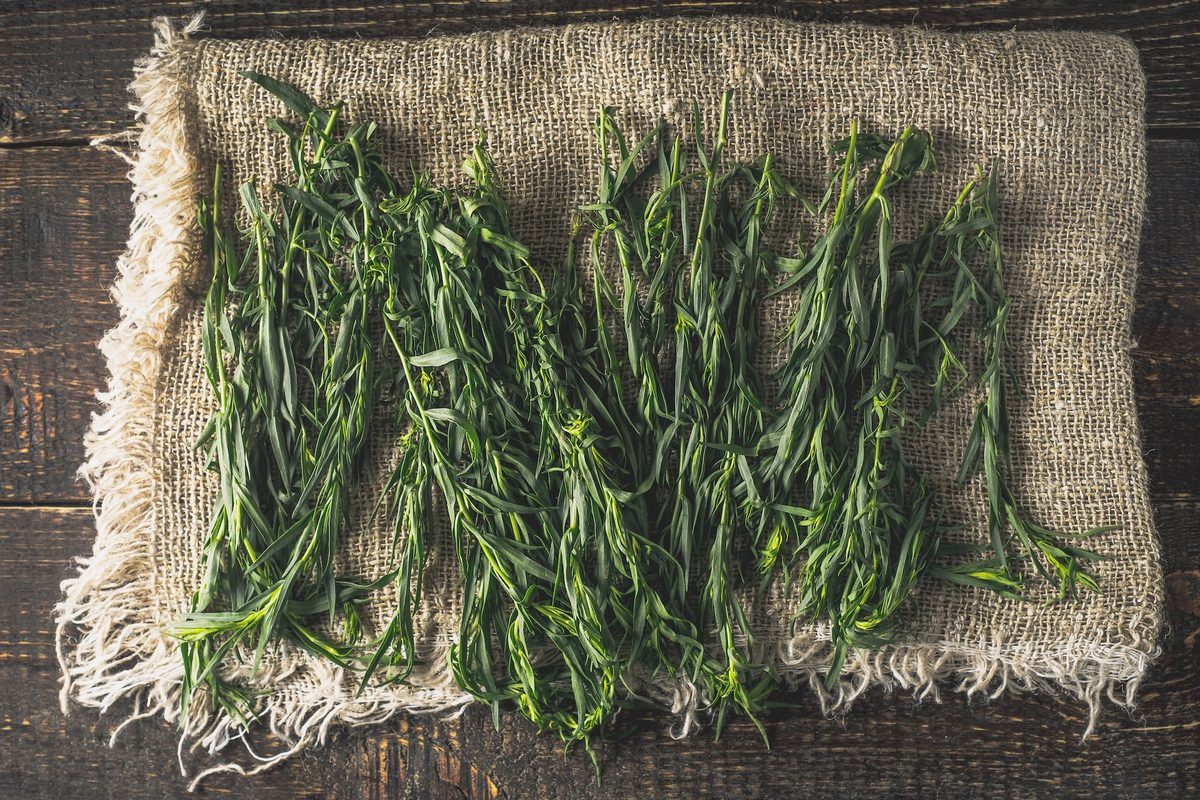
Tarragon and rosemary sit at opposite ends of the herb shelf. Tarragon is a tender, anise-scented leaf that loses much of its flavor when dried and belongs at the end of cooking.12 Rosemary is a needle-leaved shrub with a pungent, piney, slightly bitter edge that holds up to drying and long cooking.342 They are not interchangeable, and most recipes that call for one would not welcome the other.
Side by side
| Tarragon | Rosemary | |
|---|---|---|
| Species | Artemisia dracunculus L.5 | Salvia rosmarinus Spenn., formerly Rosmarinus officinalis L.6 |
| Family | Asteraceae (daisy family)5 | Lamiaceae (mint family)6 |
| Native range | Temperate Northern Hemisphere to tropical mountains (Kew)5 | The Mediterranean (Kew)6 |
| Plant | Perennial, about 2 to 3 feet tall (French tarragon)1 | Evergreen shrub, usually 0.6 to 2 meters3 |
| Leaves | Dark green, narrow and slightly twisted1 | Narrow and leathery; blade 1 to 5 cm long and 1 to 2 mm wide43 |
| Oil in the dried leaf | 0.2 to 1.0%7 | 1 to 2%4 |
| Main oil compounds | Estragole: 60 to 75% of tarragon oil (EU Scientific Committee on Food)8 | α-pinene 13.5 to 37.7% and 1,8-cineole 16.1 to 29.3%, in oils from six countries (Satyal et al. 2017)9 |
| Flavor, per the sources | Sweet anise-like scent, bittersweet flavor (PROSEA);7 licorice or anise (Illinois Extension)1 | Pungent, slightly bitter (Britannica);3 borneol gives a camphor-like smell, α-pinene a warm, piny one (PROSEA)4 |
| Strength | Medium-strength herb (University of Delaware)10 | Strong herb (University of Delaware)10 |
| Dried | Flavor is quickly lost on drying1 | Dried rosemary fared reasonably well in long, liquid cooking (ATK)2 |
| When to add | Delicate and volatile; late2 | Hearty; can go in early11 |
| US status | Tarragon oil: generally recognized as safe12 | Rosemary: a spice generally recognized as safe13 |
The oil-content figures are both PROSEA’s, for dried leaf, so they are comparable. The compound figures are not: they come from different studies and describe what leads each oil, not a measured comparison.
The flavor gap
Tarragon reads as anise. The University of Illinois Extension describes its taste as licorice or anise,1 and the same extension service says fennel also has an anise or licorice flavor;14 cooks often group the three together. Tarragon’s oil is mostly estragole.8
Rosemary has no anise in any source reviewed here. Britannica calls its taste pungent and slightly bitter.3 PROSEA ties its camphor-like smell and burning taste to borneol and its warm, piny note to α-pinene,4 and across oils from six countries α-pinene and 1,8-cineole were the leading compounds.9 Words like minty or tea-like are cooks’ descriptions, not measurements.
Drying and heat
This is where the two behave most differently in the kitchen.
- Tarragon is best fresh. Illinois Extension says its flavor is quickly lost if the leaves are dried, and recommends using it fresh whenever possible.1 America’s Test Kitchen counts tarragon among the delicate herbs whose flavor compounds are more volatile.2
- Rosemary dries well. In ATK’s tests, dried rosemary, sage and thyme fared reasonably well in recipes with long cooking times and a good amount of liquid.2 ATK also groups rosemary with the hearty herbs added early, whose flavor compounds are somewhat more heat-stable.11
Whether drying “concentrates” rosemary’s flavor, or leaves fresh and dried tasting alike, is not established by these sources; see dried rosemary vs. fresh and dried tarragon vs. fresh.
Can one stand in for the other?
Only loosely, and the result will taste different.
| Swap | Ratio | Treatment |
|---|---|---|
| Tarragon for rosemary | Half as much, fresh or dried (A Couple Cooks)15 | Attributed |
| Rosemary for tarragon | No published ratio found | Method |
Tarragon for rosemary. A Couple Cooks says tarragon can work in a pinch, at half the amount.15 The Spice House suggests tarragon in place of rosemary for fish or dishes that benefit from an anise touch.16 Expect an anise dish, not a rosemary one, and add the tarragon late.2
Rosemary for tarragon. We found no source that recommends it. Rosemary is the stronger herb by the University of Delaware’s grouping,10 lacks the anise note, and would overwhelm a béarnaise or a fines herbes omelet. If you must, use a small pinch of finely chopped rosemary and taste; a better route is one of the anise-leaning options on tarragon substitutes. For the reverse, see rosemary substitutes.
Where each belongs
Tarragon. Britannica calls it an essential ingredient in béarnaise,17 and it is one of the herbs commonly found in fines herbes.18 PROSEA says the leaves suit chicken, egg and lobster dishes especially well, and that tarragon vinegar is made by adding the herb to wine vinegar.7 Illinois Extension adds oils, marinades and salads.1
Rosemary. Britannica lists meats, vegetables, soups and beverages, and mentions baking, infused oils and herbal teas.3 Lamb, roast potatoes, focaccia and white beans are classic pairings, which is common practice rather than a sourced rule.
Both herbs turn up with chicken and vegetables, but they do different jobs there: tarragon as a fresh finishing note, rosemary as a background note that cooks in. That is our judgment.
What isn’t known
- No published measurement compares the flavor strength of tarragon and rosemary.
- No source gives a ratio for rosemary in place of tarragon.
- A claim that rosemary leaves are sharp enough to be a choking hazard circulates; no source for it was found.
- Rosemary vinegar is sometimes described as less useful than tarragon vinegar. No source compares them.
Related
- Tarragon, tarragon substitutes, tarragon uses and how to store tarragon
- Rosemary, rosemary substitutes, rosemary uses and cooking with rosemary
- Tarragon vs. dill, tarragon vs. thyme, rosemary vs. thyme and rosemary vs. sage
- Fines herbes
Footnotes
-
“Tarragon: French”, University of Illinois Extension. extension.illinois.edu · Reference work ↩ ↩2 ↩3 ↩4 ↩5 ↩6 ↩7 ↩8
-
“Science: Substituting Dried Herbs for Fresh”, America’s Test Kitchen. americastestkitchen.com · Publication ↩ ↩2 ↩3 ↩4 ↩5 ↩6 ↩7
-
“Rosemary”, Encyclopaedia Britannica. britannica.com · Reference work ↩ ↩2 ↩3 ↩4 ↩5 ↩6
-
C.C. de Guzman, Rosmarinus officinalis, Plant Resources of South-East Asia (PROSEA). uses.plantnet-project.org · Reference work ↩ ↩2 ↩3 ↩4 ↩5
-
Artemisia dracunculus L., Plants of the World Online, Royal Botanic Gardens, Kew. powo.science.kew.org · Reference work ↩ ↩2 ↩3
-
Salvia rosmarinus Spenn., Plants of the World Online, Royal Botanic Gardens, Kew. powo.science.kew.org · Reference work ↩ ↩2 ↩3
-
C.C. de Guzman and R.A. Reglos, Artemisia dracunculus, Plant Resources of South-East Asia (PROSEA). uses.plantnet-project.org · Reference work ↩ ↩2 ↩3
-
Opinion of the Scientific Committee on Food on Estragole, European Commission, 2001. food.ec.europa.eu · Regulator ↩ ↩2
-
Satyal et al., “Chemotypic Characterization and Biological Activity of Rosmarinus officinalis”, Foods, 2017. mdpi.com · Peer-reviewed ↩ ↩2
-
“Using Herbs and Spices”, University of Delaware Cooperative Extension, 2025. udel.edu · Reference work ↩ ↩2 ↩3
-
Liz Bomze, “Our Guide to Fresh Herbs”, America’s Test Kitchen, 2019. americastestkitchen.com · Publication ↩ ↩2
-
21 CFR 182.20, Essential oils, oleoresins and natural extractives, US Food and Drug Administration. ecfr.gov · Regulator ↩
-
21 CFR 182.10, Spices and other natural seasonings and flavorings, US Food and Drug Administration. ecfr.gov · Regulator ↩
-
“Fennel”, University of Illinois Extension. extension.illinois.edu · Reference work ↩
-
Sonja Overhiser, “Best Substitute for Rosemary”, A Couple Cooks, 2026. acouplecooks.com · Publication ↩ ↩2
-
“The 8 Best Substitutes for Rosemary”, The Spice House, 2024. thespicehouse.com · Merchant ↩
-
“Tarragon”, Encyclopaedia Britannica. britannica.com · Reference work ↩
-
“Fines herbes”, Encyclopaedia Britannica. britannica.com · Reference work ↩