Spice Comparisons · Comparison
Lemon Balm vs. Mint: Citral Against Menthol and Carvone
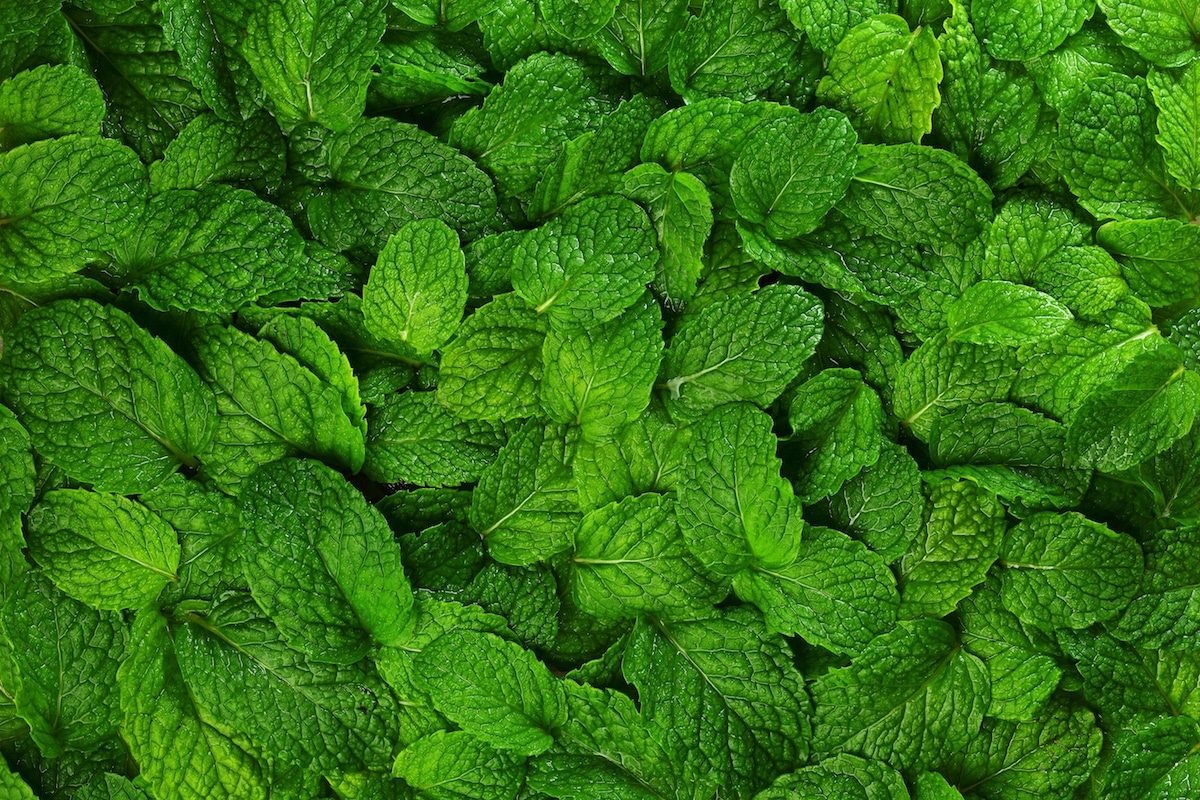
Lemon balm and mint grow in the same plant family, the Lamiaceae, but they belong to different genera and taste of different things.12 Lemon balm is a single species, Melissa officinalis, whose leaf oil is led by citral, the compound behind the smell of lemon.13 Mint is the genus Mentha, and in cooking the word usually means peppermint or spearmint.4 Peppermint oil is built on menthol and menthone, spearmint oil on carvone.2 Menthol is what makes peppermint taste cool.5 So the choice between them isn’t a matter of strength: one brings lemon, the other brings mint.
Side by side
| Lemon balm | Mint (peppermint and spearmint) | |
|---|---|---|
| Botanical name | Melissa officinalis L.1 | Peppermint: Mentha × piperita, a hybrid of water mint and spearmint. Spearmint: Mentha spicata67 |
| Family | Lamiaceae18 | Lamiaceae2 |
| How many kinds | One species; Kew recognizes two subspecies1 | About 25 species in the genus (Britannica); 25 to 30 in a 2018 review42 |
| Native range | Mediterranean to Central Asia1 | Peppermint: Europe to Central Asia, mostly known in cultivation. Spearmint: Europe to China67 |
| Key aroma compounds | Citral (geranial and neral) and citronellal3 | Peppermint: menthol and menthone. Spearmint: carvone2 |
| Cooling effect | Menthol is not among the main compounds the EMA names3 | Peppermint: menthol, which has a minty, cooling taste.5 Spearmint lacks menthol, according to McCormick9 |
| Typical uses | Salads, soups, sauces, stuffings, liqueurs, wine, herbal teas, fruit drinks8 | Mint sauce for lamb; confectionery, chewing gum, spice mixtures102 |
| US food status | On FDA’s GRAS lists as a spice and as an essential oil1112 | Peppermint and spearmint oils on FDA’s GRAS list of essential oils12 |
| EU contaminant limit | Herbal infusions capped at 400 µg/kg pyrrolizidine alkaloids13 | Peppermint infusions: the same 400 µg/kg cap13 |
| Flavor (editorial) | Soft lemon with a green, faintly minty background | Peppermint sharp and cold; spearmint sweeter and gentler |
| Price | No dated, sourced comparison found | No dated, sourced comparison found |
Same family, different branches
Both plants are Lamiaceae, the family that also includes basil.1214 Within it, lemon balm and mint are separate genera, Melissa and Mentha. Mint is not a subfamily: it is one genus of about 25 species.4 A figure of 40 or more mint varieties circulates widely; we could not trace it to a source, and the published species counts are about 25. Lemon balm, by contrast, is one species with two subspecies recognized by Kew.1
The two also differ in what kind of mint-family plant they are. Penn State Extension describes lemon balm as a perennial that grows up to 3 feet, hardy to Zone 5, and spreads if left unattended.15 Peppermint is a hybrid, mostly known as a cultivated plant that occasionally escapes.6
Flavor: lemon against menthol and carvone
The differences in taste follow the oils.
| Oil (scope) | Main compounds | Source |
|---|---|---|
| Lemon balm, general description (EMA) | Mainly citral, neral and citronellal; β-caryophyllene and germacrene D about 10% each | EMA3 |
| Lemon balm, one Algerian sample (Algiers, May 2018) | Geranial 45.06%, neral 31.72%, citronellal 6.42% | Abdellatif et al.16 |
| Peppermint (Clark and Menory 1980, as tabulated in a 2018 review) | Menthol 29–48%, menthone 20–31%, menthyl acetate 3–10%, menthofuran 6.8% | Singh and Pandey2 |
| Spearmint, Serbia (as tabulated in the same review) | Carvone 69.5%, menthone 21.9% | Singh and Pandey2 |
These are separate samples from separate studies, so they show which compounds lead each oil, not a typical value. McCormick puts peppermint’s menthol at about 40 percent and describes spearmint as milder and lacking menthol.9
What that means on the plate:
- Lemon balm tastes of lemon, without the sourness of the fruit. Its faint mint background is our tasting note; none of the sources we read lists menthol or carvone among its main compounds.
- Peppermint tastes cool. Britannica describes menthol as having a strong minty, cooling odor and taste, and peppermint oil is a natural source of it.5
- Spearmint is minty but softer. Katzer calls it minty but not pungent.17
So the claim that mint is “simply minty with no lemon note” is right, and the claim that mint’s coolness is universal is not: it belongs mostly to peppermint.
How cooks use them
Mint has a few firmly established jobs. Mint sauce, made from fresh mint, sugar and vinegar, is the traditional partner for roast lamb in England.10 Katzer writes that true peppermint is used almost exclusively for confectionery and sweet liqueurs and that its freshness goes extremely well with chocolate, while spearmint is the mint for British mint sauce.17 A 2018 review lists mint as a flavoring in confectionery, cough drops and chewing gum, and in spice mixtures.2
Lemon balm is used to flavor salads, soups, sauces, stuffings, liqueurs, wine, herbal teas and fruit drinks.8 The EMA adds that it gives fragrance to wine, tea and beer.3 Penn State’s lemon balm syrup, made by steeping six 4-inch sprigs in a boiling syrup of equal parts sugar and water for 30 minutes, goes into cocktails, seltzer, pound cake or fruit.15
Handling. LSU AgCenter groups mint with the delicate herbs that are best added near the end of cooking, because prolonged heat costs flavor and aroma.18 Lemon balm isn’t on LSU’s list, but cooks treat it the same way; that is common practice rather than a measured finding. America’s Test Kitchen lists mint among the herbs much weaker in flavor when dried.19
Can one stand in for the other?
Not on its own. Lemon balm can’t supply mint’s menthol or carvone, and mint can’t supply citral. Each can be pushed closer to the other with a second ingredient. These starting points follow our lemon balm substitute and mint substitute pages.
| Swap | Starting amount | Treatment |
|---|---|---|
| Mint plus lemon zest in place of 1 tablespoon chopped fresh lemon balm | 1½ teaspoons chopped fresh mint (spearmint is gentler) plus ¾ teaspoon finely grated lemon zest, then taste | Method |
| Lemon balm in place of mint where mint is the main flavor | Not a good swap; use the other mint instead | Method |
| Lemon balm in place of mint in a mixed herb salad or sauce | The same volume, then taste | Method |
| Lemon balm plus mint extract, to add mint flavor | A drop or two of extract, then taste | Method |
| Dried in place of fresh, either herb | 1 teaspoon dried per 1 tablespoon fresh | Computed (general herb rule) |
No published ratio exists for swapping these two herbs, so the first four rows are starting points. For scale on the extract, McCormick’s label for its Pure Mint Extract equates 1 teaspoon with a whole bunch of mint leaves,20 so a few drops go a long way. The dried-herb rule of 1 tablespoon fresh to 1 teaspoon dried is LSU AgCenter’s general guide, not a measurement for either herb.18
Health and safety
Medicinal claims. The EMA’s herbal committee accepts lemon balm leaf as a traditional herbal medicine for mild symptoms of stress, to aid sleep, and for mild digestive complaints such as bloating and wind. That rests on long-standing use, and the EMA says the evidence is insufficient to establish its efficacy.213 For mint, nearly all the research concerns peppermint oil, not the leaf. NCCIH reports that enteric-coated peppermint oil capsules may improve symptoms of irritable bowel syndrome in adults, but that very little research has been done on peppermint leaf.22 The claim that mint does nothing for sleep or anxiety could not be traced to a source either way. This page makes no claim that either herb treats any condition.
Cautions. For lemon balm medicines, the EMA limits use to adults and children over 12, warns of possible drowsiness, and does not recommend use in pregnancy or breastfeeding.213 NCCIH says peppermint tea appears to be safe, and lists heartburn, nausea, abdominal pain and dry mouth as possible side effects of peppermint oil taken by mouth.22
What isn’t known
- No study compares the two leaves’ oils in the same analysis.
- No published substitution ratio exists for this pair.
- No source we found counts mint “varieties”; the species counts above are the only published figures.
- No shelf-life or drying test for lemon balm was found.
- No dated, sourced price comparison.
Related
- Lemon balm and mint, the full profiles
- Lemon balm substitutes and mint substitutes
- Spearmint, peppermint, spearmint vs. peppermint and types of mint
- Lemon balm vs. lemon verbena, lemon balm vs. lemongrass, basil vs. mint and oregano vs. mint
- Cooking with mint and too much mint
Footnotes
-
Melissa officinalis L., Plants of the World Online, Royal Botanic Gardens, Kew. powo.science.kew.org · Reference work ↩ ↩2 ↩3 ↩4 ↩5 ↩6 ↩7 ↩8
-
Pooja Singh and Abhay K. Pandey, “Prospective of Essential Oils of the Genus Mentha as Biopesticides: A Review”, Frontiers in Plant Science, 2018. frontiersin.org · Peer-reviewed ↩ ↩2 ↩3 ↩4 ↩5 ↩6 ↩7 ↩8 ↩9 ↩10
-
Assessment report on Melissa officinalis L., folium, European Medicines Agency. ema.europa.eu · Regulator ↩ ↩2 ↩3 ↩4 ↩5 ↩6 ↩7
-
“Mint (plant)”, Encyclopaedia Britannica. britannica.com · Reference work ↩ ↩2 ↩3
-
Leroy G. Wade, “Menthol”, Encyclopaedia Britannica, 2026. britannica.com · Reference work ↩ ↩2 ↩3
-
Mentha × piperita L., Plants of the World Online, Royal Botanic Gardens, Kew. powo.science.kew.org · Reference work ↩ ↩2 ↩3
-
Mentha spicata L., Plants of the World Online, Royal Botanic Gardens, Kew. powo.science.kew.org · Reference work ↩ ↩2
-
Melissa Petruzzello, “Lemon balm”, Encyclopaedia Britannica. britannica.com · Reference work ↩ ↩2 ↩3
-
McCormick Kitchens, “About Mint: Uses, Pairings and Recipes”, McCormick, 2026. mccormick.com · Merchant ↩ ↩2
-
“Mint Sauce”, Saveur, quoting Megan Wetherall, 2000. saveur.com · Publication ↩ ↩2
-
21 CFR 182.10, US Food and Drug Administration. ecfr.gov · Regulator ↩
-
21 CFR 182.20, US Food and Drug Administration. ecfr.gov · Regulator ↩ ↩2
-
Commission Regulation (EU) 2023/915, Annex I, section 2.4. eur-lex.europa.eu · Regulator ↩ ↩2
-
Sohini Dasgupta (rev.), “Basil”, Encyclopaedia Britannica, 2026. britannica.com · Reference work ↩
-
Mandy L. Smith and Susan Marquesen, “Lemon-Scented Herbs in the Garden and the Kitchen”, Penn State Extension, 2025. extension.psu.edu · Reference work ↩ ↩2
-
Abdellatif et al., “Minerals, Essential Oils, and Biological Properties of Melissa officinalis L.”, Plants, 2021. pmc.ncbi.nlm.nih.gov · Peer-reviewed ↩
-
Gernot Katzer, “Mint (Mentha)”, Gernot Katzer’s Spice Pages. gernot-katzers-spice-pages.com · Reference work ↩ ↩2
-
“Flavorful Herbs”, LSU AgCenter. lsuagcenter.com · Reference work ↩ ↩2
-
Danielle Lapierre, “When You Should Actually Use Dried Herbs (and Which Ones to Avoid)”, America’s Test Kitchen, 2022. americastestkitchen.com · Publication ↩
-
Pure Mint Extract, 2 oz, McCormick product page. mccormick.com · Merchant ↩
-
“Melissa leaf”, summary for the public, European Medicines Agency, 2014. ema.europa.eu · Regulator ↩ ↩2
-
“Peppermint Oil”, National Center for Complementary and Integrative Health, 2025. nccih.nih.gov · Regulator ↩ ↩2