Spice Substitutes · Substitutes
Red Pepper Flakes Substitutes, Matched to the Heat and Texture You Need
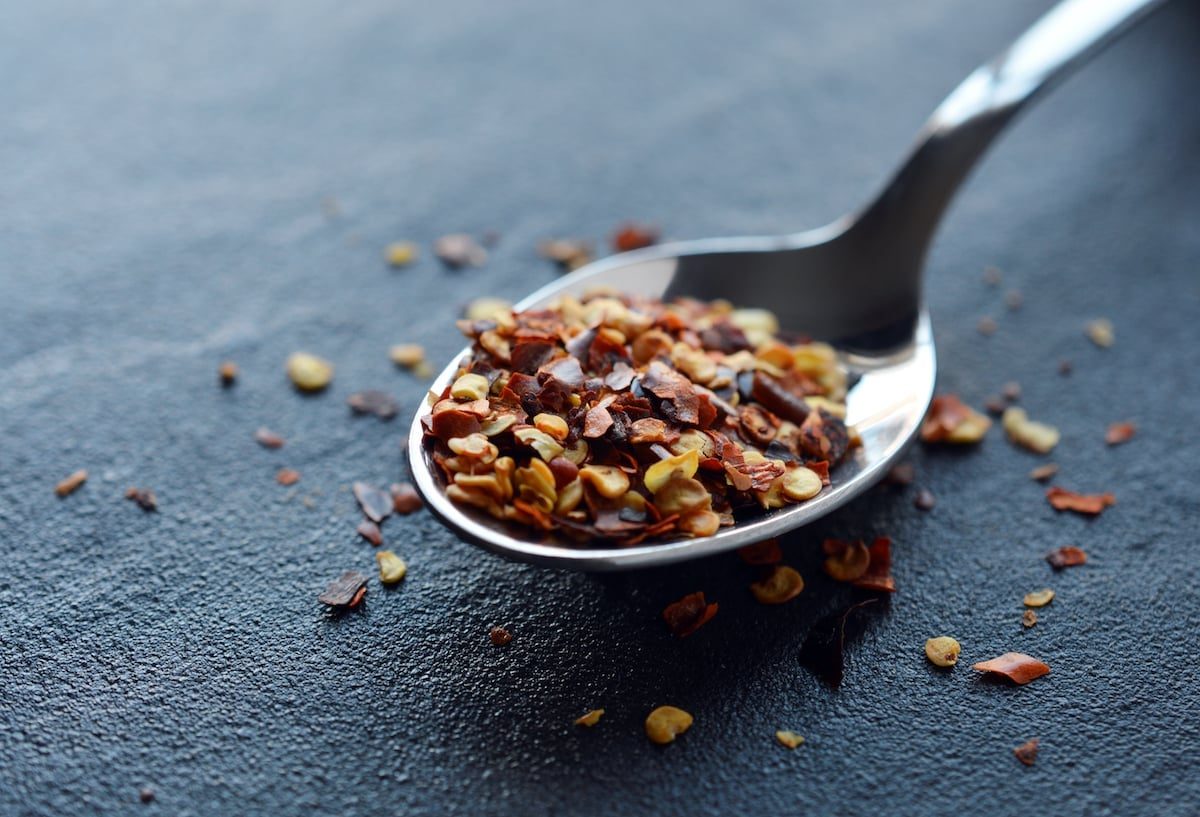
Red pepper flakes, sold in the US as crushed red pepper, are dried red chiles broken into flakes, seeds and all. McCormick Science Institute says they typically use the cayenne variety, alone or blended with other cultivars.1 PepperScale agrees that a jar is usually a mix: cayenne most often, with chile de árbol or ancho among the others.23 They do two jobs: they add heat, and at the table they add visible specks of red that deliver it in small bursts. The best substitute depends on which of those jobs matters in your dish.
Quick answer
| What the flakes are doing | Best substitute | Starting amount, per 1 part flakes | Treatment |
|---|---|---|---|
| Heat and texture, sprinkled on at the table | Dried chiles de árbol, crushed | 1 part, then taste | Attributed (PepperScale) |
| Heat cooked into a sauce, oil or stew | Cayenne powder | 1/3 part, then add to taste | Attributed (PepperScale) |
| Mild warmth and red color | Gochugaru | 1 part, more if you want more heat | Attributed (PepperScale) |
| Mild warmth and red color | Aleppo-style flakes or pul biber | 1 part, more if you want more heat | Method |
| Fresh heat in a cooked dish | Fresh red chile, finely chopped | A little at a time | Method |
How the ratios on this page are labeled
Every ratio carries one of four labels.
- Computed: based on a measurable physical relationship, with the source named.
- Attributed: a named source publishes this ratio. We quote it as theirs.
- Disputed: named sources give different answers to the same swap. We show each one and do not average them.
- Method: we found no published ratio. We give a direction and a cautious starting point, and say so.
PepperScale is the one source we found that publishes ratios for replacing red pepper flakes, and those are labeled Attributed; everything else is Method.2 Chili Pepper Madness gives a ratio for the reverse swap: the same amount to 1½ times as much red chili flakes in place of cayenne.4 Heat also varies so much by chile and lot that no ratio could promise a match (see the table below). Add any substitute in stages and taste.
How hot are red pepper flakes, and the chiles that replace them?
The figures below come from different kinds of sources and describe different things, so they sit side by side and are not combined.
| Product or chile | Heat | Scope and source |
|---|---|---|
| Crushed or flaked chilli, as a category | 900 SHU or more | Category boundary, not a measurement of any jar. Codex CXS 353-20225 |
| Crushed red pepper | 15,000–30,000 SHU | Dave DeWitt’s heat scale, which he calls “necessarily approximate”6 |
| Chile de árbol | 15,000–30,000 SHU | Same row of DeWitt’s scale6 |
| Cayenne Long | 30,000–50,000 SHU | DeWitt’s scale;6 PepperScale gives the same range for cayenne powder2 |
| Aleppo pepper | Around 10,000 SHU | PepperScale, general rating, no method stated2 |
| Gochugaru | 1,500–10,000 SHU | PepperScale, general rating, no method stated2 |
| Cayenne Large Red Thick; Mirasol | 2,500–5,000 SHU | DeWitt’s scale6 |
| Ancho | 1,000–1,500 SHU | DeWitt’s scale6 |
| Jalapeño | 2,500–10,000 SHU | DeWitt’s jalapeño profile7 |
| Cayenne peppers, no sample stated | About 8,000 SHU | McCormick Science Institute1 |
McCormick Science Institute also says cayenne powder is typically hotter than red pepper flakes,1 and PepperScale says the same.2 None of these figures comes with a sample or method. Scoville taste tests are subjective, and high-performance liquid chromatography (HPLC) is the most accurate way to measure chile heat.8 Retail jars rarely state either. Treat every number here as a rough guide to which chiles are hotter, not as a basis for a precise swap.
If the flakes are heat and texture at the table
This is the pizza and pasta shaker. McCormick Science Institute describes red pepper as a finishing sprinkle for pizza, pasta and “anything.”1 Here you need something that looks and behaves like flakes: dry, coarse, and hot enough that a pinch does the work.
1. Crush your own dried chiles
Under the international standard for dried chile, crushed or flaked chilli may be made with or without seeds.5 Flakes are nothing more than that, so any dried red chile you can break up will make them. Which chile you pick decides the heat.
- Chile de árbol is the closest heat match. DeWitt puts it on the same row of his scale as crushed red pepper, 15,000 to 30,000 SHU.6 Gernot Katzer describes de árbol as a long, pointed chile “of biting heat” and groups it with the less aromatic, more pungent cultivars.9
- Guajillo and ancho make mild flakes. Guajillo is also called mirasol in Mexico,10 and DeWitt rates mirasol at 2,500 to 5,000 SHU and ancho at 1,000 to 1,500.6 Both are far milder than crushed red pepper on his scale. Use them where you want chile flavor and color more than heat.
Break the chiles into pieces, remove the stems, and pulse briefly in a spice grinder until you have a mix of flakes and seeds. That is common kitchen practice, not a sourced method. If you want less heat, remove the pale inner walls along with the seeds before grinding: researchers at The Ohio State University describe the heat compounds collecting in small blisters along the inner walls of the fruit.11
Ratio (Attributed): PepperScale calls crushed chiles de árbol a very good heat match and the closest to one for one of its substitutes, but says to taste, since it depends on the pods.2 With guajillo or ancho you can use more (Method), but expect a milder, fruitier result.
Drying fresh chiles. You can also dry your own red jalapeños or serranos in a low oven or dehydrator and crush them. DeWitt’s jalapeño profile gives 2,500 to 10,000 SHU for the pod,7 which is milder than crushed red pepper on his scale.6 That range is fourfold, so taste a pinch of each batch before you use it.
2. Other countries’ chile flakes
Several cuisines make flakes of their own. They are usually milder than American crushed red pepper, and some contain salt and oil.
- Aleppo-style pepper. The Spice House, which notes that this pepper originates in the Syrian town of Aleppo, says its flakes “add color, mild heat, and a unique salty-raisiny flavor.”12 Its label lists chiles, vegetable oil and salt.12
- Turkish pul biber. Turkey’s food codex allows pul biber to contain up to 40 percent seeds by weight and up to 7 percent salt, with added vegetable oil permitted.13 The ipek (“silk”) grade is held to 2 percent seeds.13
PepperScale rates Aleppo at around 10,000 SHU, milder than a usual jar of flakes, with a tangy, almost fruity edge.2 Because both can contain salt, taste before you salt the dish.
Ratio (Method): No published ratio was found. Start with 1 part for 1 part flakes and add more if you want more heat. In our judgment these flakes are milder, so you can usually afford to go higher.
If the flakes are heat cooked into a dish
In a pan sauce, an arrabbiata, a chili oil or a stew, the flakes dissolve into the dish and their texture stops mattering. A powder does the same job and spreads its heat more evenly.
1. Cayenne powder
Flakes are typically cayenne,1 so ground cayenne is usually the same chile in a finer form. McCormick Science Institute says cayenne powder is typically hotter than the flakes.1 A powder also releases its heat all at once rather than in bursts, which in our judgment makes it easier to overshoot.
Ratio (Attributed): PepperScale names cayenne the best option, warns against a one-for-one swap, and says to start at about a third of the flakes called for.2 Chili Pepper Madness’s guidance for the reverse swap uses 1 to 1½ parts flakes for each part cayenne,4 which points the same way, as does McCormick Science Institute’s view that cayenne is the hotter of the two.1 Cook for a minute, taste, and add more.
2. Hot sauce or chili powder
A vinegar-based hot sauce or a chili powder blend will add heat to a cooked dish too, but each brings more than heat. Chili powder carries cumin, oregano, garlic and salt (see chili powder), and DeWitt rates chili powder at only 500 to 1,000 SHU.6 Use either only where those extra flavors suit the dish.
Ratio (Attributed): PepperScale says a few drops of a basic hot sauce such as Sriracha is often enough to match the heat of a teaspoon of flakes.2 For chili powder it says to start at around half the flakes, keeping in mind the garlic, onion and cumin that come with it.2 By DeWitt’s ratings, though, chili powder is far milder than crushed red pepper,6 so matching the heat would take much more; in most dishes its other flavors will take over first.
If the flakes are there for mild warmth and color
Sometimes flakes are used generously, for color as much as for heat.
1. Gochugaru
Gochugaru is Korean red pepper, sold as coarse flakes or finer powder. The international kimchi standard describes kimchi’s seasoning as mainly red pepper (Capsicum annuum) powder.14 That is the same species as cayenne, and like all C. annuum chiles it was domesticated in central-east Mexico, not in Korea.115 Maangchi, the Korean cooking author, says she uses mild gochugaru flakes in kimchi “so that I can add a lot for color without making the dish too spicy.”16 That makes it a good substitute when color and gentle warmth are the point.
Its heat is hard to pin down. Kwon and colleagues state that Korean gochu should have mild spiciness, under 1,000 SHU, without giving samples or a method.17 A 1994 HPLC study of 20 Korean red peppers measured capsaicinoids from 7.0 to 75.9 mg per 100 g,18 a tenfold range. Maangchi says gochugaru is sold in mild and hot versions.16
It does not work the other way round as well: Maangchi says other chili flakes “won’t work with Korean dishes” because the flavor is different and they are too spicy.16 See gochugaru substitutes.
Ratio (Attributed): PepperScale says to start at one for one and go up, since by its rating gochugaru is milder than the usual jar.2 If the dish needs more heat, add a pinch of cayenne rather than more gochugaru (Method).
2. Paprika plus a pinch of cayenne
Sweet paprika gives red color with very little heat. Codex defines paprika as 480 SHU or less.5 PepperScale lists paprika on its own as a swap to skip for that reason: you get the color and a little earthy sweetness but almost none of the heat.2 Add a pinch of cayenne for the heat. See paprika substitutes and paprika vs. cayenne for how the two compare.
Ratio (Method): No published ratio was found. In our judgment, about 1 part paprika plus a small pinch of cayenne per part flakes is a reasonable place to start.
If you only have fresh chiles
Finely chopped fresh red chile works in cooked dishes, where its moisture and bulk don’t matter: stir-fries, sauces, braises. It is a poor choice for sprinkling on pizza. Heat varies widely; DeWitt’s range for the jalapeño alone runs from 2,500 to 10,000 SHU,7 so add fresh chile in small amounts and taste.
Ratio (Method): No published conversion between fresh chile and dried flakes was found. Start with a small piece, cook it for a minute, and taste.
What isn’t known
- No published study compares the heat of a jar of red pepper flakes with any substitute. Every starting amount above, including PepperScale’s, is a judgment, not a measurement.
- No retail jar we know of states its Scoville rating or capsaicinoid content. The DeWitt figures are approximate ratings for chile types, not measurements of any product.6
- It is often said that gochugaru is the same as Western red pepper flakes except that it has no seeds. PepperScale describes gochugaru as seedless,2 but no source reviewed here measures how much seed it contains.
- No source was found that rates Anaheim chiles on a heat scale, so we can’t say how mild flakes made from them would be.
Related
- Red pepper flakes, cayenne pepper and cayenne pepper substitutes
- Chile de árbol powder, guajillo powder, ancho powder
- Gochugaru and gochugaru substitutes
- Paprika, chili powder, paprika vs. cayenne, black pepper vs. cayenne
- Cayenne pepper uses
Footnotes
-
“Red Pepper”, McCormick Science Institute. mccormickscienceinstitute.com · Merchant ↩ ↩2 ↩3 ↩4 ↩5 ↩6 ↩7 ↩8
-
Matt Bray, What’s A Good Chili Flakes Substitute?, PepperScale, 2026. pepperscale.com · Publication · PepperScale is also owned by Matt Bray, the editor of this site. ↩ ↩2 ↩3 ↩4 ↩5 ↩6 ↩7 ↩8 ↩9 ↩10 ↩11 ↩12 ↩13 ↩14
-
Matt Bray, Seven Tasty Crushed Red Pepper Uses, PepperScale, 2022. pepperscale.com · Publication · PepperScale is also owned by Matt Bray, the editor of this site. ↩
-
Hultquist, What Can I Substitute for Cayenne Pepper?, Chili Pepper Madness, 2020. chilipeppermadness.com · Publication ↩ ↩2
-
Standard for Dried or Dehydrated Chilli Pepper and Paprika, CXS 353-2022, Codex Alimentarius. fao.org · Standard ↩ ↩2 ↩3
-
DeWitt, Heat Scale Updated, Fiery Foods & Barbecue Central, 2008. fieryfoodscentral.com · Publication ↩ ↩2 ↩3 ↩4 ↩5 ↩6 ↩7 ↩8 ↩9 ↩10 ↩11
-
DeWitt, Pepper Profile: Jalapeño, Fiery Foods & Barbecue Central, 2008. fieryfoodscentral.com · Publication ↩ ↩2 ↩3
-
Bosland and Walker, Measuring Chile Pepper Heat, NMSU Guide H-237, 2010. pubs.nmsu.edu · Reference work ↩
-
Paprika and Mexican chiles, Gernot Katzer’s Spice Pages. gernot-katzers-spice-pages.com · Reference work ↩
-
Santiago-López et al., HMG14E, híbrido de chile guajillo, Revista Fitotecnia Mexicana, 2020. revistafitotecniamexicana.org · Peer-reviewed ↩
-
Hernandez-Garcia and Zhang, Pepper Heat, eXtension Plant Breeding and Genomics, The Ohio State University. plant-breeding-genomics.extension.org · Reference work ↩
-
Aleppo Peppers, The Spice House. thespicehouse.com · Merchant ↩ ↩2
-
Türk Gıda Kodeksi Baharat Tebliği (2022/7), Ministry of Agriculture and Forestry of Türkiye, 2022. faolex.fao.org · Regulator ↩ ↩2
-
Standard for Kimchi, CXS 223-2001, Codex Alimentarius. fao.org · Standard ↩
-
Kraft et al., Multiple lines of evidence for the origin of domesticated chili pepper, PNAS, 2014. escholarship.org · Peer-reviewed ↩
-
Maangchi, Korean hot pepper flakes (Gochugaru), Maangchi.com. maangchi.com · Publication ↩ ↩2 ↩3
-
Kwon et al., History of Korean gochu, gochujang, and kimchi, Journal of Ethnic Foods, 2014 (abstract). agris.fao.org · Peer-reviewed ↩
-
Chai et al., Relationships Between the Content and Sensory Evaluation of Pungent Principles in Red Pepper, Analytical Science and Technology, 1994 (abstract). accesson.kr · Peer-reviewed ↩