Spices · Profile
Chile de Árbol Powder: A Hot, Slender Mexican Chile, Ground
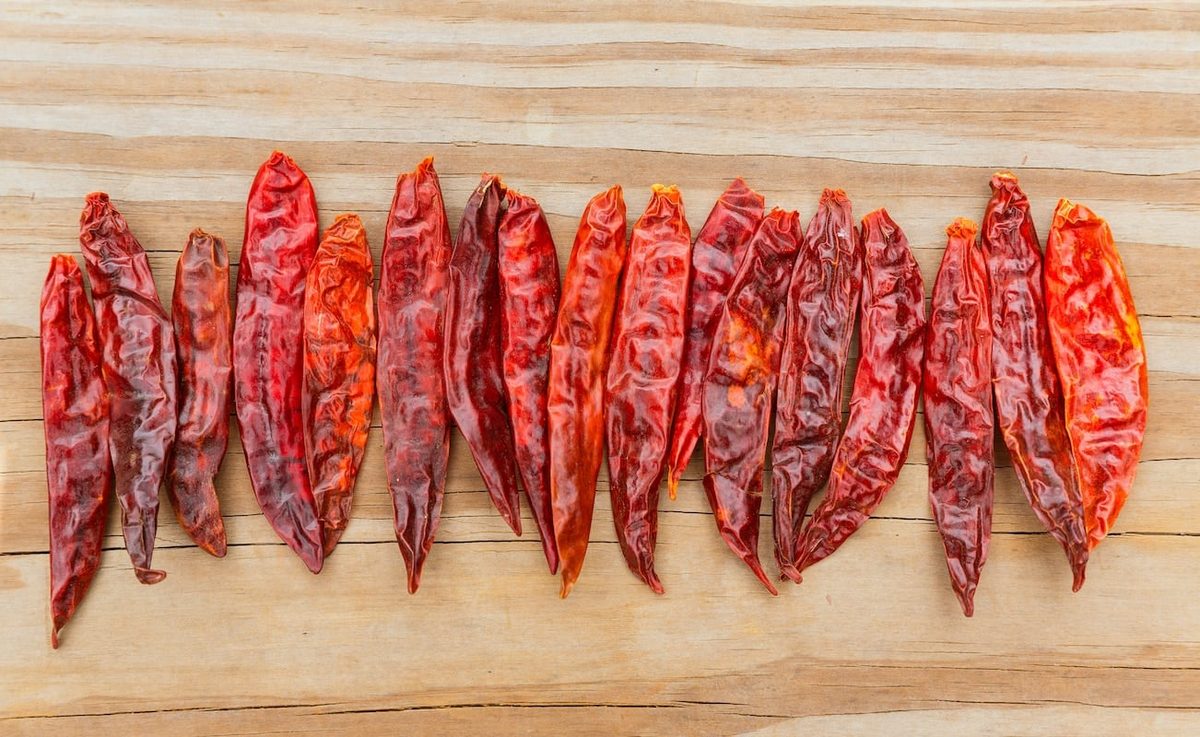
Chile de árbol powder is ground, dried chile de árbol, a slender red Mexican chile of Capsicum annuum, the same species as cayenne, jalapeño and paprika.12 It is one of the hotter chiles in everyday Mexican cooking: Gernot Katzer singles it out as an example of the long, pointed types “of biting heat”.3 This page covers what it is, how hot it is (the figures disagree), how it is used, and what to look for when buying.
At a glance
| Botanical name | Capsicum annuum L.12 |
| Plant family | Solanaceae (nightshade family)1 |
| Part used | The dried ripe fruit (pod), ground |
| Native range of the species | Southern US to Brazil and the Caribbean; domesticated in central-east Mexico14 |
| Heat | 15,000–30,000 SHU on Dave DeWitt’s heat scale and on PepperScale; no laboratory measurement found (see Heat)56 |
| Forms sold | Whole dried pods, crushed, ground powder |
| International standard | Codex CXS 353-2022 (dried chilli pepper and paprika)7 |
Measured values
5 figures, sourced| Measure | Value | Scope | Source |
|---|---|---|---|
| Pungency (Scoville) Conventional range | 15,000–30,000 SHU | chile de árbol pod type, conventional range as published by Dave DeWitt (heat scale, 2008 update, which he calls necessarily approximate) and by PepperScale ("medium hot"); no method statedNo laboratory measurement found | fieryfoodscentral.com · pepperscale.com |
| Pungency (Scoville), minimum for "chilli" Limit | 900 SHU or more | Codex CXS 353-2022 category threshold, not a rating of this chile | fao.org |
| Ochratoxin A, maximum Limit | 20 µg/kg | EU, dried Capsicum fruits, whole or ground (includes chillies, chilli powder, cayenne, paprika) | eur-lex.europa.eu |
| Aflatoxin B1, maximum Limit | 5.0 µg/kg | EU, dried Capsicum products | eur-lex.europa.eu |
| Total aflatoxins, maximum Limit | 10.0 µg/kg | EU, dried Capsicum products | eur-lex.europa.eu |
Each figure is quoted as its source states it, with the samples or standard it applies to. Where sources differ, both are shown; nothing is averaged. All measured values
What it is
Capsicum annuum is native from the southern United States to Brazil and the Caribbean, and a 2014 study combining four independent lines of evidence points to central-east Mexico as where it was domesticated.14 Chile de árbol is one of that species’ many pod types. A 2019 study of Mexican dried chiles lists it alongside guajillo, ancho, mulato, puya and pasilla among the chiles sold whole and dried, and refers to it as Capsicum annuum.2
Katzer describes it as a type with long, pointed fruit and biting heat.3 Ground, it becomes chile de árbol powder. The Codex standard for dried chile covers chile that is whole, crushed or ground to a powder, and a product sold as pure ground chile should contain chile alone.7
The name
Árbol is Spanish for tree: the Real Academia Española defines it as a plant with a tall woody stem that branches some way above the ground.8 No source we opened explains why this chile carries the name. Explanations that circulate online (that the name comes from Nahuatl, that it was coined by the 16th-century naturalist Francisco Hernández, or that the plant itself looks like a tree) could not be traced to a source. The alternative name pico de pájaro (bird’s beak) could not be traced either.
Not the same as Thai bird’s eye chile
A widely repeated claim says chile de árbol is the Thai bird’s eye chile under another name. No source supports that. Katzer notes that “bird’s eye” is a loose label, often used for any small, pointed, very pungent chile, which is one reason names like these get confused.9
Relationship to cayenne
Chile de árbol and cayenne are both Capsicum annuum pod types.13 Beyond the shared species, we found no source that traces a closer relationship between them, so “cayenne’s Mexican cousin” is a comparison of use, not botany.
Heat
Heat in chiles comes from capsaicinoids, chiefly capsaicin and dihydrocapsaicin. NMSU’s chile scientists note that high-performance liquid chromatography (HPLC) is the most accurate way to measure them, while the older Scoville taste test is subjective.10 We found no published HPLC measurement of chile de árbol, so every figure below is a general rating for the type, not a measured lot.
| Source | Figure | Scope |
|---|---|---|
| Dave DeWitt’s heat scale, Fiery Foods & Barbecue Central (2008 update of a scale first compiled in 1989)5 | 15,000–30,000 SHU | Pod type, general rating; DeWitt calls such figures “necessarily approximate” |
| PepperScale6 | 15,000–30,000 SHU, “medium hot” | Pod type, general rating; no method stated |
| Gernot Katzer3 | “Biting heat”; no figure | Pod type, descriptive |
| Codex CXS 353-20227 | 900 SHU or more defines “chilli” (as opposed to paprika or hot paprika) | Category threshold, not a rating of this chile |
| Widely repeated online | 10,000–30,000 SHU | No source found |
The 10,000–30,000 figure is not shown to be wrong; we simply could not find where it came from.
Is it milder than cayenne? It depends which cayenne. DeWitt’s same scale lists a long cayenne at 30,000–50,000 SHU and the ‘Large Red Thick’ cayenne at 2,500–5,000.5 New Mexico State University measured its ‘NuMex Las Cruces’ cayenne at 17,400 SHU by HPLC, against 12,900 for ‘Large Red Thick’ and 13,200 for ‘Mesilla’.11 Those are single-cultivar measurements from one trial, not a market figure for cayenne powder. On these numbers, chile de árbol can fall on either side of cayenne. PepperScale does compare them directly: hotter than jalapeños, it says, but not quite as hot as cayenne, which it rates at 30,000 to 50,000 SHU.6 That comparison rests on the conventional ranges, not on a measurement of either chile.
Flavor
The flavor beyond the heat is our description: clean and sharp, with a toasty, slightly grassy dried-chile note rather than the dark, raisiny sweetness of ancho or pasilla. Katzer groups it with the “less aromatic, but more pungent” chiles.3 PepperScale finds more in it, describing the flavor, especially when dried, as slightly nutty and smoky.6 We found no analysis of its aroma compounds.
How it is used
- With milder chiles. Katzer writes that mole-type sauces commonly combine mild, aromatic chiles such as ancho, mulato and pasilla with less aromatic, more pungent ones “like the de arbol or the smoky chipotle.”3 The same logic applies when building a powder blend: a sweet, fruity chile for body and chile de árbol for heat.
- Chili. Saveur’s chili con carne uses six dried guajillo chiles with six chiles de árbol, softened in boiling water, seeded and pureed with their soaking liquid.12 See best spices for chili.
- Salsas, hot sauces and chile oil. By common practice, the powder or whole pods go into table salsas and hot sauces, and the whole pods are fried in oil to make chile oil.
- Sauces, stews, soups, rice and eggs. PepperScale lists Mexican sauces, stews and soups, and rehydrated pods in Mexican rice, scrambled eggs and salsas.6 On form, it notes that flakes tend to sit on top of food while powder permeates the dish,6 and it names garlic as a common partner.6
- Beyond Mexican cooking. It can stand in, by kitchen judgment, wherever a recipe wants clean red-chile heat without much else: curries, stir-fries, chili. Thai and Indian recipes usually call for their own chiles, so treat this as a substitution, not a tradition.
Because the heat varies from lot to lot and no measured figure exists, add the powder a pinch at a time and taste. That is method, not a measured ratio.
Buying and quality
- Read the label. Pure chile de árbol powder should list only chile. Products sold as “chili powder” in the US are usually blends with cumin and oregano; see chili powder.
- Color and smell. A bright brick-red color and a sharp, toasty smell are signs of fresh stock; a dull brown color and little smell suggest age. That is kitchen judgment rather than a standard.
- Grading. The Codex standard for dried chilli pepper and paprika sets the international framework for ground chile, including the 900 SHU line that separates “chilli” from paprika.7
Storage
We found no published shelf-life figure for chile de árbol powder from a regulator or standards body. Keep it airtight, cool, dry and dark, and judge it by color and smell.
Safety
Mycotoxins. The European Union sets maximum levels for mycotoxins in dried Capsicum products “including chillies, chilli powder, cayenne or paprika”: 20 µg/kg for ochratoxin A, and 5.0 µg/kg for aflatoxin B1 and 10.0 µg/kg for total aflatoxins.13 We found no recall or regulator finding specific to chile de árbol.
Health claims. Capsaicin’s best-supported medical use is as a high-concentration (8%) skin patch, a prescription treatment: a 2017 Cochrane review found moderate-quality evidence that it can give moderate relief to a minority of people with postherpetic neuralgia, with lower-quality evidence for other nerve pain.14 That is a medicine, not dietary chile, and this page makes no claim that chile de árbol powder treats or prevents any condition. The vitamin and mineral figures that circulate for chile de árbol could not be traced to a nutrient analysis.
Handling. By common kitchen practice, avoid touching your eyes after handling the powder, and keep it out of reach of small children.
History
Chile peppers are American plants (see the native range above).1 The McCormick Science Institute notes that Portuguese traders rapidly introduced red peppers throughout Asia.15 The claims that Mesoamericans cultivated chiles by 5000 BCE and used them to fumigate houses could not be traced to a source we could open; the domestication study cited above places domestication in central-east Mexico without giving that date.4
Substitutes and comparisons
- Cayenne pepper is the usual stand-in for clean red-chile heat; see also cayenne substitutes and paprika vs. cayenne.
- Red pepper flakes give similar heat in a coarser form.
- For a milder, fruitier chile, see guajillo powder, ancho powder or pasilla powder; for smoke, chipotle powder.
- For much more heat: habanero powder.
No source we found gives a tested swap ratio between these chiles. Start with less than the recipe calls for and add to taste.
Footnotes
-
Capsicum annuum L., Plants of the World Online, Royal Botanic Gardens, Kew. powo.science.kew.org · Reference work ↩ ↩2 ↩3 ↩4 ↩5 ↩6 ↩7
-
Martínez-Damián et al., “Intensity of color and bioactive compounds in collections of guajillo chili from Northern Mexico”, Revista Mexicana de Ciencias Agrícolas, 2019. cienciasagricolas.inifap.gob.mx · Peer-reviewed ↩ ↩2 ↩3
-
Gernot Katzer, “Paprika and Mexican chiles”, Gernot Katzer’s Spice Pages. gernot-katzers-spice-pages.com · Reference work ↩ ↩2 ↩3 ↩4 ↩5 ↩6
-
Kraft et al., “Multiple lines of evidence for the origin of domesticated chili pepper, Capsicum annuum, in Mexico”, PNAS, 2014. escholarship.org · Peer-reviewed ↩ ↩2 ↩3
-
Dave DeWitt, “Heat Scale Updated”, Fiery Foods & Barbecue Central, 2008. fieryfoodscentral.com · Publication ↩ ↩2 ↩3
-
Matt Bray, Chile De Arbol Guide: Heat, Flavor, Pairings, And More, PepperScale. pepperscale.com · Publication · PepperScale is also owned by Matt Bray, the editor of this site. ↩ ↩2 ↩3 ↩4 ↩5 ↩6 ↩7
-
Standard for Dried or Dehydrated Chilli Pepper and Paprika, CXS 353-2022, Codex Alimentarius. fao.org · Standard ↩ ↩2 ↩3 ↩4
-
“árbol”, Diccionario de la lengua española, Real Academia Española. dle.rae.es · Reference work ↩
-
Gernot Katzer, “Chiles (Capsicum)”, Gernot Katzer’s Spice Pages. gernot-katzers-spice-pages.com · Reference work ↩
-
Bosland and Walker, “Measuring Chile Pepper Heat”, Guide H-237, New Mexico State University, 2010. pubs.nmsu.edu · Reference work ↩
-
Bosland and Strausbaugh, “‘NuMex Las Cruces’ Cayenne Pepper”, HortScience, 2010. journals.ashs.org · Peer-reviewed ↩
-
“Chili Con Carne”, Saveur, 2012. saveur.com · Publication ↩
-
Commission Regulation (EU) 2023/915 on maximum levels for certain contaminants in food. eur-lex.europa.eu · Regulator ↩
-
Derry et al., “Topical capsaicin (high concentration) for chronic neuropathic pain in adults”, Cochrane Database of Systematic Reviews, 2017. cochrane.org · Peer-reviewed ↩
-
“Red Pepper”, McCormick Science Institute. mccormickscienceinstitute.com · Reference work ↩