Spice Comparisons · Comparison
Black Pepper vs. Cayenne: Piperine, Capsaicin and What Each Does to a Dish
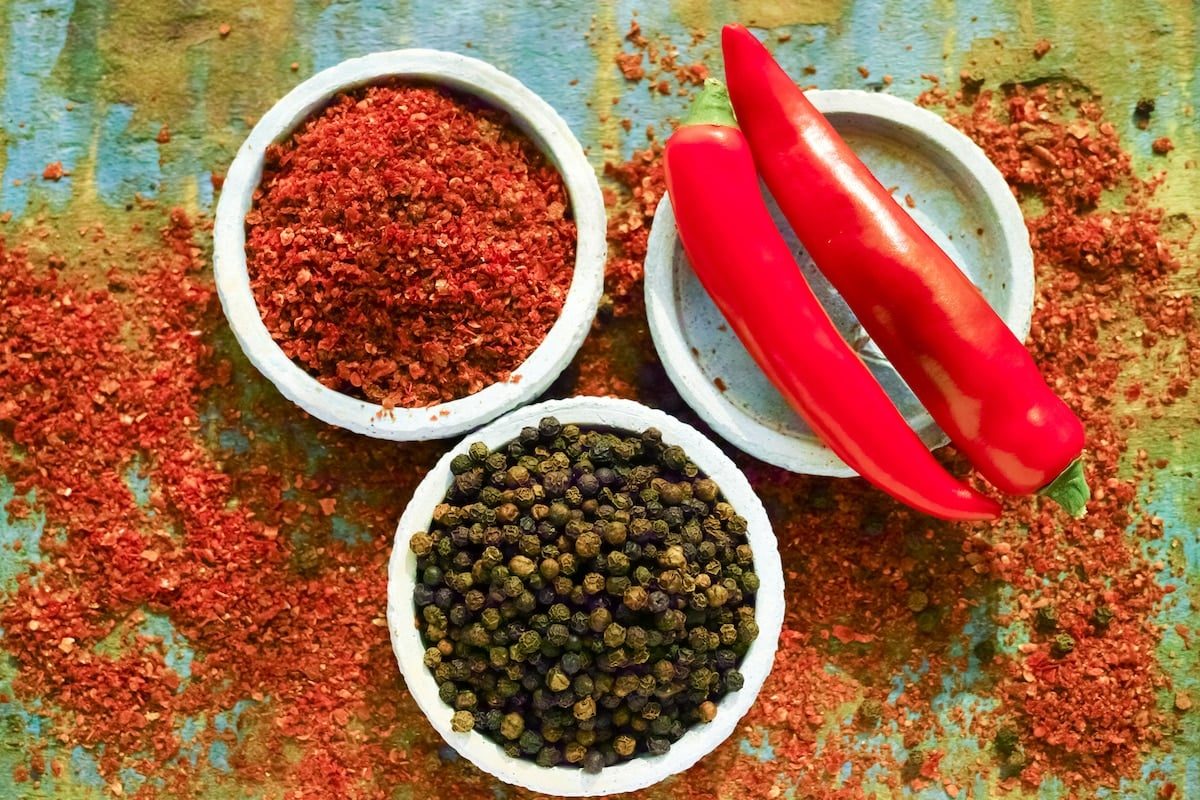
Black pepper and cayenne share a word and nothing else. Black pepper is the dried berry of Piper nigrum, a climbing vine from India; cayenne is a hot red chile, Capsicum annuum, from the Americas. McCormick Science Institute puts it bluntly: red pepper is not at all botanically related to black pepper.123 Their heat comes from different compounds, piperine in pepper and capsaicinoids in chiles, and the two behave differently in the pot.45
Side by side
| Black pepper | Cayenne | |
|---|---|---|
| Species | Piper nigrum1 | Capsicum annuum23 |
| Family | Piperaceae (pepper family)14 | Solanaceae (nightshade family)3 |
| Native range | Western Ghats of Kerala, India1 | Southern United States to Brazil and the Caribbean2 |
| Part used | Dried berries with the outer layer intact6 | Fruit (pod), dried and ground; sold in the trade as “red pepper”3 |
| Heat compound | Piperine, 4.9 to 7.7% of black pepper (PROSEA)7 | Capsaicinoids, mainly capsaicin and dihydrocapsaicin; no percentage for cayenne found5 |
| Aroma | Essential oil, up to 3% of ground pepper, about 90% of it terpene hydrocarbons74 | Little aroma beyond heat (editorial) |
| Heat in Scoville units | No published figure found | Disputed: about 8,000 to 70,000 depending on the source (see below) |
| Flavor (editorial) | Warm, woody and resinous, with a sharp bite | Clean, fast heat with a dry red-pepper flavor and little sweetness or smoke |
| Color | Dark outer layer; white pepper is the same berry with the dark outer part of the pericarp removed4 | Orange-red |
| Typical uses | All-purpose savory seasoning, at the stove and the table | Seasoning blends, meats, pickles and seafood; Italian, Indian, Mexican and Caribbean cooking; chili powder, jerk and berbere3 |
| Price | No dated, sourced retail comparison found | No dated, sourced retail comparison found |
For each spice in depth, see the black pepper and cayenne pepper profiles.
Why both are called pepper
McCormick Science Institute notes that early Spanish explorers found red pepper in the Caribbean while they were looking for black pepper berries.3 The name followed the heat, not the botany.
Two different kinds of heat
PepperScale sums up the practical gap: black pepper “provides a mild heat at best,” while cayenne is a medium-hot chile.8 It also notes that what is sold as “red pepper,” whether flakes or powder, is in most cases made with cayenne.8
Same receptor, very different strength. Piperine is the primary pungent alkaloid of black pepper, and it acts on TRPV1, the same heat-sensing receptor that capsaicin activates. In a 2005 study on human receptors expressed in cultured cells, piperine was a less potent activator than capsaicin; it needed about 37.9 µM to reach half its maximum effect.9 That is a laboratory measure, not a taste test, so it cannot be turned into a “how many times hotter” figure for food.
How the heat is measured. Chile heat is usually given in Scoville heat units, originally a dilution test judged by tasters; New Mexico State University calls high-performance liquid chromatography the most accurate method.5 We found no published Scoville figure for black pepper, so a like-for-like heat number for the two does not exist.
How hot cayenne is depends on whom you ask. The figures below describe different things and do not average into one answer.
| Scope | Heat | Source |
|---|---|---|
| “Cayenne peppers”, no sample or method stated | about 8,000 SHU | McCormick Science Institute3 |
| Cultivars ‘Large Red Thick’ and ‘Mesilla’, trials near Las Cruces, HPLC | 12,900 and 13,200 SHU | HortScience, 201010 |
| Cultivar ‘NuMex Las Cruces’, same trials | 17,400 SHU | HortScience, 201010 |
| Cayenne as a category, on a heat scale its author calls approximate; same range from Chili Pepper Madness and PepperScale | 30,000 to 50,000 SHU | DeWitt, 2008; Hultquist, 2020; PepperScale11128 |
| One merchant’s cayenne powder, no method stated | 35,000 to 70,000 SHU | The Spice House13 |
The cultivar figures belong to those cultivars in those trials. The category range is attributed, not measured, which makes it untraceable rather than wrong.
What cooking does to each
This is the difference that matters most at the stove. In a 1992 Indian study of spices boiled with food for 15 to 30 minutes, 50 to 60% of the piperine was lost when black pepper was cooked as part of curry powder; losses were lower when pepper was cooked on its own, though the abstract gives no figure for that case.14 Under the same conditions, the abstract puts capsaicin losses “of the order of 0.30%.”14 We could read only the abstract, not the full paper.
What follows for a cook, in our judgment: cayenne added early keeps its heat through a long simmer, while black pepper’s bite fades with time in the pot, which is one reason many cooks grind pepper over a dish at the end. No sensory study we found measures how much of the perceived bite survives in either case.
Can one stand in for the other?
For heat alone, partly. For flavor, no: cayenne brings none of pepper’s aroma, and black pepper brings none of cayenne’s color. PepperScale reaches the same verdict: either can work where a recipe needs only gentle heat, but in most other cases they are not good substitutes.8 It describes freshly ground black pepper as having notes of pine and citrus, and says cayenne’s mild fruitiness, most noticeable when fresh, largely fades once it is dried and ground.8
- Cayenne for black pepper (Attributed). Better Homes & Gardens gives ⅛ teaspoon of cayenne in place of ½ teaspoon of black pepper, a quarter of the amount.15 See black pepper substitutes for other options, including white pepper.
- Black pepper for cayenne (Method). PepperScale warns that black pepper cannot be swapped one for one because it will not make food as hot,8 but gives no ratio, and we found none elsewhere. Cayenne pepper substitutes does not rank black pepper among its options; other chiles do the job better. If black pepper is all you have, add it in small steps toward the end of cooking and taste, knowing that its heat fades in a long simmer14 and that it will not match cayenne’s color.
Safety
Microbial contamination. In 2009 and 2010, a Salmonella Montevideo outbreak in the United States was traced to Italian-style meats, and investigators found the outbreak strain in samples of both black and red pepper.16
Contaminant limits. The EU sets maximum levels of ochratoxin A and aflatoxins for dried Capsicum products, a category that names chilli powder and cayenne.17 We did not check equivalent limits for black pepper for this page.
What isn’t known
- No published Scoville figure exists for black pepper, so the two cannot be compared on one heat scale.
- The in vitro potency difference between piperine and capsaicin does not translate into a tasting ratio.
- The 1992 cooking study was read only as an abstract.
- No published ratio exists for black pepper in place of cayenne.
Related
- Black pepper and cayenne pepper profiles
- Black pepper substitutes and cayenne pepper substitutes
- White pepper vs. black pepper, long pepper vs. black pepper and allspice vs. black pepper
- Paprika vs. cayenne and cayenne pepper uses
- Cracked vs. ground black pepper
Footnotes
-
Piper nigrum L., Plants of the World Online, Royal Botanic Gardens, Kew. powo.science.kew.org · Reference work ↩ ↩2 ↩3 ↩4
-
Capsicum annuum L., Plants of the World Online, Royal Botanic Gardens, Kew. powo.science.kew.org · Reference work ↩ ↩2 ↩3
-
“Red Pepper”, McCormick Science Institute. mccormickscienceinstitute.com · Merchant ↩ ↩2 ↩3 ↩4 ↩5 ↩6 ↩7
-
“Black pepper”, Encyclopaedia Britannica, 2026. britannica.com · Reference work ↩ ↩2 ↩3 ↩4
-
Bosland and Walker, “Measuring Chile Pepper Heat”, Guide H-237, New Mexico State University, 2010. pubs.nmsu.edu · Reference work ↩ ↩2 ↩3
-
Standard for Black, White and Green Peppers (CXS 326-2017), Codex Alimentarius. fao.org · Standard ↩
-
Piper nigrum, Plant Resources of South-East Asia (PROSEA). uses.plantnet-project.org · Reference work ↩ ↩2
-
Matt Bray, Black Pepper Vs. Red Pepper, PepperScale. pepperscale.com · Publication · PepperScale is also owned by Matt Bray, the editor of this site. ↩ ↩2 ↩3 ↩4 ↩5 ↩6
-
McNamara, Randall and Gunthorpe, “Effects of piperine, the pungent component of black pepper, at the human vanilloid receptor (TRPV1)”, British Journal of Pharmacology, 2005. pmc.ncbi.nlm.nih.gov · Peer-reviewed ↩
-
Bosland and Strausbaugh, “‘NuMex Las Cruces’ Cayenne Pepper”, HortScience, 2010. journals.ashs.org · Peer-reviewed ↩ ↩2
-
Dave DeWitt, “Heat Scale Updated”, Fiery Foods & Barbecue Central, 2008. fieryfoodscentral.com · Publication ↩
-
Mike Hultquist, “What Can I Substitute for Cayenne Pepper?”, Chili Pepper Madness, 2020. chilipeppermadness.com · Publication ↩
-
Cayenne Pepper, product page, The Spice House. thespicehouse.com · Merchant ↩
-
Srinivasan, Sambaiah and Chandrasekhara, “Loss of active principles of common spices during domestic cooking”, Food Chemistry, 1992 (abstract). agris.fao.org · Peer-reviewed ↩ ↩2 ↩3
-
“100 Emergency Ingredient Substitutions”, Better Homes & Gardens. static.onecms.io · Publication ↩
-
“2010 Salmonella Outbreak Linked to Red and Black Pepper/Italian-Style Meats”, CDC, 2010. archive.cdc.gov · Regulator ↩
-
Commission Regulation (EU) 2023/915, maximum levels for certain contaminants in food. eur-lex.europa.eu · Regulator ↩