Cooking · Dish guide
The Best Spices for Pizza: Oregano, Basil, Garlic, Red Pepper and Parmesan
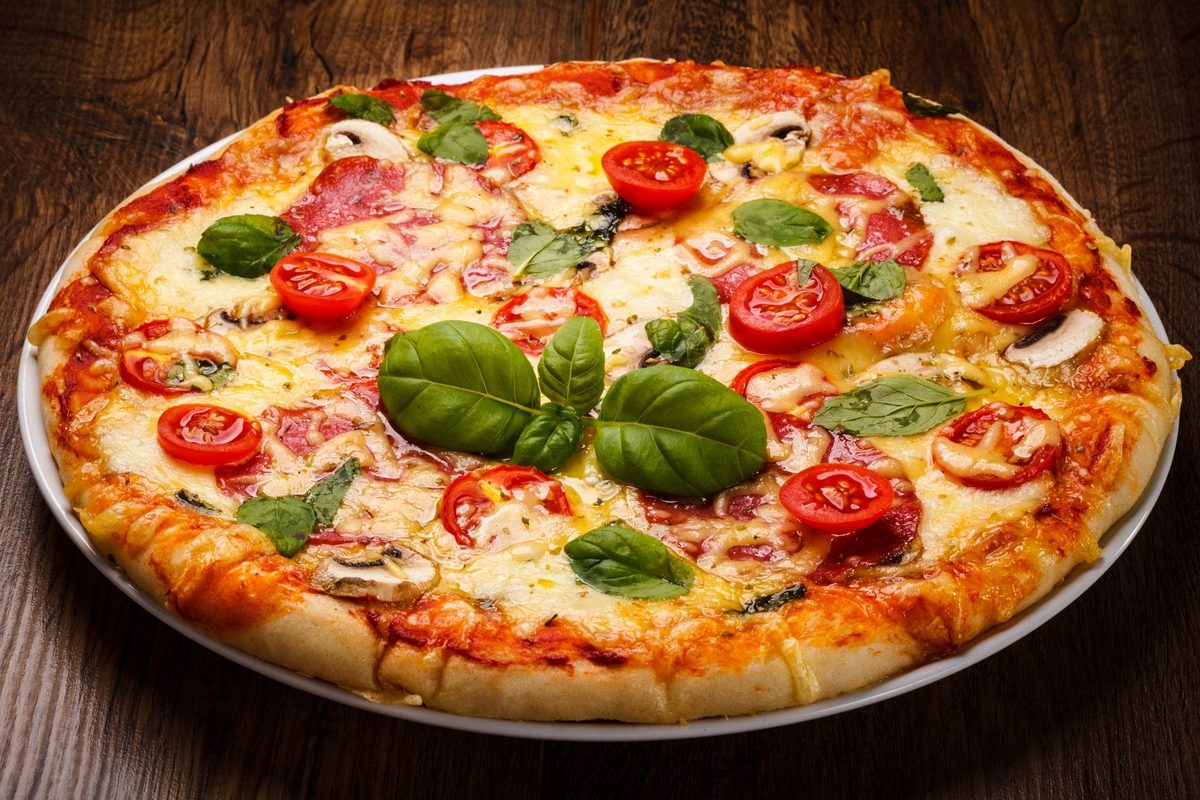
Pizza seasoning comes down to a short list: oregano, basil, garlic and red pepper flakes, with grated Parmesan often added on top. The strictest definition of a pizza, the European Union’s rules for Pizza Napoletana, names only garlic and oregano as optional extras and fresh basil leaves on the cheese version.1 Britannica calls oregano essential in Italian pizza and pasta sauces.2 This page covers what each seasoning does, how three published sauce recipes use them, and when each one goes on. Quantities appear only where a named recipe gives them.
At a glance
| Seasoning | Job on the pizza | Where it usually goes |
|---|---|---|
| Oregano | Warm, pungent herbal backbone | In the sauce or sprinkled on the tomato134 |
| Basil | Sweet, fresh herb note; classic with tomato and mozzarella | Fresh leaves on top; dried in some sauces134 |
| Garlic | Savory, pungent depth | Sliced on the tomato, or cooked into the sauce14 |
| Red pepper flakes | Heat | In the sauce, or shaken on at the table35 |
| Parmesan | Salt and savory (umami) depth | Grated over the pizza36 |
| Rosemary | Piney, resinous note | Not in the recipes below; a focaccia classic7 |
The Neapolitan baseline
Pizza Napoletana is registered in the EU as a traditional speciality guaranteed (TSG), and its 2010 specification spells out the topping.1 It allows two garnishes:
- Tomato, garlic and oregano: 70 to 100 g of crushed peeled tomatoes, a pinch of oregano, a peeled garlic clove sliced thin over the tomato, salt, and 4 to 5 g of extra virgin olive oil.1
- Tomato, mozzarella and basil: 60 to 80 g of tomatoes, 80 to 100 g of sliced Mozzarella di Bufala Campana, several fresh basil leaves, and the same measure of oil.1
That is the whole seasoning list. The specification names garlic and oregano as the other ingredients that may be used, and expects the basil, garlic and oregano to come out of the oven with an intense aroma and without looking burnt.1 The basil, mozzarella and tomato pizza is older than the famous Margherita story: National Geographic reports that the dish existed at least three decades before any royal visit to Naples, and that the 1889 tale of a pizza named for Queen Margherita rests on a forged document.8
Three sauce recipes side by side
American pizza sauces season more heavily than Naples does. Here is how two King Arthur Baking sauces and an Oregon State University recipe compare:
| King Arthur “Zesty” sauce (about 1 quart)3 | King Arthur no-cook sauce (about 1 quart)3 | Oregon State KidSpirit (2 large pizzas)4 | |
|---|---|---|---|
| Tomatoes | One 28-oz can crushed | One 28-oz can crushed | 28-oz can crushed plus 6-oz can paste |
| Oregano | 2 tsp dried | None | 1/2 tsp dried |
| Basil | None | 1/2 tsp dried | 1 tsp dried |
| Garlic | None | 2 cloves, roasted and mashed | 2 cloves, minced, cooked in oil 1 to 2 minutes |
| Red pepper flakes | 1 tsp | None | A pinch, optional |
| Sugar | 1 to 2 tsp | None | 1 1/2 tsp |
| Salt | 1/2 to 1 tsp | To taste | 3/4 tsp |
| Other | 1 1/2 tsp balsamic vinegar, 2 tbsp olive oil | Black pepper, olive oil | Black pepper, 1 tbsp olive oil |
| Cooking | Simmered 10 to 15 minutes | Not cooked | Simmered 15 to 30 minutes |
No single herb dominates across them. One sauce leans on oregano, one on basil, and one uses both. All three are the publishers’ own recipes, not a standard.
The core seasonings and what each one does
Oregano
Oregano is an aromatic perennial of the mint family, and Britannica describes its taste as warm and pungent.2 Both cooked sauces above use it dried.34 That suits a simmered sauce: in America’s Test Kitchen’s trials, dried oregano held up well in dishes cooked more than 20 minutes with a good amount of liquid.9 Dried herbs are also stronger than fresh, so the University of Delaware’s extension guide counts 3/4 to 1 teaspoon of dried crumbled herb as equal to 2 to 3 teaspoons of fresh.10 See cooking with oregano, fresh vs. dried oregano and too much oregano.
Basil
Basil is an annual herb of the mint family.11 The PROSEA plant handbook notes that its leaves are used in Italian pizzas, pasta, chicken and cheese dishes and have a special affinity with tomatoes.12 On the cheese-and-basil Neapolitan pizza the leaves are fresh and go on before baking;1 King Arthur’s Neapolitan-style recipe instead adds fresh basil after the pizza comes out of the oven.3 Dried basil turns up in two of the sauces.34
The LSU AgCenter groups basil with the delicate herbs that lose flavor under long heat and are best added at the end.13 That supports the after-baking approach; the Neapolitan specification shows the leaves can survive a very short bake. See basil vs. oregano, cooking with basil and too much basil.
Garlic
In Naples, garlic goes on raw, sliced thin over the tomato.1 The Oregon State sauce cooks minced garlic in oil for a minute or two, just until soft and fragrant,4 and King Arthur’s no-cook sauce roasts whole cloves first and mashes them in.3 Keep the pan heat in mind: America’s Test Kitchen warns that garlic added too early to a hot pan burns quickly and turns acrid and bitter.14 Garlic powder is a common shortcut in sauces; see garlic powder vs. garlic.
Red pepper flakes
Crushed red pepper is usually made from the cayenne variety, alone or blended with other peppers, and the McCormick Science Institute describes it as a finishing sprinkle for pizza and pasta that is often found on kitchen tables.5 King Arthur’s zesty sauce cooks a full teaspoon into a quart of sauce; the Oregon State recipe treats a pinch as optional.34 Ground cayenne is typically hotter than flakes, so use less of it if you swap.5
Parmesan
Mozzarella is the melting cheese; Parmesan is the seasoning cheese. King Arthur’s South Shore bar pizza uses 1/2 cup of finely grated Parmesan and sprinkles about half of it over the pizza.3 America’s Test Kitchen calls aged Parmesan unparalleled among cheeses for umami.6 A table compiled by Germany’s food-safety commission from Australian and New Zealand regulatory data puts Parmesan at about 1.2 g of free glutamate per 100 g,15 and the FDA notes that the free glutamate in foods is chemically the same as the glutamate in MSG.16 See MSG and MSG substitutes.
Rosemary
Rosemary (Salvia rosmarinus) is native to the Mediterranean.17 None of the sauces above uses it, and it is not part of the Neapolitan specification.134 Its natural home is the bread: America’s Test Kitchen’s focaccia presses small tufts of fresh rosemary deep into the dough before baking.7 ATK counts rosemary among the hearty herbs that go in early.18 On a white pizza or a potato pizza it plays the same role; that is a matter of taste rather than a sourced rule. See cooking with rosemary.
When to add each seasoning
| Seasoning | Before baking | After baking | Source |
|---|---|---|---|
| Oregano | Sprinkled on the tomato, or cooked into the sauce | EU specification; King Arthur; Oregon State134 | |
| Fresh basil | Laid on the cheese | EU specification1 | |
| Fresh basil | Scattered on the hot pizza | King Arthur Neapolitan-style3 | |
| Garlic | Sliced on the tomato, or cooked into the sauce | EU specification; Oregon State14 | |
| Red pepper flakes | Cooked into the sauce | Shaken on at the table | King Arthur; McCormick Science Institute35 |
| Parmesan | Sprinkled on before baking | King Arthur South Shore bar pizza3 |
The two basil methods are both published practice. A practical starting point (Method, not a tested rule): use dried oregano in the sauce, add fresh basil after baking if your oven runs long and hot, and keep flakes and grated cheese at the table so each person can season their own slice.
Related
- Italian seasoning and Italian spices
- Good spices for spaghetti sauce
- Oregano uses and basil uses
- The master list of herbs and spices
Footnotes
-
Commission Regulation (EU) No 97/2010, Pizza Napoletana (TSG), 2010. legislation.gov.uk · Regulator ↩ ↩2 ↩3 ↩4 ↩5 ↩6 ↩7 ↩8 ↩9 ↩10 ↩11 ↩12 ↩13 ↩14
-
Anoushka Pant, “Oregano”, Encyclopaedia Britannica. britannica.com · Reference work ↩ ↩2
-
“Homemade Pizza: From Pan to Neapolitan”, King Arthur Baking workbook. shop.kingarthurbaking.com · Publication ↩ ↩2 ↩3 ↩4 ↩5 ↩6 ↩7 ↩8 ↩9 ↩10 ↩11 ↩12 ↩13 ↩14 ↩15 ↩16 ↩17
-
“Red Sauce for Pizza”, OSU KidSpirit, Oregon State University. kidspirit.oregonstate.edu · Reference work ↩ ↩2 ↩3 ↩4 ↩5 ↩6 ↩7 ↩8 ↩9 ↩10 ↩11
-
“Red Pepper”, McCormick Science Institute. mccormickscienceinstitute.com · Merchant ↩ ↩2 ↩3 ↩4
-
“Getting to Know: Umami Powerhouses”, America’s Test Kitchen (Cook’s Country). americastestkitchen.com · Publication ↩ ↩2
-
Andrew Janjigian, “Freshly Milled Wheat Flour Focaccia with Rosemary, Fennel, and Sea Salt”, America’s Test Kitchen. americastestkitchen.com · Publication ↩ ↩2
-
Braden Phillips, “Pizza Margherita may be fit for a queen, but was it really named after one?”, National Geographic, 2022. nationalgeographic.com · Publication ↩
-
“Science: Substituting Dried Herbs for Fresh”, America’s Test Kitchen. americastestkitchen.com · Publication ↩
-
“Using Herbs and Spices”, University of Delaware Cooperative Extension, revised 2025. udel.edu · Reference work ↩
-
“Basil”, Encyclopaedia Britannica. britannica.com · Reference work ↩
-
Aguilar, Pham Truong Thi Tho and Oyen, “Ocimum basilicum”, PROSEA. uses.plantnet-project.org · Reference work ↩
-
“Flavorful Herbs”, LSU AgCenter. lsuagcenter.com · Reference work ↩
-
Liz Bomze, “Why You Should Wait to Add Garlic”, America’s Test Kitchen, 2023. americastestkitchen.com · Publication ↩
-
Senate Commission on Food Safety (SKLM), DFG, glutamate opinion, 2005, Tables 1 and 2 (citing FSANZ 2003). dfg.de · Regulator ↩
-
“Questions and Answers on Monosodium glutamate (MSG)”, U.S. Food and Drug Administration. fda.gov · Regulator ↩
-
“Salvia rosmarinus Spenn.”, Plants of the World Online, Royal Botanic Gardens, Kew. powo.science.kew.org · Reference work ↩
-
Liz Bomze, “Our Guide to Fresh Herbs”, America’s Test Kitchen, 2019. americastestkitchen.com · Publication ↩