Spice Comparisons · Comparison
Sage vs. Lavender: A Savory Leaf and a Floral Bud
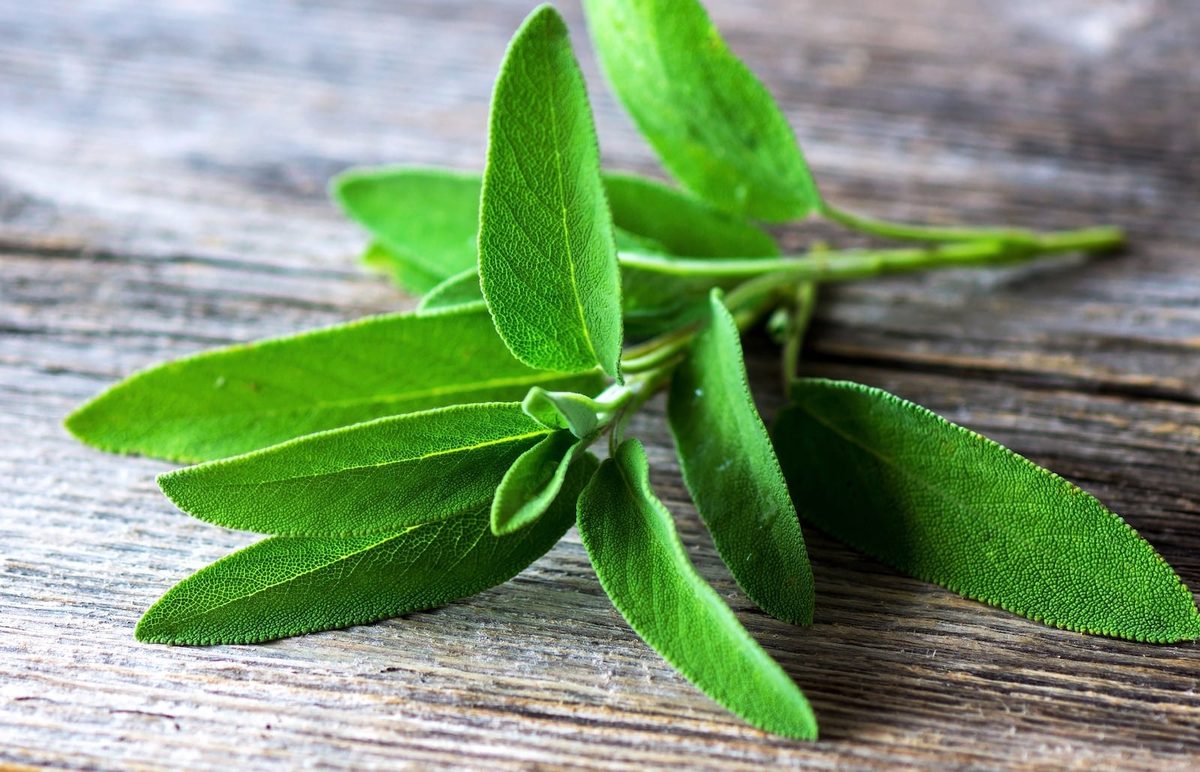
Sage is a bitter, camphor-scented leaf for sausages and stuffings; culinary lavender is a floral bud used mostly in sweets and drinks.12 Both belong to the mint family,32 but their oils are built on different compounds: thujones lead sage oil, while linalool and linalyl acetate lead English lavender oil.14 They meet in only one place, savory roasts, and even there they are more often partners than stand-ins.
Side by side
| Sage | Lavender (culinary) | |
|---|---|---|
| Species | Salvia officinalis, common sage35 | Lavandula angustifolia, English or true lavender, the species the Herb Society of America recommends for cooking67 |
| Family | Lamiaceae (mint family)3 | Lamiaceae (mint family)2 |
| Native range | Southwestern Germany to southern Europe3 | Northeastern Spain to Italy6 |
| Part used | Leaves, fresh or dried1 | Flower buds, usually dried7 |
| The leaf | Oblong to elliptical, up to 10 cm, wrinkled, white-hairy beneath1 | Gray-green, hoary and linear2 |
| Leading oil compounds | α- and β-thujone, 1,8-cineole, camphor1 | Linalool and linalyl acetate4 |
| Flavor | Bitter and pungent with a pleasant aroma (PROSEA);1 musky and resinous (editorial) | Floral and sweet, turning bitter and soapy when overused (editorial) |
| Forms | Fresh leaves; dried whole, rubbed or ground1 | Dried culinary buds, fresh flowers |
| Typical uses | Sausages, stuffings, soups, canned vegetables; fresh in herb butters, cheeses, salads and liqueurs1 | Beverages and sweets;2 some roast meats7 |
| US food status | GRAS spice8 | GRAS spice (listed as Lavandula officinalis)8 |
Why they taste so different
Sage’s dried leaves yield up to 2.5 percent essential oil, and PROSEA credits the thujones with sage’s strong characteristic smell.1 One Spanish sage oil it reports carried 22.8 percent α-thujone, 15.7 percent 1,8-cineole and 5.0 percent camphor.1
English lavender oil is built on two other compounds. In a study of 13 Ukrainian L. angustifolia cultivars, linalool and linalyl acetate were the principal constituents of every sample, ranging from 11.4 to 46.7 percent and 7.4 to 44.2 percent.4 The authors note that the species is valued for its low camphor content.4
Those figures come from different studies and are given only to show what leads each oil, not to compare one sample with another. The useful connection is this: the Herb Society of America says the harsher lavenders, lavandin and L. stoechas, have high levels of cineole and camphor, which give them a strong, astringent aroma and bitter taste.7 Cineole and camphor are two of sage’s main oil compounds.1 So the more a lavender tastes like sage, the worse it usually is for cooking. Buy lavender labeled L. angustifolia for sweets.
How each is used
Sage is a savory herb. PROSEA lists sausages, stuffings, soups and canned vegetables as its spice uses, and fresh leaves in herb butters, cheeses, liqueurs, pickles, salads and vinegars.1 America’s Test Kitchen counts it among the hearty herbs that go in early in cooking.9 It also anchors poultry seasoning, though not always as the lead herb: McCormick’s culinary blend lists thyme first, then sage, marjoram and rosemary.10 The University of Delaware puts sage in its strong-herb group and warns that too much can be extremely objectionable.11
Lavender is mostly a sweet herb. The Herb Society suggests it in cookies and cakes, and infused in a simple syrup or honey for lemonade, iced tea, coffee and cocktails, or in a dairy base for custard, pudding and ice cream.7 Its advice on amounts is to use less than you think, because it is easier to add as you go.7 Britannica notes that the dried flowers have long been used in sachets to scent chests and closets,2 a reminder that a heavy hand makes food taste of perfume.
Where they overlap. The Herb Society suggests the lower-camphor lavandins ‘Provence’ and ‘Gros Bleu’ for savory cooking, blended with other herbs under a roast chicken’s skin or with beef, “especially when pairing with rosemary, sage, and thyme.”7 In other words, a little lavender can join sage in a roast; it does not replace it.
Can one stand in for the other?
Not well, and no source we found publishes a ratio in either direction.
- Sage for lavender, in sweets and drinks. No. Sage brings bitterness and camphor where lavender is meant to be floral. Our lavender substitutes page suggests rose petals or citrus zest for that job.
- Sage for lavender, in a savory roast. Possible, as a different dish rather than a copy. Our lavender substitutes page ranks rosemary and thyme first for savory lavender. If sage is what you have (Method, no published ratio), start with about half as much sage as the lavender called for and taste.
- Lavender for sage. Not recommended. Our sage substitutes page covers the herbs that do the job: marjoram, thyme, rosemary and poultry seasoning. Lavender would not give a stuffing or sausage the flavor its eaters expect.
Safety
The FDA lists both as spices generally recognized as safe.8 NCCIH says sage is likely safe in the amounts commonly found in foods, though it may be unsafe during pregnancy because of its thujone,5 and that lavender is likely safe in the amounts typically used in foods.12 The European Medicines Agency concluded that the benefits of sage essential oil do not outweigh its risks;13 that applies to the concentrated oil, not the dried leaf. The health research on lavender concerns lavender oil products, not the culinary herb.12
What isn’t known
- No study we found analyzes sage and lavender oils side by side; the compound figures come from different studies.
- No published ratio exists for swapping either herb for the other.
- Claims that sage “cuts through” fat because of astringent oils are widely repeated; we found no source that tests them.
Related
- Profiles: sage and lavender
- Substitutes: sage substitutes and lavender substitutes
- Comparisons: rosemary vs. sage, rosemary vs. lavender and hyssop vs. lavender
- Cooking: cooking with sage, cooking with lavender, too much sage and poultry seasoning
Footnotes
-
U.A. Dasuki, Salvia officinalis, Plant Resources of South-East Asia (PROSEA). uses.plantnet-project.org · Reference work ↩ ↩2 ↩3 ↩4 ↩5 ↩6 ↩7 ↩8 ↩9 ↩10 ↩11 ↩12
-
“Lavender”, Encyclopaedia Britannica. britannica.com · Reference work ↩ ↩2 ↩3 ↩4 ↩5 ↩6
-
Salvia officinalis L., Plants of the World Online, Royal Botanic Gardens, Kew. powo.science.kew.org · Reference work ↩ ↩2 ↩3 ↩4
-
Pokajewicz et al., “Chemical Composition of the Essential Oil of the New Cultivars of Lavandula angustifolia Mill. Bred in Ukraine”, Molecules, 2021. mdpi.com · Peer-reviewed ↩ ↩2 ↩3 ↩4
-
“Sage”, National Center for Complementary and Integrative Health, 2025. nccih.nih.gov · Regulator ↩ ↩2
-
Lavandula angustifolia Mill., Plants of the World Online, Royal Botanic Gardens, Kew. powo.science.kew.org · Reference work ↩ ↩2
-
Paola Legarre, “Lavender in the Kitchen: Flavor Profiles Across Species and Cultivars”, The Herb Society of America, 2025. blog.herbsociety.org · Publication ↩ ↩2 ↩3 ↩4 ↩5 ↩6 ↩7
-
21 CFR 182.10, US Food and Drug Administration. ecfr.gov · Regulator ↩ ↩2 ↩3
-
Liz Bomze, “Our Guide to Fresh Herbs”, America’s Test Kitchen, 2019. americastestkitchen.com · Publication ↩
-
McCormick Culinary Poultry Seasoning, product page, McCormick & Company. mccormick.com · Merchant ↩
-
“Using Herbs and Spices”, University of Delaware Cooperative Extension, 2025. udel.edu · Reference work ↩
-
“Lavender”, National Center for Complementary and Integrative Health, 2025. nccih.nih.gov · Regulator ↩ ↩2
-
Public statement on herbal medicinal products containing thujone, European Medicines Agency, 2012. ema.europa.eu · Regulator ↩