Spice Substitutes · Substitutes
Star Anise Substitutes: Anise Seed, Five-Spice, Fennel and How Much to Use
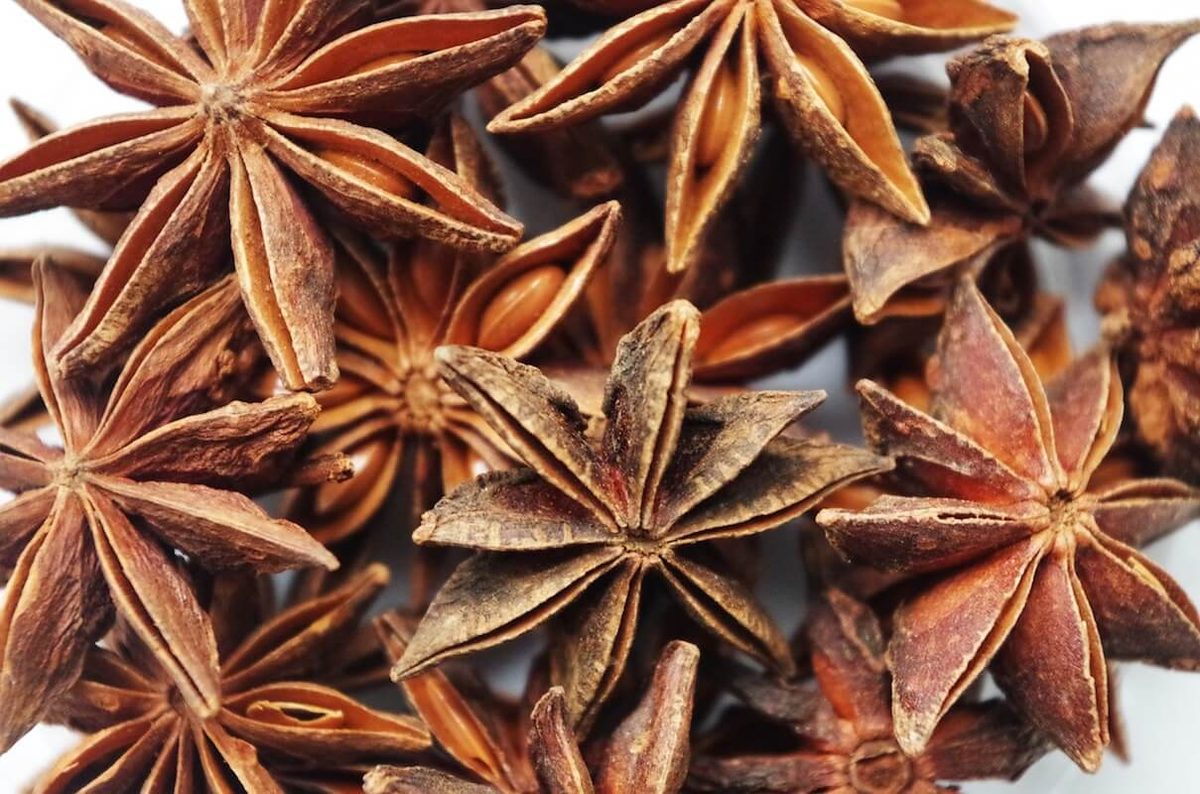
Star anise is the dried, star-shaped fruit of Illicium verum, a tree thought most likely to be native to southern China and northeast Vietnam.1 Its essential oil is 70 to 93 percent trans-anethole, which gives it an anise-like smell and sweet flavor.2 Any substitute with plenty of anethole will get you close. Which one to use depends on whether the star anise is simmering whole in a liquid, going into a ground blend, or adding warmth to something sweet.
Before buying a replacement, one safety point. Japanese star anise is a different, toxic plant. The section on buying star anise safely explains what to look for.
Quick answer
| What star anise is doing | Best substitute | Starting amount, per 1 whole star | Treatment |
|---|---|---|---|
| Licorice note in a broth or braise (pho, braised pork or chicken) | Anise seed, in a tea ball or spice bag | 1/2 teaspoon | Attributed |
| Same job, if you have no anise seed | Fennel seed | 1/4 teaspoon, then taste | Attributed |
| Part of a ground blend or rub | Chinese five-spice powder | 1/2 teaspoon | Attributed |
| Sweet warmth, no licorice needed | Ground cloves or allspice | A small pinch | Attributed |
| A recipe calls for ground star anise and you have whole | Whole star anise, ground | 1 star = 1/2 teaspoon ground | Computed |
How the ratios on this page are labeled
- Computed: based on a measurable physical relationship, with the source named.
- Attributed: a named source publishes this ratio. We quote it as theirs.
- Disputed: named sources give different answers to the same swap. We show each one and do not average them.
- Method: we found no published ratio. We give a direction and a cautious starting point, and say so.
The star anise ratios we found come from a merchant and a food writer. None says how it was arrived at, and no study measures the flavor strength of star anise against a substitute.
Why anise seed and fennel work, and where they fall short
Star anise, anise seed and fennel seed come from unrelated plants but share their main aroma compound.
| Plant | trans-Anethole in the essential oil | |
|---|---|---|
| Star anise | Illicium verum1 | 70 to 93%2 |
| Anise seed | Pimpinella anisum3 | 80 to 95%, which PROSEA calls the character-impact compound3 |
| Fennel seed (sweet) | Foeniculum vulgare4 | Up to 70 to 80%4 |
The ranges come from separate PROSEA entries and different samples, so they overlap rather than rank. America’s Test Kitchen explains that all three get their licorice character from trans-anethole, but each plant has its own secondary compounds, and its tasters noticed the difference.5 When ATK swapped fennel and then anise seed into pho, tasters quickly identified the change, and the magazine advises against treating them as interchangeable.5 The Spice House takes the opposite view and calls anise seed “a great substitute for star anise.”6 Both can be true: in a dish where star anise is the flavor you would name, a careful taster will notice; in a crowded spice mix, they may not.
If star anise is simmering in a broth or braise
This is star anise as a whole spice steeped in liquid. NPR’s pho recipe adds star anise with cinnamon, cloves and peppercorns,7 and Kew notes that in China it is generally used in pork and chicken dishes.1
1. Anise seed
Ratio (Attributed): The Spice House says star anise is the stronger of the two and that 1/2 teaspoon of anise seed replaces one whole star.6 A Couple Cooks gives the same figure.8 Two sources agree, but neither says how the figure was set.
Put loose seeds in a tea ball or a knotted square of cheesecloth so you can lift them out with the other whole spices.
2. Fennel seed
PROSEA says the anethole in sweet fennel oil is responsible for its anise fragrance and sweet taste. Bitter or common fennel, by contrast, has a pungent, camphor-like odor and taste.4 Use sweet fennel seed if you have the choice.
Ratio (Attributed): A Couple Cooks says to use 1/4 teaspoon of fennel seed for each whole star anise.8 The Spice House lists fennel seed as a substitute without an amount.6 Taste the broth near the end and add more if the licorice note is faint.
If star anise is part of a ground blend or rub
Chinese five-spice powder
Britannica lists the usual five-spice components as fennel seed, cassia, cloves, star anise and Sichuan pepper, and describes the blend as licorice base notes with sweet top notes.9 Star anise is one part among several. The Woks of Life’s recipe uses 2 parts fennel, 1 part cassia, 1 part Sichuan pepper, 1 part star anise (four stars) and 1/3 part cloves.10 That is a single recipe, not a standard, and commercial blends vary. Using five-spice in place of star anise also adds cinnamon, clove and the numbing tingle of Sichuan pepper,9 so check that these suit the dish.
Ratio (Attributed): A Couple Cooks says to use 1/2 teaspoon of five-spice powder for each whole star anise.8 The Spice House lists five-spice without an amount.6
Whole star anise, ground
Ratio (Computed): McCormick’s conversion is 1 whole star = 1/2 teaspoon ground.11 A Couple Cooks gives the same figure in both directions.8 This is a volume conversion, not a potency figure.
If star anise is adding sweet warmth
Sometimes star anise is one warm spice among cinnamon and cloves, and the licorice is not the point. Cloves and allspice can fill that role, but they bring no anethole. Clove bud oil is 70 to 90 percent eugenol,12 and allspice berry oil is 50 to 80 percent eugenol,13 so both taste of clove, not licorice.
Ratio (Attributed): The Spice House says cloves work because they also bring sweetness and bitter flavors, and advises using less clove than star anise because clove is stronger.6 A Couple Cooks suggests “a small pinch” of ground cloves, or a small pinch of allspice.8 Neither gives a measured amount.
Weaker options
Tarragon. PROSEA describes tarragon as having a sweet, anise-like scent and a bittersweet flavor.14 It is a leafy herb, so it suits a sauce or braise finished with fresh herbs better than a long-simmered broth.
Caraway. Britannica describes caraway’s aroma as reminiscent of anise, with a warm, slightly sharp taste.15 It will read as caraway first.
Ratio (Method): We found no published ratio for either. For tarragon, add a little chopped fresh leaf near the end and taste. For caraway, start with 1/4 teaspoon of seed per star anise.
Buying star anise safely
Japanese star anise, Illicium anisatum, is a separate species in the same genus as star anise.16 Kew’s star anise profile describes it as highly toxic.1 In September 2003, the US Food and Drug Administration advised the public not to drink teas brewed from star anise, after illnesses affecting about 40 people, including about 15 infants. FDA said Japanese star anise “has long been recognized as toxic in many countries.”17 The two fruits look similar.2 Buy star anise sold as a food spice from a supplier you trust, and never cook with star anise sold for decoration or potpourri.
What isn’t known
- No published study compares the flavor strength of star anise with anise seed, fennel or five-spice. The Attributed ratios above are rules of thumb.
- Five-spice blends have no fixed recipe, so the amount of star anise in a jar of five-spice varies.
- A widely repeated claim says anise essential oil is about eight times stronger than whole anise seed. No source reviewed here supports it.
- No source supports a combined caraway-and-tarragon substitute or adding sugar to allspice to imitate star anise.
Related
- Star anise, cooking with star anise, star anise uses
- Star anise vs anise seed, cloves vs star anise, fennel seed vs anise seed
- Anise seed, fennel seed, Chinese five-spice powder, allspice, cloves, tarragon, caraway seeds
- Anise seed substitutes, Chinese five-spice substitutes, fennel seed substitutes
Footnotes
-
Illicium verum, Plants of the World Online and Kew Species Profiles, Royal Botanic Gardens, Kew. powo.science.kew.org · Reference work ↩ ↩2 ↩3 ↩4
-
Vu Ngoc Lô, Illicium verum, PROSEA. uses.plantnet-project.org · Reference work ↩ ↩2 ↩3
-
Cardenas and de Guzman, Pimpinella anisum, PROSEA. uses.plantnet-project.org · Reference work ↩ ↩2
-
Purwaningsih, Harmida and Brink, Foeniculum vulgare, PROSEA. uses.plantnet-project.org · Reference work ↩ ↩2 ↩3
-
Janjigian, Why Anise Seed, Fennel Seed, and Star Anise aren’t Interchangeable, America’s Test Kitchen, 2020. americastestkitchen.com · Publication ↩ ↩2
-
Star Anise Substitute, The Spice House, 2018. thespicehouse.com · Merchant ↩ ↩2 ↩3 ↩4 ↩5
-
Overhiser, Best Star Anise Substitute, A Couple Cooks, 2026. acouplecooks.com · Publication ↩ ↩2 ↩3 ↩4 ↩5
-
Hill, Five-spice powder, Encyclopaedia Britannica. britannica.com · Reference work ↩ ↩2
-
How to Make Five Spice Powder, The Woks of Life, 2020. thewoksoflife.com · Publication ↩
-
How to Grind Your Own Spices, McCormick. mccormick.com · Merchant ↩
-
Verheij and Snijders, Syzygium aromaticum, PROSEA. uses.plantnet-project.org · Reference work ↩
-
Sulistiarini, Pimenta dioica, PROSEA. uses.plantnet-project.org · Reference work ↩
-
de Guzman and Reglos, Artemisia dracunculus, PROSEA. uses.plantnet-project.org · Reference work ↩
-
Caraway, Encyclopaedia Britannica. britannica.com · Reference work ↩
-
Illicium anisatum, Plants of the World Online, Royal Botanic Gardens, Kew. powo.science.kew.org · Reference work ↩
-
Teas Made from Star Anise Were Associated With Illnesses, US Food and Drug Administration, 2003. fda.gov · Regulator ↩