Spice Comparisons · Comparison
Cloves vs. Star Anise: Flower Bud vs. Fruit, Eugenol vs. Anethole
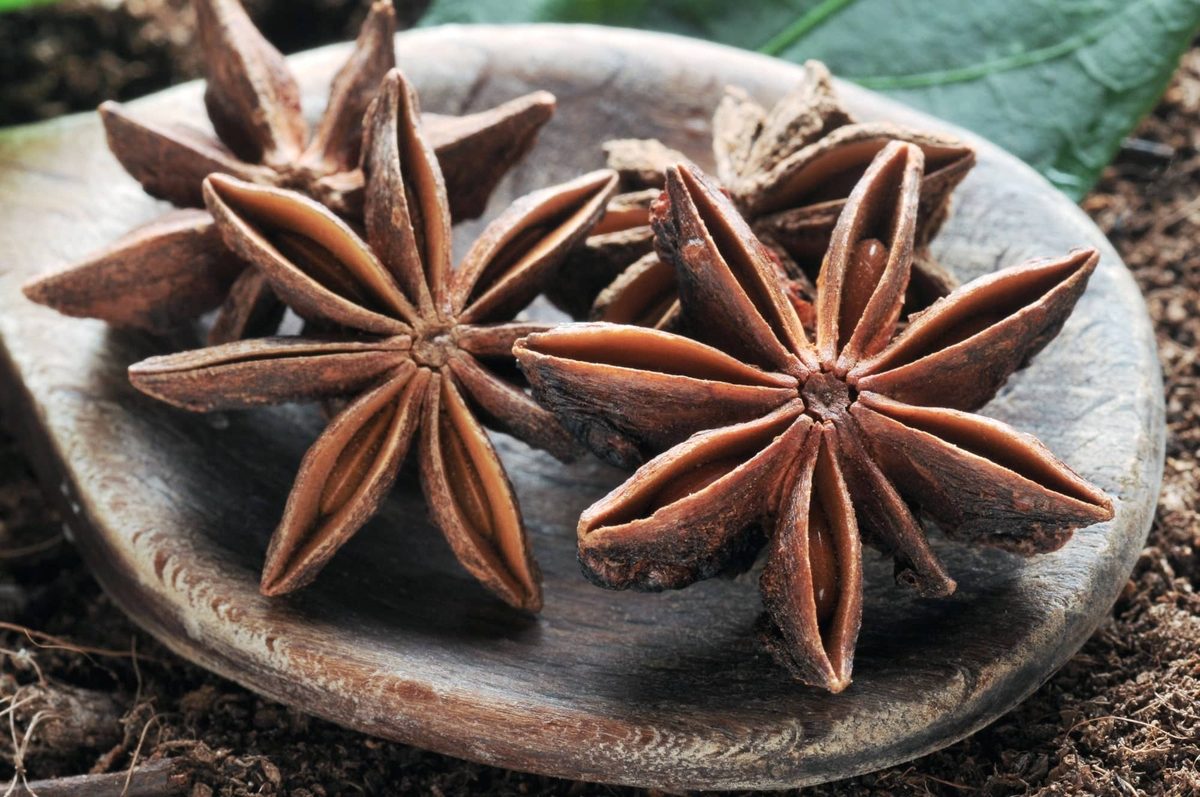
Cloves and star anise share a pot more often than they share a flavor. A clove is a dried flower bud from a tree in the myrtle family, and it tastes of eugenol. Star anise is a dried fruit from an unrelated tree, and it tastes of trans-anethole, the same licorice compound as anise seed.12 They meet in Chinese five-spice, in pho broth and in Sichuan chili oil, but one cannot do the other’s job.345
Side by side
| Cloves | Star anise | |
|---|---|---|
| Plant | Syzygium aromaticum6 | Illicium verum7 |
| Family | Myrtaceae (myrtle family)6 | Schisandraceae7 |
| Native range | Maluku, Indonesia6 | Thought most likely southern China and northeastern Vietnam (Kew); known only from cultivation (PROSEA)72 |
| Part used | The flower bud, picked just before it opens1 | The fruit, picked just before it ripens72 |
| Main producers | Indonesia first, then Madagascar, the Comoros, Tanzania and Sri Lanka (Britannica, citing a 2021 report)8 | China and Vietnam2 |
| Essential oil | 15–17% of the bud (PROSEA); 14–20% (Britannica)18 | 3–3.5% yield by steam distillation of the fruit (PROSEA)2 |
| Main aroma compound | Eugenol, 70–90% of bud oil1 | trans-Anethole, 70–93% of the oil2 |
| Flavor (editorial) | Hot, sweet-warm, medicinal, a little bitter and numbing | Sweet licorice with a woody edge |
| Forms | Whole buds, ground, oleoresin, bud oil1 | Whole stars, broken pieces, ground, essential oil |
| Safety point | Clove oil, not the spice (see below)9 | Toxic look-alike, Japanese star anise1011 |
The oil figures in the two columns are not the same kind of number. The clove figures are oil content of the bud; the star anise figure is a distillation yield. Both come from PROSEA, but from separate entries and samples, so they show that cloves are far oilier without putting an exact multiple on it.
What you’re looking at
Cloves. PROSEA describes the clove as a flower bud 1 to 2 cm long. The long part is a tubular calyx that ends in four small, fleshy lobes, and the round head on top is made of four petals still stuck together; on the tree they drop off as a single cap when the flower opens.1 The ball is the unopened petals, not the sepals.
Star anise. The “star” is a cluster of boat-shaped pods (follicles), usually 8 but anywhere from 5 to 13, forming a fruit 2.5 to 4.5 cm across. Each rough, reddish-brown pod holds one smooth, glossy, light-brown seed about 8 to 9 mm long.2
How they taste, and why
Britannica describes cloves as strong in aroma and hot and pungent in taste.8 PROSEA gives eugenol as 70 to 90% of clove bud oil, with eugenyl acetate up to 17%.1 Eugenol is also the reason clove oil turns up in dentistry: a 2020 review notes its analgesic, anesthetic and antiseptic effects.12 In food, our description is sweet-warm, medicinal and faintly numbing, with a bitter, astringent edge in quantity. The Spice House likewise says cloves bring sweetness along with bitter flavors.13
Star anise is a much simpler spice chemically. Its oil is 70 to 93% trans-anethole and has an anise-like smell and sweet flavor.2 PROSEA notes that star anise competes with anise seed for some of the same market because anethole is the major oil component in both.2 That shared compound is why star anise tastes like licorice and cloves do not.
Where you’ll find them together
- Chinese five-spice. Britannica lists fennel seed, cassia, cloves, star anise and Sichuan pepper as the usual five, with licorice base notes and sweet top notes.3 Star anise is one part among several, not the main ingredient by weight: The Woks of Life’s recipe uses 2 parts fennel and 1 part star anise to 1/3 part cloves.14 Commercial blends vary.
- Pho. NPR’s one-day pho adds star anise, cinnamon, cloves and peppercorns to the broth.5
- Sichuan-style chili oil. The Woks of Life’s chili oil infuses the oil with 5 star anise, cassia, bay leaves and Sichuan peppercorns, with cloves as an option.4
Where each one goes alone
Cloves. Britannica says cloves flavor many foods, particularly meats and baked goods.8 Great British Chefs lists them among the spices commonly used in garam masala,15 and Saveur’s Cincinnati chili uses them with cinnamon, allspice and nutmeg.16 Studding a ham or an onion with whole cloves, and simmering them in mulled drinks, are common kitchen practice.
Cloves are not a given in pumpkin pie spice. McCormick’s lists cinnamon, ginger, nutmeg and allspice, and no cloves.17 Check the label of your jar.
Star anise. Kew says star anise is generally used in pork and chicken dishes in China.7 The Woks of Life’s red braised pork belly simmers 2 star anise with cinnamon and bay leaves.18 PROSEA lists liqueurs, baked goods, puddings and meat products among the foods flavored with the fruit and its oil.2 A star or two in apple pie filling or poached fruit is a cook’s choice rather than a tradition; that is our judgment.
Can one stand in for the other?
Only partly, and only one direction has published guidance. See star anise substitutes and clove substitutes for the full ranked lists.
Cloves in place of star anise (Attributed). Use cloves only when star anise is one warm spice among several and the licorice is not the point. The Spice House says cloves can work because they also bring sweetness and bitterness, and advises using less clove than you would star anise.13 A Couple Cooks suggests “a small pinch” of ground cloves.19 Neither gives a measured amount. If the licorice note matters, as in pho or red-braised pork, anise seed or fennel is the better swap (see the star anise substitutes page).
Star anise in place of cloves (Method). We found no source that recommends this swap or gives a ratio. In a blend of several warm spices, a small piece of star anise can fill the gap, but expect a licorice note that cloves never give. Start with a quarter of a star per two or three whole cloves in a simmered liquid, taste, and add more. That starting point is ours, not a tested figure. For a clove-like flavor, the clove substitutes page ranks ground allspice first.
Whole to ground. McCormick’s conversions are 1 whole star anise to 1/2 teaspoon ground, and 3 whole cloves to 1/4 teaspoon ground.20 These are volume conversions for the same spice, not a ratio between the two.
Safety
Japanese star anise. Illicium anisatum is a separate species in the same genus.11 In September 2003 the FDA advised the public not to drink teas brewed from star anise after about 40 illnesses, about 15 of them in infants, and said Japanese star anise “has long been recognized as toxic in many countries.”10 PROSEA notes that star anise is sometimes adulterated with similar-looking fruits, including Japanese star anise.2 Buy star anise sold as a food spice and never cook with star anise sold for decoration.
Clove oil is not the spice. The European Medicines Agency’s monograph on clove oil as a traditional herbal medicine says use in children and adolescents under 18 is not recommended.9 We found no regulator or clinical source that sets a level at which cloves eaten in food become a concern.
What isn’t known
- No study we found compares the flavor strength of cloves and star anise, so there is no measured ratio between them in either direction.
- The essential-oil figures in the table come from separate PROSEA entries and samples and measure different things (oil content vs. distillation yield).
- How much clove or star anise a commercial five-spice contains is not published; it varies by brand and recipe.
- Widely repeated claims that cloves are central to masala chai, gingerbread or jams, and that star anise is the main spice in five-spice, could not be traced to a source.
Related
- Cloves, cooking with cloves, ground vs. whole cloves, too much clove
- Star anise, cooking with star anise, star anise uses
- Star anise substitutes, clove substitutes
- Star anise vs. anise seed, allspice vs. cloves, cloves vs. cinnamon
- Chinese five-spice powder, pumpkin pie spice, garam masala
Footnotes
-
E.W.M. Verheij and C.H.A. Snijders, Syzygium aromaticum, Plant Resources of South-East Asia (PROSEA). uses.plantnet-project.org · Reference work ↩ ↩2 ↩3 ↩4 ↩5 ↩6 ↩7
-
Vu Ngoc Lô, Illicium verum, Plant Resources of South-East Asia (PROSEA). uses.plantnet-project.org · Reference work ↩ ↩2 ↩3 ↩4 ↩5 ↩6 ↩7 ↩8 ↩9 ↩10 ↩11
-
Tony Hill, “Five-spice powder”, Encyclopaedia Britannica. britannica.com · Reference work ↩ ↩2
-
“How to Make Chili Oil”, The Woks of Life, 2020. thewoksoflife.com · Publication ↩ ↩2
-
T. Susan Chang, “One-Day Pho”, NPR, 2012. npr.org · Publication ↩ ↩2
-
Syzygium aromaticum (L.) Merr. & L.M.Perry, Plants of the World Online, Royal Botanic Gardens, Kew. powo.science.kew.org · Reference work ↩ ↩2 ↩3
-
Illicium verum Hook.f., Plants of the World Online and Kew Species Profiles, Royal Botanic Gardens, Kew. powo.science.kew.org · Reference work ↩ ↩2 ↩3 ↩4 ↩5
-
“Clove”, Encyclopaedia Britannica. britannica.com · Reference work ↩ ↩2 ↩3 ↩4
-
Community herbal monograph on clove oil, European Medicines Agency, 2011. ema.europa.eu · Regulator ↩ ↩2
-
“Teas Made from Star Anise Were Associated With Illnesses Including Seizures”, U.S. Food and Drug Administration, 2003. fda.gov · Regulator ↩ ↩2
-
Illicium anisatum L., Plants of the World Online, Royal Botanic Gardens, Kew. powo.science.kew.org · Reference work ↩ ↩2
-
Batiha et al., “Syzygium aromaticum L. (Myrtaceae): Traditional Uses, Bioactive Chemical Constituents, Pharmacological and Toxicological Activities”, Biomolecules, 2020. mdpi.com · Peer-reviewed ↩
-
“Star Anise Substitute”, The Spice House, 2018. thespicehouse.com · Merchant ↩ ↩2
-
“How to Make Five Spice Powder”, The Woks of Life, 2020. thewoksoflife.com · Publication ↩
-
“How to make garam masala”, Great British Chefs, 2025. greatbritishchefs.com · Publication ↩
-
“Cincinnati Chili”, Saveur. saveur.com · Publication ↩
-
McCormick Pumpkin Pie Spice, McCormick & Company. mccormick.com · Merchant ↩
-
Judy Leung, “Chairman Mao’s Red Braised Pork Belly”, The Woks of Life, 2018. thewoksoflife.com · Publication ↩
-
Sonja Overhiser, “Best Star Anise Substitute”, A Couple Cooks, 2026. acouplecooks.com · Publication ↩
-
“How to Grind Your Own Spices, Plus Spice Conversions”, McCormick, 2025. mccormick.com · Merchant ↩