Spice Substitutes · Substitutes
Winter Savory Substitutes, Ranked by the Job Savory Is Doing
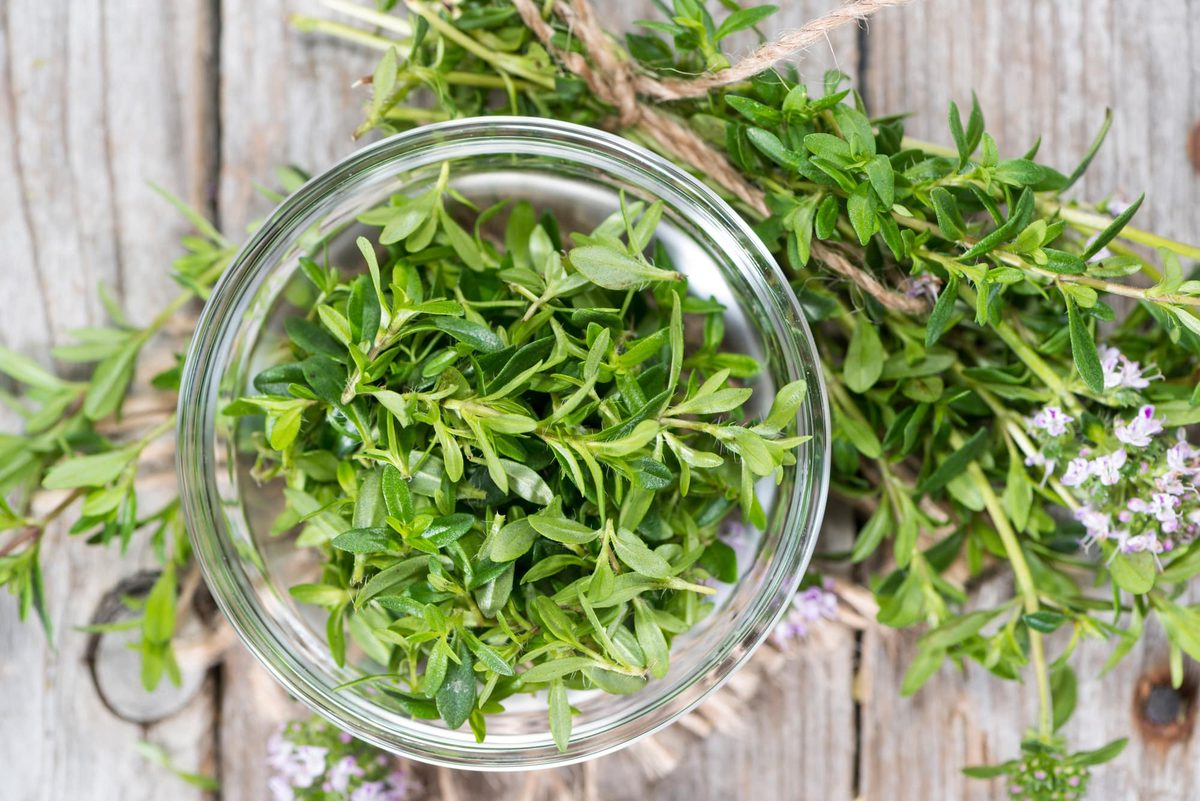
Winter savory is Satureja montana, a perennial, shrubby herb of the mint family native from south-central and southern Europe to Lebanon.1 Britannica says it can be used much like summer savory in cooking but has a harsher, more bitter flavor.2 Monticello’s notes on the herb list bean dishes, organ meats and wild game among its uses.3 In one analysis of a Croatian winter savory oil, the leading compound was carvacrol, at 13.7 percent, followed by p-cymene at 11.8 percent.4 Carvacrol is also a main compound in thyme and oregano oils,56 which is why those herbs make reasonable stand-ins. The right one depends on what the savory is doing in your dish.
Quick answer
| What winter savory is doing | Best substitute | Starting amount, per 1 part winter savory | Treatment |
|---|---|---|---|
| Any savory job: beans, stews, stuffing, poultry | Summer savory | 1 part, up to 1 1/2 parts | Method |
| Same jobs, no savory of either kind | Thyme plus sage, two to one | 2/3 part thyme + 1/3 part sage | Method |
| Bean pots and long braises | Thyme | 1 part | Method |
| A sharper, more pungent note | Oregano | 1/2 part dried | Method |
| Roasted meats and vegetables | Herbes de Provence | 1 part | Method |
| Game and rich roasts | Rosemary | 1/2 part | Method |
How the ratios on this page are labeled
Every ratio carries one of four labels.
- Computed: based on a measurable physical relationship, with the source named.
- Attributed: a named source publishes this ratio. We quote it as theirs.
- Disputed: named sources give different answers to the same swap. We show each one and do not average them.
- Method: we found no published ratio. We give a direction and a cautious starting point, and say so.
We found no credible source that publishes a ratio for any herb in place of winter savory. Every amount on this page is a Method starting point. The closest published figure is America’s Test Kitchen’s tested swap for summer savory, used below as a guide.
If you have summer savory
Summer savory, Satureja hortensis, is in the same genus.7 Britannica describes its flavor as delicate, sweet and spicy, and winter savory’s as harsher and more bitter.2 America’s Test Kitchen likewise describes summer savory as the more delicate of the two, with winter savory coarser in texture.8 The oils overlap: across the studies in one review, carvacrol made up 11 to 67 percent of summer savory oil,9 and carvacrol led the Croatian winter savory sample.4
Ratio (Method): No published ratio was found. Because summer savory is the milder herb, start with the same amount and add up to half again if the dish needs more. If you are swapping fresh for dried or dried for fresh, the University of Delaware’s extension service notes that dried herbs are stronger than fresh.10
If you have neither kind of savory
1. Thyme and sage, two to one
In an ATK tasting, most tasters detected a stronger resemblance in savory to thyme and sage than to mint.8 Its test cooks replaced fresh summer savory with fresh thyme and fresh sage in sausage stuffing and chicken soup, and tasters judged the combination nearly identical to savory.8 ATK’s published rule is 2 parts fresh thyme to 1 part fresh sage, for summer savory.8
Ratio (Method): ATK tested this blend against summer savory, not winter savory, so we treat it as a starting point here. Use the same total volume as the winter savory, two thirds thyme and one third sage, and taste.
2. Thyme alone
PROSEA names thymol and carvacrol as the characteristic compounds of thyme oil,5 so thyme shares savory’s main phenol. It is also a hardy herb that America’s Test Kitchen groups with those added early in cooking.11 That suits bean pots and braises, winter savory’s usual territory.
Ratio (Method): No published ratio was found. The University of Delaware puts thyme and savory in the same medium-strength group,10 so start with the same amount and taste.
3. Oregano
Oregano carries even more of the shared phenols: carvacrol and thymol together make up about 78 to 85 percent of oregano essential oil.6 Britannica describes its taste as warm and pungent.12 In our judgment it is the most assertive herb on this page, and it pushes a dish toward Greek and Italian flavors.
Ratio (Method): No published ratio was found. Start with half as much dried oregano as winter savory, or the same amount of fresh, and taste.
4. Sage alone
In our judgment sage gives the stuffing and sausage side of savory but not its thyme-like side. PROSEA credits sage’s strong smell to thujones and lists sausages and stuffings among its main uses.13 The University of Delaware puts sage in its strong group, a step above savory.10
Ratio (Method): No published ratio was found. Start with half as much sage as winter savory.
If savory is one herb in a blend for roasts
Herbes de Provence
The French Label Rouge specification for herbes de Provence calls for 26 to 27 percent savory, with the same share of rosemary and oregano and 19 percent thyme.14 It puts savory back into the dish, though rosemary and oregano make up most of the rest.
Ratio (Method): No published ratio was found. Start with the same amount and taste.
If savory is seasoning game or a rich roast
Rosemary
Rosemary is a stronger herb: the University of Delaware puts it in its strong group.10 Its oil is dominated by α-pinene and 1,8-cineole rather than carvacrol,15 so it brings a piney, resinous note rather than savory’s sharp, thyme-like one.
Ratio (Method): No published ratio was found. Start with half as much, finely chopped.
Marjoram
Marjoram is gentler. Its sweet note is credited to cis-sabinene hydrate,16 and the University of Delaware’s general advice for long-simmered dishes is to add herbs in the last 45 minutes.10
Ratio (Method): No published ratio was found. Start with the same amount, stirred in toward the end.
If savory is seasoning a pot of beans
Savory is the classic bean herb: Monticello lists bean dishes among winter savory’s uses,3 and Duden defines the German Bohnenkraut, “bean herb,” as a seasoning used especially for bean dishes.17 In our judgment thyme, or the thyme and sage blend, is the safest replacement in a bean pot.
Epazote is sometimes suggested as well. It is a different plant altogether, Dysphania ambrosioides, in the amaranth family,18 and Tasting Table calls beans its best-known application.19 Tasting Table compares its flavor to anise or licorice,19 which is nothing like savory. Use it only where its own flavor belongs, as in Mexican bean dishes. Tasting Table advises adding it near the end of cooking.19
Epazote ratio (Method): No published ratio was found. Start with a single sprig or a small pinch of dried epazote per pot and taste.
What isn’t known
- No published measurement compares winter savory’s strength with summer savory or any other substitute.
- A figure of 1 1/2 times as much summer savory is sometimes given. We found no source for it; the Method range above is a starting point, not a measurement.
- Thyme is sometimes described as more potent than winter savory, with a half-quantity swap. We found no source for either claim, and the University of Delaware groups thyme and savory together.10
- Sage and epazote are sometimes recommended for digestive comfort in bean dishes. We found no clinical study supporting either, and this page makes no health claims for any herb.
- Only one analyzed sample of winter savory oil was reviewed here. Its composition may not represent winter savory in general.
Related
- Winter savory and winter savory uses
- Summer savory vs. winter savory, summer savory and summer savory substitutes
- Thyme, sage, oregano, marjoram, rosemary and epazote
- Herbes de Provence, fresh thyme vs. dried and too much sage?
Footnotes
-
Satureja montana L., Plants of the World Online, Royal Botanic Gardens, Kew. powo.science.kew.org · Reference work ↩
-
“Savory”, Encyclopaedia Britannica. britannica.com · Reference work ↩ ↩2
-
“Winter Savory”, Thomas Jefferson Foundation, Monticello. monticello.org · Reference work ↩ ↩2
-
Bezić et al., “Essential Oil Composition and ITS Sequence Variability of Four South-Croatian Satureja Species”, Molecules, 2009. mdpi.com · Peer-reviewed ↩ ↩2
-
S.H. Widodo, Thymus vulgaris, Plant Resources of South-East Asia (PROSEA). uses.plantnet-project.org · Reference work ↩ ↩2
-
Lombrea et al., “A Recent Insight Regarding the Phytochemistry and Bioactivity of Origanum vulgare L. Essential Oil”, International Journal of Molecular Sciences, 2020. mdpi.com · Peer-reviewed ↩ ↩2
-
Satureja hortensis L., Plants of the World Online, Royal Botanic Gardens, Kew. powo.science.kew.org · Reference work ↩
-
“Cooking with Savory”, America’s Test Kitchen. americastestkitchen.com · Publication ↩ ↩2 ↩3 ↩4
-
Fierascu et al., “Phytochemical Profile and Biological Activities of Satureja hortensis L.”, Molecules, 2018. mdpi.com · Peer-reviewed ↩
-
“Using Herbs and Spices”, University of Delaware Cooperative Extension, 2025. udel.edu · Reference work ↩ ↩2 ↩3 ↩4 ↩5 ↩6
-
Liz Bomze, “Our Guide to Fresh Herbs”, America’s Test Kitchen, 2019. americastestkitchen.com · Publication ↩
-
“Oregano”, Encyclopaedia Britannica. britannica.com · Reference work ↩
-
U.A. Dasuki, Salvia officinalis, Plant Resources of South-East Asia (PROSEA). uses.plantnet-project.org · Reference work ↩
-
Label Rouge “Herbes de Provence” (LA 02/03), specification modification request, INAO, 2014. extranet.inao.gouv.fr · Regulator ↩
-
Satyal et al., “Chemotypic Characterization and Biological Activity of Rosmarinus officinalis”, Foods, 2017. mdpi.com · Peer-reviewed ↩
-
Kakouri et al., “Origanum majorana Essential Oil: A Review of Its Chemical Profile”, Life, 2022. mdpi.com · Peer-reviewed ↩
-
Dysphania ambrosioides (L.) Mosyakin & Clemants, Plants of the World Online, Royal Botanic Gardens, Kew. powo.science.kew.org · Reference work ↩
-
Nikita Ephanov, “Epazote: The Mexican Herb You Should Be Adding To Beans”, Tasting Table, 2022. tastingtable.com · Publication ↩ ↩2 ↩3