Spice Comparisons · Comparison
Alaea Salt vs. Himalayan Salt: Clay-Colored Sea Salt vs. Mined Rock Salt
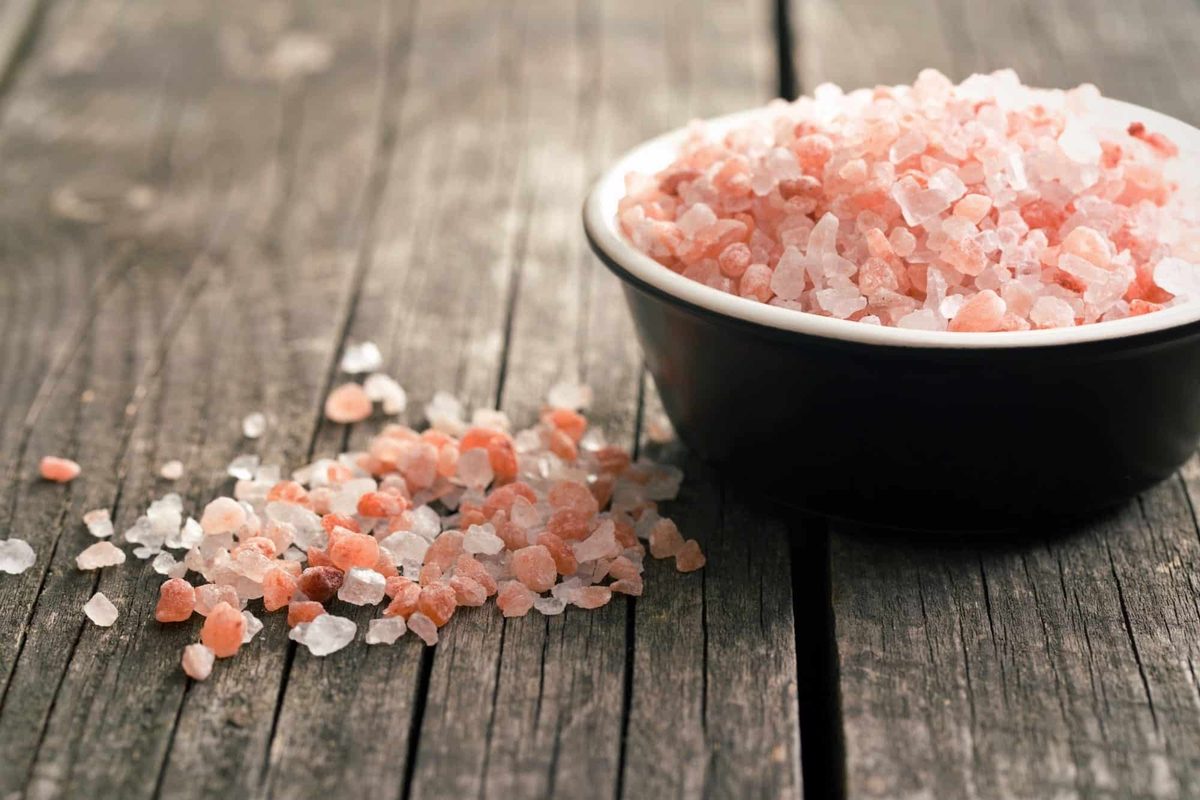
Both salts are colored by iron oxide, but they are different products. Alaea salt is Hawaiian-style sea salt mixed with ʻalaea, a red clay;1 Himalayan salt is rock salt mined in Pakistan, tinted pink by traces of iron oxide in the salt itself.2 Once either one dissolves into food it seasons like any other salt, so the real choice is about color, crunch, and what is actually in the jar.
Side by side
| Alaea salt | Himalayan salt | |
|---|---|---|
| What it is | White sea salt mixed with red ʻalaea clay1 | Rock salt: mined sodium chloride with trace minerals2 |
| Where it comes from | Traditionally the Hanapēpē salt ponds on Kauaʻi,3 but that salt cannot be sold; commercial alaea is made by companies blending sea salt and clay14 | Commercial supply is produced in Pakistan;2 the state-owned PMDC runs the Khewra mine5 |
| How it’s made | Seawater evaporated in shallow ponds; white salt raked, rinsed and dried, then some of it mixed with clay1 | Mined from salt beds that Harriet Hall describes as laid down by ancient oceans about 250 million years ago6 |
| Where the color comes from | Iron oxide in the added clay1 | Traces of iron oxide in the salt2 |
| Color (editorial) | Brick red | Pale to deep pink |
| Forms | Usually coarse crystals; SaltWorks lists only sea salt and clay as ingredients47 | Fine and coarse grinds, blocks and slabs (common retail practice) |
| Sodium | No published measurement for alaea; most sea salts are about 40% sodium8 | In 31 Australian retail pink salts, about 8% less sodium by weight than one white table salt control2 |
| Other minerals | No published analysis found | More calcium, iron, magnesium and potassium than white salt, but not enough to matter at normal intakes2 |
| Iodine | Specialty sea salts are not usually iodized9 | Not usually iodized9 |
| Typical uses | Kalua pig, poke, finishing710 | Everyday salt, finishing, grinders, salt blocks |
| Price | No dated, sourced retail comparison found | No dated, sourced retail comparison found |
The sodium and mineral figures come from one study of pink salt bought in Australia in 2018.2 Nothing comparable exists for alaea salt, so the two columns cannot be set against each other number for number.
Where each one really comes from
Alaea. Hawaiian sea salt is called paʻakai, which the University of Hawaiʻi glosses as “to solidify the sea.”1 At Hanapēpē, underground seawater is drawn from deep wells into holding pools and then into shallow ponds, and the white salt that forms is raked, rinsed and dried; some of it is then mixed with ʻalaea clay from the mountains of Waimea.1 The Hawaii State Legislature calls the Hanapēpē ponds ancient, authentic Hawaiian salt ponds,3 and Honolulu Civil Beat reported in 2018 that 21 families connected by bloodline still work them.11 That salt does not meet US food-grade requirements, so it may be given or traded but not sold.111
So the alaea salt in stores is a commercial blend, and the label matters. SaltWorks, for example, sells an “Alaea Red Hawaiian-style Sea Salt” whose sea salt comes from the Pacific Ocean and whose clay comes from the Hawaiian islands.4 Claims that most alaea salt is made in particular countries circulate widely; we found no source that documents them.
Himalayan. The 2020 Foods study states that Pakistan produces Himalayan pink salt for commercial distribution.2 PMDC, Pakistan’s state mining company, calls its Khewra mine the world’s second largest salt mine and says it extracts about 1.4 million tons of rock salt a year across all its operations.5 The common claim that all Himalayan salt comes from a single mine is broader than any source we found. The same study bought one “pink salt” from Peru, so a pink color on a label does not by itself mean Pakistani rock salt.2
Color: same pigment, different route
Both reds trace to iron oxide.12 In alaea the pigment is added: the clay is mixed into white salt.1 In Himalayan salt it is part of the mined rock, and in the Australian study, darker pink samples generally held more minerals.2 That last finding covers pink salt only. No one has published a mineral analysis of commercial alaea salt, and we found no food-safety assessment of the clay itself.
Flavor and saltiness
America’s Test Kitchen found that sea salts vary in color but only slightly in flavor, and taste no different from table salt once mixed into food.12 We found no sensory test of either alaea or Himalayan salt specifically. Food writer Sue Lau calls alaea complex and “not quite as salty as other salt types,”7 which is her opinion rather than a measurement. It is consistent with what is in the jar: commercial alaea is salt plus clay,4 so gram for gram it cannot carry more salt than plain salt. Himalayan salt is still overwhelmingly sodium chloride.2
Neither is a health upgrade. The study’s authors found that a teaspoon of pink salt made no clinically significant contribution to nutrient intake, and that you would need more than 30 g a day, about 6 teaspoons, before its minerals mattered, at which point the sodium would cancel any benefit.2 The widely advertised “84 minerals” figure could not be traced to any laboratory analysis; the 2020 study measured 25 minerals,2 and Harriet Hall points out that such lists include poisons such as mercury, arsenic, lead and thallium.6 The American Heart Association’s point applies to both salts: for heart health, total sodium intake is what matters.8
Safety
- Iodine. The NIH lists Himalayan salt among specialty salts that are not usually iodized, along with sea salt.9 If you rely on salt for iodine, keep iodized salt in the kitchen too; see iodized vs. non-iodized salt.
- Lead in one pink salt. In the 2020 study, one sample, the only one from Peru, carried 130 times more lead than the white control and exceeded the limit the authors applied.2 That is one product in one study, not a finding about Himalayan salt in general.
- The clay. We found no regulator assessment of ʻalaea clay as a food ingredient. The Hanapēpē restriction attaches to the traditional salt, not specifically to the clay.1
Can one stand in for the other?
For seasoning, yes. For a salt block, no. The ratios below come from our alaea salt substitutes page and keep its labels: Computed has a measurable basis, Attributed quotes a named source, Disputed shows sources that disagree, and Method is our starting point where no published number exists.
| Swap | Job | Starting amount | Treatment |
|---|---|---|---|
| Coarse Himalayan for alaea | Seasoning kalua pig or another cooked dish | About 3/4 of the alaea volume, then taste | Method |
| Any food-grade salt for alaea, by weight | Seasoning | No more than the same weight | Computed (upper limit) |
| Coarse Himalayan for alaea | Finishing, for color | Sprinkle to taste | Method |
| Alaea for Himalayan | Seasoning or finishing | Start with the same amount and taste | Method |
| Alaea for a Himalayan salt block | Cooking or serving surface | No substitute | n/a |
Himalayan in place of alaea. Lau says alaea “can’t be substituted for on an equal basis” and tells cooks to cut back when using ordinary coarse salt.7 She gives no figure, so the three-quarters starting point is ours. By weight, the Codex standard requires food-grade salt to be at least 97% sodium chloride on a dry basis,13 while alaea is salt diluted with some clay,4 so the same weight of plain salt is the most you would need. For finishing, coarse pink salt gives color and crunch, though pink rather than brick red.
Alaea in place of Himalayan. No source gives a ratio. Because alaea carries some clay,4 you may need slightly more by weight; start with the same amount and taste. America’s Test Kitchen notes that salt in its most basic form is sodium chloride whatever the source,12 so once dissolved, only the color and crunch change.
It is sometimes said that kalua pig depends on the clay in alaea for its texture. We found no source for that.
When to use which
- Hawaiian dishes. Alaea is the traditional choice. Lau seasons her kalua pig with alaea alone,7 SaltWorks says its salt is traditionally used on kalua pig,4 and a Food Network ahi poke recipe from chef Pierre Alabadejos of the Four Seasons Resort Maui calls for “Hawaiian alae (red sea salt).”10
- Everyday cooking. Either works once dissolved;12 fine Himalayan salt is the easier one to measure (our judgment).
- Finishing. Both, for color: brick red or pink. That is a matter of looks, not taste.
- Cooking on a block. Only Himalayan salt is commonly sold this way. We found no published testing of how much salt a block transfers to food. See cooking with Himalayan salt.
What isn’t known
- No published weight per teaspoon, sodium content or clay share for any commercial alaea salt.
- No mineral or heavy-metal analysis of alaea salt or ʻalaea clay.
- No sensory test of either salt against ordinary salt.
- No dated price comparison.
Related
- Alaea salt and alaea salt substitutes
- Himalayan salt, cooking with Himalayan salt
- Hawaiian sea salt, black lava salt
- Celtic salt vs. Himalayan salt, fleur de sel vs. Himalayan salt, kosher salt vs. Himalayan salt, Himalayan salt vs. sea salt
Footnotes
-
Traditional Ways of Knowing: Salt Harvesting, University of Hawaiʻi at Mānoa. manoa.hawaii.edu · Reference work ↩ ↩2 ↩3 ↩4 ↩5 ↩6 ↩7 ↩8 ↩9 ↩10 ↩11
-
Fayet-Moore et al., “An Analysis of the Mineral Composition of Pink Salt Available in Australia”, Foods, 2020. mdpi.com · Peer-reviewed ↩ ↩2 ↩3 ↩4 ↩5 ↩6 ↩7 ↩8 ↩9 ↩10 ↩11 ↩12 ↩13 ↩14 ↩15
-
House Concurrent Resolution No. 117 (2008), Hawaii State Legislature. data.capitol.hawaii.gov · Regulator ↩ ↩2
-
Alaea Red Hawaiian-style Sea Salt, product page, SaltWorks. seasalt.com · Merchant ↩ ↩2 ↩3 ↩4 ↩5 ↩6 ↩7
-
Pakistan Mineral Development Corporation. pmdc.gov.pk · Reference work ↩ ↩2
-
Harriet Hall, “Pink Himalayan Sea Salt: An Update”, Science-Based Medicine, 2017. sciencebasedmedicine.org · Publication ↩ ↩2
-
Sue Lau, “Hawaiian pulled pork”, The Christian Science Monitor, 2015. csmonitor.com · Publication ↩ ↩2 ↩3 ↩4 ↩5
-
Sodium Sources: Where Does All That Sodium Come From?, American Heart Association. heart.org · Reference work ↩ ↩2
-
Iodine: Fact Sheet for Health Professionals, NIH Office of Dietary Supplements. ods.od.nih.gov · Regulator ↩ ↩2 ↩3
-
“Ahi Poke”, recipe courtesy of Pierre Alabadejos, Food Network. foodnetwork.com · Publication ↩ ↩2
-
Brittany Lyte, “The Imperiled Legacy of the Hanapepe Salt Flats”, Honolulu Civil Beat, 2018. civilbeat.org · Publication ↩ ↩2
-
Salt Types and Measurements, America’s Test Kitchen. americastestkitchen.com · Publication ↩ ↩2 ↩3
-
Standard for Food Grade Salt (CXS 150-1985), Codex Alimentarius. services.bis.gov.in · Standard ↩