Spice Comparisons · Comparison
Kosher Salt vs. Himalayan Salt: Crystal, Weight and Minerals Compared
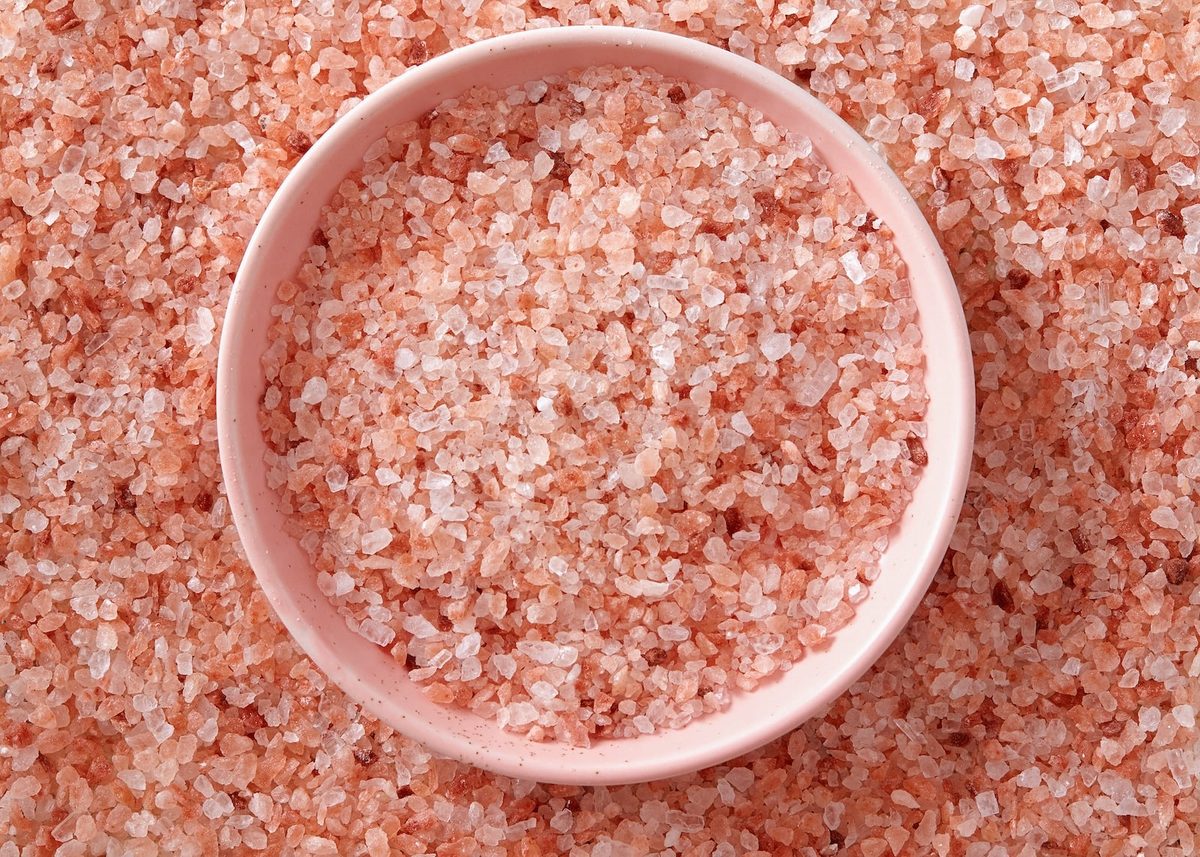
Kosher salt and Himalayan salt are both coarse, mostly sodium chloride, and both usually free of iodine.12 They get there differently. Kosher salt is named for its traditional use in koshering meat, and the two big US brands make it by evaporating brine.13 Himalayan salt is rock salt mined in Pakistan and tinted pink by traces of iron oxide.4 For a cook, the difference that matters most is weight: a teaspoon of Morton kosher salt weighs 4.8 grams and a teaspoon of Diamond Crystal 2.8 grams,3 while Morton’s coarse Himalayan salt label works out to about 6 grams.5 Swap them spoon for spoon and the amount of salt changes.
Side by side
| Kosher salt | Himalayan salt | |
|---|---|---|
| What it is | Coarse-grained sodium chloride named for koshering meat61 | Rock salt, mined; pink from traces of iron oxide4 |
| How it’s made | Diamond Crystal: brine heated and stirred in open pans. Morton: brine evaporated in vacuum evaporators, then pressed into flakes3 | Mined from deposits in Pakistan, for commercial pink salt; PMDC runs the Khewra mine47 |
| Crystal | Diamond Crystal: hollow pyramids. Morton: thin, dense flakes3 | Sold fine and coarse; Morton sells both8 |
| Color | White (editorial) | White through pink and dark pink to grayish, in PMDC’s grades7 |
| Additives | Morton: yellow prussiate of soda (anticaking agent). Diamond Crystal: none93 | Usually none; Morton’s coarse pink lists only salt5 |
| Iodine | Not usually iodized2 | Not usually iodized2 |
| Grams per teaspoon | Morton 4.8 g; Diamond Crystal 2.8 g (ATK)3 | No independent figure; Morton coarse label 1.5 g per ¼ teaspoon, about 6 g per teaspoon5 |
| Sodium per ¼ teaspoon (Morton labels) | 480 mg in 1.2 g9 | 570 mg in 1.5 g5 |
| Flavor (editorial) | Salty; Diamond Crystal crunches lightly, Morton harder | Salty; hard crunch when coarse |
| Price | No dated, sourced comparison found | No dated, sourced comparison found |
Where each comes from
Kosher salt. The name describes a use, not a source. America’s Test Kitchen describes kosher salt as originally used for koshering meat, and the Tufts Health & Nutrition Letter explains that its coarse grains draw blood out of meat, as Jewish dietary law requires.61 In the US it mostly means two brands, and they are made differently. Diamond Crystal comes from the Alberger process: brine is heated and agitated in open containers so hollow, pyramid-shaped crystals form on the surface. Morton’s brine goes through vacuum evaporators, and the salt is pressed through rollers into thin flakes.3
Himalayan salt. Harriet Hall of Science-Based Medicine describes the salt beds as deposited from ancient oceans about 250 million years ago.10 Commercial pink salt comes from Pakistan,4 where the state-owned Pakistan Mineral Development Corporation runs the Khewra mine.7 A widely repeated explanation credits the pink to minerals, bacteria and algae left from an ancient sea; the published analysis we found attributes it to traces of iron oxide.4
What’s in them
No laboratory study we found measured kosher salt and Himalayan salt side by side, so the figures below come from different sources and shouldn’t be compared decimal for decimal.
- Sodium. Table salt, kosher salt and most sea salts are about 40% sodium, the American Heart Association says.11 A Swiss government survey found four Himalaya salts at 37.7% to 38.2%.12 Morton’s labels work out to 400 mg of sodium per gram for its kosher salt and 380 mg per gram for its coarse Himalayan salt (our arithmetic).95
- Minerals. In a 2020 analysis of 31 pink salts bought in Australia, pink salt carried more calcium, iron, magnesium, manganese and potassium than a white table salt, but a 5 g teaspoon made no clinically significant contribution to nutrient intake except sodium.4 It would take more than 30 g a day for the minerals to matter, and the sodium would counteract any benefit.4
- Contaminants. The Swiss survey found 21,864 to 44,654 µg/kg of aluminum in its four Himalaya samples.12 It found specialty salts generally higher in contaminants than standard salts, with most contaminants below 1% of tolerable intake, and attributed the high levels in Himalaya salt to natural contamination.12 It analyzed no kosher salt.
- “84 minerals.” Hall traces the claim that pink salt contains 84 trace minerals to marketing.10
Flavor and handling
Weight for weight, salt tastes like salt. In ATK’s test, broths seasoned with equal weights of Morton and Diamond Crystal tasted exactly the same.3 We found no taste test of Himalayan salt against kosher salt, so claims that pink salt has “mineral notes” or that kosher salt is “cleaner” are untested.
Handling is where they differ:
- Kosher salt is ATK’s testers’ first choice for seasoning meat, because the large grains spread easily and cling.6 ATK’s tasters preferred Diamond Crystal’s “delicate and fleeting crunch” to Morton’s harder grains.3 Kosher salt is much coarser than table salt and dissolves more slowly, Tufts notes.1
- Coarse Himalayan salt is harder and denser. It goes in grinders, or on top of food where the pink color shows: steak, fish, eggs, salads. That is kitchen judgment.
A common claim says kosher salt helps meat hold its moisture. We found no test of it. For salt blocks, see cooking with Himalayan salt.
Pickling. Neither is the best choice. The National Center for Home Food Preservation recommends canning or pickling salt, and says flake salt is not recommended because its density varies.13 Kosher salt is not automatically additive-free: Morton’s lists an anticaking agent.9 See pickling salt vs. kosher salt.
Can one stand in for the other?
Yes, but measure carefully. These treatments follow our kosher salt substitute page.
| Swap | Starting amount | Treatment |
|---|---|---|
| Either, by weight | The same weight | Computed |
| Morton coarse Himalayan for 1 tsp Morton kosher | ⅘ teaspoon | Computed (Morton labels; Morton’s chart agrees) |
| Morton coarse Himalayan for 1 tsp Diamond Crystal | A scant ½ teaspoon | Computed |
| Morton kosher for 1 tsp Morton coarse Himalayan | 1¼ teaspoons | Computed (Morton labels; Morton’s chart agrees) |
| Diamond Crystal for 1 tsp Morton coarse Himalayan | About 2 teaspoons, then taste | Computed (about 2⅛ by weight; start low) |
| Another brand’s coarse pink salt for kosher salt, by volume | About half the volume of kosher salt called for, then taste | Method |
| Either, as a finishing salt | By the pinch, to taste | Method |
How these were worked out. By weight: the Codex standard requires food-grade salt, from rock deposits, the sea or brine, to be at least 97% sodium chloride on a dry basis.14 By volume: Morton’s labels give 1.2 g per ¼ teaspoon for its kosher salt and 1.5 g for its coarse Himalayan salt,95 so ⅘ teaspoon of the pink salt carries the salt of a teaspoon of Morton kosher. Morton’s chart, which applies only between Morton products, treats a teaspoon of its Himalayan salt as equal to a teaspoon of table salt and to 1¼ teaspoons of its kosher salt, and gives the same answer.8 Diamond Crystal’s 2.8 g per teaspoon is ATK’s measurement,3 set against Morton’s Himalayan label, so those rows mix two sources; we round toward less salt. ATK recommends weighing salt rather than measuring it by volume.15 Other brands’ grinds publish no weights that we found.
Health notes
- Sodium. A teaspoon of a lighter salt holds less sodium only because fewer crystals fit, and total sodium intake is what matters for heart health.11 Neither salt is a lower-sodium choice by weight.
- Iodine. The NIH Office of Dietary Supplements lists both kosher and Himalayan salt among specialty salts that are not usually iodized.2 If you cook only with these, see iodized vs. non-iodized salt.
- Health claims. Hall reviews claims that Himalayan salt detoxifies, lowers blood pressure or strengthens bones and finds them unsupported.10 This page makes no claim that either salt treats or prevents any condition.
What isn’t known
- No laboratory analysis of US kosher salt brands for minerals or contaminants was found.
- No taste test comparing kosher salt with Himalayan salt.
- Diamond Crystal’s own grams-per-teaspoon figure could not be retrieved from its maker; no independent weight for coarse pink salt outside Morton’s label.
- No test of kosher salt’s effect on meat moisture; no dated price data.
Related
- Kosher salt and Himalayan salt, the full profiles
- Kosher salt substitutes and cooking with kosher salt
- Himalayan salt vs. table salt, Himalayan salt vs. sea salt and fleur de sel vs. Himalayan salt
- Kosher salt vs. table salt, kosher salt vs. sea salt and Maldon salt vs. kosher salt
Footnotes
-
What’s the difference between kosher salt and other salt?, Tufts Health & Nutrition Letter, 2013 (updated 2019). nutritionletter.tufts.edu · Publication ↩ ↩2 ↩3 ↩4 ↩5
-
Iodine: Fact Sheet for Health Professionals, NIH Office of Dietary Supplements. ods.od.nih.gov · Regulator ↩ ↩2 ↩3 ↩4
-
Kate Shannon Levine, The Best Kosher Salt, America’s Test Kitchen, 2019. americastestkitchen.com · Publication ↩ ↩2 ↩3 ↩4 ↩5 ↩6 ↩7 ↩8 ↩9 ↩10
-
Fayet-Moore F et al., An Analysis of the Mineral Composition of Pink Salt Available in Australia, Foods, 2020. mdpi.com · Peer-reviewed ↩ ↩2 ↩3 ↩4 ↩5 ↩6 ↩7
-
Morton Coarse Himalayan Pink Salt, product page, Morton Salt. mortonsalt.com · Merchant ↩ ↩2 ↩3 ↩4 ↩5 ↩6
-
Salt Types and Measurements, America’s Test Kitchen. americastestkitchen.com · Publication ↩ ↩2 ↩3
-
Pakistan Mineral Development Corporation, home page. pmdc.gov.pk · Merchant ↩ ↩2 ↩3
-
Salt Conversion Chart, Morton Salt. mortonsalt.com · Merchant ↩ ↩2
-
Morton Kosher Salt Flakes, product page, Morton Salt. mortonsalt.com · Merchant ↩ ↩2 ↩3 ↩4 ↩5
-
Harriet Hall, Pink Himalayan Sea Salt: An Update, Science-Based Medicine, 2017. sciencebasedmedicine.org · Publication ↩ ↩2 ↩3
-
Sodium Sources: Where Does All That Sodium Come From?, American Heart Association, 2025. heart.org · Reference work ↩ ↩2
-
Esther Infanger and Max Haldimann, Report on the composition of prevalent salt varieties, Swiss Federal Food Safety and Veterinary Office, 2016. warwick.ac.uk · Regulator ↩ ↩2 ↩3
-
Salts Used in Pickling, National Center for Home Food Preservation. nchfp.uga.edu · Reference work ↩
-
Standard for Food Grade Salt, CXS 150-1985 (rev. 2012), Codex Alimentarius. services.bis.gov.in · Standard ↩
-
Eden Faithfull, The Wrong Brand of Kosher Salt Could Ruin Your Dinner, America’s Test Kitchen, 2022. americastestkitchen.com · Publication ↩