Spice Comparisons · Comparison
Himalayan Salt vs. Sea Salt: Pink Rock Salt and Evaporated Seawater Compared
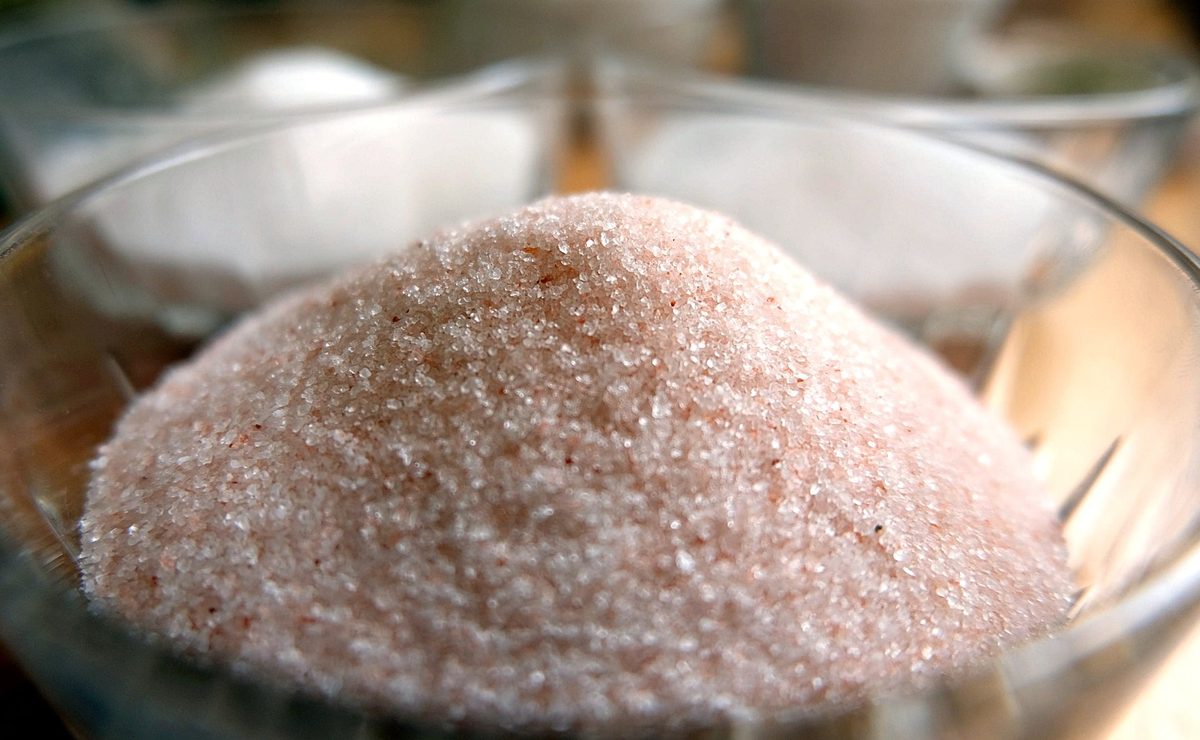
Himalayan salt and sea salt reach the kitchen by opposite routes. Himalayan salt is rock salt, mined in Pakistan and tinted pink by traces of iron oxide.1 Sea salt is the salt left behind when seawater evaporates.2 In the one laboratory survey that measured both, a 2016 study by Switzerland’s food safety office, four Himalaya salts ran 37.7% to 38.2% sodium and seven sea salts 38.9% to 40.7%.3 Neither is a meaningful source of minerals or iodine. What changes in cooking is the crystal you buy, since both come fine, coarse or, for sea salt, in flakes.
Side by side
| Himalayan salt | Sea salt | |
|---|---|---|
| What it is | Rock salt, mined from underground deposits1 | Salt left behind when seawater evaporates2 |
| Where it comes from | Pakistan, for commercial pink salt; the state-owned PMDC runs the Khewra mine14 | Coastal salt works worldwide; methods vary, from sun-evaporated (Morton fine sea salt) to boiled brine (Maldon)56 |
| Color | Pink from traces of iron oxide; PMDC sells grades from white through pink and dark pink to grayish14 | Usually white; some are colored, such as Hawaiian red salt from iron oxide in ʻalaea clay, or Guérande gray salt from fine clay particles78 |
| Forms | Fine and coarse; Morton sells both9 | Fine, coarse and flaky10 |
| Sodium (Swiss survey) | 37.7% to 38.2% (4 samples)3 | 38.9% to 40.7% (7 samples)3 |
| Iodine | Not usually iodized11 | Not usually iodized11 |
| Weight per ¼ teaspoon (Morton labels) | Coarse Himalayan: 1.5 g12 | Fine sea salt: 1.4 g5 |
| Flavor (editorial) | Salty; a hard, dry crunch when coarse | Salty; fine sea salt behaves like table salt, flakes give a light crunch |
| Price | No dated, sourced comparison found | No dated, sourced comparison found |
Measured in one laboratory
Comparing mineral figures from different studies mixes sample sets and methods. The May 2016 report by the Swiss Federal Food Safety and Veterinary Office (FSVO) avoids that: it analyzed 25 salts bought from local retailers or online, including four Himalaya salts and seven sea salts, in one project.3 Three of the Himalaya samples were labeled as from Pakistan and one as from South Africa, which the report notes may be the packing country.3 The figures describe these 11 samples, not either kind of salt in general.
| Measured (Swiss FSVO, 2016) | Himalaya salt (4 samples) | Sea salt (7 samples) |
|---|---|---|
| Sodium, % | 37.7 to 38.2 | 38.9 to 40.7 |
| Potassium, g/kg | Below 0.05 in all four | Below 0.05 in six; 1.2 in one |
| Iron, g/kg | 0.09 to 0.37 | Not reported in the rows we checked |
| Iodine, µg/kg | Below 20 in all four | Below 20 or not detected in four; 28, 44 and 54 in three |
| Aluminum, µg/kg | 21,864 to 44,654 | Below the detection limit in six; 742 in one |
All figures from the FSVO report’s Tables 1 to 3.3
What the table shows:
- Sodium is close. Every Himalaya sample was slightly lower than every sea salt sample, by 0.7 to 3 percentage points. The American Heart Association puts table salt and most sea salts at about 40% sodium.2 Neither is a low-sodium salt.
- “More minerals” doesn’t hold either way. One sea salt had measurable potassium and none of the Himalaya salts did; the Himalaya salts had iron, which the report says is mainly present as insoluble iron oxide,3 the compound the Australian study credits with the pink color.1
- Aluminum is the clearest difference. Every Himalaya sample carried tens of thousands of µg/kg; six of the seven sea salts were below the detection limit.3
- Contaminants in context. The report found specialty salts generally carried more contaminants than standard salts, but most did not reach even 1% of tolerable intake levels.3 The highest levels of nickel, lead, arsenic and aluminum, up to 32% of tolerable intake, were in Himalaya, kala namak and bamboo salts, calculated for intakes of 5 g and 9 g of salt a day.3 The report attributes the high levels in Himalaya salt to natural contamination.3
- The verdict. The FSVO concluded that specialty salts do not possess any advantages over standard salts.3
A separate study of 31 pink salts bought in Australia found more calcium, iron, magnesium and potassium than in a white table salt, yet a 5 g teaspoon made no clinically significant contribution to nutrient intake except sodium.1 It would take more than 30 g a day, about six teaspoons, for the minerals to matter, and the sodium would counteract any benefit.1 Those were different samples and methods, so the two studies’ numbers shouldn’t be mixed.
Microplastics. In a 2018 study of 39 salt brands, microplastic contamination was highest in sea salt, then lake salt, then rock salt, according to a Greenpeace press release on the study.13 The release gives no separate figure for pink salt.
Flavor and texture
America’s Test Kitchen found that sea salts vary in color but only slightly in flavor, and that once mixed into food, sea salt tastes no different from table salt.10 We found no taste test of Himalayan salt against sea salt. A widely repeated claim says trace minerals soften the “sharpness” of salt or give one of these a cleaner taste; no source we found tests it.
So the real choice is the crystal:
- Coarse Himalayan salt: hard, dry, pink crystals for grinders and for finishing pale food such as fish, eggs and greens, where the color shows.
- Flaky sea salt such as Maldon: thin pyramid flakes formed on the surface of boiling brine, shaped by surface tension, for a lighter crunch.6
- Fleur de sel: fine crystals skimmed from the surface of the salt pans and allowed up to 12% moisture under the Guérande specification, so they are damp rather than dry.8
- Fine sea salt and fine pink salt: everyday cooking salts that dissolve like table salt.
Those uses are kitchen judgment. A common claim holds that dry pink crystals pull moisture from food and melt away quickly while damp sea salts last longer on the plate. We found no test of how either dissolves on food. Himalayan salt blocks for cooking and serving are covered in cooking with Himalayan salt.
Can one stand in for the other?
Yes. For the full lists, see sea salt substitutes.
| Swap | Starting amount | Treatment |
|---|---|---|
| Either, measured into a recipe by weight | The same weight | Computed |
| Morton fine or coarse Himalayan for Morton fine or coarse sea salt, by the teaspoon | Teaspoon for teaspoon | Attributed (Morton products only) |
| Coarse Himalayan for flaky sea salt, for finishing | By the pinch, fewer crystals | Method |
| Flaky sea salt for coarse Himalayan, for finishing | By the pinch, to taste | Method |
| Fine Himalayan for flaky sea salt measured into a recipe | About ½ teaspoon per teaspoon of flakes, then taste | Method |
How these were worked out. By weight: the Codex standard requires food-grade salt from the sea, rock deposits or brine to be at least 97% sodium chloride on a dry basis,14 and the Swiss sodium figures overlap closely.3 By volume: Morton’s chart treats a teaspoon of its table salt, its fine and coarse sea salt and its Himalayan salt as equal, and says the chart applies only between Morton products.9 Its labels agree closely: 1.5 g per ¼ teaspoon for coarse Himalayan and 1.4 g for fine sea salt.125 Flakes pack loosely, and large-crystal salts hold less sodium per teaspoon only because fewer crystals fit.2 With no published weight for a teaspoon of flaky salt, the last row borrows the table-salt starting point from our Maldon salt substitute page. It is a cautious start, not a measurement.
Health notes
- Sodium. Total sodium intake is what matters most for heart health, the AHA says, and neither salt changes that.2 The FDA’s Daily Value for sodium is less than 2,300 mg a day.15
- Iodine. The NIH Office of Dietary Supplements lists both sea salt and Himalayan salt among specialty salts that are not usually iodized, and says noniodized sea salt provides virtually no iodine.11 US iodized salt carries 45 micrograms per gram,11 or 45,000 µg/kg, more than 800 times the highest sea salt figure in the Swiss table (our arithmetic). See iodized vs. non-iodized salt.
- Health claims. Harriet Hall reviews claims that Himalayan salt detoxifies, lowers blood pressure or strengthens bones and finds them unsupported by evidence.16 This page makes no claim that either salt treats or prevents any condition.
What isn’t known
- No taste test comparing Himalayan salt and sea salt directly was found.
- No test of how fast either dissolves on food.
- The Swiss report’s sea salt origins and iron results were not part of the rows we checked.
- No published weight per teaspoon for flaky sea salts, or for any Himalayan or sea salt outside Morton’s labels.
- No dated, sourced price comparison.
Related
- Himalayan salt and sea salt, the full profiles
- Sea salt substitutes and Maldon salt substitutes
- Himalayan salt vs. table salt, kosher salt vs. Himalayan salt, Celtic salt vs. Himalayan salt and fleur de sel vs. Himalayan salt
- Rock salt vs. sea salt and table salt vs. sea salt
- Cooking with sea salt and too much sea salt
Footnotes
-
Fayet-Moore F et al., An Analysis of the Mineral Composition of Pink Salt Available in Australia, Foods, 2020. mdpi.com · Peer-reviewed ↩ ↩2 ↩3 ↩4 ↩5 ↩6 ↩7
-
Sodium Sources: Where Does All That Sodium Come From?, American Heart Association, 2025. heart.org · Reference work ↩ ↩2 ↩3 ↩4 ↩5
-
Esther Infanger and Max Haldimann, Report on the composition of prevalent salt varieties, Swiss Federal Food Safety and Veterinary Office, 2016. warwick.ac.uk · Regulator ↩ ↩2 ↩3 ↩4 ↩5 ↩6 ↩7 ↩8 ↩9 ↩10 ↩11 ↩12 ↩13
-
Pakistan Mineral Development Corporation, home page. pmdc.gov.pk · Merchant ↩ ↩2
-
Morton Fine Sea Salt, product page, Morton Salt. mortonsalt.com · Merchant ↩ ↩2 ↩3
-
Clare Finney, Clear as crystal: the decades-old traditions of Maldon sea salt, Foodism, 2018. foodism.co.uk · Publication ↩ ↩2
-
Traditional Ways of Knowing: Salt Harvesting, University of Hawaiʻi at Mānoa, 2011. manoa.hawaii.edu · Reference work ↩
-
Cahier des charges de l’IGP Sel de Guérande / Fleur de sel de Guérande, French Ministry of Agriculture, 2025. info.agriculture.gouv.fr · Regulator ↩ ↩2
-
Salt Conversion Chart, Morton Salt. mortonsalt.com · Merchant ↩ ↩2
-
Salt Types and Measurements, America’s Test Kitchen. americastestkitchen.com · Publication ↩ ↩2
-
Iodine: Fact Sheet for Health Professionals, NIH Office of Dietary Supplements. ods.od.nih.gov · Regulator ↩ ↩2 ↩3 ↩4
-
Morton Coarse Himalayan Pink Salt, product page, Morton Salt. mortonsalt.com · Merchant ↩ ↩2
-
Over 90% of sampled salt brands globally found to contain microplastics, Greenpeace International press release, 2018. greenpeace.org · Publication ↩
-
Standard for Food Grade Salt, CXS 150-1985 (rev. 2012), Codex Alimentarius. services.bis.gov.in · Standard ↩
-
Sodium in Your Diet, U.S. Food and Drug Administration. fda.gov · Regulator ↩
-
Harriet Hall, Pink Himalayan Sea Salt: An Update, Science-Based Medicine, 2017. sciencebasedmedicine.org · Publication ↩