Cooking · Cooking with
Cooking With Himalayan Salt: Finishing, Salt Blocks and What It Won’t Do
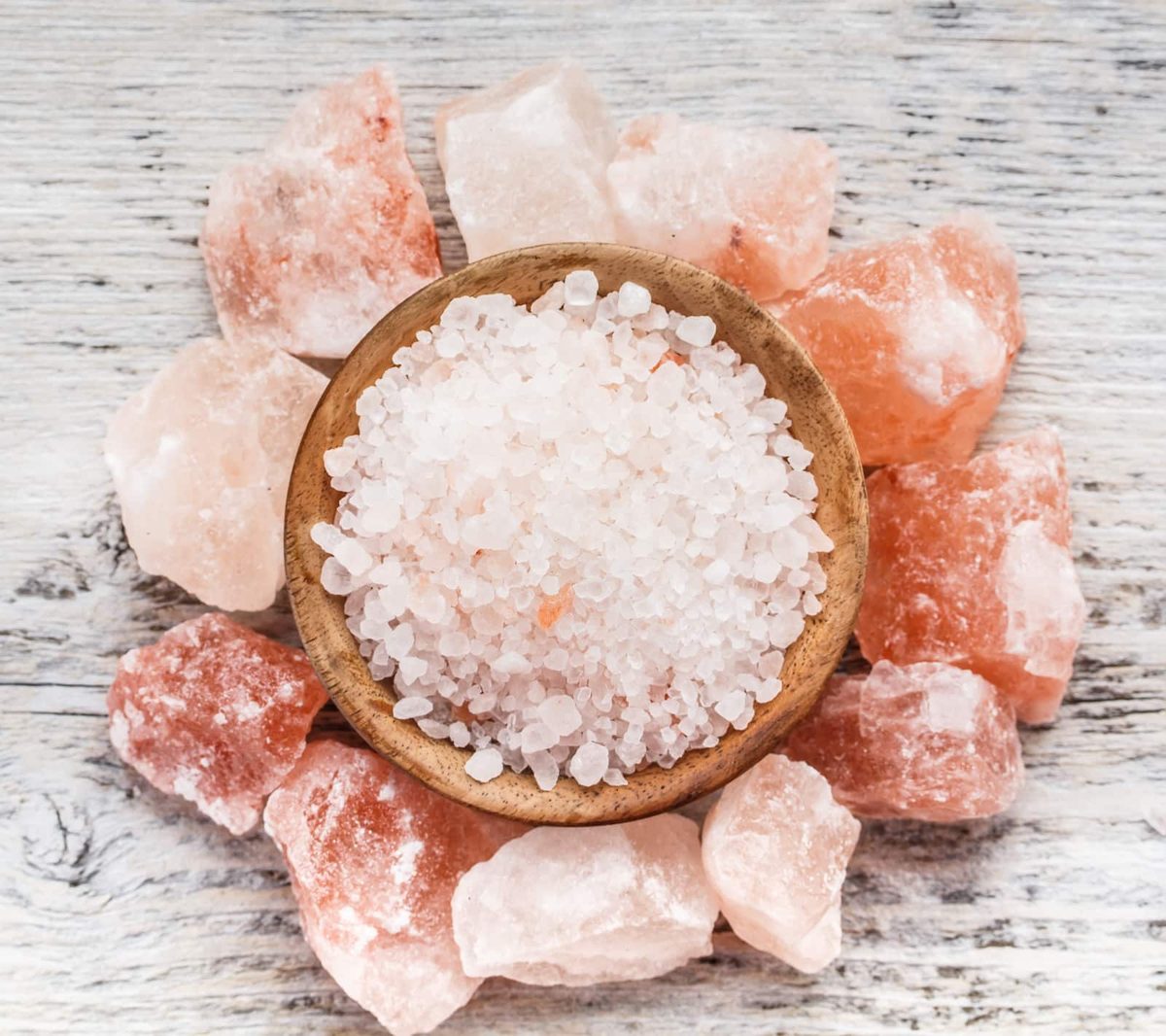
Himalayan salt is rock salt mined in Pakistan and tinted pink by traces of iron oxide.1 In the kitchen it does three things well: it adds color and crunch as a finishing salt, it works like any other salt when ground fine, and in block form it becomes a cooking and serving surface. What it doesn’t do is supply useful minerals or cut your sodium. This page covers each use, with the numbers behind it.
Quick guide
| Use | How | Basis |
|---|---|---|
| Finishing | Coarse crystals over food just before serving, for color and crunch | Kitchen judgment |
| Everyday seasoning | Fine pink salt, used like any fine salt; weigh it for baking | Morton label and chart23 |
| Searing on a block | Heat slowly over 30 minutes or more; cook thin, quick-cooking foods | The Meadow’s instructions4 |
| Serving on a block | Moist foods such as mozzarella and sliced apples pick up a light saltiness | The Meadow4 |
| As a health food | Not supported: the minerals are too small to matter | Fayet-Moore et al.1 |
What you’re cooking with
Pink salt is rock salt, mined rather than evaporated from seawater; Pakistan produces it for commercial distribution, and the state-owned Pakistan Mineral Development Corporation runs the Khewra mine and sells the salt in shades from white through pink to grayish.15 Harriet Hall of Science-Based Medicine describes the deposits as laid down by ancient oceans about 250 million years ago.6 The color comes from traces of iron oxide, according to a 2020 study of 31 pink salts sold in Australia.1 A Swiss government survey of four Himalaya salts found the iron mainly present as insoluble iron oxide.7
Chemically it is still salt. The same Swiss survey measured sodium in its four Himalaya salts at 37.7 to 38.2% by weight, against 38.9 to 40.7% in seven sea salts, and concluded that specialty salts “do not possess any advantages over standard salts.”7 Not every salt sold as pink comes from Pakistan: in the Australian study, one pink salt came from Peru.1
As a finishing salt
Coarse pink crystals scattered over food at the end stay crunchy and visible: on sliced steak, roasted vegetables, eggs, salads, or a chocolate dessert. Those are common uses rather than tested claims. It is often said that pink salt tastes milder than table salt. We found no taste test of Himalayan salt itself; America’s Test Kitchen found that sea salt tastes no different from table salt once mixed into food, and keeps it for finishing.8 By weight, pink salt carries a little less sodium than white salts: 0.7 to 3 percentage points below the Swiss sea salts, and about 8% less than the one white salt in the Australian study.71 Nobody has shown that a gap that small reads as “milder.”
As an everyday salt
Ground fine, pink salt can replace table salt in cooking. Morton’s label for its coarse Himalayan salt lists 1.5 g per ¼ teaspoon, the same as its iodized table salt, and its conversion chart treats a teaspoon of either as equal, with a small adjustment at larger volumes (1 cup of table salt equals 1 cup plus 2 tablespoons of coarse Himalayan).23 Morton says the chart applies only between its own products.3 Other brands, and especially grinder salts, can pack differently, so for baking, weigh it.
Cooking on a salt block
A salt block is a slab of Himalayan salt that can be heated and used like a griddle, or chilled and used as a serving plate. The best-documented instructions come from The Meadow, a salt merchant that sells the blocks; what follows is its guidance for its own product, not an independent test.
Heating. The block must be completely dry; The Meadow says a block that has been used should rest at least 24 hours before heating again.4 On a gas burner, it says to start on low for at least 15 minutes, then raise the heat gradually: low-medium for 15 minutes, then medium-high for 15 minutes.4 On an electric range, it sets the block on a metal ring to leave an air gap above the element; on a charcoal grill, it puts the block on the side away from the coals.4 It does not recommend heating a block in the oven.4 The block is ready, by its reckoning, at 500°F or more, or when drops of water sizzle away instantly.4 The Meadow says its blocks are tested from 0°F up to 700°F and that cracks and fissures will appear in early use and are normal.4
Holding heat. Because the salt is dense, The Meadow says a block holds whatever temperature it reaches “for a good while.”4 A common claim says salt blocks stay hot for hours; we found no measurement of that.
Saltiness. The Meadow says a block imparts “only a very moderate saltiness,” that wet foods pick up salt faster than fatty ones, and that if food comes out too salty, a thin layer of oil on the block helps.4 It favors foods that cook quickly, and warns that a block that isn’t hot enough over-salts food.4 We found no published measurement of how much salt a block transfers.
What to cook. The Meadow suggests scallops and thinly sliced hanger steak, and for steak gives 1 to 2 minutes per side for thin slices and 4 to 5 minutes per side for thicker cuts such as rib eye.49 Check doneness with a thermometer rather than by the clock: FoodSafety.gov gives 145°F with a 3-minute rest for beef steaks, and says to cook scallops until the flesh is pearly or white and opaque.10
Serving cold. The Meadow lists chilling among block uses and notes that moist foods such as mozzarella and sliced apples take on a delicate saltiness when served on one.4 It gives no chilling instructions.
Cleaning and storage. Let the block cool completely, wipe it with a damp sponge, scrub with a soft brush or scouring pad, and use no soap, keeping water to a minimum; then pat it dry and stand it on a rack.4 Store it where humidity is low.4 The Meadow attributes the block’s easy upkeep to the “powerful antimicrobial properties of the salt”; we found no independent test of that claim, so treat it as the seller’s.4
What it won’t do
Supply minerals. Pink salt does carry more calcium, iron, magnesium and potassium than white salt, but in the 2020 study a 5 g teaspoon made no clinically significant contribution to nutrient intake, and you would need more than 30 g a day, about six teaspoons, before the minerals mattered, by which point the sodium would far outweigh them.1 Claims that it detoxifies the body or lowers blood pressure are collected and rejected in Harriet Hall’s review.6
Cut sodium. A teaspoon of coarse pink salt can hold less sodium than a teaspoon of table salt only because fewer large crystals fit in the spoon; the American Heart Association says total sodium intake is what matters for heart health.11 The FDA’s Daily Value for sodium is less than 2,300 mg a day.12
Supply iodine. Himalayan salt is not usually iodized, and the Swiss survey measured iodine in its Himalaya samples at less than 20 µg per kilogram.137 If you rely on salt for iodine, keep iodized salt in the kitchen too; see iodized vs. non-iodized salt.
A note on contaminants. The Swiss survey found specialty salts generally carried more contaminants than standard salts, with the highest levels of some metals in Himalaya and two other specialty salts, which it judged likely to be natural; most contaminants stayed below 1% of tolerable intake levels.7 In the Australian study, one pink salt, the sample from Peru, exceeded the lead limit the authors applied.1 Buying salt with a stated origin is a reasonable precaution; see Himalayan salt for detail.
What isn’t known
- No sensory test of Himalayan salt against table or sea salt.
- No independent measurement of how much salt a block transfers to food, how long it stays hot, or whether it is self-cleaning.
- No independent grams-per-teaspoon figure for coarse or grinder pink salt; only Morton’s label.
Related
- Himalayan salt, the full profile, and rock salt
- Himalayan salt vs. table salt, Himalayan salt vs. sea salt and kosher salt vs. Himalayan salt
- Fleur de sel vs. Himalayan salt and Celtic salt vs. Himalayan salt
- The best salt for cooking and too much salt?
Footnotes
-
Fayet-Moore F et al., An Analysis of the Mineral Composition of Pink Salt Available in Australia, Foods, 2020. mdpi.com · Peer-reviewed ↩ ↩2 ↩3 ↩4 ↩5 ↩6 ↩7 ↩8
-
Morton Coarse Himalayan Pink Salt, product page, Morton Salt. mortonsalt.com · Merchant ↩ ↩2
-
Salt Conversion Chart, Morton Salt. mortonsalt.com · Merchant ↩ ↩2 ↩3
-
Himalayan Salt Blocks 101, The Meadow. themeadow.com · Merchant ↩ ↩2 ↩3 ↩4 ↩5 ↩6 ↩7 ↩8 ↩9 ↩10 ↩11 ↩12 ↩13 ↩14 ↩15 ↩16
-
Pakistan Mineral Development Corporation, home page. pmdc.gov.pk · Merchant ↩
-
Harriet Hall, Pink Himalayan Sea Salt: An Update, Science-Based Medicine, 2017. sciencebasedmedicine.org · Publication ↩ ↩2
-
Esther Infanger and Max Haldimann, Report on the composition of prevalent salt varieties, Swiss Federal Food Safety and Veterinary Office, 2016. warwick.ac.uk · Regulator ↩ ↩2 ↩3 ↩4 ↩5
-
Salt Types and Measurements, America’s Test Kitchen. americastestkitchen.com · Publication ↩
-
How to Cook Steak on a Himalayan Salt Block, The Meadow. themeadow.com · Merchant ↩
-
Cook to a Safe Minimum Internal Temperature, FoodSafety.gov. foodsafety.gov · Regulator ↩
-
Sodium Sources: Where Does All That Sodium Come From?, American Heart Association, 2025. heart.org · Reference work ↩
-
Sodium in Your Diet, U.S. Food and Drug Administration. fda.gov · Regulator ↩
-
Iodine: Fact Sheet for Health Professionals, NIH Office of Dietary Supplements. ods.od.nih.gov · Regulator ↩