Spice Substitutes · Substitutes
Alaea Salt Substitutes: What to Use for Seasoning, Color and Crunch
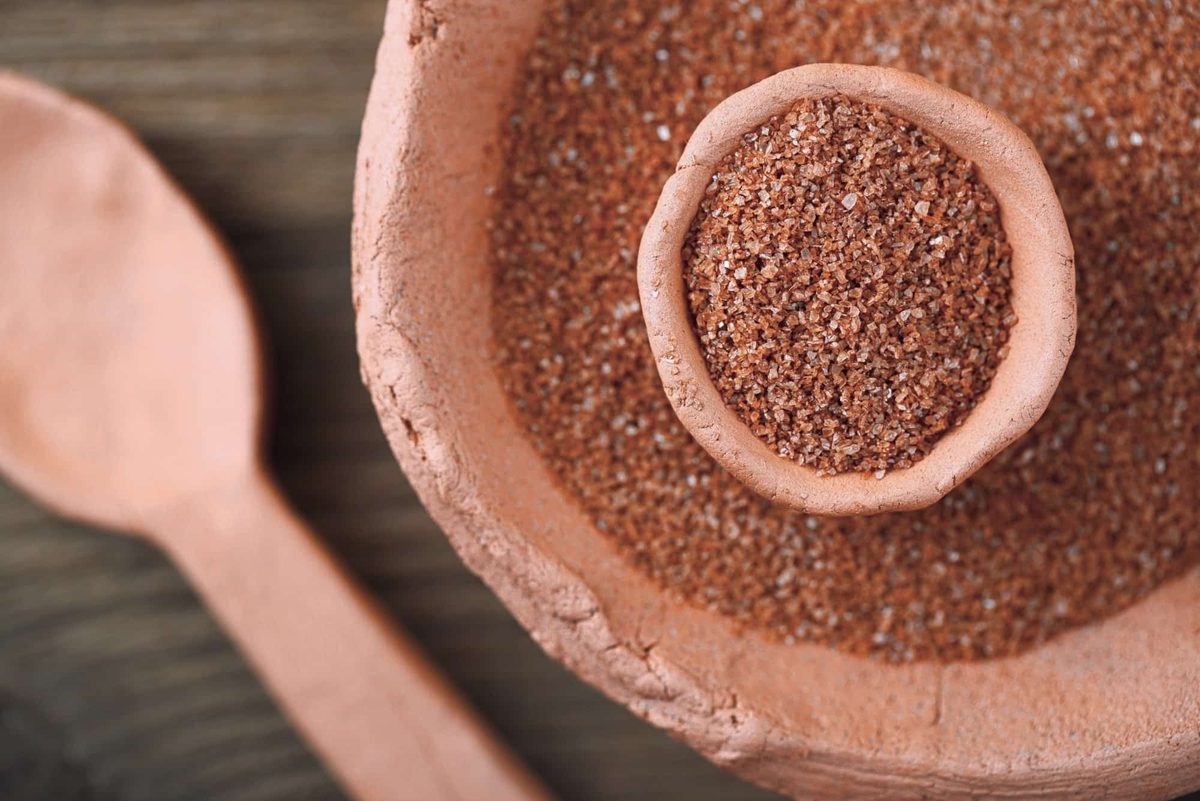
Alaea salt is Hawaiian sea salt mixed with ʻalaea, a red clay whose color comes from iron oxide.1 It is associated with kalua pig: in Sue Lau’s Hawaiian pulled pork, the meat is simply seasoned with alaea,2 and cooks also use its brick-red crystals as a finishing salt. No other salt does both jobs, so the right substitute depends on which one you need. For seasoning, almost any clean salt works once you adjust the amount. For color, nothing matches exactly.
Quick answer
| What alaea salt is doing | Best substitute | Starting amount, per 1 part alaea | Treatment |
|---|---|---|---|
| Seasoning kalua pig or another cooked dish | Coarse sea salt or coarse kosher salt | About 3/4 part by volume, then taste | Method |
| The same, with only fine table salt on hand | Table salt | About 1/2 part by volume, then taste | Method |
| The same, measured by weight | Any food-grade salt | No more than 1 part by weight | Computed (upper limit) |
| Finishing, for color | Coarse Himalayan pink salt | Sprinkle to taste | Method |
| Finishing, for crunch | Maldon or another flaky sea salt | Sprinkle to taste | Method |
How the ratios on this page are labeled
Every ratio carries one of four labels.
- Computed: based on a measurable physical relationship, with the source named.
- Attributed: a named source publishes this ratio. We quote it as theirs.
- Disputed: named sources give different answers to the same swap. We show each one and do not average them.
- Method: we found no published ratio. We give a direction and a cautious starting point, and say so.
No published measurement gives the weight of a teaspoon of alaea salt, its sodium content or how much clay it contains. That is why most figures here are Method starting points.
If alaea salt is seasoning a dish
Once salt dissolves into a dish, its color and crystal shape stop mattering. America’s Test Kitchen found that sea salts vary in color but only slightly in flavor, and that sea salt tastes no different from table salt once mixed into food.3 Salt is sodium chloride whatever its source,3 and table salt, kosher salt and most sea salts are all about 40 percent sodium.4 For a dish like kalua pig, then, the question is how much ordinary salt to use, not which kind.
How much: the evidence
Two points pull in the same direction.
- The clay. Commercial alaea salt is sea salt plus red clay; SaltWorks lists its ingredients as exactly those two.5 Any clay in the jar means that, gram for gram, alaea cannot be saltier than plain salt. No producer we found says how much clay it adds.
- A cook’s advice. Food writer Sue Lau, who seasons her Hawaiian pulled pork with 2 tablespoons of coarse alaea salt, calls alaea “not quite as salty as other salt types” and says it “can’t be substituted for on an equal basis”; she tells cooks to cut back when using ordinary coarse salt instead.2 She gives no figure, and we found no sensory test of alaea salt to check her view against.
By weight (Computed, upper limit): The Codex standard for food-grade salt requires at least 97 percent sodium chloride on a dry basis,6 and alaea is salt diluted with some clay.5 So the same weight of plain salt is the most you would need. Start a little below that and taste.
Coarse sea salt or coarse kosher salt
Ratio (Method): Start with about three quarters of the alaea volume, following Lau’s direction to cut back,2 then taste and add more. Kosher salt brands differ widely in how much a spoonful weighs: America’s Test Kitchen weighed a teaspoon of Morton kosher salt at 4.8 grams and Diamond Crystal at 2.8 grams.7 With a light, flaky kosher salt such as Diamond Crystal, you may end up close to the full volume. The three-quarters figure is our starting point, not a measured equivalence.
Fine table salt
Table salt packs more salt into a spoon than coarse crystals do. America’s Test Kitchen puts a teaspoon of table salt at about 6 grams regardless of brand,7 and larger crystals carry less sodium per teaspoon simply because fewer of them fit.4
Ratio (Method): Start with about half the alaea volume and taste. How coarse alaea salt is varies by product, and no one has published its weight per teaspoon, so this is a cautious starting point.
Iodized table salt brings iodine that specialty sea salts usually lack,8 and America’s Test Kitchen tasters found no detectable difference between iodized and non-iodized salt.3
Rock salt, if it is sold as food
The Codex standard for food-grade salt covers salt from the sea, from rock deposits and from brine.6 Food-grade coarse rock salt can season a dish the same way as coarse sea salt, so use the same three-quarters starting point (Method). Be careful with the rock salt sold for ice cream makers: Morton says its ice cream salt is not intended for consumption.9
If alaea salt is a finishing salt
Here the color and crunch are the point, and they don’t dissolve away.
1. Coarse Himalayan pink salt, for color
Both salts owe their color to iron oxide: alaea to the iron oxide in its clay,1 Himalayan pink salt to traces of iron oxide in the salt itself.10 The shade is different, pink rather than brick red, so treat it as a near miss. Himalayan pink salt for commercial sale is produced in Pakistan,10 from beds that Harriet Hall describes as deposited from ancient oceans about 250 million years ago.11
Ratio (Method): Sprinkle to taste, as you would alaea. No published ratio exists for finishing salts, and the amount is a matter of look and crunch.
2. Maldon or another flaky sea salt, for crunch
Maldon salt comes from Maldon, in Essex in southeastern England.12 Its flakes are thin pyramids, shaped by surface tension as the seawater is boiled.13 It gives crunch on a finished plate but no color.
Ratio (Method): Sprinkle to taste.
Other options
- Celtic sea salt is a moist gray salt; the brand says the natural brine stays in the salt.14 It works for seasoning, but its damp, gray crystals won’t give alaea’s look.
- Plain white sea salt. At Hanapēpē, alaea is made by mixing some of the white sea salt with clay.1 A white sea salt does the seasoning job without the color.
What isn’t known
- No source publishes the weight of a teaspoon of alaea salt, its sodium content or the share of clay in it. Volume ratios on this page are starting points.
- Whether alaea tastes less salty than plain salt is one cook’s opinion. Sue Lau says it does;2 America’s Test Kitchen’s broader finding is that sea salts taste much alike once dissolved.3 We found no test of alaea itself.
- Claims that commercial alaea salt comes mostly from particular countries circulate widely, but we found no source that documents them. Read the label for where the salt and the clay come from.5
Related
- Alaea salt and alaea salt vs. Himalayan salt
- Hawaiian sea salt and Hawaiian sea salt substitutes
- Himalayan salt, rock salt, Maldon sea salt, Celtic sea salt
- Kosher salt, table salt, sea salt and kosher salt vs. sea salt
- Black lava salt and best salt for cooking
Footnotes
-
Traditional Ways of Knowing: Salt Harvesting, Exploring Our Fluid Earth, University of Hawaiʻi at Mānoa, 2011. manoa.hawaii.edu · Reference work ↩ ↩2 ↩3
-
Sue Lau, Hawaiian pulled pork, The Christian Science Monitor, 2015. csmonitor.com · Publication ↩ ↩2 ↩3 ↩4
-
Salt Types and Measurements, America’s Test Kitchen. americastestkitchen.com · Publication ↩ ↩2 ↩3 ↩4
-
Sodium Sources: Where Does All That Sodium Come From?, American Heart Association, 2025. heart.org · Reference work ↩ ↩2
-
Alaea Red Hawaiian-style Sea Salt, product page, SaltWorks. seasalt.com · Merchant ↩ ↩2 ↩3
-
Standard for Food Grade Salt, CXS 150-1985, Codex Alimentarius Commission. services.bis.gov.in · Standard ↩ ↩2
-
Kate Shannon Levine, The Best Kosher Salt, America’s Test Kitchen, 2019. americastestkitchen.com · Publication ↩ ↩2
-
Iodine: Fact Sheet for Health Professionals, NIH Office of Dietary Supplements. ods.od.nih.gov · Regulator ↩
-
Morton Ice Cream Salt, product page, Morton Salt. mortonsalt.com · Merchant ↩
-
Fayet-Moore et al., An Analysis of the Mineral Composition of Pink Salt Available in Australia, Foods, 2020. mdpi.com · Peer-reviewed ↩ ↩2
-
Harriet Hall, Pink Himalayan Sea Salt: An Update, Science-Based Medicine, 2017. sciencebasedmedicine.org · Publication ↩
-
Maldon, Encyclopaedia Britannica. britannica.com · Reference work ↩
-
Clare Finney, Clear as crystal: the decades-old traditions of Maldon sea salt, Foodism, 2018. foodism.co.uk · Publication ↩
-
FAQs, Celtic Sea Salt. celticseasalt.com · Merchant ↩