Spice Comparisons · Comparison
Celtic Salt vs. Himalayan Salt: Gray Sea Salt and Pink Rock Salt Compared
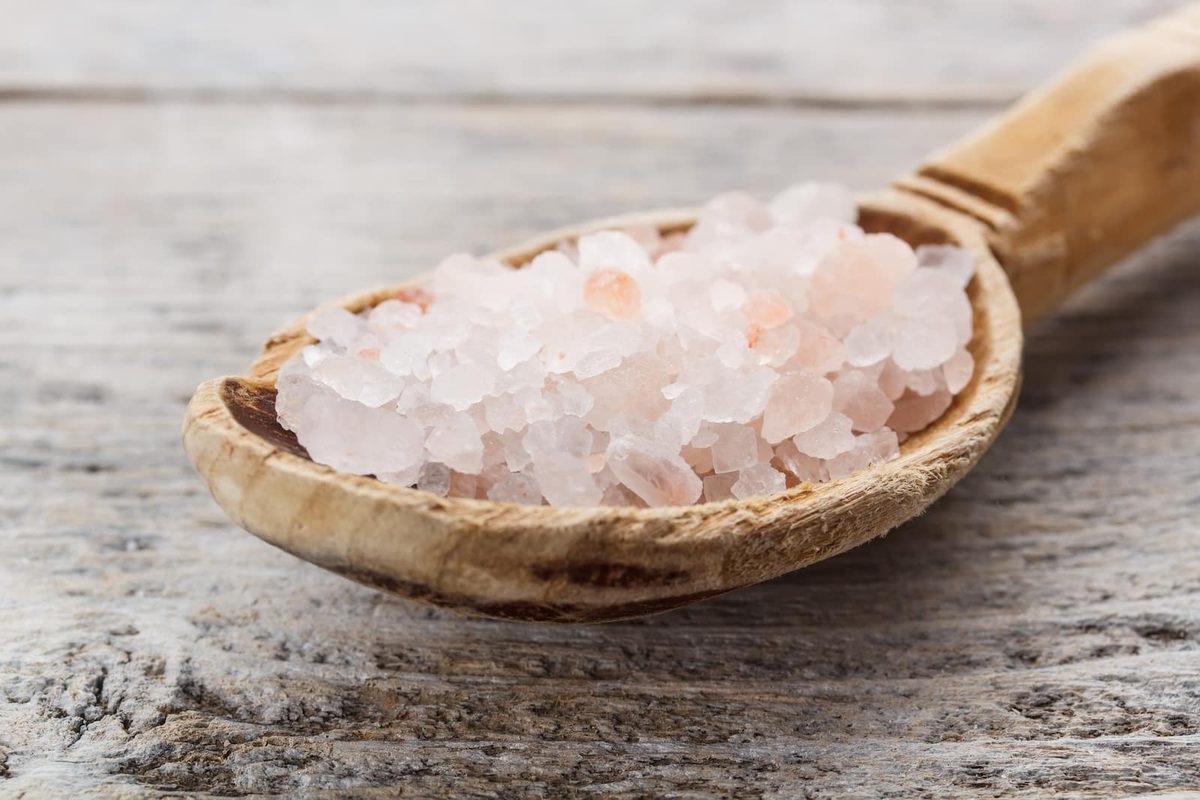
Celtic salt and Himalayan salt are both sold as natural alternatives to table salt, but they come from opposite ends of the salt world. “Celtic salt” usually means Celtic Sea Salt, a brand founded in 1976,1 whose Light Grey Celtic is a moist gray sea salt of the kind French producers call sel gris. Himalayan salt is rock salt, mined in Pakistan and tinted pink by traces of iron oxide.2 Both are overwhelmingly sodium chloride.3 The differences a cook will notice are moisture, crystal and color, not nutrition.
Side by side
| Celtic salt (gray sea salt) | Himalayan salt | |
|---|---|---|
| What it is | Sea salt from evaporation pans; “Celtic Sea Salt” is a brand name1 | Rock salt, mined from underground deposits2 |
| Where it comes from | The brand’s pages we read don’t say where Light Grey Celtic is harvested.4 Guérande, on France’s Atlantic coast, is a gray-salt source with a detailed official specification5 | Pakistan, for commercial pink salt; the state-owned PMDC runs the Khewra mine26 |
| How it forms | In Guérande, crystallizes on the clay bottom of the salt pans and is gathered by hand5 | Beds deposited from ancient oceans about 250 million years ago (Hall)7 |
| Color | Gray, from fine clay particles (Guérande)5 | Pink, from traces of iron oxide;2 PMDC sells white through pink to grayish6 |
| Moisture | Up to 12% for Guérande gray salt;5 the brand says brine stays in its salt4 | No published moisture figure found |
| Additives | Prohibited in Guérande salt, which is also not washed5 | Morton’s coarse pink salt lists only salt8 |
| Weight, ¼ teaspoon (brand labels) | 1.5 g, Light Grey Celtic9 | 1.5 g, Morton coarse Himalayan8 |
| Sodium, ¼ teaspoon (brand labels) | 480 mg9 | 570 mg8 |
| Iodine | None added; the brand reports about 0.2 ppm naturally present4 | Not usually iodized10 |
| Flavor (editorial) | Salty, with a damp, crunchy crystal | Salty, with a hard, dry crunch when coarse |
| Price | No dated, sourced retail comparison found | No dated, sourced retail comparison found |
The weight and sodium rows compare two brands’ own labels, not independent measurements, and they describe those two products only.
Where each one comes from
Celtic Sea Salt says it was founded by Dr. Jacques Delangre, who coined the word “Celtic” to honor hand-harvesting methods the company dates back to the Celts and Mayans.14 That is the brand’s account. The company’s FAQ names Spanish locations for two of its other products but, on the pages we read, not a harvest site for Light Grey Celtic.4 If origin matters to you, check the package.
The best-documented gray salt is from Guérande, where an official French specification describes the process. Gray salt forms on the clay bottom of the final pans, and the harvester, the paludier, gathers it by hand from the brine.5 It drains for several hours before storage, is not washed, and may contain no additives.5 Its color comes from insoluble matter, which the specification describes as fine particles of clay.5 The gray is clay, not a sign of extra magnesium or other dissolved minerals.
Himalayan salt is rock salt. Science-Based Medicine’s Harriet Hall describes the beds as deposited from ancient oceans about 250 million years ago.7 The commercial product comes from Pakistan,2 where the Pakistan Mineral Development Corporation runs the Khewra mine and holds the geographical indication “Khewra Pink Rock Salt.”6 Not every “pink salt” is from there: in a 2020 study of 31 pink salts sold in Australia, one sample came from Peru.2 Morton describes its pink salt only as sourced from the Himalayan Mountains.8
Moisture, color and crystals
This is where the two really differ. Guérande gray salt may hold up to 12% moisture,5 and Celtic Sea Salt attributes its own salt’s dampness to brine, the “mother liquor,” left in the crystals.4 Himalayan salt is mined from underground rock salt deposits,2 and we found no published moisture figure for it.
Grain size depends on the product. Morton, for example, sells Himalayan salt both fine and coarse.11 Gray salt’s damp crystals can be hard to grind; the brand suggests drying them gently over low heat first and avoiding metal grinders.4 Neither is a flaky salt; for flakes, see Maldon sea salt.
A widely repeated claim says that a dry salt such as Himalayan draws juices out of a steak faster than a damp gray salt does. We found no test of it, so treat it as untested.
Is either one healthier?
Not in any way that shows up at normal amounts.
Sodium chloride first. The Codex Alimentarius standard requires food-grade salt to be at least 97% sodium chloride on a dry basis, whether it comes from the sea, rock deposits or natural brine.3 The American Heart Association says table salt, kosher salt and most sea salts are about 40% sodium.12
What the labels show. Light Grey Celtic’s label gives 480 mg of sodium in 1.5 g, and Morton’s coarse Himalayan gives 570 mg in 1.5 g.98 By our arithmetic that is about 32% and 38% sodium. The Celtic figure is below the usual 40%. Its label doesn’t say why; moisture is one possible reason, since the brand says brine stays in its salt,4 but we found no analysis that confirms it.
Minerals. The best data on pink salt is a 2020 analysis of 31 pink salts bought in Australia. Pink salt carried more calcium, iron, magnesium, manganese and potassium than the white table-salt control, but a 5 g teaspoon made no clinically significant contribution to nutrient intake except sodium.2 You would need more than 30 g a day, about 6 teaspoons, before the minerals mattered, and the authors concluded the sodium would counteract any benefit.2 Celtic Sea Salt says its salt contains more than 70 trace minerals and elements;1 we found no independent analysis of it. Himalayan salt is often advertised with “84 minerals,” a figure we could not trace to any laboratory analysis; Hall traces it to marketing copy.7 The AHA notes sea salt may carry trace minerals such as magnesium, potassium and calcium, and that total sodium is what matters for heart health.12
Iodine. Neither is a source. The NIH Office of Dietary Supplements lists sea salt and Himalayan salt among specialty salts that are not usually iodized.10 Celtic Sea Salt adds no iodine and reports a natural trace of about 0.2 ppm.4 If you cook only with these salts and rely on salt for iodine, see iodized vs. non-iodized salt.
Sodium limits. The FDA’s Daily Value for sodium is less than 2,300 mg a day.13 At the label figures above, a teaspoon of Light Grey Celtic carries about 1,920 mg and a teaspoon of Morton coarse Himalayan about 2,280 mg (our arithmetic).
Contaminants
- Lead. In the 2020 Australian study, one pink salt, the only sample from Peru, had 2.59 mg/kg of lead against the 2 mg/kg limit the authors applied; cadmium, arsenic and mercury stayed within limits across all 31 samples.2 Celtic Sea Salt reports its own typical lead content as about 0.68 micrograms per serving and says each lot is tested;4 that is the company’s figure, and we found no independent test.
- Microplastics. In a 2018 study of 39 salt brands from 21 countries and regions, contamination was highest in sea salt, then lake salt, then rock salt, according to a Greenpeace press release on the study.14 The release gives no separate figure for gray or pink salt, so it shows a difference between salt types, not between these two products.
In the kitchen
America’s Test Kitchen found that sea salts vary in color but only slightly in flavor, and that they taste no different from table salt once mixed into food.15 ATK recommends sea salts as finishing salts, scattered on food just before serving.15 So the choice comes down to what sits on top of the food.
- Celtic salt gives damp, chunky crystals that hold their shape on steak, roast vegetables, tomatoes and salads. Many cooks find it brinier eaten whole; that is a matter of taste, not a measured result.
- Himalayan salt, coarse, gives a hard, dry crunch and a pink color that shows on pale foods such as eggs, fish and dressed greens. That is a kitchen judgment.
- Inside the dish, in soups, pasta water and doughs, the crystals dissolve and the difference disappears.15
For Himalayan technique, see cooking with Himalayan salt.
Can one stand in for the other?
Yes, almost always. Measure with care, because a teaspoon of one is not exactly a teaspoon of the other in sodium. The figures below reuse the conversions on our Celtic salt substitute page.
| Swap | Match by weight | Match by sodium | Treatment |
|---|---|---|---|
| Morton coarse Himalayan for 1 teaspoon Light Grey Celtic | 1 teaspoon (both labels: 1.5 g per ¼ teaspoon) | About ⅚ teaspoon (480 mg ÷ 570 mg) | Computed98 |
| Light Grey Celtic for 1 teaspoon Morton coarse Himalayan | 1 teaspoon | A little under 1¼ teaspoons (570 mg ÷ 480 mg) | Computed98 |
| Either, as a finishing salt | By the pinch, to taste | Method |
How these were worked out. Both swaps rest on the two brands’ own labels, so they apply to those products, not to every gray or pink salt. Morton’s own chart treats a teaspoon of its Himalayan salt as equal to a teaspoon of table salt, but a cup of table salt as equal to a cup plus 2 tablespoons of its coarse Himalayan salt; Morton says the chart applies only between Morton products.11 For a larger batch, such as a brine or a salt crust, weigh the salt.
What no swap reproduces. Pink salt won’t give you gray salt’s dampness, and gray salt won’t give you the pink. If a recipe depends on either, use the salt it was written for.
What isn’t known
- No independent laboratory analysis of Celtic Sea Salt’s minerals, sodium or lead was found. Its figures here are the brand’s own.
- The brand’s pages we read don’t say where Light Grey Celtic is harvested.
- No published moisture figure for Himalayan salt was found.
- No taste test compares gray and pink salt directly. ATK’s tests cover sea salts against table salt.15
- No dated, sourced price comparison was found.
Related
- Celtic sea salt and Himalayan salt, the full profiles
- Celtic salt substitutes
- Celtic sea salt vs. table salt
- Himalayan salt vs. table salt, Himalayan salt vs. sea salt and kosher salt vs. Himalayan salt
- Fleur de sel and fleur de sel vs. Himalayan salt
- The best salt for cooking
Footnotes
-
About Celtic Sea Salt, Celtic Sea Salt (Selina Naturally). celticseasalt.com · Merchant ↩ ↩2 ↩3 ↩4
-
Fayet-Moore F et al., An Analysis of the Mineral Composition of Pink Salt Available in Australia, Foods, 2020. mdpi.com · Peer-reviewed ↩ ↩2 ↩3 ↩4 ↩5 ↩6 ↩7 ↩8 ↩9 ↩10
-
Standard for Food Grade Salt, CXS 150-1985 (rev. 2012), Codex Alimentarius. services.bis.gov.in · Standard ↩ ↩2
-
FAQs, Celtic Sea Salt (Selina Naturally). celticseasalt.com · Merchant ↩ ↩2 ↩3 ↩4 ↩5 ↩6 ↩7 ↩8 ↩9 ↩10
-
Cahier des charges de l’IGP Sel de Guérande / Fleur de sel de Guérande, French Ministry of Agriculture, 2025. info.agriculture.gouv.fr · Regulator ↩ ↩2 ↩3 ↩4 ↩5 ↩6 ↩7 ↩8 ↩9
-
Pakistan Mineral Development Corporation, home page. pmdc.gov.pk · Merchant ↩ ↩2 ↩3
-
Harriet Hall, Pink Himalayan Sea Salt: An Update, Science-Based Medicine, 2017. sciencebasedmedicine.org · Publication ↩ ↩2 ↩3
-
Morton Coarse Himalayan Pink Salt, product page, Morton Salt. mortonsalt.com · Merchant ↩ ↩2 ↩3 ↩4 ↩5 ↩6 ↩7
-
Light Grey Celtic, product page, Celtic Sea Salt (Selina Naturally). celticseasalt.com · Merchant ↩ ↩2 ↩3 ↩4 ↩5
-
Iodine: Fact Sheet for Health Professionals, NIH Office of Dietary Supplements. ods.od.nih.gov · Regulator ↩ ↩2
-
Salt Conversion Chart, Morton Salt. mortonsalt.com · Merchant ↩ ↩2
-
Sodium Sources: Where Does All That Sodium Come From?, American Heart Association, 2025. heart.org · Reference work ↩ ↩2
-
Sodium in Your Diet, U.S. Food and Drug Administration. fda.gov · Regulator ↩
-
Over 90% of sampled salt brands globally found to contain microplastics, Greenpeace International press release, 2018, on Kim J-S et al., Environmental Science & Technology, 2018. greenpeace.org · Publication ↩
-
Salt Types and Measurements, America’s Test Kitchen. americastestkitchen.com · Publication ↩ ↩2 ↩3 ↩4