Spices · Profile
Bell Pepper Powder: Sweet Pepper Flavor Without the Heat
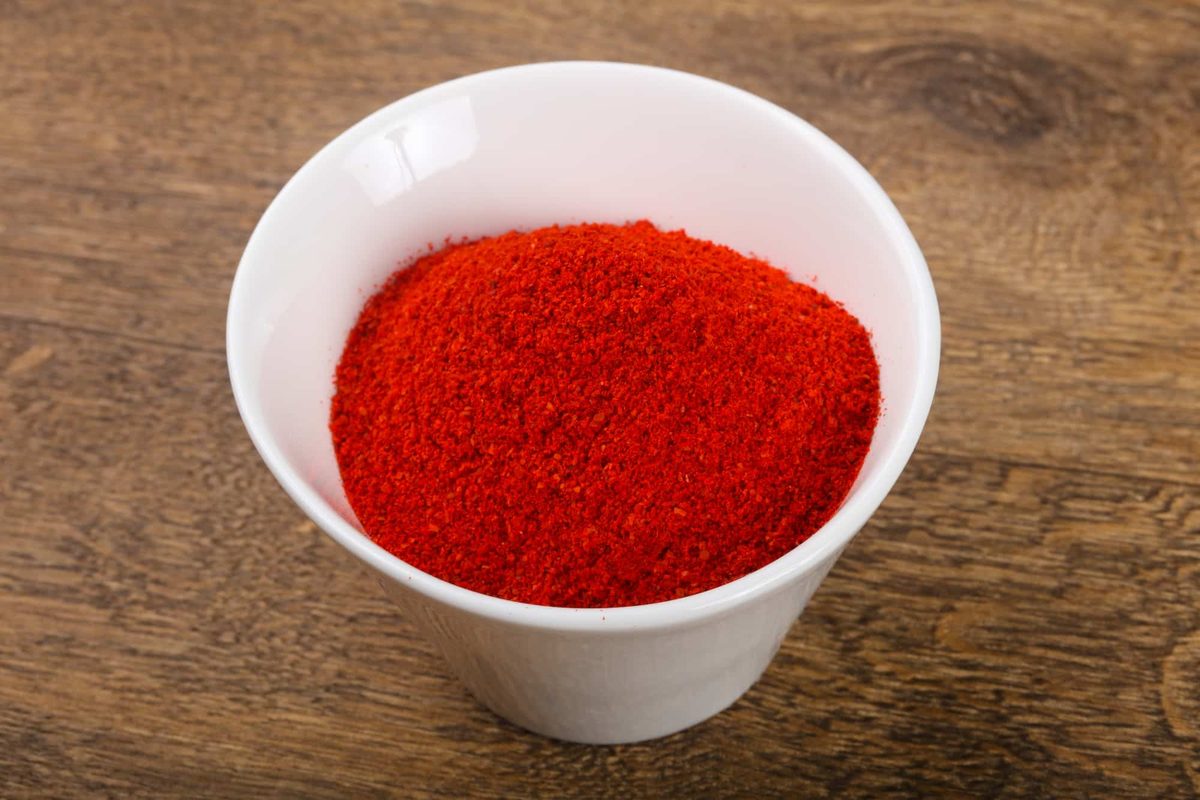
Bell pepper powder is dried bell pepper ground fine: the flavor of sweet pepper, concentrated, with no heat at all. It sits next to paprika on the spectrum of ground Capsicum, and is used more by food manufacturers than by home cooks. This page covers what it is, how it compares with paprika, what the nutrient data show, and how to use it.
At a glance
| What it is | Dried, ground sweet bell pepper, red or green |
| Botanical name | Capsicum annuum1 |
| Native range of the species | Southern United States to Brazil and the Caribbean (Kew)2 |
| Domesticated | Mexico; the evidence points to central-east Mexico3 |
| Heat | 0 SHU for sweet bell pepper, in one university trial1 |
| Name first recorded | 1707 (Merriam-Webster; Online Etymology Dictionary)45 |
| Forms sold | Powder; also granules and freeze-dried or dehydrated flakes |
Measured values
9 figures, sourced| Measure | Value | Scope | Source |
|---|---|---|---|
| Pungency (Scoville) | 0 SHU | sweet bell pepper (C. annuum) in one university trial (The Ohio State University) | plant-breeding-genomics.extension.org |
| Water Nutrient | 2 % | freeze-dried red sweet pepper (closest USDA entry; not the same product as air-dried powder), USDA FoodData Central FDC 169373 | fdc.nal.usda.gov |
| Vitamin C Nutrient | 1,900 mg per 100 g | freeze-dried red sweet pepper (closest USDA entry; not the same product as air-dried powder), USDA FoodData Central FDC 169373 | fdc.nal.usda.gov |
| Vitamin A (RAE) Nutrient | 3,860 µg per 100 g | freeze-dried red sweet pepper (closest USDA entry; not the same product as air-dried powder), USDA FoodData Central FDC 169373 | fdc.nal.usda.gov |
| Vitamin B6 Nutrient | 2.22 mg per 100 g | freeze-dried red sweet pepper (closest USDA entry; not the same product as air-dried powder), USDA FoodData Central FDC 169373 | fdc.nal.usda.gov |
| Potassium Nutrient | 3,170 mg per 100 g | freeze-dried red sweet pepper (closest USDA entry; not the same product as air-dried powder), USDA FoodData Central FDC 169373 | fdc.nal.usda.gov |
| Iron Nutrient | 10.4 mg per 100 g | freeze-dried red sweet pepper (closest USDA entry; not the same product as air-dried powder), USDA FoodData Central FDC 169373 | fdc.nal.usda.gov |
| Calcium Nutrient | 134 mg per 100 g | freeze-dried red sweet pepper (closest USDA entry; not the same product as air-dried powder), USDA FoodData Central FDC 169373 | fdc.nal.usda.gov |
| Dietary fiber Nutrient | 21.3 g per 100 g | freeze-dried red sweet pepper (closest USDA entry; not the same product as air-dried powder), USDA FoodData Central FDC 169373 | fdc.nal.usda.gov |
Each figure is quoted as its source states it, with the samples or standard it applies to. Where sources differ, both are shown; nothing is averaged. All measured values
What bell pepper powder is
Merriam-Webster defines a bell pepper as a sweet pepper, especially a large bell-shaped one.4 Botanically it is Capsicum annuum.1 The powder is the dried fruit, ground.
Bell pepper powder and paprika. Both are ground, dried C. annuum. Under the international Codex standard, “paprika” is the class of dried Capsicum at 480 Scoville heat units or less.6 Bell pepper powder is sold under its own name, and no standard checked for this page defines it separately. The practical difference: paprika tastes of dried, often toasted red pepper; bell pepper powder tastes more like the fresh vegetable. That last comparison is ours.
Red and green. Red powder tastes sweeter and fruitier; green powder is more vegetal and slightly bitter. That is a common description of the powder, not a sourced finding, but it matches what PepperScale says of the fresh peppers: green bells are picked before they ripen and taste a little grassy and bitter, while red, yellow and orange bells have ripened and are sweeter.7
Flavor and heat
Sweet, fruity and lightly vegetal, with a cooked-pepper depth when bloomed in fat. That description is ours. No compound analysis of bell pepper powder was checked for this page. For paprika, a close relative, McCormick Science Institute attributes the green, vegetative note to methoxypyrazines.8
No heat. Researchers at The Ohio State University report that the sweet bell pepper they tested “scored 0 SHU.”1 They also note that two recessive genes conferring non-pungency, pun1 and pun12, have been identified in peppers.1
| Scope | Heat | Source |
|---|---|---|
| Sweet bell pepper (C. annuum) in one university’s tests | 0 SHU | The Ohio State University, eXtension1 |
| Bell peppers in general (no method stated) | Zero Scoville heat units | PepperScale7 |
| Paprika as a category, international standard | 480 SHU or less | Codex CXS 353-20226 |
| Bell pepper powder, retail | No published measurement found |
Origin and history
Capsicum annuum is native from the southern United States to Brazil and the Caribbean,2 and a 2014 study combining genetics, ecology, archaeobotany and historical linguistics found that it was domesticated in central-east Mexico.3
The name. Merriam-Webster and the Online Etymology Dictionary both date the English term “bell pepper” to 1707, named for the fruit’s shape.45 It is often said that the privateer and surgeon Lionel Wafer first used the name in 1699. The 1699 edition of Wafer’s book was checked only in part for this page, and the name was not found in the portion read, so that claim remains untraced. A further claim, that the 18th-century historian Edward Long recorded bell peppers grown in Jamaica for pickles, also could not be traced.
Popular histories also say bell peppers reached their modern form through centuries of selective breeding and that chiles were dried long before the Aztecs. Neither could be traced to a source checked for this page.
How it is used
In manufactured foods. USDA’s purchasing specification for spice blends lists red bell pepper among the dehydrated vegetables in one of its salt-free seasonings.9 It is widely said that bell pepper powder appears in snack-chip seasonings; no specific product label was confirmed for this page.
At home. As kitchen practice rather than sourced findings:
- Instead of fresh pepper where you want the flavor without the water or bulk: soups, sauces, gravies, meatloaf, dips.
- Instead of paprika where you want pepper flavor and color without smokiness or heat, for instance in deviled eggs, potato salad or a dry rub for children’s food.
- For color. Red powder tints fresh pasta dough, butter, cream cheese and dips.
- In blends. Pairs well with garlic powder, onion powder, oregano and black pepper in homemade seasoning salts and rubs; see Italian seasoning.
Technique. Like paprika, it scorches quickly. Warm it briefly in oil over moderate heat, or add it with liquid. Kitchen practice, not a measured finding. Because it has no heat, start with 1 to 2 teaspoons in a dish for four and adjust; that is a cooking judgment.
Buying and quality
- Check the label for color (red or green) and for added salt, anti-caking agents or other vegetables.
- Color and aroma. A bright, even color and a clear sweet-pepper smell are reasonable signs of freshness; brown red powder or dull khaki green powder has faded. Kitchen judgment.
- Clumping. Break up small lumps, but discard powder that has caked hard or smells musty. Kitchen judgment.
Storage
Keep it airtight, dark, cool and dry. No shelf-life figure from a regulator or standards body was found for bell pepper powder; figures that circulate online could not be traced. Replace it when the color and smell fade.
Nutrition and health
USDA FoodData Central has no entry for bell pepper powder. The closest is freeze-dried red sweet pepper (one SR Legacy entry), which is 2% water.10 It is not the same product as an air-dried powder, and a powder’s values may differ. Per 100 g, and computed per gram:
| Nutrient | Per 100 g, freeze-dried red sweet pepper10 | Per 1 g, computed | % Daily Value per g11 |
|---|---|---|---|
| Vitamin C | 1,900 mg | 19 mg | about 21% (DV 90 mg) |
| Vitamin A (RAE) | 3,860 µg | about 39 µg | about 4% (DV 900 µg) |
| Vitamin B6 | 2.22 mg | about 0.02 mg | about 1% (DV 1.7 mg) |
| Potassium | 3,170 mg | about 32 mg | under 1% (DV 4,700 mg) |
| Iron | 10.4 mg | about 0.1 mg | under 1% (DV 18 mg) |
| Calcium | 134 mg | about 1.3 mg | about 0.1% (DV 1,300 mg) |
| Dietary fiber | 21.3 g | about 0.2 g | under 1% (DV 28 g) |
What this shows: vitamin C is the standout. On these figures a single gram of freeze-dried red pepper carries about a fifth of the daily value, a much higher share than for any other nutrient listed. Fiber is about a fifth of the weight, not most of it, and the potassium, iron and calcium per serving are small. The weight of a teaspoon of powder was not found in a USDA entry, so no per-teaspoon figure is given.
Claims that bell pepper powder protects against macular degeneration and cataracts, prevents anemia or treats constipation were not supported by any source reviewed for this page. No claim is made here that it treats or prevents any disease.
Safety
- Mycotoxins (EU). EU law caps ochratoxin A at 20 µg/kg in dried Capsicum fruits, whole or ground; the regulation’s examples are chillies, chilli powder, cayenne and paprika,12 and it was not confirmed whether bell pepper powder is treated the same way.
- Allergy and interactions. No regulator or major review statement specific to bell pepper powder was found for this page.
Substitutes and comparisons
- Paprika and paprika substitutes
- Paprika vs. chili powder
- Other dried Capsicum: ancho powder, jalapeño powder, cayenne pepper
Footnotes
-
Hernandez-Garcia and Zhang, Pepper Heat, eXtension Plant Breeding and Genomics, The Ohio State University. plant-breeding-genomics.extension.org · Reference work ↩ ↩2 ↩3 ↩4 ↩5 ↩6
-
Capsicum annuum L., Plants of the World Online, Royal Botanic Gardens, Kew. powo.science.kew.org · Reference work ↩ ↩2
-
Kraft et al., Multiple lines of evidence for the origin of domesticated chili pepper, PNAS, 2014. escholarship.org · Peer-reviewed ↩ ↩2
-
bell pepper, Merriam-Webster Dictionary. merriam-webster.com · Reference work ↩ ↩2 ↩3
-
bell (n.), Online Etymology Dictionary. etymonline.com · Reference work ↩ ↩2
-
Standard for Dried or Dehydrated Chilli Pepper and Paprika, CXS 353-2022, Codex Alimentarius. fao.org · Standard ↩ ↩2
-
Matt Bray, Common Peppers You’ll Find at the Supermarket (and How Hot They Are), PepperScale, updated 2026. pepperscale.com · Publication · PepperScale is also owned by Matt Bray, the editor of this site. ↩ ↩2
-
Paprika, McCormick Science Institute. mccormickscienceinstitute.com · Merchant ↩
-
Commercial Item Description A-A-20001C, Spices and Spice Blends, USDA Agricultural Marketing Service, 2023. ams.usda.gov · Regulator ↩
-
Peppers, sweet, red, freeze-dried (FDC 169373), USDA FoodData Central. fdc.nal.usda.gov · Regulator ↩ ↩2
-
Daily Value on the Nutrition and Supplement Facts Labels, FDA. fda.gov · Regulator ↩
-
Commission Regulation (EU) 2023/915, EUR-Lex. eur-lex.europa.eu · Regulator ↩