Seasonings · Profile
Italian Seasoning: Which Herbs Are in It, Where It Came From, and How to Use It
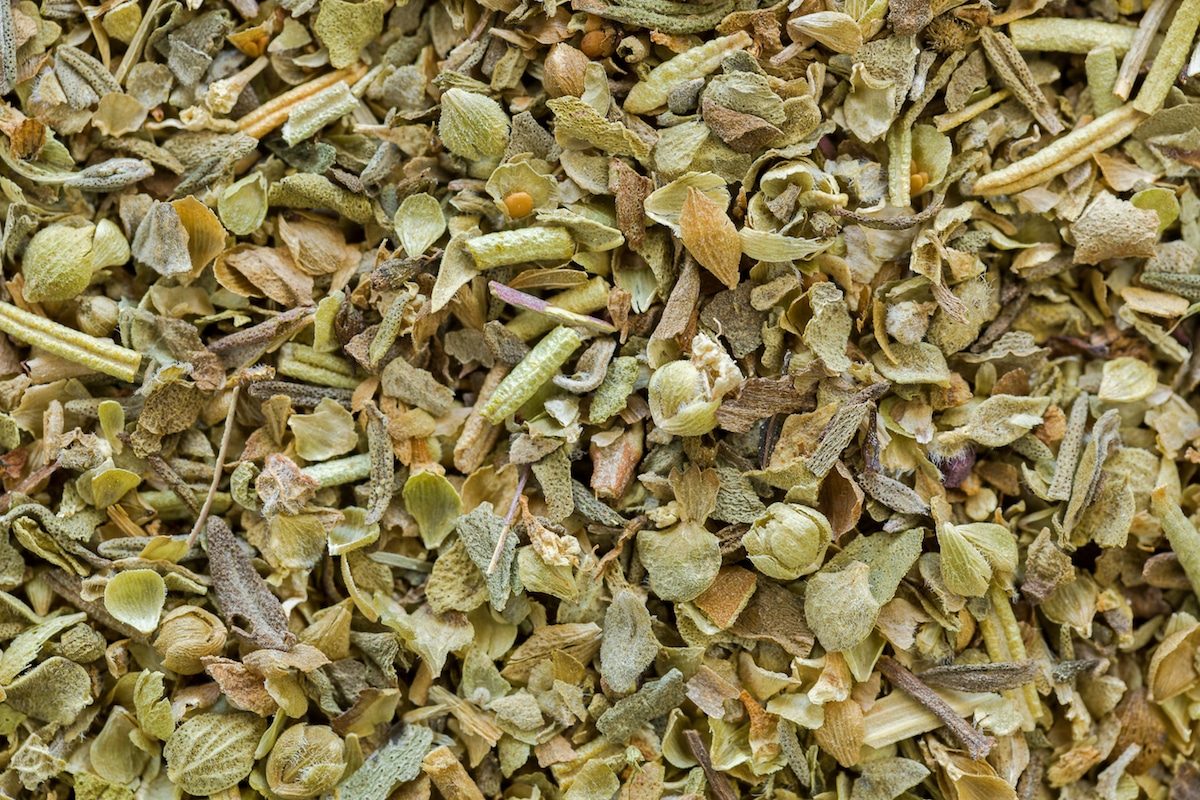
Italian seasoning is a blend of dried, crumbled herbs, usually oregano, basil, thyme, rosemary and marjoram, often with sage and sometimes savory. It contains no salt in its usual form, and the mix and proportions change from brand to brand. Despite the name, the bottled blend is most likely an American product rather than something Italian cooks reach for. This page covers which herbs go into it, where each comes from and what gives it its smell, how to use it, and what to look for when buying.
At a glance
| What it is | A blend of dried green herb leaves1 |
| Typical herbs | Oregano, basil, thyme, rosemary, marjoram, sage; some brands add savory123 |
| Fixed recipe? | No. The USDA purchasing specification names five herbs and says the blend is “not limited to” them1 |
| Main aroma compounds | Carvacrol and thymol (oregano, thyme); α-pinene and 1,8-cineole (rosemary); methyl chavicol (basil); thujones (sage)45678 |
| Salt | None in the two brands below, which list herbs only23 |
| Forms sold | Dried leaf pieces; salt-free “Italian” blends may add garlic and onion1 |
| Origin of the blend | Probably American, as a commercial product9 |
Measured values
2 figures, sourced| Measure | Value | Scope | Source |
|---|---|---|---|
| Moisture, maximum Limit | 12 % | USDA Commercial Item Description A-A-20001C (federal purchase specification), Italian seasoningNot a standard that retail blends must meet | ams.usda.gov |
| Particle size, minimum through No. 10 sieve Limit | 90 % | USDA Commercial Item Description A-A-20001C (federal purchase specification), Italian seasoningNot a standard that retail blends must meet | ams.usda.gov |
Each figure is quoted as its source states it, with the samples or standard it applies to. Where sources differ, both are shown; nothing is averaged. All measured values
What is in it
| Blend | Herbs, in order given | Source |
|---|---|---|
| McCormick Italian Seasoning | Marjoram, basil, rosemary, thyme, oregano, savory and sage | 2 |
| Simply Organic Italian Seasoning | Oregano, marjoram, thyme, rosemary, basil, sage (all organic) | 3 |
| USDA purchasing specification (minimum list) | Thyme, rosemary, sage, oregano and basil, as pieces of green leaf | 1 |
| USDA salt-free “Italian” seasoning (minimum list) | Garlic, onion, oregano, rosemary, parsley and celery seed | 1 |
US labels list ingredients in descending order by weight, so the first herb is the largest share.10 The two brands above lead with different herbs: marjoram in one, oregano in the other.23 The federal specification, written for government food purchases, also sets a maximum moisture of 12% and a particle size (90% through a No. 10 sieve).1 It is not a standard that retail blends must meet.
Where Italian seasoning comes from
No one has pinned down when the bottled blend first appeared. Tasting Table’s 2024 history says it is “more than likely an American invention,” or at least popularized in American kitchens, and that a bottle labeled Italian seasoning would be hard to find in an Italian grocery store.9 The same article says Italian cooks are more likely to use fresh herbs than dried, and that traditional recipes do not call for a mix of dried herbs in equal measure.9
The herbs themselves have different homes, according to Kew’s Plants of the World Online:
| Herb | Native range (Kew) | Source |
|---|---|---|
| Oregano (Origanum vulgare) | Macaronesia to China | 11 |
| Thyme (Thymus vulgaris) | Southwest Europe and southeast Italy | 12 |
| Rosemary (Salvia rosmarinus) | Mediterranean | 13 |
| Sage (Salvia officinalis) | Southwest Germany to southern Europe | 14 |
| Marjoram (Origanum majorana) | Southern Türkiye and Cyprus | 15 |
| Basil (Ocimum basilicum) | Tropical and subtropical Asia to northern Australia | 16 |
Basil is the outlier: it is native to Asia, not the Mediterranean.169
Flavor and the compounds behind it
A typical blend smells green, resinous and savory: oregano and thyme give the sharp, warm note, rosemary a piney one, sage a musky depth, and marjoram and basil a sweeter edge. That description is ours. The compounds come from each herb’s essential oil, and the figures describe distilled oils from particular samples, not a teaspoon of dried leaf:
| Herb | Key compounds | Scope and source |
|---|---|---|
| Oregano | Carvacrol and thymol, together about 78–85% of the oil | Review of published analyses4 |
| Thyme | Thymol and carvacrol, the oil’s characteristic constituents | PROSEA5 |
| Rosemary | α-pinene 13.5–37.7% and 1,8-cineole 16.1–29.3% | Oils from plants collected in six countries6 |
| Basil | Methyl chavicol (estragole), 53.3% in one French-type oil | PROSEA7 |
| Marjoram | cis-Sabinene hydrate, credited with the sweet marjoram note | Review17 |
| Sage | Thujones, responsible for sage’s strong smell | PROSEA8 |
Oregano and thyme share the same two phenols, carvacrol and thymol.45
How Italian seasoning is used
It suits Italian-American cooking: tomato sauces, meatballs, homemade sausage, pizza, garlic bread, vinaigrettes, roasted vegetables, soups and stews. That list is common practice, not a sourced finding. Cooks usually add it early to sauces and braises and stir it into oil for dressings and marinades, which is also common practice rather than a tested rule.
For dishes where one herb should lead, single herbs give more control than a blend that fixes the proportions. Tasting Table makes the same point about Italian recipes calling for specific herbs rather than an even mix.9 See Italian spices and good spices for pizza.
Buying and quality
- Check the order of herbs. The first-listed herb dominates. Choose a marjoram-led blend for a sweeter, milder mix and an oregano-led one for a sharper mix.23
- Watch for salt or garlic. Some products sold as “Italian” seasoning add garlic, onion or other ingredients; read the label if you are controlling salt or want herbs only.1
- Oregano is the most adulterated herb in the EU’s checks. In a 2019–2021 EU coordinated control plan, 48% of oregano samples were at risk of contamination, most often with olive leaves.18 That figure covers samples taken in the EU, not any brand of Italian seasoning.
Storage
No regulator or standards body we found gives a shelf life for Italian seasoning. Keep it sealed, away from heat, light and steam from the stove. A blend that smells dusty or faint when crushed between the fingers has lost most of its aroma; that test is common practice, not a measured figure.
Safety
- Pyrrolizidine alkaloids. The EU caps these plant toxins at 1,000 µg/kg in dried oregano and marjoram and 400 µg/kg in most other dried herbs.19
- Health claims. Claims that Italian seasoning protects against food poisoning, eases digestion or lowers cancer risk could not be traced to any study of the blend. This page makes no health claim for the blend.
Substitutes and comparisons
- Italian seasoning substitutes
- Herbes de Provence vs. Italian seasoning (see also herbes de Provence)
- Basil vs. oregano and marjoram vs. oregano
- Greek seasoning and all-purpose seasoning
The individual herbs: oregano, basil, thyme, rosemary, marjoram, sage and summer savory.
Footnotes
-
Commercial Item Description A-A-20001C, Spices and Spice Blends, USDA Agricultural Marketing Service, 2023. ams.usda.gov · Regulator ↩ ↩2 ↩3 ↩4 ↩5 ↩6 ↩7 ↩8
-
McCormick Italian Seasoning, ingredients, via Giant Food Stores product listing. giantfoodstores.com · Merchant ↩ ↩2 ↩3 ↩4 ↩5
-
Simply Organic Italian Seasoning, ingredients, via Giant Food Stores product listing. giantfoodstores.com · Merchant ↩ ↩2 ↩3 ↩4 ↩5
-
Lombrea et al., “A Recent Insight Regarding the Phytochemistry and Bioactivity of Origanum vulgare L. Essential Oil”, International Journal of Molecular Sciences, 2020. mdpi.com · Peer-reviewed ↩ ↩2 ↩3
-
S.H. Widodo, Thymus vulgaris, Plant Resources of South-East Asia (PROSEA). uses.plantnet-project.org · Reference work ↩ ↩2 ↩3
-
Satyal et al., “Chemotypic Characterization and Biological Activity of Rosmarinus officinalis”, Foods, 2017. mdpi.com · Peer-reviewed ↩ ↩2
-
Aguilar, Pham and Oyen, Ocimum basilicum, Plant Resources of South-East Asia (PROSEA). uses.plantnet-project.org · Reference work ↩ ↩2
-
U.A. Dasuki, Salvia officinalis, Plant Resources of South-East Asia (PROSEA). uses.plantnet-project.org · Reference work ↩ ↩2
-
Zoë Lourey-Christianson, “Why Italian Seasoning Isn’t A Thing In Italy (And Where It Actually Came From)”, Tasting Table, 2024. tastingtable.com · Publication ↩ ↩2 ↩3 ↩4 ↩5
-
21 CFR 101.4, Food; designation of ingredients. ecfr.gov · Regulator ↩
-
Origanum vulgare L., Plants of the World Online, Royal Botanic Gardens, Kew. powo.science.kew.org · Reference work ↩
-
Thymus vulgaris L., Plants of the World Online, Royal Botanic Gardens, Kew. powo.science.kew.org · Reference work ↩
-
Salvia rosmarinus Spenn., Plants of the World Online, Royal Botanic Gardens, Kew. powo.science.kew.org · Reference work ↩
-
Salvia officinalis L., Plants of the World Online, Royal Botanic Gardens, Kew. powo.science.kew.org · Reference work ↩
-
Origanum majorana L., Plants of the World Online, Royal Botanic Gardens, Kew. powo.science.kew.org · Reference work ↩
-
Ocimum basilicum L., Plants of the World Online, Royal Botanic Gardens, Kew. powo.science.kew.org · Reference work ↩ ↩2
-
Kakouri et al., “Origanum majorana Essential Oil: A Review of Its Chemical Profile and Pesticide Activity”, Life, 2022. mdpi.com · Peer-reviewed ↩
-
“Herbs and spices (2019-2021): EU coordinated action”, European Commission, EU Agri-Food Fraud Network. food.ec.europa.eu · Regulator ↩
-
Commission Regulation (EU) 2023/915 on maximum levels for certain contaminants in food. eur-lex.europa.eu · Regulator ↩