Spice Comparisons · Comparison
Paprika vs. Chili Powder: A Single Chile Against a Blend
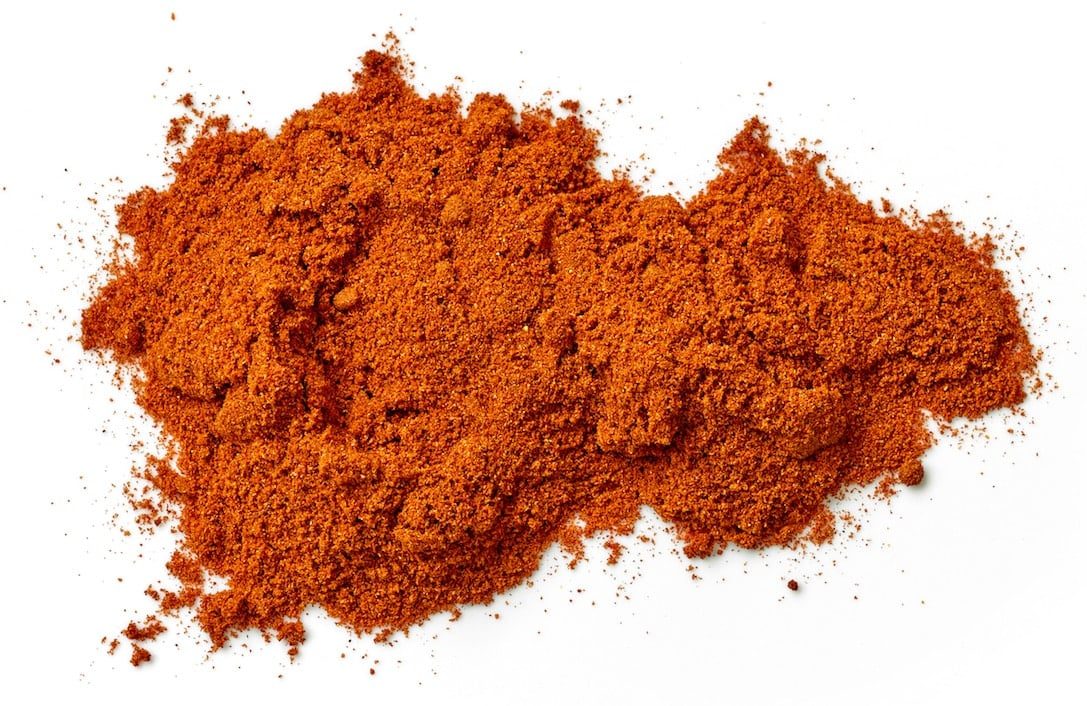
Paprika is ground chile and nothing else. The international Codex standard treats paprika as dried Capsicum fruit, whole, crushed or ground, at 480 Scoville heat units (SHU) or less.1 American chili powder is a blend. The USDA purchasing specification says it should include ground chili pepper, cumin, oregano, salt and garlic powder,2 and Saveur says the chile in it is usually ancho.3 So the real difference is not the shade of red in the jar: one adds pepper flavor and color, the other adds a whole seasoning, salt included.
Side by side
| Paprika | Chili powder (US blend) | |
|---|---|---|
| What it is | Dried, ground Capsicum annuum fruit only14 | Ground chili pepper with cumin, oregano, salt and garlic powder, “not limited to” those2 |
| The chile | Selected for color and sweet pepper flavor; protected origins name their own varieties, such as Bola in Murcia5 | Usually ancho, a dried poblano (Saveur; CPI)36 |
| Color | Red, mainly from capsanthin and capsorubin;7 Hungary’s premium class must reach 120 ASTA color units8 | Reddish-brown, per the USDA specification2 |
| Heat | 480 SHU or less by definition; “hot paprika” above 480 and below 9001 | 900–2,000 SHU in the USDA purchasing specification2 |
| Salt | None; it is chile alone1 | Salt is a listed ingredient2 |
| Styles | Sweet, bittersweet and hot; smoked in La Vera, unsmoked in Murcia95 | Mild, hot and dark styles vary by maker; no fixed recipe2 |
| Vitamin A per teaspoon (computed) | About 57 µg RAE, about 6% of the Daily Value (1 tsp = 2.3 g)1011 | About 40 µg RAE, about 4% (1 tsp = 2.7 g)1211 |
| EU mycotoxin limits | Dried Capsicum, explicitly including paprika: ochratoxin A 20 µg/kg; aflatoxin B1 5.0 µg/kg; total aflatoxins 10.0 µg/kg13 | The same regulation names chilli powder in that category; its wording addresses chile products, not blends13 |
| Flavor (editorial) | Ripe, sweet pepper; smoky if smoked | Earthy and warm from cumin, on a mild, slightly raisiny chile base, with oregano and garlic |
| Price | No dated, sourced retail comparison found | No dated, sourced retail comparison found |
The flavor row is ours. For the full picture of each spice, see paprika and chili powder.
A label tells you which you have. If the ingredient list names only chile, it is ground chile; if it names cumin, oregano and garlic, it is the American blend. Outside North America, “chilli powder” usually means plain ground chile, which the Codex standard covers alongside paprika.1 That second kind is closer to a hot paprika than to the American blend.
How hot is each?
The figures below come from different kinds of documents, so they are shown side by side and not combined.
| Product and scope | Heat | Source |
|---|---|---|
| Paprika, as a category in the international standard | 480 SHU or less | Codex CXS 353-20221 |
| Hot paprika, same standard | Above 480 and below 900 SHU | Codex CXS 353-20221 |
| Hungarian sweet (non-pungent) ground paprika, labeling class | Capsaicinoids below 30 mg/kg (not Scoville units) | Hungarian Food Codex MÉ 2-1088 |
| Regular paprika, general rating; no method stated | Usually no more than 100–500 SHU | PepperScale, Is Paprika Spicy?14 |
| Mild paprika, general rating; no method stated | Typically 500–1,500 SHU | PepperScale, paprika substitutes guide15 |
| Chili powder bought under the US federal purchasing specification | 900–2,000 SHU | USDA AMS, A-A-20001C (2023)2 |
| Ancho, as a pepper type; no lot or method stated | 1,000–2,000 SHU | Chile Pepper Institute, NMSU6 |
| Ancho, on a scale its author calls necessarily approximate | 1,000–1,500 SHU | Dave DeWitt, 200816 |
| Retail chili powder brands | No published measurement found; PepperScale says there is no universal Scoville rating for the blends and that most are relatively mild | PepperScale17 |
How to read this:
- Both Codex paprika rows are boundaries, not measurements. They say where a product stops being called paprika, not how hot a given jar is.1 PepperScale’s two paprika ratings come from two of its articles and do not agree with each other; both reach above the Codex ceiling, which as the international standard is the stronger source, so they are shown, not adopted.1514
- The USDA range is what a federal buyer will accept, not a survey of store shelves.2 It does show the blend is meant to be mild.
- On these figures, chili powder runs hotter than paprika. USDA’s range starts where the Codex hot-paprika band ends, and both ancho figures sit above the paprika ceiling.12616 Chili Pepper Madness says the same thing in plain words: chili powder is usually hotter than paprika.18 A hot paprika and a mild chili powder can still land close together.
The differences that change a dish
Chili powder brings other spices
This is the difference that matters most. Cumin, oregano and garlic are part of the blend,2 so chili powder pushes a dish toward Tex-Mex whether you want it to or not. PepperScale adds that the blends are highly variable, and that how hot one is depends on the chile its maker used.17 Paprika adds only pepper. In a Hungarian goulash or paprikash, where paprika is the defining spice,19 chili powder would make a different dish. That is our judgment.
Chili powder brings salt
USDA lists salt as an ingredient of chili powder,2 and USDA FoodData Central’s chili powder entry carries 2,870 mg of sodium per 100 g, about 77 mg per teaspoon by our arithmetic.12 When a recipe uses chili powder by the tablespoon, taste before salting. Paprika, being chile alone,1 adds none.
Smoke, if you choose it
Smoke comes only from smoked paprika. Pimentón de la Vera is dried over oak fires, and its specification describes a smoky, intense and penetrating flavor and aroma; Pimentón de Murcia is dried in the sun or with hot air.95 USDA’s ingredient list for chili powder includes nothing smoked,2 though makers are free to add to it. See smoked paprika.
Color
Paprika is graded on color: Hungary’s codex sets a 120 ASTA minimum for its premium class,8 and the protected Spanish paprikas set their own.9 USDA asks only that chili powder be reddish-brown and free of lumps.2 As a dusting on deviled eggs or potato salad, paprika gives the brighter red; that part is our judgment.
Where each comes from
Paprika’s protected origins are in Spain and Hungary,895 but McCormick Science Institute also names China, India and the United States as important producers.4 Chili powder is a Texas product of the 1890s. Who invented it is disputed: D Magazine says Fort Worth grocer DeWitt Clinton Pendery was marketing a chili blend by 1890, and UTSA’s archive of the Gebhardt company credits William Gebhardt of New Braunfels, who registered his Eagle Brand chili powder trademark in 1896.2021 See chili powder for the full history.
Can one stand in for the other?
Sometimes, if you account for what the blend adds. The ratios below come from our substitute pages and keep their labels there.
- Paprika in place of chili powder (Attributed). The Spice House says to use paprika one-to-one with a pinch of cayenne, and a little cumin for earthiness.22 Mashed says sweet paprika can go in at equal amounts, and to start with half or less if the paprika is hot.23 Neither says how the figure was arrived at. In chili or taco meat, add cumin and oregano as well, since paprika brings neither. See chili powder substitutes.
- Chili powder in place of paprika (Method). We found no published ratio. Chili Pepper Madness notes that chili powder is a blend and usually hotter than paprika.18 PepperScale calls the flavor difference definite, from the cumin and garlic, but says that where paprika is only a dash or a pinch for color you are unlikely to notice.15 Start with half the paprika amount, reduce the recipe’s salt, and use it only where cumin and oregano fit: chili, tacos, rubs. Not for goulash or a dusting on eggs. See paprika substitutes.
- Make your own blend from paprika. Chili Pepper Madness’s homemade chili powder uses paprika as its chile base, with cayenne, garlic, onion, oregano and cumin.24 Recipes differ widely, and our chili powder substitutes page sets two of them side by side.
What isn’t known
- No published heat measurement exists for retail chili powder brands; the 900–2,000 SHU range is a federal purchasing specification.
- No source we found publishes how much chile, cumin or oregano commercial chili powders contain, or whether a given brand uses paprika.
- No Scoville measurement for paprika as a product was found; only the Codex category boundaries.
- A widely repeated claim says chili powder was invented to help American cooks make chili con carne. PepperScale states that the blend was created to season chili,17 but the sources on its first makers reviewed here date its first sale to 1890s Texas without stating their purpose.
- It is often said that Hungarian paprika tastes more intensely of pepper than Spanish. No source reviewed here measures or states that.
Related
- Paprika vs. cayenne
- Smoked paprika, ancho powder, cayenne pepper, cumin
- Taco seasoning and best spices for chili
Footnotes
-
Standard for Dried or Dehydrated Chilli Pepper and Paprika (CXS 353-2022), Codex Alimentarius. fao.org · Standard ↩ ↩2 ↩3 ↩4 ↩5 ↩6 ↩7 ↩8 ↩9 ↩10
-
Commercial Item Description A-A-20001C, Spices and Spice Blends, USDA Agricultural Marketing Service, 2023. ams.usda.gov · Regulator ↩ ↩2 ↩3 ↩4 ↩5 ↩6 ↩7 ↩8 ↩9 ↩10 ↩11 ↩12 ↩13
-
Chili Powder, Saveur, 2009. saveur.com · Publication ↩ ↩2
-
Paprika, McCormick Science Institute. mccormickscienceinstitute.com · Merchant ↩ ↩2
-
Pimentón de Murcia PDO application and specification, European Commission eAmbrosia. ec.europa.eu · Regulator ↩ ↩2 ↩3 ↩4
-
Ancho recipe card, Chile Pepper Institute, New Mexico State University. cpi.nmsu.edu · Reference work ↩ ↩2 ↩3
-
Paprika extract (CTA), FAO/WHO JECFA, 2008 (rev. 2013). fao.org · Regulator ↩
-
MÉ 2-108, Hungarian Food Codex Committee, 2013. elelmiszerlanc.kormany.hu · Standard ↩ ↩2 ↩3 ↩4
-
Pimentón de la Vera PDO product specification, Consejo Regulador. assets.publishing.service.gov.uk · Regulator ↩ ↩2 ↩3 ↩4
-
Spices, paprika (FDC 171329), USDA FoodData Central. fdc.nal.usda.gov · Regulator ↩
-
Daily Value on the Nutrition and Supplement Facts Labels, FDA. fda.gov · Regulator ↩ ↩2
-
Spices, chili powder (FDC 171319), USDA FoodData Central. fdc.nal.usda.gov · Regulator ↩ ↩2
-
Commission Regulation (EU) 2023/915, EUR-Lex. eur-lex.europa.eu · Regulator ↩ ↩2
-
Matt Bray, Is Paprika Spicy?, PepperScale, 2024. pepperscale.com · Publication · PepperScale is also owned by Matt Bray, the editor of this site. ↩ ↩2
-
Matt Bray, What’s A Good Paprika Substitute?, PepperScale, 2022. pepperscale.com · Publication · PepperScale is also owned by Matt Bray, the editor of this site. ↩ ↩2 ↩3
-
Dave DeWitt, Heat Scale Updated, Fiery Foods & Barbecue Central, 2008. fieryfoodscentral.com · Publication ↩ ↩2
-
Matt Bray, Is Chili Powder Spicy?, PepperScale, 2023. pepperscale.com · Publication · PepperScale is also owned by Matt Bray, the editor of this site. ↩ ↩2 ↩3
-
Mike Hultquist, Paprika Substitute, Chili Pepper Madness, 2019 (updated 2025). chilipeppermadness.com · Publication ↩ ↩2
-
Paprika: why this smoky spice plays a crucial role in Hungarian cuisine, MICHELIN Guide, 2023. guide.michelin.com · Publication ↩
-
Kathy Wise, The Man Who Invented Chili Powder, D Magazine, 2018. dmagazine.com · Publication ↩
-
Mexican Foods Company Collection (Gebhardt), UTSA Libraries Special Collections. lib.utsa.edu · Reference work ↩
-
Chili Powder Substitute, The Spice House, 2018. thespicehouse.com · Merchant ↩
-
Nancy Mock, 10 Best Substitutes For Chili Powder, Mashed, 2021 (updated 2023). mashed.com · Publication ↩
-
Mike Hultquist, Chili Powder Substitutes, Chili Pepper Madness, 2018 (modified 2025). chilipeppermadness.com · Publication ↩