Spices · Profile
Ancho Powder: Ground Dried Poblano, Its Heat, Flavor and Uses
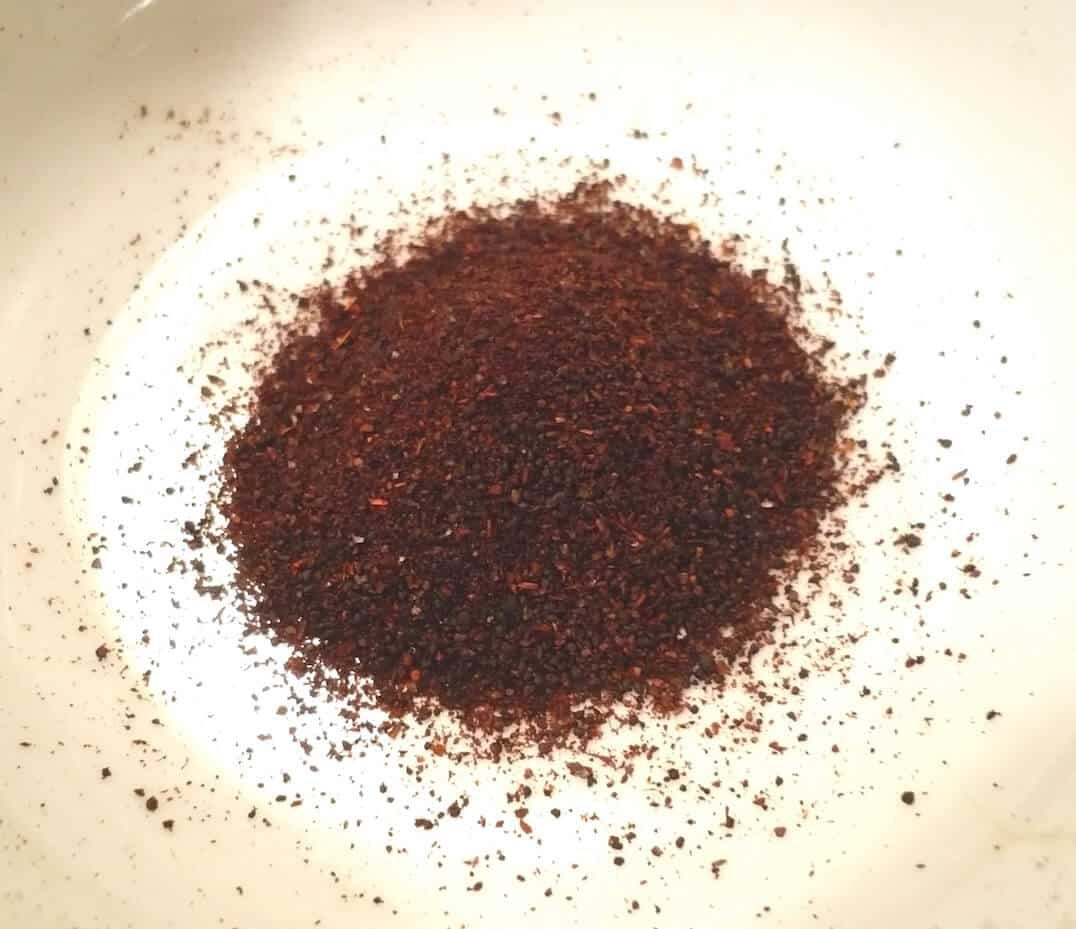
Ancho powder is ground ancho chile, and an ancho is a dried poblano.1 It is a mild chile, and New Mexico State University’s Chile Pepper Institute describes its flavor as sweet and smoky with hints of dried fruit.1 This page covers what ancho is, how hot it is (the figures depend on what was measured), how it is used, and what its nutrition and safety records show.
At a glance
| What it is | Ground dried poblano chile1 |
| Botanical name | Capsicum annuum12 |
| Plant family | Solanaceae (nightshade family)3 |
| Domesticated | Mexico; the evidence points to central-east Mexico4 |
| Heat | Mild; the Chile Pepper Institute gives 1,000–2,000 Scoville heat units for ancho (see table)1 |
| Flavor (Chile Pepper Institute) | Sweet and smoky, with hints of dried fruit1 |
| Key dish | Mole15 |
| Forms sold | Whole dried pods and ground powder1 |
Measured values
11 figures, sourced| Measure | Value | Scope | Source |
|---|---|---|---|
| Pungency (Scoville) Conventional range | 1,000–2,000 SHU | ancho as a pepper type, NMSU Chile Pepper Institute general figure; no lot or method statedGeneral figure for the pepper type, not a measurement of any lot or powder | cpi.nmsu.edu |
| Pungency (Scoville) | 3,524–4,870 SHU | fresh poblano cultivars grown at Waseca, Minnesota, 2021, electrochemical device (not HPLC); 'Ancho Poblano' 3,524 to 'Bastan' 4,870Fresh cultivars, not dried ancho powder | docs.lib.purdue.edu |
| Pungency (Scoville) Conventional range | 1,000–1,500 SHU | ancho as a pepper type, conventional range as published by Dave DeWitt (2008 heat scale, which he calls necessarily approximate) and by PepperScale's chile profile; no method statedAttributed, cites no measurement | fieryfoodscentral.com · pepperscale.com |
| Pungency (Scoville), minimum Limit | 900 SHU or more | anything sold as dried chilli pepper under Codex CXS 353-2022 (ancho is a listed variety) | fao.org |
| Vitamin A (RAE) Nutrient | 1,020 µg per 100 g | whole dried ancho peppers, USDA FoodData Central FDC 169396 | fdc.nal.usda.gov |
| Iron Nutrient | 10.9 mg per 100 g | whole dried ancho peppers, USDA FoodData Central FDC 169396 | fdc.nal.usda.gov |
| Dietary fiber Nutrient | 21.6 g per 100 g | whole dried ancho peppers, USDA FoodData Central FDC 169396 | fdc.nal.usda.gov |
| Vitamin C Nutrient | 2.0 mg per 100 g | whole dried ancho peppers, USDA FoodData Central FDC 169396 | fdc.nal.usda.gov |
| Ochratoxin A, maximum Limit | 20 µg/kg | EU, dried Capsicum fruits, whole or ground | eur-lex.europa.eu |
| Aflatoxin B1, maximum Limit | 5.0 µg/kg | EU, dried Capsicum fruits | eur-lex.europa.eu |
| Total aflatoxins, maximum Limit | 10.0 µg/kg | EU, dried Capsicum fruits | eur-lex.europa.eu |
Each figure is quoted as its source states it, with the samples or standard it applies to. Where sources differ, both are shown; nothing is averaged. All measured values
Ancho, poblano and the name
A poblano is the fresh green chile; dried, it becomes an ancho. The Chile Pepper Institute (CPI) at New Mexico State University puts it simply: anchos are dried poblanos, Capsicum annuum, with dark, wrinkled skin ranging from reddish-brown to almost black.1 The Codex international standard for dried chile lists “Ancho” among the varietal names of chilli pepper it covers.3 For which ripeness stage poblanos are picked at before drying, no source was checked for this page.
Poblano is Spanish for “of Puebla”: the Real Academia Española defines it as belonging or relating to Puebla or its people.6 The name links the chile to the Mexican state of Puebla, but no source checked for this page shows that the poblano type was developed there. The species itself is native from the southern United States to Brazil and the Caribbean,7 and a 2014 study found that four independent lines of evidence point to its domestication in central-east Mexico.4
Ancho powder made from a single chile is a different product from American chili powder, which is a blend; Saveur notes that the chile in most chili powder blends is usually ancho.8
Flavor
CPI describes ancho as having sweet, smoky flavors with hints of dried fruit.1 PepperScale describes an earthy sweetness with subtle notes of raisin and coffee.9 In a sauce the powder reads as raisin and prune, with a slight bitterness and gentle warmth; that description is editorial. The often-repeated claim that ancho is the sweetest of all dried chiles could not be traced to a source.
How hot is ancho?
| Scope | Heat | Source |
|---|---|---|
| Ancho as a pepper type (CPI general figure; no lot or method stated) | 1,000–2,000 SHU | NMSU Chile Pepper Institute1 |
| Fresh poblano cultivars grown at Waseca, Minnesota, 2021, measured with an electrochemical device (not HPLC) | 3,524 SHU (‘Ancho Poblano’) to 4,870 SHU (‘Bastan’) | University of Minnesota trial, 202210 |
| Anything sold as dried chilli pepper under the international standard (ancho is a listed variety) | 900 SHU or more | Codex CXS 353-20223 |
| Ancho, on Dave DeWitt’s heat scale, which he calls necessarily approximate | 1,000–1,500 SHU | DeWitt, 200811 |
| Ancho, PepperScale’s chile profile (no method stated) | 1,000–1,500 SHU | PepperScale9 |
How to read this:
- CPI’s 1,000–2,000 is a general figure for the pepper type, not a measurement of any particular lot or powder.
- The Minnesota figures describe fresh fruit of specific cultivars, grown in one place in one year, measured with a ChilliPot device that the authors describe as an electrochemical method whose correlation with the standard HPLC method “has not been proven.”10 They do not show that CPI’s range is wrong, and they are not figures for dried ancho powder.
- The Codex threshold is a category boundary, the line the standard draws between hot paprika and chilli pepper, not a measurement.3
- The 1,000–1,500 range is attributed, not measured. It matches Dave DeWitt’s approximate heat scale,11 which cites no measurement, and PepperScale gives the same range.9 NMSU notes that HPLC is the most accurate way to measure chile heat and that Scoville taste tests are subjective.12
In our judgment, ancho is mild enough to measure by the teaspoon or tablespoon rather than the pinch, but taste as you go.
How it is used
Mole. CPI calls ancho a key ingredient in Mexican mole sauce.1 El Universal lists ancho alongside mulato, pasilla and chipotle among the chiles in mole poblano.5 By common practice, whole pods are toasted, soaked and blended for mole, and powder is a shortcut. See mole powder.
Sauces, stews and marinades. CPI notes that ancho is commonly used ground for seasoning or rehydrated in sauces, stews and marinades, and that it pairs well with chocolate, tomatoes and meats.1 Common uses for the powder, as kitchen practice rather than sourced findings:
- Red enchilada sauce and chili; see best spices for chili. PepperScale calls ancho a staple in mole and enchilada sauces.9
- Dry rubs for pork, beef and chicken, often with cumin and a little sugar.
- Beans, braises and soups, where it adds color and body.
- Sweet uses with chocolate, as in CPI’s ancho-orange hot fudge recipe.1
Pairings. Ancho works well with cumin, cinnamon, Mexican oregano, garlic, cocoa and cilantro. That list is cooking judgment, apart from chocolate, tomatoes and meats, which CPI names.1 PepperScale adds lime, whose acidity it says cuts through ancho’s smoky sweetness.9
Technique. Like other ground chiles, ancho powder burns easily; warm it briefly in oil over moderate heat before adding liquid. Kitchen practice, not a sourced finding.
Buying and quality
- Color and aroma. Good ancho powder is deep brick-red to mahogany and smells fruity. Gray-brown, dusty powder has faded. Kitchen judgment.
- Check the label. Pure ancho powder lists only ancho chile; a jar that also lists cumin, oregano or salt is a blend.
- Whole pods. CPI describes anchos as dark and wrinkled, reddish-brown to almost black.1 Pods that are still pliable rather than brittle are generally fresher, in our judgment, and can be toasted and ground at home.
Storage
Keep the powder airtight, dark and cool. No shelf-life figure from a regulator or standards body was found for ancho powder; figures that circulate online could not be traced. If the color has dulled and the fruity smell is gone, replace it.
Nutrition and health
USDA FoodData Central has an entry for whole dried ancho peppers, with one pepper weighing 17 g; it has no entry for the powder and gives no tablespoon weight.2 Per pepper, that works out to:
| Nutrient | Per 100 g2 | Per pepper (17 g), computed | % Daily Value per pepper13 |
|---|---|---|---|
| Vitamin A (RAE) | 1,020 µg | about 173 µg | about 19% (DV 900 µg) |
| Iron | 10.9 mg | about 1.9 mg | about 10% (DV 18 mg) |
| Dietary fiber | 21.6 g | about 3.7 g | about 13% (DV 28 g) |
| Vitamin C | 2.0 mg | about 0.3 mg | under 1% (DV 90 mg) |
A whole pepper is a lot of ancho for one serving; a teaspoon of powder in a dish for four supplies far less. Figures that circulate for a tablespoon of ancho powder (such as 69% of daily vitamin A) could not be traced, and USDA gives no tablespoon weight from which to check them.
Capsaicin. The strongest human evidence concerns a prescription skin patch, not chile in food. A 2017 Cochrane systematic review found moderate-quality evidence that a high-concentration (8%) capsaicin patch gave moderate pain relief to a minority of people with postherpetic neuralgia, with very low-quality evidence for other nerve pain.14 Claims that eating ancho relieves arthritis or psoriasis pain through endorphins, suppresses appetite or prevents prostate cancer were not supported by any source reviewed for this page. No claim is made here that ancho treats or prevents any disease.
Safety
- Mycotoxins (EU). EU law caps ochratoxin A at 20 µg/kg in dried Capsicum fruits, whole or ground, and sets 5.0 µg/kg for aflatoxin B1 and 10.0 µg/kg for total aflatoxins.15
- Handling. Even mild chile powders irritate eyes; wash hands after handling. Common-sense guidance, not a sourced finding.
Substitutes and comparisons
- Ancho powder substitutes
- Other Mexican chile powders: pasilla powder (and pasilla substitutes), guajillo powder, chipotle powder
- Related: chili powder, paprika, smoked paprika
Footnotes
-
Ancho recipe card, Chile Pepper Institute, New Mexico State University. cpi.nmsu.edu · Reference work ↩ ↩2 ↩3 ↩4 ↩5 ↩6 ↩7 ↩8 ↩9 ↩10 ↩11 ↩12 ↩13 ↩14 ↩15 ↩16
-
Peppers, ancho, dried (FDC 169396), USDA FoodData Central. fdc.nal.usda.gov · Regulator ↩ ↩2 ↩3
-
Standard for Dried or Dehydrated Chilli Pepper and Paprika, CXS 353-2022, Codex Alimentarius. fao.org · Standard ↩ ↩2 ↩3 ↩4
-
Kraft et al., Multiple lines of evidence for the origin of domesticated chili pepper, PNAS, 2014. escholarship.org · Peer-reviewed ↩ ↩2
-
Nuestro mero mole…¡el mole poblano!, El Universal, 2017. eluniversal.com.mx · Publication ↩ ↩2
-
poblano, Diccionario de la lengua española, Real Academia Española. dle.rae.es · Reference work ↩
-
Capsicum annuum L., Plants of the World Online, Royal Botanic Gardens, Kew. powo.science.kew.org · Reference work ↩
-
Chili Powder, Saveur, 2009. saveur.com · Publication ↩
-
Matt Bray, Ancho Pepper Guide: Heat, Flavor, Pairings, And More, PepperScale. pepperscale.com · Publication · PepperScale is also owned by Matt Bray, the editor of this site. ↩ ↩2 ↩3 ↩4 ↩5
-
Rohwer and Hoidal, Chile Pepper Variety Evaluation, Midwest Vegetable Trial Reports, 2022. docs.lib.purdue.edu · Reference work ↩ ↩2
-
Dave DeWitt, “Heat Scale Updated”, Fiery Foods & Barbecue Central, 2008. fieryfoodscentral.com · Publication ↩ ↩2
-
Bosland and Walker, Measuring Chile Pepper Heat, NMSU Guide H-237, 2010. pubs.nmsu.edu · Reference work ↩
-
Daily Value on the Nutrition and Supplement Facts Labels, FDA. fda.gov · Regulator ↩
-
Derry et al., Topical capsaicin (high concentration) for chronic neuropathic pain in adults, Cochrane Database of Systematic Reviews, 2017. cochrane.org · Peer-reviewed ↩
-
Commission Regulation (EU) 2023/915, EUR-Lex. eur-lex.europa.eu · Regulator ↩