Spices · Profile
Smoked Paprika: How Pimentón de la Vera Is Made, How Hot It Is, and How to Use It
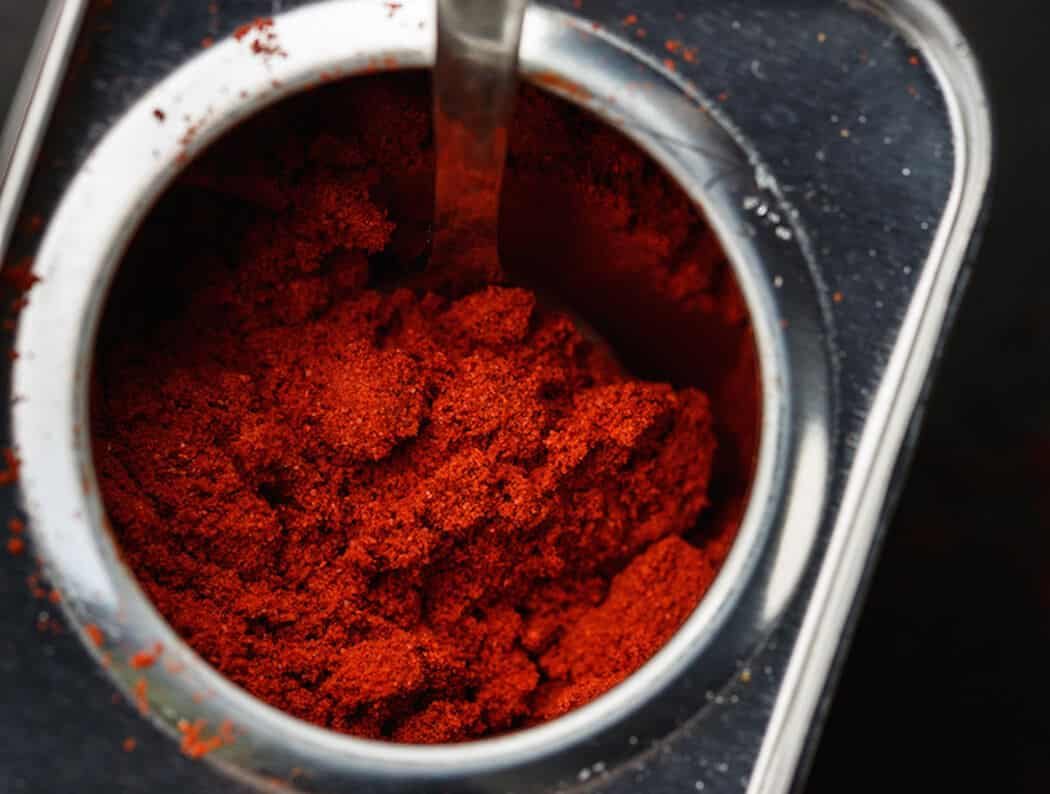
Smoked paprika is ground red pepper that has been dried over a wood fire, so it tastes of smoke as much as of pepper. The model for it is Spain’s Pimentón de la Vera, a protected product whose peppers are dried for 10 to 15 days over holm oak or oak.1 It comes sweet, bittersweet or hot, and it is the spice that gives many Spanish chorizos their color. This page covers how it is made, what separates it from ordinary paprika, how hot it is, how to use it, and one safety question specific to smoked spices.
At a glance
| What it is | Ground dried red pepper, smoke-dried before milling1 |
| Botanical name | Capsicum annuum; domesticated in Mexico2 |
| Best-known origin | Pimentón de la Vera PDO, north of Cáceres province, Extremadura, Spain1 |
| How it is dried | Over holm oak and/or oak fires for 10 to 15 days, from about 80% to under 15% moisture13 |
| Types (La Vera) | Sweet, bittersweet (ocal) and hot1 |
| Pepper varieties (La Vera) | Bola, Jaranda, Jariza, Jeromín1 |
| Minimum color (La Vera) | 90 ASTA units at milling1 |
| Main uses | Spanish cured sausages and meats; stews, rubs, potatoes, eggs |
Measured values
15 figures, sourced| Measure | Value | Scope | Source |
|---|---|---|---|
| Moisture after smoke-drying Limit | under 15 % | Pimentón de la Vera PDO specification, fruit dried 10 to 15 days from 80% moisture | assets.publishing.service.gov.uk |
| Moisture, maximum Limit | 14 % | Pimentón de la Vera PDO specification, finished powder | assets.publishing.service.gov.uk |
| Extractable color (ASTA), minimum Limit | 90 ASTA units, at milling | Pimentón de la Vera PDO specification | assets.publishing.service.gov.uk |
| Pungency, paprika category Limit | 480 SHU or less Scoville heat units | Paprika as a category, Codex CXS 353-2022The La Vera specification gives no Scoville or capsaicin limit for its types. | fao.org |
| Pungency, hot paprika category Limit | above 480 and below 900 Scoville heat units | Hot paprika as a category, Codex CXS 353-2022 | fao.org |
| Vitamin A (RAE) Nutrient | 2,460 µg per 100 g | USDA FoodData Central, paprika (FDC ID 171329, one SR Legacy composite); no separate entry for smoked paprika | fdc.nal.usda.gov |
| Vitamin E (alpha-tocopherol) Nutrient | 29.1 mg per 100 g | USDA FoodData Central, paprika (FDC ID 171329, one SR Legacy composite); no separate entry for smoked paprika | fdc.nal.usda.gov |
| Vitamin B6 Nutrient | 2.14 mg per 100 g | USDA FoodData Central, paprika (FDC ID 171329, one SR Legacy composite); no separate entry for smoked paprika | fdc.nal.usda.gov |
| Iron Nutrient | 21.1 mg per 100 g | USDA FoodData Central, paprika (FDC ID 171329, one SR Legacy composite); no separate entry for smoked paprika | fdc.nal.usda.gov |
| Calcium Nutrient | 229 mg per 100 g | USDA FoodData Central, paprika (FDC ID 171329, one SR Legacy composite); no separate entry for smoked paprika | fdc.nal.usda.gov |
| Benzo[a]pyrene | 40.1 to 70.4 µg/kg | Three samples of Spanish smoked paprika powder assessed by BfR (Opinion 018/2024)Sources differ in scope from the Spanish 144-sample average. EU limits of 10 µg/kg benzo[a]pyrene and 50 µg/kg PAH4 for dried spices do not apply to smoked Capsicum (smoked paprika). | bfr.bund.de |
| PAH4 (sum of four PAHs) | 167.9 to 311.7 µg/kg | Three samples of Spanish smoked paprika powder assessed by BfR (Opinion 018/2024) | bfr.bund.de |
| Benzo[a]pyrene | 0.049 mg/kg, average | Reference values from 144 samples of PDO Pimentón de la Vera (Spanish study, 2021)Sources differ in scope from the BfR three-sample figures. | mdpi-res.com |
| PAH4 (sum of four PAHs) | 0.780 mg/kg, average | Reference values from 144 samples of PDO Pimentón de la Vera (Spanish study, 2021) | mdpi-res.com |
| Ochratoxin A, maximum Limit | 20 µg/kg | EU Regulation 2023/915, dried Capsicum fruits (includes chillies, chilli powder, cayenne and paprika) | eur-lex.europa.eu |
Each figure is quoted as its source states it, with the samples or standard it applies to. Where sources differ, both are shown; nothing is averaged. All measured values
How smoked paprika is made
The defining step is drying over smoke rather than in the sun. In La Vera that is a matter of climate: the area’s damp autumn does not allow sun-drying, so the peppers are dried in sheds over fires.3 The PDO specification describes drying sheds with a holm oak and/or oak furnace on the lower floor, and a drying time of 10 to 15 days in which the fruit goes from 80% moisture to under 15%.1 The finished powder may hold no more than 14% moisture.1
It is often said that smoked paprika is sun-dried first and smoked afterward. The La Vera specification describes smoke-drying from fresh, not a two-step process.1
Not all Spanish pimentón is smoked. Pimentón de Murcia, the other Spanish PDO, is dried in the sun or with hot air.4 The international Codex standard for dried chile and paprika does not mention smoking at all,5 and no standard checked for this page defines “smoked paprika” outside the La Vera PDO. PepperScale points out that any paprika can be smoked, Hungarian types included, though the Spanish smoked kind is the one most often sold outside Spain.67
The three La Vera types
| Type | Heat, per the specification | Varieties used1 |
|---|---|---|
| Sweet (dulce) | Mild flavor, completely sweet | Bola and Jaranda |
| Bittersweet (agridulce, ocal) | Mild heat on the palate | Jaranda and Jariza |
| Hot (picante) | Pronounced heat on the palate | Jeromín, Jariza and Jaranda |
The specification records capsaicin as absent in Jaranda, Jariza and Bola, and present in Jeromín.1
Flavor
The specification describes Pimentón de la Vera as smoky, intense and penetrating in flavor and aroma, and says its flavor, aroma and color stay stable over time, mainly because of the slow drying.1 In the pot it reads as wood smoke and sweet roasted pepper, with the hot type adding a slow, warm heat. That last part is ours. PepperScale notes that some people find it tastes a little like liquid smoke in powder form, and that its smoke is often too much for a recipe written for sweet paprika.6
For the compounds behind paprika color (capsanthin and capsorubin) and heat, see paprika.
How hot is smoked paprika?
The figures that exist are category definitions, not measurements of smoked paprika, so they are shown separately:
| Scope | Heat | Source |
|---|---|---|
| Pimentón de la Vera, sweet and bittersweet types | Described as “completely sweet” and “mild heat”; no Scoville or capsaicin limit given | La Vera PDO specification1 |
| Pimentón de la Vera, hot type | Described as “pronounced heat”; no Scoville or capsaicin limit given | La Vera PDO specification1 |
| Paprika as a category, international standard | 480 SHU or less | Codex CXS 353-20225 |
| Hot paprika as a category, same standard | Above 480 and below 900 SHU | Codex CXS 353-20225 |
| Smoked paprika as sold (descriptive, no figure) | Usually mild; hot versions are labeled hot, and smoked hot paprika is more often found at specialty stores | PepperScale896 |
| Smoked hot paprika compared with cayenne | No measured comparison found |
The Codex bands tell you where the line between paprika and chile is drawn internationally; whether a given hot pimentón falls inside the hot-paprika band is not stated in the La Vera specification. The common claim that even hot smoked paprika is much milder than cayenne could not be traced to a measurement; PepperScale states that picante paprika lacks searing heat, but gives no figure.10 When a label says only “smoked paprika”, assume nothing about heat and taste first.
Origin and history
Peppers reach Spain. Capsicum annuum was domesticated in central-east Mexico,2 and peppers reached Europe through Spain after the voyages to the Americas.11
La Vera. The specification puts the first records of pepper growing in the province of Cáceres at the end of the 15th century, started by the Hieronymite friars of the Monastery of Guadalupe and later reaching the Monastery of Yuste.1 By the mid-18th century La Vera was producing 1,000 arrobas of paprika a year, but its real industrial development began at the start of the 20th century.1 A widely repeated version of this story says the friars grew peppers at Charles V’s behest and that industrial production began in the late 17th century; the specification mentions neither.
Murcia. The Pimentón de Murcia file credits Hieronymite friars with introducing the pepper there too, dating the first records to the early 16th century, and places the start of industrial production in the mid-19th century.4 It is sometimes said that Murcia began growing peppers in the 18th century; the PDO file dates it two centuries earlier.
How it is used
Chorizo and cured meats. The La Vera specification says the stable red of smoke-dried pimentón made it the best preservative for sausages and cured meats, and cites its use with pork, kid, lamb and game.1 Two protected Spanish chorizos show how it is written into the rules:
| Chorizo de Cantimpalos PGI12 | Chorizo Riojano PGI13 | |
|---|---|---|
| Pimentón | A basic ingredient, with salt | Seasoned with “100% premium quality pimentón” |
| Amount | 18 to 25 g per kg of meat | Not stated |
| Smoked? | At least 50% must be Pimentón de La Vera PDO | Not stated |
| Other seasonings | Salt; optional garlic and oregano | Salt and garlic |
So pimentón is central to Spanish chorizo, but not every protected chorizo specifies smoked pimentón. It is often said that chorizo’s red color and smoky flavor come almost entirely from smoked paprika. The specifications make pimentón a basic ingredient, but only Cantimpalos requires smoked La Vera pimentón, and neither says how much of the color or flavor it supplies.
In the kitchen. As common practice rather than sourced findings, cooks use smoked paprika in:
- Potato dishes such as patatas bravas, roast potatoes and potato salad.
- Bean and chickpea stews, lentils and soups.
- Barbecue rubs, marinades and sauces, where it gives a smoky note without a smoker; see BBQ spices. PepperScale also recommends it as a dry rub for barbecue and hearty meats.6
- Deviled eggs, hummus and roasted vegetables, as a finishing dust.
Paella is often said to call for smoked paprika. PepperScale says paella and patatas bravas often rely on smoked Spanish paprika for their flavor,7 but no Spanish recipe standard or regional source checked for this page shows it as standard.
Technique. Like other paprikas it scorches quickly. Warm it briefly in oil off high heat, or add it with liquid; burned paprika turns bitter. That is kitchen practice. Start with about 1 teaspoon in a dish for four and adjust; that is a cooking judgment, not a measured figure.
Buying and quality
- Look for the PDO. The Pimentón de la Vera specification sets the smoke-drying method, the growing area and the permitted varieties.1 The protected area spans the districts of La Vera, Campo Arañuelo, Valle del Ambroz and others in northern Cáceres.1
- Read the type. Sweet (dulce), bittersweet (agridulce) or hot (picante). The label tells you; the color does not.
- Color. The La Vera minimum is 90 ASTA units at milling.1 A brick-red powder is a reasonable sign of freshness; a brown, dull one has faded. That part is kitchen judgment.
- Adulteration. A 2020 review of paprika fraud lists bulking with white pepper, curcuma, brick powder and barium sulfate among known problems for paprika in general.14 See paprika for more.
Storage
Keep it airtight, dark and cool. The La Vera specification says its flavor, aroma and color are highly stable over time,1 but gives no shelf life, and no shelf-life figure from a regulator or standards body was found. Replace it when the smoke smell fades.
Nutrition and health
USDA FoodData Central has no separate entry for smoked paprika; its paprika entry (one SR Legacy composite) is the closest, and 1 teaspoon weighs 2.3 g.15
| Nutrient | Per 100 g, paprika15 | Per 1 tsp (2.3 g), computed | % Daily Value per tsp16 |
|---|---|---|---|
| Vitamin A (RAE) | 2,460 µg | about 57 µg | about 6% (DV 900 µg) |
| Vitamin E (alpha-tocopherol) | 29.1 mg | about 0.67 mg | about 4.5% (DV 15 mg) |
| Vitamin B6 | 2.14 mg | about 0.05 mg | about 3% (DV 1.7 mg) |
| Iron | 21.1 mg | about 0.49 mg | about 3% (DV 18 mg) |
| Calcium | 229 mg | about 5 mg | under 1% (DV 1,300 mg) |
Paprika is rich in these nutrients by weight, but a teaspoon supplies only a few percent of the daily value. Claims that it strengthens bones, prevents anemia, protects DNA or lowers cancer risk were not supported by any source reviewed for this page, and no claim is made here that smoked paprika treats or prevents any disease.
Safety
Smoke compounds (PAHs). Smoked paprika has been assessed for polycyclic aromatic hydrocarbons (PAHs), contaminants for which EU law sets limits in spices.17
- EU limits. For dried spices, EU law caps benzo[a]pyrene at 10 µg/kg and the sum of four PAHs (PAH4) at 50 µg/kg, but those limits do not apply to smoked Capsicum, that is, smoked paprika, or to cardamom.17
- German risk assessment (2024). Germany’s Federal Institute for Risk Assessment (BfR) assessed three samples of Spanish smoked paprika powder that contained 40.1 to 70.4 µg/kg benzo[a]pyrene and 167.9 to 311.7 µg/kg PAH4. It concluded that these concentrations are of little concern for public health, noted gaps in the data on long-term consumption, and said exposure should still be kept as low as reasonably achievable.17
- Spanish study (2021). Spanish researchers used reference values from 144 samples of PDO Pimentón de la Vera, averaging 0.049 mg/kg benzo[a]pyrene and 0.780 mg/kg PAH4, and estimated average Spanish consumption at 139 g of smoked paprika per person per year. They concluded that PAH intake from smoked paprika is a negligible fraction of total intake.18
Both sets of figures are above the general spice limits, which do not apply to smoked paprika; both assessments still conclude that the risk from normal use is low.
Mycotoxins (EU). EU law caps ochratoxin A at 20 µg/kg in dried Capsicum fruits, a category it says includes chillies, chilli powder, cayenne and paprika.19
Substitutes and comparisons
- Smoked paprika substitutes and paprika substitutes
- Paprika, for Hungarian grades and unsmoked Spanish pimentón
- Other smoky options: chipotle powder, which PepperScale recommends for a similar smoky flavor with much more heat,6 and smoked sea salt
- Paprika vs. cayenne and paprika vs. chili powder
Footnotes
-
Pimentón de la Vera PDO product specification, Consejo Regulador. assets.publishing.service.gov.uk · Regulator ↩ ↩2 ↩3 ↩4 ↩5 ↩6 ↩7 ↩8 ↩9 ↩10 ↩11 ↩12 ↩13 ↩14 ↩15 ↩16 ↩17 ↩18 ↩19 ↩20 ↩21 ↩22
-
Kraft et al., Multiple lines of evidence for the origin of domesticated chili pepper, PNAS, 2014. escholarship.org · Peer-reviewed ↩ ↩2
-
Pimentón de la Vera PDO, Foods & Wines from Spain (ICEX). foodswinesfromspain.com · Regulator ↩ ↩2
-
Pimentón de Murcia PDO application and specification, European Commission eAmbrosia. ec.europa.eu · Regulator ↩ ↩2
-
Standard for Dried or Dehydrated Chilli Pepper and Paprika, CXS 353-2022, Codex Alimentarius. fao.org · Standard ↩ ↩2 ↩3
-
Matt Bray, Smoked Paprika Vs. Paprika: PepperScale Showdown, PepperScale, 2015. pepperscale.com · Publication · PepperScale is also owned by Matt Bray, the editor of this site. ↩ ↩2 ↩3 ↩4 ↩5
-
Matt Bray, Hungarian Paprika Vs. Spanish Paprika: How Do They Compare?, PepperScale, 2022. pepperscale.com · Publication · PepperScale is also owned by Matt Bray, the editor of this site. ↩ ↩2
-
Matt Bray, Smoked Paprika Substitutes: What To Use When You’re Out, PepperScale, 2025. pepperscale.com · Publication · PepperScale is also owned by Matt Bray, the editor of this site. ↩
-
Matt Bray, Is Paprika Spicy?, PepperScale, 2024. pepperscale.com · Publication · PepperScale is also owned by Matt Bray, the editor of this site. ↩
-
Matt Bray, Spanish Paprika 101: Much More Than Smoked, PepperScale, 2018. pepperscale.com · Publication · PepperScale is also owned by Matt Bray, the editor of this site. ↩
-
Pék et al., Capsicum conservation and production in Hungary, Spanish Ministry of Agriculture library. mapa.gob.es · Reference work ↩
-
Chorizo de Cantimpalos PGI product specification, Spanish Ministry of Agriculture, 2023. mapa.gob.es · Regulator ↩
-
Chorizo Riojano PGI, Foods & Wines from Spain (ICEX). foodswinesfromspain.com · Regulator ↩
-
Galvin-King, Haughey, Elliott, Detection of substitution adulteration of paprika, Foods, 2020. pmc.ncbi.nlm.nih.gov · Peer-reviewed ↩
-
Spices, paprika (FDC 171329), USDA FoodData Central. fdc.nal.usda.gov · Regulator ↩ ↩2
-
Daily Value on the Nutrition and Supplement Facts Labels, FDA. fda.gov · Regulator ↩
-
Polycyclic aromatic hydrocarbons in smoked paprika powder, BfR Opinion 018/2024. bfr.bund.de · Regulator ↩ ↩2 ↩3
-
Coleto et al., An Approach to the Consumption of Smoked Paprika in Spain and its Impact on the Intake of Polycyclic Aromatic Hydrocarbons, Foods, 2021. mdpi-res.com · Peer-reviewed ↩
-
Commission Regulation (EU) 2023/915, EUR-Lex. eur-lex.europa.eu · Regulator ↩