Spice Comparisons · Comparison
Cracked vs. Ground Black Pepper: Freshness, Texture and When to Use Each
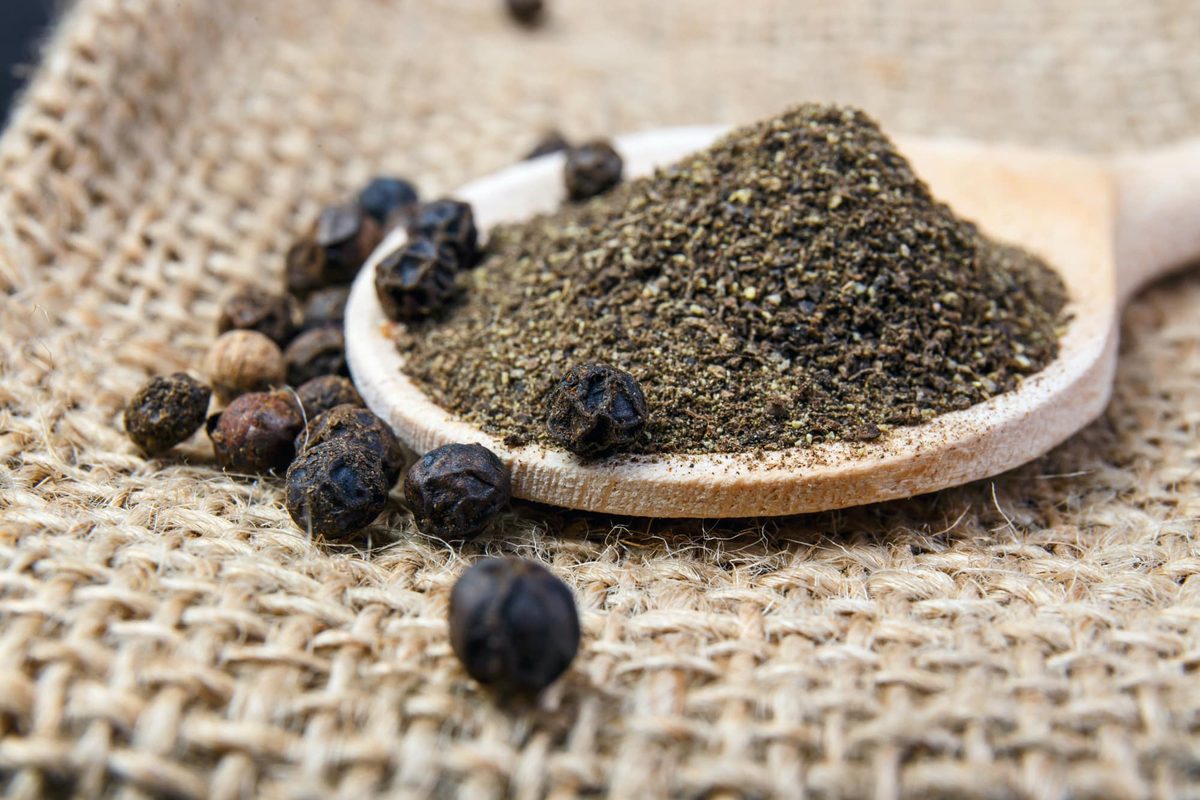
Cracked and ground black pepper are the same thing broken to different sizes. Both start as the dried berry of Piper nigrum,12 and both carry the same two kinds of flavor: heat from piperine and aroma from a volatile essential oil.23 What changes with the grind is texture, how quickly the aroma fades in the jar, and how the pepper spreads through a dish. In our judgment the biggest practical difference is usually freshness, not particle size: pre-ground pepper that has sat on a shelf is not the same product as pepper cracked or ground a minute ago.4
Side by side
| Cracked black pepper | Ground black pepper | |
|---|---|---|
| What it is | Peppercorns broken into coarse, uneven pieces | Peppercorns milled to a fine, even powder |
| Source | The dried berry of Piper nigrum, pericarp intact1 | Same1 |
| Heat | Piperine, 4.9 to 7.7% of black pepper (PROSEA)3 | Same peppercorns, same piperine3 |
| Aroma | Essential oil, about 90% monoterpene and sesquiterpene hydrocarbons (PROSEA)3 | Same oil; Britannica gives up to 3% essential oil in ground pepper2 |
| Texture (editorial) | Crunchy bits and some fine dust | Fine and even, disappears into sauces |
| Keeping quality | No published shelf-life figure for cracked pepper | Katzer: few spices deteriorate as quickly as ground pepper4 |
| Typical uses (common practice) | Steak crusts, rubs, finishing | Sauces, dressings, baking, spice blends |
| Volume | No published conversion | 1 teaspoon whole peppercorns makes about 1 1/2 teaspoons ground (McCormick)5 |
The heat and aroma rows describe black pepper in general. No source we found measures cracked and pre-ground pepper from the same lot side by side.
The differences that change a dish
Aroma fades fastest once pepper is ground
Gernot Katzer’s Spice Pages say few other spices deteriorate as quickly as ground pepper, and that black pepper can lose its aroma fully; he recommends a pepper mill to keep fresh, aromatic pepper on hand.4 America’s Test Kitchen gives the same advice in kitchen terms: grind your own peppercorns just before you need them.6
The general shelf-life guidance points the same way. Every named source gives whole spices a longer window than ground:
| Source | Whole spices (peppercorns named by McCormick) | Ground spices |
|---|---|---|
| University of California Cooperative Extension | 2 years7 | 1 year7 |
| America’s Test Kitchen | 2 years8 | 1 year8 |
| McCormick | 3 to 4 years9 | 2 to 4 years9 |
These are category figures, not measurements on pepper, and none of them covers cracked pepper, which sits between whole and ground. A widely repeated explanation says the larger pieces of cracked pepper expose less surface and so hold their aroma longer. That is plausible, but we found no study that measures it for pepper.
Grinding itself costs some oil
How the pepper is ground matters too. In a 2020 study, black pepper ground cryogenically (cold, with liquid nitrogen) retained significantly more oil, oleoresin and piperine than pepper ground at room temperature.10 Home pepper mills are not industrial grinders, so this shows a direction, not a kitchen figure.
Is cracked pepper stronger?
It is often said that cracked pepper tastes stronger than ground. We found no taste test or measurement that shows it. The one relevant measurement points the other way in a lab setting: in a 2022 extraction study, finer particles gave up more oleoresin, and more piperine, to the solvent.11 That was ethanol extraction in a lab, not cooking, so it does not settle how either grind tastes on food. What can be said is that freshly cracked pepper is far more aromatic than old pre-ground pepper,4 and that a coarse piece delivers its heat in a concentrated bite, which is a texture effect (our judgment).
In the pan
Katzer says pepper can be cooked for quite a long time without losing its flavor.4 A 1992 study measured something narrower: when pepper was boiled as part of a curry, 50 to 60% of the piperine was lost.12 The two are not in direct conflict, since one describes taste and the other a single compound under one set of conditions, but together they suggest adding a final grind of pepper at the end when you want it to read clearly. That last step is our cooking judgment.
Can one stand in for the other?
Yes, with texture in mind. No source gives a ratio between cracked and ground pepper, so these are Method starting points:
- Ground in place of cracked. Use the same amount by volume, or a little less, and taste. You lose the crunch, which is the point of cracked pepper on a steak or in a crust.
- Cracked in place of ground. Start with the same amount. In a smooth sauce or a delicate dressing the pieces will show; a few seconds in a spice grinder brings cracked pepper down to a finer grind.
- From whole peppercorns. McCormick gives 1 teaspoon of peppercorns as making about 1 1/2 teaspoons ground (Computed, by volume, not potency).5 That is the conversion to use when a recipe calls for ground pepper and you are grinding your own.
For other spices in place of pepper, see black pepper substitutes.
When to use each
These are common practice rather than sourced rules:
- Cracked: steak au poivre and other pepper crusts, beef and pork rubs, salads and finishing, anywhere you want visible pepper and bursts of heat.
- Ground: cream and cheese sauces, gravies, dressings, baking and spice blends, anywhere pepper should disappear into the dish.
What isn’t known
- No study compares the aroma loss of cracked and pre-ground pepper over time; the shelf-life figures above are for whole and ground spices in general.
- No measurement shows cracked pepper to be hotter or stronger than ground; the claim is untraceable.
- No published ratio converts cracked to ground pepper.
Related
- Black pepper, the full profile
- Black pepper substitutes
- White pepper vs. black pepper, Tellicherry pepper vs. black pepper, long pepper vs. black pepper, peppercorn medley vs. black pepper
- Lemon pepper, green peppercorns
- How long can spices last? and cumin seeds vs. ground cumin
Footnotes
-
Standard for Black, White and Green Peppers (CXS 326-2017), Codex Alimentarius Commission. fao.org · Standard ↩ ↩2 ↩3
-
“Black pepper”, Encyclopaedia Britannica. britannica.com · Reference work ↩ ↩2 ↩3
-
Piper nigrum, Plant Resources of South-East Asia (PROSEA). uses.plantnet-project.org · Reference work ↩ ↩2 ↩3 ↩4
-
Gernot Katzer, “Pepper (Piper nigrum L.)”, Gernot Katzer’s Spice Pages. gernot-katzers-spice-pages.com · Reference work ↩ ↩2 ↩3 ↩4 ↩5
-
“How to Grind Your Own Spices”, McCormick, 2025. mccormick.com · Merchant ↩ ↩2
-
“Savory Spices”, America’s Test Kitchen. americastestkitchen.com · Publication ↩
-
Anna Martin, “Add a Little Spice to Your Life! Part II”, University of California Cooperative Extension, 2002. ucanr.edu · Reference work ↩ ↩2
-
“Keeping Spices and Dried Herbs Fresher Longer”, America’s Test Kitchen. americastestkitchen.com · Publication ↩ ↩2
-
“How Long Do Spices Last?”, McCormick, 2025. mccormick.com · Merchant ↩ ↩2
-
Balasubramanian et al., “Physicochemical properties of ambient and cryoground black pepper”, International Journal of Seed Spices, 2020. epubs.icar.org.in · Peer-reviewed ↩
-
Induruwa and Jittanit, “Effect of Particle Size and Solid-to-Solvent Ratio on … Black Pepper Oleoresin Extracts”, Applied Engineering in Agriculture, 2022. agris.fao.org · Peer-reviewed ↩
-
Srinivasan, Sambaiah and Chandrasekhara, “Loss of active principles of common spices during domestic cooking”, Food Chemistry, 1992. agris.fao.org · Peer-reviewed ↩