Spice Substitutes · Substitutes
Cayenne Pepper Substitutes, Ranked by the Job Cayenne Is Doing
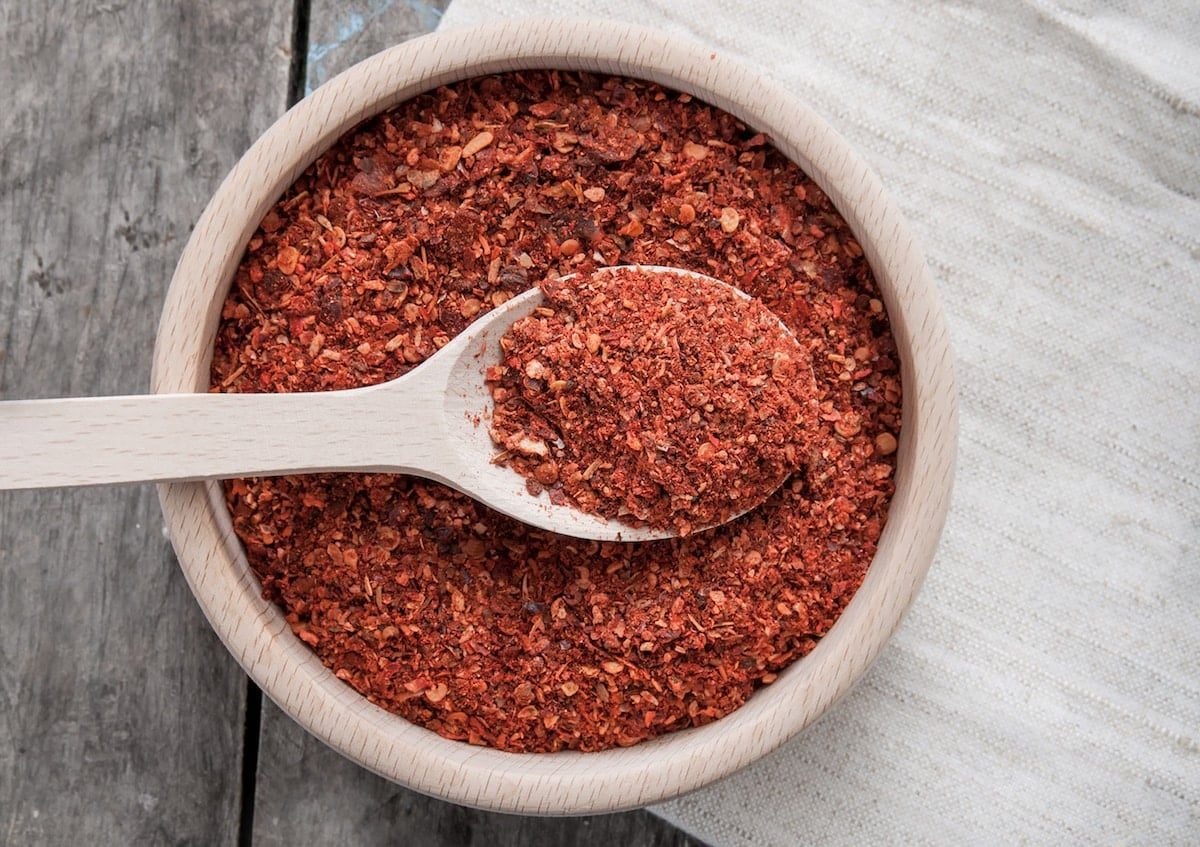
Ground cayenne is a hot red chile, Capsicum annuum, and in the trade it is often sold simply as “red pepper”.1 It brings fast, clean heat with little smoke or sweetness. The heat comes from capsaicinoids, mainly capsaicin and dihydrocapsaicin, which every hot chile contains in some amount.2 So any hot chile can stand in for cayenne’s heat. The questions are how much heat it carries and what else comes with it: smoke, sweetness, salt, vinegar or a different texture.
Quick answer
| What cayenne is doing | Best substitute | Starting amount, per 1 part cayenne | Treatment |
|---|---|---|---|
| Clean heat in a cooked dish | Red pepper flakes, ground fine | 1 to 2 parts | Disputed |
| Heat at a similar level, as a powder | Chile de árbol powder | 1 part | Attributed |
| Red color with some heat (rubs, deviled eggs) | Hot paprika | 1 to 2 parts | Disputed |
| Heat in a spice blend or chili | Chili powder | 1 part, for much milder heat | Attributed |
| Heat in a soup, sauce or marinade | Hot sauce | A few drops to 1 part | Disputed |
The rest of the page explains each choice and the other options.
How the ratios on this page are labeled
Every ratio carries one of four labels.
- Computed: based on a measurable physical relationship, with the source named.
- Attributed: a named source publishes this ratio. We quote it as theirs.
- Disputed: named sources give different answers to the same swap. We show each one and do not average them.
- Method: we found no published ratio. We give a direction and a cautious starting point, and say so.
The ratios we found come from three bylined food publications, Chili Pepper Madness, Mashed and PepperScale, and Mashed credits several of its figures to a gardening blog. None of them says how its numbers were arrived at. Because no one publishes how hot a given jar of cayenne is (see below), no ratio can promise to match its heat. Add the substitute in stages and taste.
How hot is cayenne?
The published figures do not agree, and they are not measuring the same thing.
| Scope | Heat | Source |
|---|---|---|
| Cayenne powder, one merchant’s own product; no method stated | 35,000–70,000 SHU | The Spice House3 |
| Cayenne in general; no method stated | 30,000–50,000 SHU | Mike Hultquist, Chili Pepper Madness;4 PepperScale5 |
| “Cayenne Long”, on a heat scale its author calls “necessarily approximate” | 30,000–50,000 SHU | Dave DeWitt, 20086 |
| “Cayenne Large Red Thick”, same approximate scale | 2,500–5,000 SHU | Dave DeWitt, 20086 |
| Cultivar ‘Large Red Thick’, replicated trials in New Mexico, measured by HPLC | 12,900 SHU | HortScience, 20107 |
| Cultivar ‘Mesilla’, same trials | 13,200 SHU | HortScience, 20107 |
| Cultivar ‘NuMex Nematador’ | 15,000 SHU (rated) | NMSU, 20188 |
| “Cayenne peppers”; no sample, method or date stated | About 8,000 SHU | McCormick Science Institute1 |
How to read this:
- The 30,000–50,000 range has named sources but no published measurement behind it. DeWitt’s scale, Chili Pepper Madness and PepperScale all carry it; none says what was measured or how.5 That makes it attributable, not proven, and not wrong.
- The cultivar figures describe those cultivars, grown in those trials. They show how much one type of chile can vary. They do not show that the 30,000–50,000 range is wrong, and they are not figures for retail cayenne powder.
- The same cultivar name gets two different numbers. DeWitt’s approximate scale puts ‘Large Red Thick’ at 2,500–5,000; the New Mexico trial measured 12,900 by HPLC.67 They come from different methods and are not reconciled here.
- What sits in a jar depends on its maker. NMSU notes that Scoville taste tests are subjective and that HPLC is the most accurate method.2 Retail jars rarely state either.
How hot are the substitutes?
These figures come from different kinds of sources; they are listed for orientation, not ranked against the cayenne figures above.
| Substitute | Heat | Scope | Source |
|---|---|---|---|
| Crushed red pepper | 15,000–30,000 SHU | Approximate scale; PepperScale gives the same range for commercial flakes | Dave DeWitt, 2008;6 PepperScale5 |
| Crushed red pepper vs. cayenne powder | Cayenne powder is “typically hotter” | General statement | McCormick Science Institute1 |
| Chile de árbol | 15,000–30,000 SHU | Approximate scale | Dave DeWitt, 20086 |
| Jalapeño pods | 2,500–10,000 SHU | General figure for the pod type | Dave DeWitt, 20089 |
| Chipotle | Usually 5,000–10,000 SHU | Chipotle in general | Mick Vann, 201210 |
| Chipotle powder (morita) | 13,000–28,000 SHU | One merchant’s own product | The Spice House11 |
| Tabasco brand sauce | 5,000–15,000 SHU | Approximate scale | Dave DeWitt, 20086 |
| Original Tabasco sauce | 2,500–5,000 SHU | No method stated | PepperScale5 |
| Louisiana hot sauce | 2,500–5,000 SHU | Approximate scale | Dave DeWitt, 20086 |
| Chili powder | 900–2,000 SHU | What USDA’s federal buyers accept, not a shelf survey | USDA AMS, 202312 |
| Hot paprika (category) | Above 480 and below 900 SHU | A category boundary, not a measurement | Codex CXS 353-202213 |
| Korean red peppers, 20 samples, HPLC | 7.0–75.9 mg capsaicinoids per 100 g | Lab content, not Scoville units | Chai et al., 199414 |
| Korean red pepper powders by variety | Highest: ‘Chungyang’, 126.1 mg per 100 g | Lab content, not Scoville units | Choi et al., 200015 |
If cayenne is clean heat in a cooked dish
This is cayenne’s main job: heat without much other flavor, in stews, sauces, soups and braises.
1. Red pepper flakes, ground
McCormick Science Institute says crushed red pepper flakes typically use the cayenne variety, alone or blended with other cultivars,1 so flakes are often the same chile in a coarser form, seeds included. It also says cayenne powder is typically hotter than the flakes.1 Grinding the flakes in a spice grinder or mortar spreads the heat more evenly through a dish; that is kitchen practice.
Ratio (Disputed):
| Source | Red pepper flakes in place of cayenne |
|---|---|
| Chili Pepper Madness4 | Same amount to 1½ times as much, starting low |
| Mashed16 | Same range, starting low |
| PepperScale5 | Closer to double, since the flakes run milder than pure cayenne |
Our starting point (Method): begin at the same amount, the low end Chili Pepper Madness and Mashed give, taste, and work up toward PepperScale’s double. PepperScale adds that flakes spread heat unevenly, so judge by the mouthful rather than by the pot.5
2. Chile de árbol powder
Gernot Katzer groups chile de árbol among the less aromatic, more pungent Mexican chiles.17 DeWitt’s scale puts it in the same band as crushed red pepper.6 It is the closest single-chile powder to cayenne’s clean heat, in our judgment.
Ratio (Attributed): Mashed suggests a one-to-one swap of powdered chile de árbol for cayenne.16
3. Gochugaru
Korean red pepper powder is fruitier and usually coarser than cayenne; that description is ours. Its heat varies widely by variety and lot, from 7.0 to 126.1 mg of capsaicinoids per 100 g across two Korean studies (table above).1415 So a bag can be much milder or about as hot as cayenne; taste a pinch first.
Ratio (Attributed): Chili Pepper Madness says to use equal measures of gochugaru for cayenne.4 Mashed says to start one-to-one and taste as you go.16
If cayenne is color as well as heat
In rubs, deviled eggs and finishing dusts, cayenne adds red color along with heat.
Hot paprika
Paprika’s red comes from carotenoids, chiefly capsanthin and capsorubin.18 By the international standard’s definitions, paprika has no more than 480 Scoville units and hot paprika sits between 480 and 900,13 so even hot paprika is mild next to any cayenne figure above. Spanish pimentón comes in sweet, bittersweet and hot types; the hot type has “pronounced heat on the palate”, and Pimentón de la Vera is smoke-dried,19 while Pimentón de Murcia is dried in the sun or with hot air.20 A smoked pimentón will add smoke as well as color.
Ratio (Disputed): Chili Pepper Madness says to use double the amount of paprika.4 Mashed gives the same doubling.16 PepperScale says to start at roughly one for one and adjust, because paprika heat is inconsistent between brands.5 Our starting point (Method): begin one for one, taste, and go up toward double if you want more color. Doubling gives you color; in our judgment it will not give you cayenne’s heat. If heat matters, add a pinch of red pepper flakes too.
If cayenne is heat inside a spice blend
Chili powder
American chili powder is a blend of ground chili pepper, cumin, oregano, salt and garlic powder,12 so it brings those flavors as well as some heat. USDA’s purchasing specification accepts 900–2,000 SHU for it.12 That is a buyer’s specification, not a survey of store shelves, but every published cayenne figure above is higher.
Ratio (Attributed): Chili Pepper Madness says to use equal measures of chili powder for cayenne.4 Mashed’s cayenne article also says an equal amount works if you want.16 Expect much less heat at that ratio; PepperScale says you will need noticeably more chili powder to reach the same heat, and that it brings a Tex-Mex flavor along with it.5 Mashed’s separate chili powder article, by a different writer, goes the other way and uses only ⅛ teaspoon of cayenne for each teaspoon of chili powder,21 which shows how far apart the two spices’ heat is thought to be. Cut back on the recipe’s own cumin, oregano and salt.
If cayenne is heat in a liquid dish
Hot sauce
McCormick Science Institute describes a mash of red peppers as the key ingredient in Louisiana-style hot sauces, and New Mexico’s cayenne growers supply that market.17 Bottled sauces also carry vinegar and salt; check the label. DeWitt’s scale puts Tabasco brand sauce at 5,000–15,000 SHU and Louisiana hot sauce at 2,500–5,000.6
Ratio (Disputed):
| Source | Hot sauce in place of cayenne |
|---|---|
| Chili Pepper Madness4 | Half to equal measures |
| Mashed (crediting the blog Grow Hot Peppers)16 | 8 drops for each ½ teaspoon of cayenne |
| PepperScale5 | A few drops of original Tabasco, when the recipe can take something liquid |
Eight drops is far less than half a teaspoon, so the two sources are a long way apart. Our starting point (Method): begin with a few drops, as Mashed and PepperScale suggest, taste after a minute of simmering, and move toward Chili Pepper Madness’s amount only if the dish can take the extra vinegar and liquid.
Other options
| Substitute | Starting amount, per 1 part cayenne | Treatment | Notes |
|---|---|---|---|
| Chipotle powder | 1 part, then taste | Method | A smoke-dried jalapeño;17 adds strong smoke. Its two published heat figures differ several-fold (table above).1011 PepperScale advises skipping it: reach for chipotle when you want smoke, not heat.5 |
| Jalapeño powder | 1 part, then taste | Method | Unsmoked; brighter and more vegetal, in our judgment. DeWitt’s pod figure is 2,500–10,000 SHU.9 |
| Guajillo powder | 1 part | Attributed | Mashed suggests one-to-one;16 guajillo is also called mirasol in Mexico,22 and DeWitt’s scale lists mirasol at 2,500–5,000 SHU,6 so expect much less heat. |
No published ratio was found for chipotle or jalapeño powder in place of cayenne; the Method amounts are starting points, not measured equivalents.
If the recipe calls for fresh cayenne
Fresh cayenne pods are harder to find than the powder. PepperScale publishes swaps for the fresh chile, with its own heat figures, none with a stated method:5
| Fresh substitute | PepperScale’s heat figure | Amount, per fresh cayenne | Treatment |
|---|---|---|---|
| Tabasco pepper | 30,000–50,000 SHU | 1:1 | Attributed |
| Thai chile | 50,000–100,000 SHU | About half as much, then build | Attributed |
| Serrano | 10,000–23,000 SHU | Roughly double | Attributed |
| Jalapeño | 2,500–8,000 SHU | More than double, and you may not reach the same heat | Attributed |
PepperScale notes that a tabasco pepper is juicier, with a sweet, fruity edge that cayenne lacks, and that serrano and jalapeño taste brighter and grassier.5
What isn’t known
- No published measurement compares the heat of a retail cayenne powder with any substitute. Every ratio above is a rule of thumb.
- The common 30,000–50,000 SHU range for cayenne can be attributed to named writers but not to a published measurement. Lab measurements exist only for specific cultivars.
- It is sometimes said that gochugaru is about 10,000 SHU. No source we found measures it in Scoville units; the Korean studies report capsaicinoid content, which varies widely.
Related
- Cayenne pepper and cayenne pepper uses
- Red pepper flakes and red pepper flakes substitutes, chile de árbol powder, gochugaru
- Paprika, smoked paprika, paprika vs. cayenne
- Chili powder, chipotle powder, jalapeño powder, guajillo powder
- Black pepper vs. cayenne
Footnotes
-
Red Pepper, McCormick Science Institute. mccormickscienceinstitute.com · Merchant ↩ ↩2 ↩3 ↩4 ↩5 ↩6
-
Bosland and Walker, Measuring Chile Pepper Heat, NMSU Guide H-237, 2010. pubs.nmsu.edu · Reference work ↩ ↩2
-
Cayenne Pepper, The Spice House (product page). thespicehouse.com · Merchant ↩
-
Mike Hultquist, What Can I Substitute for Cayenne Pepper?, Chili Pepper Madness, 2020. chilipeppermadness.com · Publication ↩ ↩2 ↩3 ↩4 ↩5 ↩6
-
Matt Bray, What’s A Good Cayenne Pepper Substitute?, PepperScale, updated 2026. pepperscale.com · Publication · PepperScale is also owned by Matt Bray, the editor of this site. ↩ ↩2 ↩3 ↩4 ↩5 ↩6 ↩7 ↩8 ↩9 ↩10 ↩11 ↩12
-
Dave DeWitt, Heat Scale Updated, Fiery Foods & Barbecue Central, 2008. fieryfoodscentral.com · Publication ↩ ↩2 ↩3 ↩4 ↩5 ↩6 ↩7 ↩8 ↩9 ↩10
-
Bosland and Strausbaugh, ‘NuMex Las Cruces’ Cayenne Pepper, HortScience, 2010. journals.ashs.org · Peer-reviewed ↩ ↩2 ↩3 ↩4
-
Coon and Bosland, The Chile Cultivars of New Mexico State University Released from 1913 to 2016, NMSU Research Report 792, 2018. pubs.nmsu.edu · Reference work ↩
-
Dave DeWitt, Pepper Profile: Jalapeño, Fiery Foods & Barbecue Central, 2008. fieryfoodscentral.com · Publication ↩ ↩2
-
Mick Vann, Chipotle Chiles, The Austin Chronicle, 2012. austinchronicle.com · Publication ↩ ↩2
-
Ground Chipotle Chiles, The Spice House (product page). thespicehouse.com · Merchant ↩ ↩2
-
Commercial Item Description A-A-20001C, Spices and Spice Blends, USDA Agricultural Marketing Service, 2023. ams.usda.gov · Regulator ↩ ↩2 ↩3
-
Standard for Dried or Dehydrated Chilli Pepper and Paprika, CXS 353-2022, Codex Alimentarius. fao.org · Standard ↩ ↩2
-
Chai et al., Relationships Between the Content and Sensory Evaluation of Pungent Principles in Red Pepper, Analytical Science and Technology, 1994 (abstract). accesson.kr · Peer-reviewed ↩ ↩2
-
Choi, Jeon and Park, Comparison of Quality of Red Pepper Powders Produced in Korea, Korean Journal of Food Science and Technology, 2000 (abstract). koreascience.kr · Peer-reviewed ↩ ↩2
-
Ralph Schwartz, 10 Best Substitutes For Cayenne Pepper, Mashed, 2021. mashed.com · Publication ↩ ↩2 ↩3 ↩4 ↩5 ↩6 ↩7
-
Gernot Katzer, Paprika and Mexican chiles (Capsicum annuum), Gernot Katzer’s Spice Pages. gernot-katzers-spice-pages.com · Reference work ↩ ↩2
-
Paprika extract (CTA), FAO/WHO JECFA, 2008 (rev. 2013). fao.org · Regulator ↩
-
Pimentón de la Vera PDO product specification, Consejo Regulador. assets.publishing.service.gov.uk · Regulator ↩
-
Pimentón de Murcia PDO application and specification, European Commission eAmbrosia. ec.europa.eu · Regulator ↩
-
Nancy Mock, 10 Best Substitutes For Chili Powder, Mashed, 2021 (updated 2023). mashed.com · Publication ↩
-
Santiago-López, Ramírez-Meraz and Méndez-Aguilar, HMG14E, híbrido de chile guajillo para el Altiplano de San Luis Potosí, México, Revista Fitotecnia Mexicana, 2020. revistafitotecniamexicana.org · Peer-reviewed ↩