Spices · Profile
Carom Seeds (Ajwain): The Thymol Spice of Indian Cooking
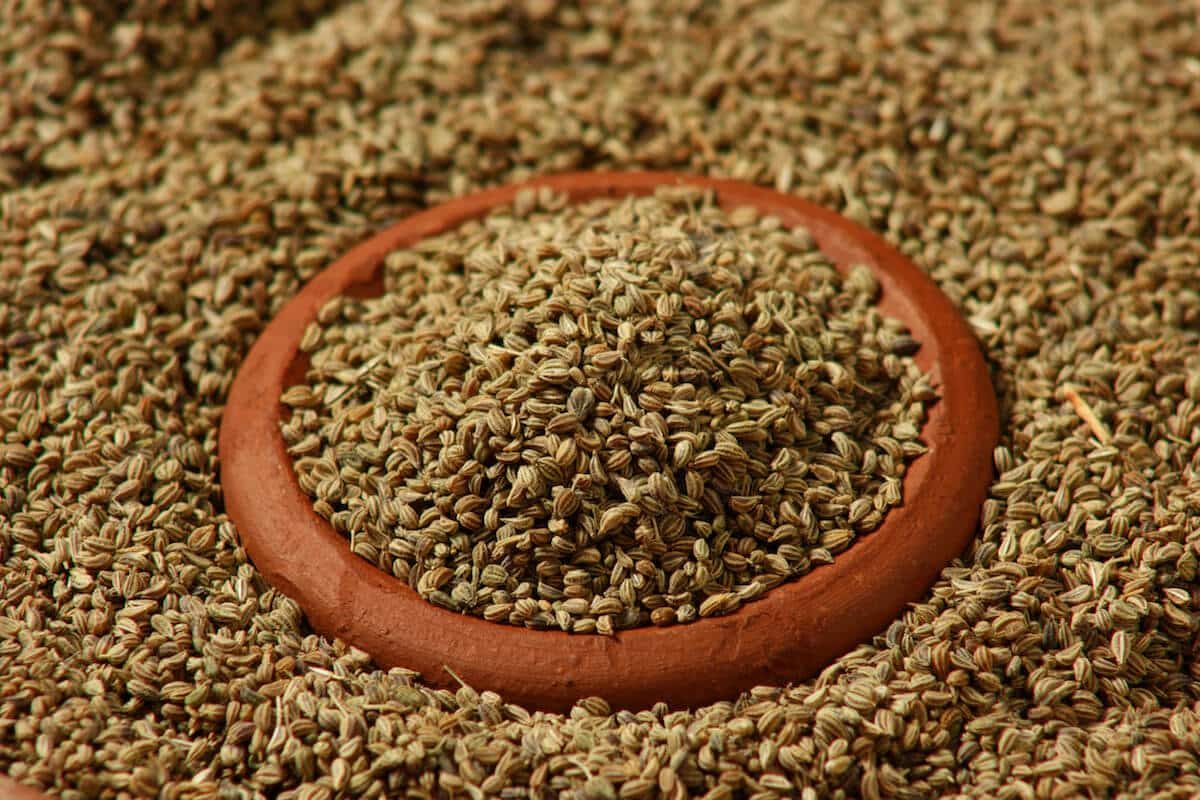
Carom seeds, sold in India as ajwain, are the small, ridged fruits of Trachyspermum ammi, a plant in the carrot and parsley family. They smell and taste like a louder, rougher thyme, for a simple chemical reason: their oil is dominated by thymol, a compound also found in thyme oil. This page covers what the plant is, where it comes from, how much India grows, how cooks use it, and what the health research does and does not show.
At a glance
| Botanical name | Trachyspermum ammi (L.) Sprague; synonyms include Carum copticum and Trachyspermum copticum1 |
| Plant family | Apiaceae (carrot/parsley family)1 |
| Part used | The dried fruit, usually called a seed2 |
| Native range | Iraq to Central Asia and Myanmar (Kew); see Origin for other views1 |
| Main producer | India: 65,018 tonnes in 2024-25 (final)3 |
| Essential oil | 2.5–5% of the dried fruit (Katzer); 2–5% (review)24 |
| Key aroma compound | Thymol, 35–60% of the oil (Katzer)2 |
| Other names | Ajwain, ajowan, carom, bishop’s weed2 |
Measured values
4 figures, sourced| Measure | Value | Scope | Source |
|---|---|---|---|
| Essential oil | 2.5–5 % of dried fruit | KatzerSources differ | gernot-katzers-spice-pages.com |
| Essential oil | 2–5 % of seed | Chahal et al. review abstract (2017)Sources differ | phytojournal.com |
| Thymol | 35–60 % of oil | Katzer | gernot-katzers-spice-pages.com |
| Thymol isolated | 98 % (almost pure thymol) | South Indian fruit, one report (Katzer) | gernot-katzers-spice-pages.com |
Each figure is quoted as its source states it, with the samples or standard it applies to. Where sources differ, both are shown; nothing is averaged. All measured values
What carom is
What is sold as carom or ajwain seed is botanically a dried fruit; Katzer notes that the fruits are often called seeds.2 Kew’s accepted name is Trachyspermum ammi, and it lists Carum copticum and Trachyspermum copticum among the plant’s 32 synonyms, which is why older books and labels use several Latin names.1 Katzer files the spice under T. copticum.2
The English names are a muddle. Katzer lists ajwain, ajowan, carom and bishop’s weed, and advises against “bishop’s weed” because the name is also used for other plants in the family.2 He also notes that ajwain is sometimes mislabeled as lovage seed, which is a different plant; see lovage.2 He traces the Hindi name back to a Sanskrit word linked to “Greek.”2
Flavor and the compounds behind it
Katzer describes the aroma as similar to thyme but stronger and less subtle.2 Raw, the seeds are sharp and slightly bitter, with a lingering bite on the tongue; that description is ours.
The chemistry explains the thyme comparison. Thymol is a crystalline phenol with an aromatic smell and antiseptic properties, and it occurs naturally in thyme oil.5 In carom, it dominates the essential oil:
| Scope | Figure | Source |
|---|---|---|
| Essential oil in the dried fruit | 2.5–5% | Katzer2 |
| Essential oil in the seed | 2–5% (brownish oil) | Chahal et al. review abstract4 |
| Thymol share of the oil | 35–60% | Katzer2 |
| South Indian fruit, one report | Almost pure thymol (98%) isolated | Katzer2 |
The review abstract names p-cymene, γ-terpinene, α-pinene, β-pinene and α-terpinene as the main companions of thymol, without percentages.4 These figures come from different samples and methods and should not be merged. For thyme itself, see thyme and oregano vs. thyme.
Origin and history
Where the plant comes from depends on the source:
| Source | Origin given |
|---|---|
| Kew (native range) | Iraq to Central Asia and Myanmar, including India, Iran, Afghanistan and Pakistan1 |
| Katzer | Eastern Mediterranean, maybe Egypt2 |
| Chahal et al. review | Originated in Egypt4 |
Kew is the botanical authority for native range; the Egypt view appears in the other two and we could not trace the evidence behind it. Kew lists the plant as introduced in places including Ethiopia, Saudi Arabia, Türkiye and Morocco.1 Katzer gives Persia and India as the main growing areas today and says ajwain is of little importance in world trade.2
Katzer reports that ajwain is much used in Ayurvedic medicine in India.2 Claims that it grew wild in ancient Egypt, served as a common medicine there, or is used in traditional Chinese medicine could not be traced and are left out.
Production
India publishes the only production figures we found. The Spices Board of India gives ajwain seed at 65,018 tonnes from 63,147 hectares in 2024-25 (final) and an advance estimate of 68,505 tonnes from 63,050 hectares for 2025-26.3 Earlier years ran from 37,884 to 39,763 tonnes (2021-22 to 2023-24), so the 2024-25 crop was far larger than the three before it; the Board notes that figures from 2020-21 on are subject to revision.3 No world total was found.
How carom is used
- Lentils and beans. Katzer calls legumes the most important use. Ajwain is fried in fat, often with cumin and chiles, and the fat poured over cooked lentils (the tadka or baghar technique); he notes that most aroma compounds in spices dissolve much better in fat than in water.2
- Potatoes and fish. Toasting or frying strengthens the aroma, and Katzer pairs it with potatoes and fish.2
- Snacks and pastry. It flavors the Rajasthani biscuits called mathari, and similar pastries in Ladakh and Nepal.2
- Beyond India. It appears in the Ethiopian spice mix berbere and has some popularity in the Arabic world.2 See berbere seasoning.
Because the flavor is strong, most cooks use it by the pinch and cook it in fat first; that is common practice rather than a measured rule. Pair it with cumin, turmeric and ginger in lentil and vegetable dishes. For a broader view of the cuisine, see Indian spices.
Buying and quality
No grading standard for ajwain was opened for this page. Look for whole, ridged seed free of stems and dust that smells strongly of thyme when crushed; that is kitchen judgment. Because ajwain is sometimes mislabeled as lovage seed,2 check the label for the name ajwain or carom.
Storage
No published shelf-life figure for carom seed from a regulator or standards body was found. Common practice is to keep whole seed sealed, away from heat and light, and judge it by smell: rub a few seeds between your fingers, and if the thyme note is faint, the seed has faded. That is a practical test, not a measured figure.
Safety and health claims
Katzer records traditional use of ajwain against digestive complaints and fever, and notes that thymol is used in Western medicines against cough and throat irritation.2 Britannica describes thymol as an antiseptic used mainly as a fungicide and preservative, and in perfumes and dentifrices.5 Those are uses of the purified compound, not evidence about eating the seed.
A 2017 review summarizes the biological and pharmacological properties reported for the plant, but its abstract does not say whether that evidence comes from lab, animal or human studies.4 We found no NIH (NCCIH) page or systematic review of human trials for ajwain. Widely repeated claims that it treats arthritis, psoriasis, acne or respiratory illness, or that it preserves pickles, could not be traced to a credible source. This page makes no claim that carom treats or prevents any condition.
Substitutes
Thyme is the closest flavor match because of the shared thymol; dried thyme is the usual stand-in. No source gives a tested ratio, so start with about the same volume of dried thyme and adjust by taste. See carom seed substitutes and thyme substitutes.
Footnotes
-
Trachyspermum ammi (L.) Sprague, Plants of the World Online, Royal Botanic Gardens, Kew. powo.science.kew.org · Reference work ↩ ↩2 ↩3 ↩4 ↩5 ↩6
-
Gernot Katzer, “Ajwain (Trachyspermum copticum)”, Gernot Katzer’s Spice Pages. gernot-katzers-spice-pages.com · Reference work ↩ ↩2 ↩3 ↩4 ↩5 ↩6 ↩7 ↩8 ↩9 ↩10 ↩11 ↩12 ↩13 ↩14 ↩15 ↩16 ↩17 ↩18 ↩19 ↩20 ↩21 ↩22
-
Spice wise area and production in India, 2021-22 to 2025-26, Spices Board India. indianspices.com · Regulator ↩ ↩2 ↩3
-
Chahal et al., “Chemical composition of Trachyspermum ammi L. and its biological properties: A review”, Journal of Pharmacognosy and Phytochemistry, 2017. phytojournal.com · Peer-reviewed ↩ ↩2 ↩3 ↩4 ↩5
-
“Thymol”, Encyclopaedia Britannica. britannica.com · Reference work ↩ ↩2