Spice Comparisons · Comparison
Oregano vs. Thyme: Same Two Phenols, Different Balance
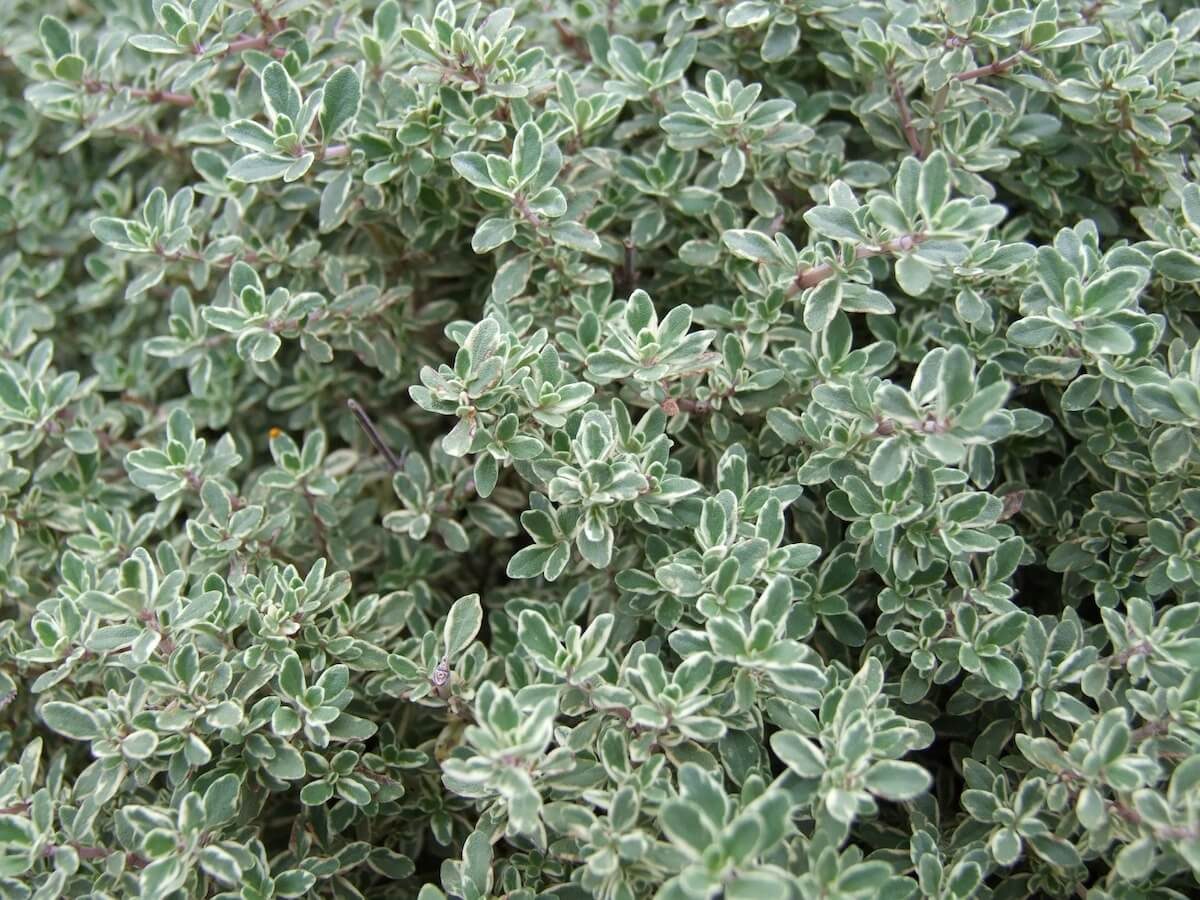
Oregano and thyme are the two mint-family herbs most alike in the kitchen, and the reason is chemical: both oils are built on the same two phenols, carvacrol and thymol.12 The balance differs. Oregano oil usually leads with carvacrol, while most thyme oils lead with thymol; one common thyme oil held 42.44% thymol and 2.28% carvacrol.13 Both are hearty herbs that dry well and go in early,45 which is why each is the other’s most-cited substitute.
Side by side
| Oregano | Thyme (common) | |
|---|---|---|
| Species | Origanum vulgare; other Origanum species are also sold as oregano61 | Thymus vulgaris7 |
| Family | Lamiaceae (mint family)6 | Lamiaceae7 |
| Native range | Macaronesia to China (Kew)8 | Southwestern Europe and southeastern Italy (Kew)7 |
| Plant | Perennial herb8 | Small evergreen subshrub, 10–30 cm, occasionally to 50 cm2 |
| Leaves | Opposite, oval, about 1.5 cm (0.6 inch) long6 | Opposite, linear to elliptical, 3–8 mm long2 |
| Key compounds | Carvacrol and thymol, about 78–85% of the oil, usually carvacrol-led1 | Thymol and carvacrol, usually thymol-led; varies by chemotype23 |
| Flavor (editorial) | Warm, resinous, pungent, a little bitter | Savory, sharp, slightly medicinal |
| Strength | Medium-strength herb (University of Delaware)9 | Also medium-strength9 |
| When to add | Early; a hearty herb4 | Early; a hearty herb4 |
| Typical uses | Pizza and pasta sauces, Greek salads, gyros6 | Butter, cheese, fish, meat, sauces, soups, stews, stuffings2 |
| Quality | 48% of samples in an EU fraud survey were suspect, mostly with olive leaves10 | No comparable survey found |
| Cost | No dated, sourced price comparison found | No dated, sourced price comparison found |
The flavor row is our description. Britannica describes the Greek and Italian culinary oreganos as having a strong aroma and a warm, pungent taste.6
The chemistry, sample by sample
Each figure belongs to the oil it was measured on. These are essential-oil figures from different studies, not measurements of dried leaf, and should not be merged.
| Herb and sample | Thymol | Carvacrol | Source |
|---|---|---|---|
| Oregano oil, typical range in a 2020 review | 78–85% combined | Lombrea et al.1 | |
| Oregano, Spanish O. vulgare samples, as tabulated in the same review | 58.7–77.4% | Lombrea et al.1 | |
| Common thyme oil in a 2023 study of eight thyme species | 42.44% | 2.28% | Dong et al.3 |
| One T. vulgaris chemotype reported by PROSEA | under 5% | under 5% | PROSEA2 |
In the 2023 study, six of the eight thyme oils were thymol-type.3 PROSEA also reports thyme chemotypes in which thymol and carvacrol are both below 5%,2 so not every thyme plant is thymol-led. The overlap goes the other way too: a 2020 review notes that the name “oregano” is applied to plants of several other genera, Thymus among them,1 and PROSEA lists Thymus capitatus under the common name Spanish oregano.2
The differences that change a dish
Strength: the sources differ
The University of Delaware’s extension guide puts oregano and thyme in the same medium-strength group.9 A Couple Cooks would avoid swapping dried thyme for dried oregano because, in its view, thyme has a much stronger flavor.11 We found no measurement either way. In practice, start a swap in either direction with less than the recipe calls for.
Cooking
America’s Test Kitchen classes both as hearty herbs to add early, noting that their flavor compounds are somewhat more heat-stable than those of delicate herbs.4 In ATK’s dried-versus-fresh tests, dried oregano and dried thyme both held up reasonably well in dishes with more than 20 minutes of cooking and a good amount of liquid.5 The University of Delaware’s gentler rule for long simmering is to add herbs during the last 45 minutes.9
Where each one belongs
Britannica calls oregano essential in Italian pizza and pasta sauces, Greek salads and gyros.6 PROSEA lists thyme for butter, cheese, fish, meat, olives, sauces, soups, stews, stuffings and vinegar.2 Thyme is a fixture of French cooking: the classic bouquet garni is sprigs of parsley and thyme with a bay leaf.12 Thyme is not one of the fines herbes, a mix that commonly includes parsley, chives, tarragon and chervil.13
They often go together. In the Label Rouge recipe for herbes de Provence as reported by the French trade press, oregano makes up 26% and thyme 19%.14
Mexican oregano is a different plant
The oregano used in Mexican cooking is usually Mexican oregano, Lippia graveolens, a verbena-family shrub whose oil is thymol-led (40–60%) and which PROSEA describes as stronger and sharper than Origanum.15 See Mexican oregano vs. oregano.
Can one stand in for the other?
Yes, better than most herb swaps, because of the shared phenols. The Spice House lists oregano first among its thyme substitutes,16 and for chili it suggests thyme, sage or marjoram when oregano is missing.17 Neither gives an amount.
- Oregano in place of thyme (Method). No published ratio was found. Fresh for fresh, start with the same amount. Dried for dried, start with about three quarters of the thyme amount and taste. This is the treatment on our thyme substitutes page.
- Thyme in place of oregano (Method). No published ratio was found. Fresh for fresh, start with the same amount. Dried for dried, start with about half and taste after 20 minutes of cooking, given A Couple Cooks’ view that dried thyme is much stronger.11 See oregano substitutes.
Where the swap shows most is a dish built around one herb, such as a pizza sauce or a thyme-roasted chicken (editorial).
Varieties
The thyme genus is large. Lemon thyme, Thymus × citriodorus, is listed by Kew as a hybrid of T. pulegioides and common thyme.18 Caraway thyme, Thymus herba-barona, is native only to Corsica;19 we found no source describing its flavor. On the oregano side, Greek oregano is known for denser, larger oil glands on the leaf than common oregano.1
What isn’t known
- No measurement compares the strength of dried oregano and dried thyme, and the sources disagree on which is stronger.
- A widely repeated claim says only English and French thyme work in place of oregano. We found no source for it.
- We found no source for oregano being the most easily detected herb in pizza sauce.
Related
- Profiles: oregano, thyme, lemon thyme, marjoram
- Substitutes: oregano substitutes, thyme substitutes
- Comparisons: marjoram vs. oregano, rosemary vs. thyme, thyme vs. lemon thyme, English thyme vs. French thyme, oregano vs. mint, basil vs. oregano
- Bouquet garni, herbes de Provence, cooking with oregano, too much thyme?
Footnotes
-
Lombrea et al., “A Recent Insight Regarding the Phytochemistry and Bioactivity of Origanum vulgare L. Essential Oil”, International Journal of Molecular Sciences, 2020. mdpi.com · Peer-reviewed ↩ ↩2 ↩3 ↩4 ↩5 ↩6 ↩7 ↩8
-
S.H. Widodo, Thymus vulgaris, Plant Resources of South-East Asia (PROSEA). uses.plantnet-project.org · Reference work ↩ ↩2 ↩3 ↩4 ↩5 ↩6 ↩7 ↩8 ↩9
-
Dong et al., “Chemical Compositions of Essential Oil Extracted from Eight Thyme Species and Potential Biological Functions”, Plants, 2023. mdpi.com · Peer-reviewed ↩ ↩2 ↩3 ↩4
-
Liz Bomze, “Our Guide to Fresh Herbs”, America’s Test Kitchen, 2019. americastestkitchen.com · Publication ↩ ↩2 ↩3 ↩4
-
“Science: Substituting Dried Herbs for Fresh”, America’s Test Kitchen. americastestkitchen.com · Publication ↩ ↩2
-
Anoushka Pant, “Oregano”, Encyclopaedia Britannica, 2026. britannica.com · Reference work ↩ ↩2 ↩3 ↩4 ↩5 ↩6
-
Thymus vulgaris L., Plants of the World Online, Royal Botanic Gardens, Kew. powo.science.kew.org · Reference work ↩ ↩2 ↩3
-
Origanum vulgare L., Plants of the World Online, Royal Botanic Gardens, Kew. powo.science.kew.org · Reference work ↩ ↩2
-
“Using Herbs and Spices”, University of Delaware Cooperative Extension, 2025. udel.edu · Reference work ↩ ↩2 ↩3 ↩4
-
“Herbs and spices (2019-2021): EU coordinated action”, European Commission. food.ec.europa.eu · Regulator ↩
-
Sonja Overhiser, “Best Oregano Substitute”, A Couple Cooks, 2026. acouplecooks.com · Publication ↩ ↩2
-
“Bouquet garni”, Encyclopaedia Britannica. britannica.com · Reference work ↩
-
“Fines herbes”, Encyclopaedia Britannica. britannica.com · Reference work ↩
-
Sylvie Carriat, “Les vraies herbes de Provence raniment la flamme”, Réussir Les Marchés, 2008. reussir.fr · Publication ↩
-
H.C. Ong and M. Brink, Lippia graveolens, Plant Resources of South-East Asia (PROSEA). uses.plantnet-project.org · Reference work ↩
-
“The 11 Best Thyme Substitutes”, The Spice House, 2018. thespicehouse.com · Merchant ↩
-
“The 8 Best Oregano Substitutes”, The Spice House, 2018. thespicehouse.com · Merchant ↩
-
Thymus × citriodorus (Pers.) Schreb., Plants of the World Online, Royal Botanic Gardens, Kew. powo.science.kew.org · Reference work ↩
-
Thymus herba-barona Loisel., Plants of the World Online, Royal Botanic Gardens, Kew. powo.science.kew.org · Reference work ↩