Spice Substitutes · Substitutes
Carom Seed (Ajwain) Substitutes: Why Thyme Comes First
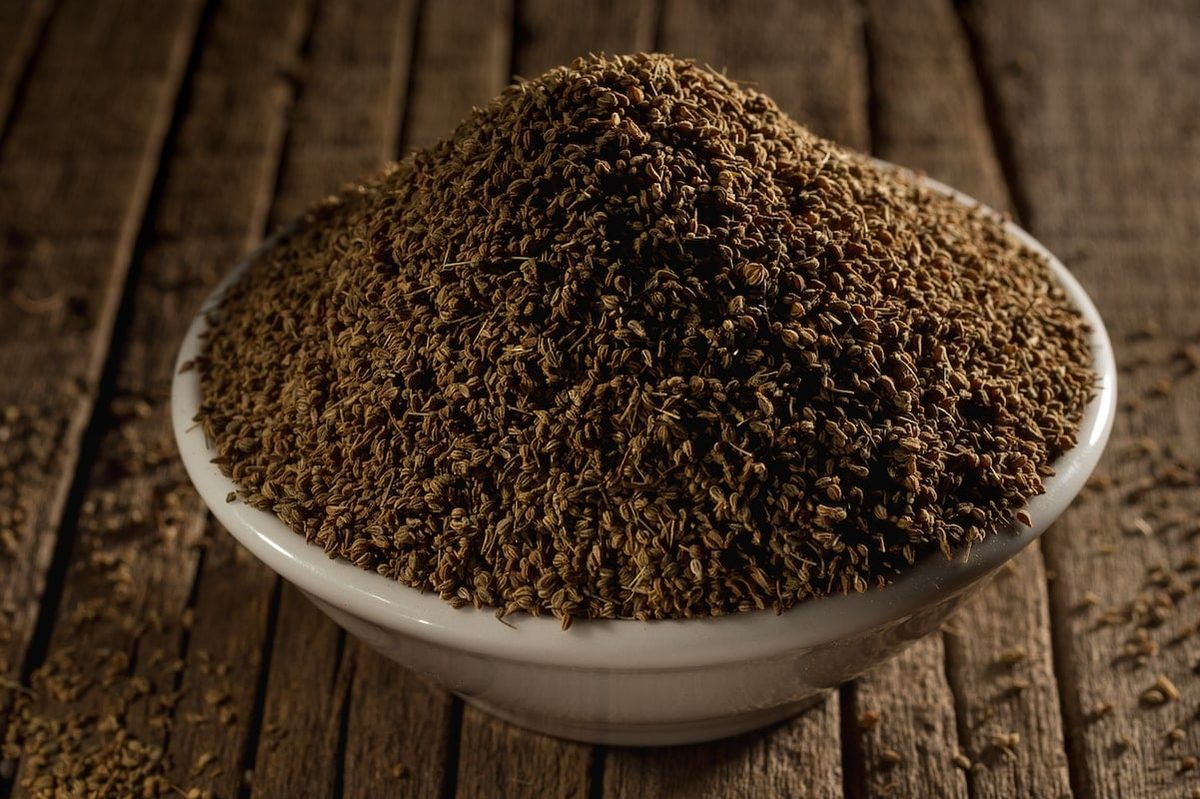
Carom seeds, sold in Indian shops as ajwain, are the small dried fruits of Trachyspermum ammi, a plant in the carrot and parsley family.12 Gernot Katzer describes their flavor as “similar to thyme, but stronger and less subtle.”2 The reason is chemical. Ajwain’s essential oil, 2.5 to 5 percent of the dried fruit, is dominated by thymol, at 35 to 60 percent of the oil.23 Thymol is the same phenol found naturally in thyme oil.4 Any good substitute has to bring thymol, or something close to it.
Quick answer
| What carom is doing | Best substitute | Starting amount, per 1 part carom seed | Treatment |
|---|---|---|---|
| Thyme-like bite in dals, breads and fried snacks | Dried thyme | 1 part, then add more | Method |
| The same, with more punch | Mexican oregano | ¾ part, then taste | Method |
| Whole seeds sizzled in oil (tadka) | Cumin seeds in the oil, plus a pinch of dried thyme | Cumin ½ part; thyme a pinch at the end | Method |
| A milder herbal note | Mediterranean oregano or marjoram | 1 part, then taste | Method |
How the ratios on this page are labeled
- Computed: based on a measurable physical relationship, with the source named.
- Attributed: a named source publishes this ratio. We quote it as theirs.
- Disputed: named sources give different answers to the same swap. We show each one and do not average them.
- Method: we found no published ratio. We give a direction and a cautious starting point, and say so.
We found no credible published ratio for any carom substitute. The pages that offer numbers are content-farm sites or unbylined aggregators, which this site does not use. Everything below is Method.
If carom is giving a thyme-like bite
This is ajwain’s main job. Katzer calls legumes (lentils and beans) its most important use, and says toasted or fried ajwain goes well with potatoes or fish; he also names it in the Rajasthani biscuits called mathari.2
1. Dried thyme
Common thyme (Thymus vulgaris) carries thymol and carvacrol as its characteristic oil compounds.5 In one 2023 analysis, a T. vulgaris oil was 42 percent thymol.6 That shared thymol is why Katzer’s thyme comparison holds.2
There are two catches. Thyme is chemically variable: PROSEA reports six chemotypes of Mediterranean T. vulgaris, and in one of them thymol and carvacrol each make up less than 5 percent of the oil.5 A jar of dried thyme may be more or less thymol-forward than you expect. And by Katzer’s description, ajwain is the stronger of the two.2
Ratio (Method): No published ratio was found. Start with the same volume of dried thyme as carom seed, taste, and add more if the dish needs more bite.
2. Mexican oregano
Mexican oregano (Lippia graveolens) is not an oregano at all in the botanical sense. It belongs to the verbena family, Verbenaceae, the same family as lemon verbena.78 Its oil is unusually thymol-rich: PROSEA gives 40 to 60 percent thymol and 3 to 25 percent carvacrol, and describes its flavor as stronger, sharper and more pungent than that of true oregano.9 That makes it the closest match to ajwain’s sharpness after thyme.
Ratio (Method): No published ratio was found. Start with three quarters of the carom amount and adjust.
If carom seeds are sizzled in oil
In the tadka technique, Katzer writes, ajwain is fried in fat, often with cumin and chiles, and the fat is poured over cooked lentils; he notes that most spice aroma compounds dissolve much better in fat than in water.2 A seed substitute is hard to find here. Dried leaves do not behave like seeds in hot oil.
1. Cumin seeds plus dried thyme
Cumin seeds give you the sizzle and a toasted seed in the oil, but not the flavor: cumin’s oil is led by cuminaldehyde, not thymol.10 Add a pinch of dried thyme to the oil at the very end, or stir it into the finished dish, to bring back the thymol note. America’s Test Kitchen classes thyme as a hearty herb whose flavor compounds are somewhat more heat-stable than those of delicate herbs.11 The combination is our suggestion, not a tested method.
Ratio (Method): If the recipe already contains cumin, add a little more of it; otherwise start with half the carom amount in cumin seed. Add dried thyme by the pinch.
If you only need a mild herbal note
1. Mediterranean oregano
Oregano (Origanum vulgare) is in the mint family.12 Carvacrol and thymol together make up roughly 78 to 85 percent of its essential oil, according to one review.13 But in oregano, carvacrol usually leads: Spanish samples in the same review held 58.7 to 77.4 percent carvacrol and only 0.2 to 5.8 percent thymol.13 It shares ajwain’s phenolic sharpness, with a more oregano-like tone.
Ratio (Method): No published ratio was found. Start one for one and taste.
2. Marjoram
Marjoram is the weakest match. Its oil comes in two main chemotypes: one led by terpinen-4-ol and cis-sabinene hydrate, the other by carvacrol and thymol.14 The University of Delaware Extension classes marjoram as a medium-strength herb and notes that long cooking costs herbs their flavor.15 Use it when nothing better is on hand, and add it late.
Ratio (Method): Start one for one, then add more to taste.
Substitutes that don’t fit
- Tarragon. PROSEA describes its scent as sweet and anise-like.16 It has none of ajwain’s thymol character.
- Lovage seed. Katzer notes that ajwain is sometimes mislabeled as lovage seed.2 If a recipe or a shop calls for lovage seed, check whether it actually means ajwain.
What isn’t known
- No credible published ratio exists for swapping carom seed with thyme, oregano or anything else, as far as we found.
- No study compares the thymol delivered by a teaspoon of carom seed with a teaspoon of dried thyme or Mexican oregano. The oil figures above come from different samples and methods and should not be combined into a strength ratio.
- Thyme’s chemotype is rarely on the label, so how close a given jar comes to ajwain is a matter of tasting.
Related
- Carom seeds
- Thyme, thyme substitutes and oregano vs. thyme
- Mexican oregano and Mexican oregano vs. oregano
- Oregano, marjoram and marjoram vs. oregano
- Cumin and tarragon
- Dried herbs vs. fresh
Footnotes
-
Trachyspermum ammi (L.) Sprague, Plants of the World Online, Royal Botanic Gardens, Kew. powo.science.kew.org · Reference work ↩
-
Katzer, Ajwain, Gernot Katzer’s Spice Pages. gernot-katzers-spice-pages.com · Reference work ↩ ↩2 ↩3 ↩4 ↩5 ↩6 ↩7 ↩8
-
Chahal et al., Chemical composition of Trachyspermum ammi L. and its biological properties, Journal of Pharmacognosy and Phytochemistry, 2017. phytojournal.com · Peer-reviewed ↩
-
Thymol, Encyclopaedia Britannica. britannica.com · Reference work ↩
-
Widodo, Thymus vulgaris, PROSEA, via Pl@ntUse. uses.plantnet-project.org · Reference work ↩ ↩2
-
Dong et al., Chemical Compositions of Essential Oil Extracted from Eight Thyme Species, Plants, 2023. mdpi.com · Peer-reviewed ↩
-
Lippia graveolens Kunth, Plants of the World Online, Royal Botanic Gardens, Kew. powo.science.kew.org · Reference work ↩
-
Aloysia citrodora Paláu, Plants of the World Online, Royal Botanic Gardens, Kew. powo.science.kew.org · Reference work ↩
-
Ong and Brink, Lippia graveolens, PROSEA, via Pl@ntUse. uses.plantnet-project.org · Reference work ↩
-
Cumin, Encyclopaedia Britannica. britannica.com · Reference work ↩
-
Bomze, Our Guide to Fresh Herbs, America’s Test Kitchen, 2019. americastestkitchen.com · Publication ↩
-
Pant, Oregano, Encyclopaedia Britannica. britannica.com · Reference work ↩
-
Lombrea et al., A Recent Insight Regarding the Phytochemistry and Bioactivity of Origanum vulgare L. Essential Oil, International Journal of Molecular Sciences, 2020. mdpi.com · Peer-reviewed ↩ ↩2
-
Kakouri et al., Origanum majorana Essential Oil, Life, 2022. mdpi.com · Peer-reviewed ↩
-
Using Herbs and Spices, University of Delaware Cooperative Extension, 2025. udel.edu · Reference work ↩
-
de Guzman and Reglos, Artemisia dracunculus, PROSEA, via Pl@ntUse. uses.plantnet-project.org · Reference work ↩