Blog · Profile
Indian Spices: Cumin, Turmeric, Cardamom, Mustard Seed, Chiles and the Rest of the Masala Box
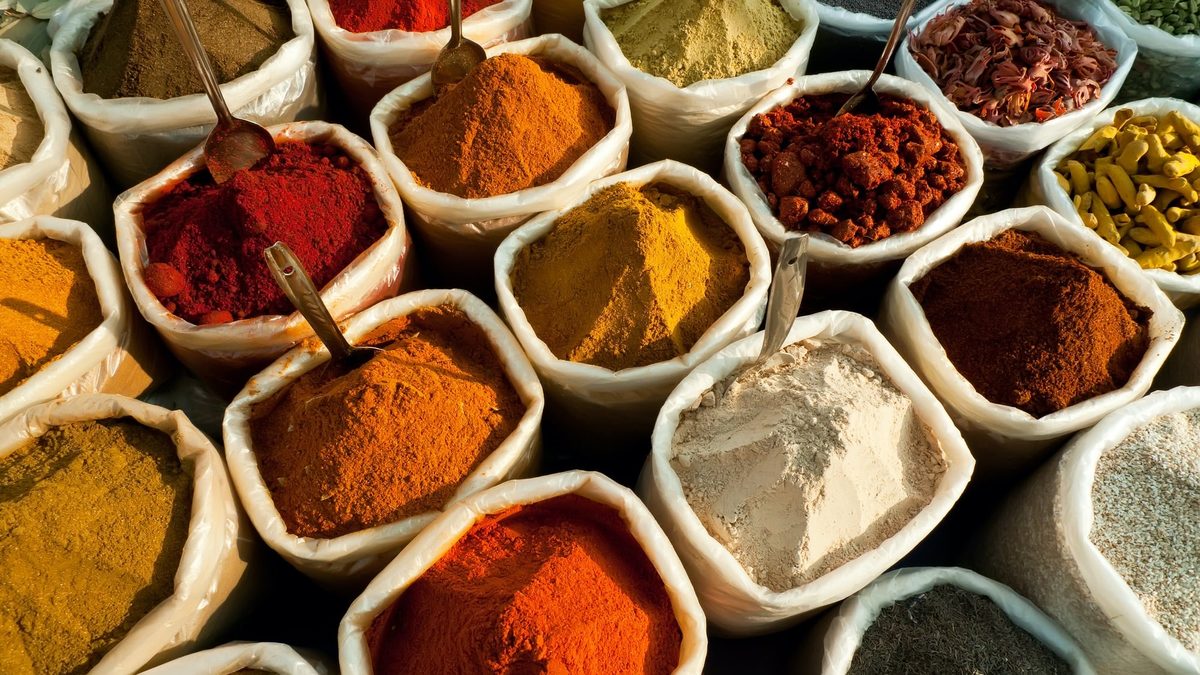
Indian cooking draws on a large spice box, and much of the world’s supply of several spices is grown in India. This page covers the spices that do the most work in Indian kitchens, how they are used, and what the sources say about each, with links to our full profiles.
At a glance
| Spice | Botanical source | Typical Indian role in the sources | Full profile |
|---|---|---|---|
| Cumin | Fruit of Cuminum cyminum, native Iraq to Afghanistan, introduced to India1 | Fried or toasted at the start of a dish2 | Cumin |
| Coriander seed | Fruit of Coriandrum sativum3 | Up to 40% of curry powder4 | Coriander |
| Turmeric | Rhizome of Curcuma longa, a cultigen from southwest India5 | The yellow color and flavor of curry6 | Turmeric |
| Mustard seed | Black (Brassica nigra) and brown (B. juncea) | Fried whole in fat, a South Indian technique7 | Black mustard seeds |
| Green cardamom | Fruit of Elettaria cardamomum, native to southwest India8 | Curries, spiced rice, tea and coffee9 | Cardamom |
| Chile | Capsicum species | Heat and color; second only to garlic among India’s spice crops by tonnage10 | Cayenne pepper |
| Cinnamon | Bark of Cinnamomum species | Garam masala, masala chai11 | Cinnamon |
| Saffron | Stigmas of Crocus sativus12 | Color and aroma | Saffron |
| Curry leaves | Leaves of the curry tree | Fried in oil to start a dish13 | Curry leaves |
Measured values
5 figures, sourced| Measure | Value | Scope | Source |
|---|---|---|---|
| Cardamom oil: 1,8-cineole | 20 to 60 % of the oil | scope not stated on source pageFigure is for green cardamom, one spice on this roundup page | uses.plantnet-project.org |
| Cardamom oil: alpha-terpinyl acetate | 20 to 53 % of the oil | scope not stated on source pageFigure is for green cardamom | uses.plantnet-project.org |
| Heat, Bhut Jolokia | 1,001,304 SHU | Bhut Jolokia (Capsicum chinense) from Assam, 2007 HortScience studyFigure is for one chile cultivar, not Indian chile generally | journals.ashs.org |
| Turmeric samples above India's lead limit | 30 % of samples | 503 turmeric samples from eastern India | nature.com |
| Lead limit for turmeric, India Limit | 10 µg/g | India's lead limit, as cited in the npj Science of Food study | nature.com |
Each figure is quoted as its source states it, with the samples or standard it applies to. Where sources differ, both are shown; nothing is averaged. All measured values
How Indian cooks use whole spices: tempering
A defining technique is frying whole spices in hot fat. Katzer writes that almost every North Indian curry or braising dish starts with spices fried in fat, often with onion, and that cumin seeds are fried or toasted before use.2 Frying whole mustard seeds in fat is, in his words, a typical South Indian technique; mustard seeds are always fried in fat or dry-toasted before use, and after frying they are no longer pungent but nutty and smoky.7 A Saveur rasam recipe shows the method: mustard, cumin and fenugreek seeds, curry leaves and dried chiles cooked in fat until the seeds pop.14 In Bengal, the five-seed blend panch phoron is used the same way; Bong Eats says the name literally means five spices, used in tempering.15 Asafoetida resin, Katzer says, must be fried quickly in hot oil.16
What India grows
India’s Spices Board publishes area and production by spice. Its 2024-25 final figures (subject to revision) include:10
| Spice | Production, 2024-25 (tonnes) |
|---|---|
| Garlic | 3,565,321 |
| Chilli | 2,694,838 |
| Ginger (fresh) | 2,653,762 |
| Cumin | 1,163,907 |
| Turmeric (dry) | 1,105,321 |
| Coriander | 844,095 |
| Fenugreek | 260,803 |
| Cardamom (small) | 20,696 |
| Nutmeg | 19,325 |
| Clove | 1,127 |
These are national totals, not shares of world production; no comparable world figures were found for most of them.
Cumin
Cumin is the dried fruit of Cuminum cyminum. Kew gives its native range as Iraq to Afghanistan, with India in its introduced range.1 PROSEA describes its flavor as strong, warm, pungent and persistent.17 Britannica calls it an essential ingredient in many mixed spices, chutneys, and chili and curry powders.18 Because the seeds are usually fried or toasted first,2 whole cumin and ground cumin play different roles. See cumin, cumin seeds vs. ground cumin, coriander vs. cumin and too much cumin.
Coriander seed
Coriander seed comes from Coriandrum sativum, native from the eastern Mediterranean to western Pakistan.3 One review describes its flavor as mild, sweet, warm and aromatic.19 It is among the oldest spices on record; PROSEA cites remains dated to 6000 BC found in Israel, and says curry powder can contain up to 40% coriander.4 See coriander, cooking with coriander and coriander substitutes.
Turmeric
Turmeric is the rhizome of Curcuma longa, a plant in the ginger family that Kew treats as a cultigen from southwest India.520 It is not just a coloring: one reference chapter describes a bitter, slightly acrid yet sweet taste, and says turmeric gives curry its distinctive yellow color and flavor.6 Health claims for turmeric are common, but the NIH’s National Center for Complementary and Integrative Health says there is not enough evidence to conclude that turmeric or curcumin helps any health condition.20 Lead is a documented problem: a study of 503 samples from eastern India found 30% above India’s lead limit of 10 µg/g.21 See turmeric, cooking with turmeric and turmeric vs. curry powder.
Mustard seeds
Indian cooking uses the dark mustard seeds: black (Brassica nigra) and the brown Indian mustard (B. juncea). Katzer documents black mustard in South Indian tempering and in Bengal’s panch phoron, and says black mustard is slightly more pungent than brown.7 Britannica says white mustard seeds, the kind used for mild Western yellow mustard, are less intensely flavored than brown.22 See black mustard seeds, brown mustard seeds, yellow vs. black mustard seeds and panch phoran.
Green cardamom
Green cardamom is the fruit of Elettaria cardamomum, native to southwest India,8 where it grows wild in the evergreen forests of the Western Ghats.9 The fruits are picked by hand while still green, one by one, because they ripen irregularly.9 Its oil is mostly 1,8-cineole (20 to 60%) and α-terpinyl acetate (20 to 53%);9 1,8-cineole has a camphor-like odor,23 which accounts for the eucalyptus-like edge many cooks notice. PROSEA calls cardamom an important ingredient of curries and spiced rice, vegetable and meat dishes, and notes its use in coffee and tea.9 See cardamom, black vs. green cardamom and cardamom pods vs. seeds.
Chiles
India grows more chile than any other spice except garlic by tonnage in the Spices Board figures above.10 The McCormick Science Institute lists Indian cooking among the uses of red pepper.24 Heat varies enormously by type. At the extreme is Bhut Jolokia, a chile from Assam that a 2007 HortScience study measured at 1,001,304 Scoville heat units; it belongs to Capsicum chinense.25 Kashmiri chile is widely described as mild and deeply red, valued for color more than heat; no measured source for that was found, so treat it as common description. See cayenne pepper, red pepper flakes and paprika vs. cayenne.
Cinnamon
The cinnamon used in India may be true (Ceylon) cinnamon or cassia; the sources do not say which dominates. Ceylon cinnamon (Cinnamomum verum) is native to Sri Lanka,26 and PROSEA says it is also grown on a smaller scale in southern India.27 NCCIH notes that cassia is the type most often sold in North America.28 CBI calls cinnamon a key ingredient in Indian dishes such as garam masala and masala chai.11 See cinnamon, Ceylon cinnamon and Ceylon vs. cassia cinnamon.
Saffron
Saffron is the dried stigmas of Crocus sativus, three per flower, and Britannica still calls it the most expensive spice in the world; it takes about 75,000 blossoms to make a pound.12 Its coloring matter is crocin, and Britannica describes a strong aroma and bitter taste.12 India is a minor producer next to Iran; a 2022 American Herbal Products Association article puts India’s production at about 22 tonnes.29 See saffron, why saffron is so expensive and saffron vs. turmeric.
Blends and the rest of the box
Garam masala has no single recipe. Great British Chefs lists cloves, bay leaf, fennel, cinnamon and cardamom among the spices commonly used,30 while Madhur Jaffrey’s version in Saveur leads with a quarter cup of cardamom seeds.31 See garam masala, garam masala vs. curry powder and chaat masala.
Other spices that matter:
- Curry leaves, which Britannica says are used extensively in Indian cuisine,32 are fried in hot oil until crisp and translucent.13 See curry leaves.
- Asafoetida (hing) is, per Katzer, even more popular in the Dravidian South.16 See asafoetida.
- Fenugreek is a characteristic ingredient in some curries and chutneys.33 See fenugreek.
- Nutmeg, cloves and mace are grown in India in small quantities (table above).10 See nutmeg, cloves and mace.
Related pages
- Curry powder and Madras curry powder
- Tandoori masala and tikka masala
- The master list of herbs and spices
Footnotes
-
Cuminum cyminum L., Plants of the World Online, Royal Botanic Gardens, Kew. powo.science.kew.org · Reference work ↩ ↩2
-
Cumin (Cuminum cyminum L.), Gernot Katzer’s Spice Pages. gernot-katzers-spice-pages.com · Reference work ↩ ↩2 ↩3
-
Coriandrum sativum L., Plants of the World Online, Royal Botanic Gardens, Kew. powo.science.kew.org · Reference work ↩ ↩2
-
Coriandrum sativum (PROSEA), Plant Resources of South-East Asia, via Pl@ntUse. uses.plantnet-project.org · Reference work ↩ ↩2
-
Curcuma longa L., Plants of the World Online, Royal Botanic Gardens, Kew. powo.science.kew.org · Reference work ↩ ↩2
-
Turmeric, the Golden Spice (Prasad S, Aggarwal BB), in Herbal Medicine: Biomolecular and Clinical Aspects, 2nd ed., 2011, CRC Press / Taylor & Francis, via NCBI Bookshelf. ncbi.nlm.nih.gov · Reference work ↩ ↩2
-
Mustard (Brassica nigra, B. juncea, Sinapis alba), Gernot Katzer’s Spice Pages, Gernot Katzer. gernot-katzers-spice-pages.com · Reference work ↩ ↩2 ↩3
-
Elettaria cardamomum (L.) Maton, Plants of the World Online, Royal Botanic Gardens, Kew. powo.science.kew.org · Reference work ↩ ↩2
-
Elettaria cardamomum (PROSEA), T.H. Wardini & A. Thomas, Plant Resources of South-East Asia, via Pl@ntUse. uses.plantnet-project.org · Reference work ↩ ↩2 ↩3 ↩4 ↩5
-
Spice wise area & production in India, 2021-22 to 2025-26 (2024-25 final, 2025-26 advance estimate), Spices Board India, Ministry of Commerce and Industry. indianspices.com · Regulator ↩ ↩2 ↩3 ↩4
-
The European market potential for cinnamon, CBI (Centre for the Promotion of Imports from developing countries). cbi.eu · Publication ↩ ↩2
-
Saffron, Encyclopaedia Britannica. britannica.com · Reference work ↩ ↩2 ↩3
-
A Guide to Curry Leaves (Nik Sharma, 13 Dec 2022), Nik Sharma Cooks. niksharmacooks.com · Publication ↩ ↩2
-
Smita Chandra’s Rasam (Spicy Tamarind Soup) (12 Jan 2015), Saveur. saveur.com · Publication ↩
-
Panch phoron (17 Feb 2017), Bong Eats. bongeats.com · Publication ↩
-
Asafetida (Ferula assa-foetida), Gernot Katzer’s Spice Pages. gernot-katzers-spice-pages.com · Reference work ↩ ↩2
-
Cuminum cyminum (PROSEA), P.C.M. Jansen, Plant Resources of South-East Asia, via Pl@ntUse. uses.plantnet-project.org · Reference work ↩
-
Cumin, Encyclopaedia Britannica (revised by Sohini Dasgupta, updated 14 Aug 2026). britannica.com · Reference work ↩
-
Essential Oil from Coriandrum sativum: A Review on Its Phytochemistry and Biological Activity (Al-Khayri et al.), Molecules 28(2):696, 2023, MDPI Molecules. mdpi.com · Peer-reviewed ↩
-
Turmeric: Usefulness and Safety (last updated April 2025), National Center for Complementary and Integrative Health (NIH). nccih.nih.gov · Regulator ↩ ↩2
-
Systemic drivers of toxic food adulteration: lead chromate in turmeric across eastern India (Forsyth et al., 2026), npj Science of Food 10:220, Nature Portfolio. nature.com · Peer-reviewed ↩
-
White mustard (revised by Melissa Petruzzello), Encyclopaedia Britannica. britannica.com · Reference work ↩
-
1,8-Cineole (CID 2758), Odor (from the Hazardous Substances Data Bank), PubChem, U.S. National Library of Medicine. pubchem.ncbi.nlm.nih.gov · Reference work ↩
-
Red Pepper, McCormick Science Institute. mccormickscienceinstitute.com · Merchant ↩
-
‘Bhut Jolokia’, HortScience 42(2):222-224 (2007), doi 10.21273/HORTSCI.42.2.222, American Society for Horticultural Science. journals.ashs.org · Peer-reviewed ↩
-
Cinnamomum verum J.Presl, Plants of the World Online, Royal Botanic Gardens, Kew. powo.science.kew.org · Reference work ↩
-
Cinnamomum verum J.S. Presl, PROSEA Handbook No. 13: Spices (Record 570), M. Flach & J.S. Siemonsma, Plant Resources of South-East Asia (PROSEA). prosea.prota4u.org · Reference work ↩
-
Cinnamon, National Center for Complementary and Integrative Health (NIH). nccih.nih.gov · Regulator ↩
-
Herbs in History: Saffron (Touwaide and Appetiti, October 2022), American Herbal Products Association. ahpa.org · Publication ↩
-
How to make garam masala (GBC Kitchen, updated 14 Feb 2025), Great British Chefs. greatbritishchefs.com · Publication ↩
-
Garam Masala (recipe from Madhur Jaffrey, Aug/Sep 2014 India issue), Saveur. saveur.com · Publication ↩
-
Curry tree (Frannie Comstock), Encyclopaedia Britannica. britannica.com · Reference work ↩
-
Fenugreek (last updated 23 Jul 2026), Encyclopaedia Britannica. britannica.com · Reference work ↩