Spice Substitutes · Substitutes
Thyme Substitutes, Ranked by the Job Thyme Is Doing
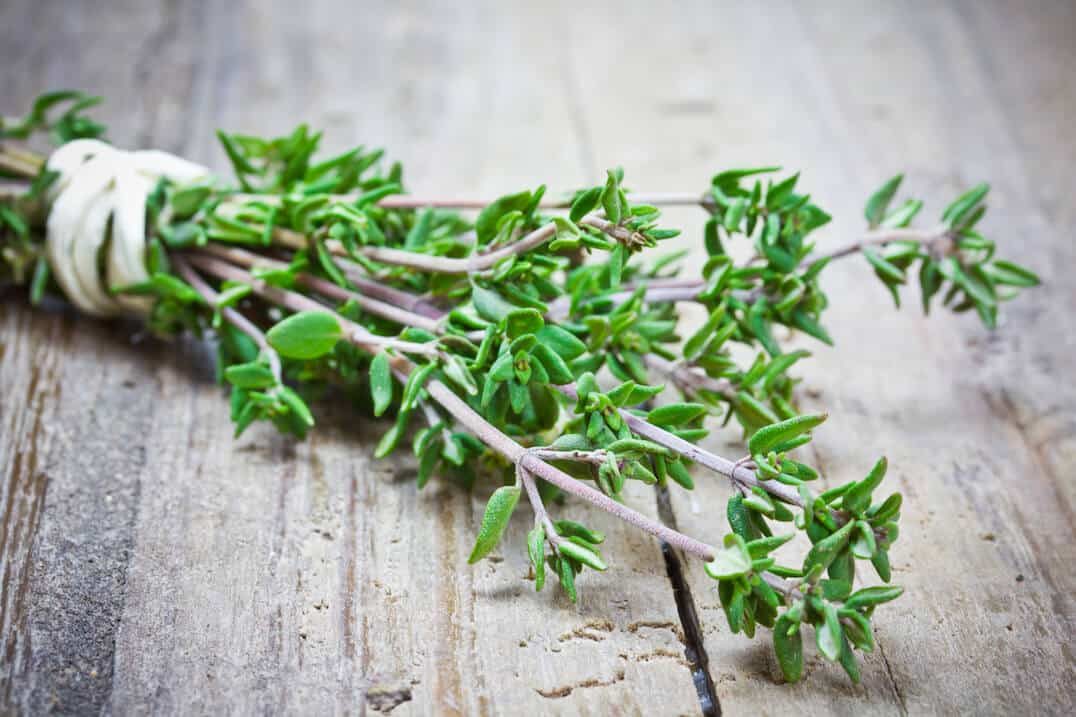
Common or garden thyme is Thymus vulgaris, a small mint-family subshrub native to southwestern Europe and southeastern Italy.1 PROSEA names thymol and carvacrol as the characteristic compounds of its oil,2 and a 2023 analysis found 42.44 percent thymol in a common thyme oil.3 The same study looked at eight thyme species and found six of them thymol-type.3 Because those two phenols carry thyme’s flavor, the closest substitutes are the herbs that share them. Which one to use depends on what thyme is doing in your recipe.
Quick answer
| What thyme is doing | Best substitute | Starting amount, per 1 part thyme | Treatment |
|---|---|---|---|
| Recipe wants fresh, you have dried | Dried thyme | 1/3 part (1 teaspoon per tablespoon) | Computed |
| Background herb in stews, soups, beans and stuffing | Savory | 1 part | Method |
| Tomato sauces, Mediterranean dishes, marinades | Oregano | 1 part fresh; 3/4 part dried | Method |
| Eggs, vegetables, lighter sauces | Marjoram | 1 part | Method |
| A rub or roast where thyme is one of several herbs | Poultry seasoning or Italian seasoning | 1 part | Method |
| Pork, lamb, roast potatoes | Rosemary | 1/2 part | Method |
How the ratios on this page are labeled
Every ratio carries one of four labels.
- Computed: based on a measurable physical relationship, such as fresh to dried, with the source named.
- Attributed: a named source publishes this ratio. We quote it as theirs.
- Disputed: named sources give different answers to the same swap. We show each one and do not average them.
- Method: we found no published ratio. We give a direction and a cautious starting point, and say so.
The Spice House lists eleven thyme substitutes but gives amounts only for fresh and dried thyme.4 We found no credible source that publishes an amount for any other herb in place of thyme, so most figures below are Method starting points.
If the recipe calls for fresh thyme and you have dried
Dried thyme is the obvious first choice, and it is one of the herbs that dries well. In America’s Test Kitchen’s tests, dried rosemary, sage and thyme fared reasonably well in recipes with fairly long cooking times (more than 20 minutes) and a good amount of liquid.5
Ratio (Computed): The sources agree that dried herbs are roughly three times as strong as fresh.
| Source | Fresh | Dried, crumbled | Ground or powdered |
|---|---|---|---|
| NDSU Extension | 1 tablespoon | 1 teaspoon | 1/2 teaspoon6 |
| Penn State Extension | 1 tablespoon | 1 teaspoon | 1/4 teaspoon7 |
| University of Delaware Extension | 2 to 3 teaspoons | 3/4 to 1 teaspoon | not given8 |
| LSU AgCenter | 1 tablespoon | 1 teaspoon | not given9 |
| America’s Test Kitchen, tasting test | 3 parts | 1 part | not given5 |
| The Spice House (for thyme) | 3 parts | 1 part | not given4 |
ATK’s testing found that 1 part dried to 3 parts fresh came closest to equal strength.5 Going the other way, the Spice House says to use three times as much fresh thyme as the dried a recipe calls for.4
Ground thyme (Disputed): NDSU puts 1 tablespoon of fresh herbs at 1/2 teaspoon ground, while Penn State says 1/4 teaspoon powdered.67 Neither is a thyme measurement. Start with the smaller figure and taste.
If thyme is a background herb in stews, soups, beans or stuffing
This is thyme’s most common job: a savory note in a long-cooked pot. America’s Test Kitchen groups thyme with the hearty herbs that go in early, whose flavor compounds are somewhat more heat-stable.10 The substitute should take long cooking too.
1. Savory
The Spice House includes summer savory among its favorite thyme substitutes.4 In an America’s Test Kitchen tasting, most tasters found that savory resembled thyme and sage more than mint.11 The chemistry fits: across the studies in one review, summer savory oil held 11 to 67 percent carvacrol and up to 28.2 percent thymol,12 the same two phenols that characterize thyme. Winter savory is harsher and more bitter, according to Britannica,13 so it is the second choice.
Ratio (Method): No published ratio was found. Start with the same amount of summer savory as thyme. With winter savory, start with a little less.
2. Marjoram, for gentler dishes
The Spice House lists marjoram among its top substitutes,4 and it is in the same family as thyme.141 In our judgment marjoram is the gentler of the two. Its sweet note is credited to cis-sabinene hydrate,15 though some marjoram oils belong to a carvacrol and thymol chemotype.15 There is no way to tell which you have from the jar. Britannica notes that oregano is also sold as “wild marjoram,”16 so check the botanical name if the label gives one: sweet marjoram is Origanum majorana.14
Ratio (Method): No published ratio was found. Start with the same amount and add more near the end if the dish needs it. The University of Delaware’s general advice for long-simmered dishes is to add herbs in the last 45 minutes.8
3. Sage, used sparingly
The Spice House cautions that sage gives a more piney flavor that does not replace thyme.4 A Couple Cooks, writing about the reverse swap, says thyme is not nearly as strong as sage.17 Sage’s own smell comes from thujones,18 not from thyme’s phenols.
Ratio (Method): No published amount was found for sage in place of thyme. Because sage is the stronger herb, start with half as much.
If thyme is in a tomato sauce or Mediterranean dish
Oregano
Oregano shares thyme’s two main phenols: carvacrol and thymol together make up about 78 to 85 percent of oregano essential oil, though oregano usually leads with carvacrol where thyme leads with thymol.193 The Spice House lists oregano first among its thyme substitutes.4 Britannica describes oregano’s taste as warm and pungent.16
Ratio (Method): No published ratio was found. Fresh for fresh, start with the same amount. In our judgment dried oregano is assertive, so start with about three quarters of the dried thyme amount and taste.
Basil
The Spice House also lists basil.4 In our judgment it is a different flavor, sweeter and greener, and LSU AgCenter groups it with the delicate herbs that are added in the last minute or two of cooking.9 Use it in a quick tomato sauce, not a long braise.
Ratio (Method): No published ratio was found. Start with the same amount of fresh basil, added at the end.
If thyme is part of a rub or roast seasoning
A blend that already contains thyme puts it back, along with its usual partners. The Spice House notes that many blends can stand in because thyme is a key component.4
- Poultry seasoning. McCormick Culinary’s lists thyme first, then sage, marjoram, rosemary, black pepper and nutmeg.20 US labels list ingredients by weight, largest first,21 so thyme is the largest single ingredient in that blend. The Spice House suggests poultry seasoning for a rub.4
- Italian seasoning. The USDA purchasing specification lists thyme, rosemary, sage, oregano and basil.22 McCormick’s version lists thyme fourth of seven herbs, after marjoram, basil and rosemary.23
- Herbes de Provence. The French Label Rouge specification calls for 19 percent thyme, with rosemary, savory and oregano at 26 to 27 percent each.24
Ratio (Method): No published ratio was found for any blend. Start with the same amount, then taste, and check the label for salt.
If thyme is seasoning pork, lamb or roast potatoes
Rosemary
The Spice House lists rosemary among its thyme substitutes.4 It is a stronger herb: the University of Delaware’s guide puts rosemary in its strong group and thyme in the medium group,8 and A Couple Cooks calls thyme much milder than rosemary.25 Rosemary oil is led by α-pinene and 1,8-cineole,26 so it reads as piney, not as thyme.
Ratio (Method): No published ratio was found for rosemary in place of thyme. Start with half as much, finely chopped, and add more after tasting.
If you have lemon thyme
Lemon thyme, Thymus × citriodorus, is a hybrid with common thyme as one parent.27 Tasting Table’s Emery Pearson notes it has less pronounced bitterness than common thyme.28 Expect a lemon note alongside the thyme.
Ratio (Method): No published ratio was found. Start with the same amount.
What isn’t known
- No published measurement compares thyme’s strength with any substitute.
- A blend of 1 teaspoon marjoram and 1/2 teaspoon parsley per teaspoon of thyme circulates widely. We found no source for it. In our judgment, parsley adds color but little of thyme’s flavor.
- Tarragon is sometimes given as a one-for-one swap for thyme in fish and chicken. The Spice House suggests tarragon for a rub,4 but no source gives an amount, and tarragon’s licorice or anise flavor is far from thyme’s.29
- No source gives a conversion from thyme sprigs to dried thyme.
Related
- Thyme, fresh thyme vs. dried, cooking with thyme and English thyme vs. French thyme
- Oregano vs. thyme, rosemary vs. thyme, tarragon vs. thyme and thyme vs. lemon thyme
- Summer savory, winter savory, oregano, marjoram, lemon thyme and rosemary
- Poultry seasoning, Italian seasoning and herbes de Provence
- Thyme uses, too much thyme? how to fix the dish and bay leaf substitutes
Footnotes
-
Thymus vulgaris L., Plants of the World Online, Royal Botanic Gardens, Kew. powo.science.kew.org · Reference work ↩ ↩2
-
S.H. Widodo, Thymus vulgaris, Plant Resources of South-East Asia (PROSEA). uses.plantnet-project.org · Reference work ↩
-
Dong et al., “Chemical Compositions of Essential Oil Extracted from Eight Thyme Species”, Plants, 2023. mdpi.com · Peer-reviewed ↩ ↩2 ↩3
-
“The 11 Best Thyme Substitutes”, The Spice House, 2018. thespicehouse.com · Merchant ↩ ↩2 ↩3 ↩4 ↩5 ↩6 ↩7 ↩8 ↩9 ↩10 ↩11 ↩12
-
“Science: Substituting Dried Herbs for Fresh”, America’s Test Kitchen. americastestkitchen.com · Publication ↩ ↩2 ↩3
-
Julie Garden-Robinson, Ingredient Substitutions (FN198), NDSU Extension, 2018. ksre.ksu.edu · Reference work ↩ ↩2
-
Stacy Reed, “Preserving Herbs by Drying”, Penn State Extension, 2024. extension.psu.edu · Reference work ↩ ↩2
-
“Using Herbs and Spices”, University of Delaware Cooperative Extension, 2025. udel.edu · Reference work ↩ ↩2 ↩3
-
“Flavorful Herbs”, LSU AgCenter. lsuagcenter.com · Reference work ↩ ↩2
-
Liz Bomze, “Our Guide to Fresh Herbs”, America’s Test Kitchen, 2019. americastestkitchen.com · Publication ↩
-
“Cooking with Savory”, America’s Test Kitchen. americastestkitchen.com · Publication ↩
-
Fierascu et al., “Phytochemical Profile and Biological Activities of Satureja hortensis L.”, Molecules, 2018. mdpi.com · Peer-reviewed ↩
-
“Savory”, Encyclopaedia Britannica. britannica.com · Reference work ↩
-
Origanum majorana L., Plants of the World Online, Royal Botanic Gardens, Kew. powo.science.kew.org · Reference work ↩ ↩2
-
Kakouri et al., “Origanum majorana Essential Oil: A Review of Its Chemical Profile”, Life, 2022. mdpi.com · Peer-reviewed ↩ ↩2
-
“Oregano”, Encyclopaedia Britannica. britannica.com · Reference work ↩ ↩2
-
Sonja Overhiser, “Best Sage Substitute”, A Couple Cooks, 2026. acouplecooks.com · Publication ↩
-
U.A. Dasuki, Salvia officinalis, Plant Resources of South-East Asia (PROSEA). uses.plantnet-project.org · Reference work ↩
-
Lombrea et al., “A Recent Insight Regarding the Phytochemistry and Bioactivity of Origanum vulgare L. Essential Oil”, International Journal of Molecular Sciences, 2020. mdpi.com · Peer-reviewed ↩
-
McCormick Culinary Poultry Seasoning, product page, McCormick & Company. mccormick.com · Merchant ↩
-
21 CFR 101.4, Food; designation of ingredients, US Food and Drug Administration. ecfr.gov · Regulator ↩
-
Commercial Item Description A-A-20001C, Spices and Spice Blends, USDA Agricultural Marketing Service, 2023. ams.usda.gov · Regulator ↩
-
McCormick Italian Seasoning, 0.75 oz, ingredient listing, Giant Food Stores. giantfoodstores.com · Merchant ↩
-
Label Rouge “Herbes de Provence” (LA 02/03), specification modification request, INAO, 2014. extranet.inao.gouv.fr · Regulator ↩
-
Sonja Overhiser, “Best Substitute for Rosemary”, A Couple Cooks, 2026. acouplecooks.com · Publication ↩
-
Satyal et al., “Chemotypic Characterization and Biological Activity of Rosmarinus officinalis”, Foods, 2017. mdpi.com · Peer-reviewed ↩
-
Thymus × citriodorus (Pers.) Schreb., Plants of the World Online, Royal Botanic Gardens, Kew. powo.science.kew.org · Reference work ↩
-
Emery Pearson, “What To Know When Cooking With Lemon Thyme”, Tasting Table, 2024. tastingtable.com · Publication ↩
-
“Tarragon: French”, University of Illinois Extension. extension.illinois.edu · Reference work ↩