Spice Comparisons · Comparison
Cloves vs. Cinnamon: Flower Bud vs. Bark, Eugenol vs. Cinnamaldehyde
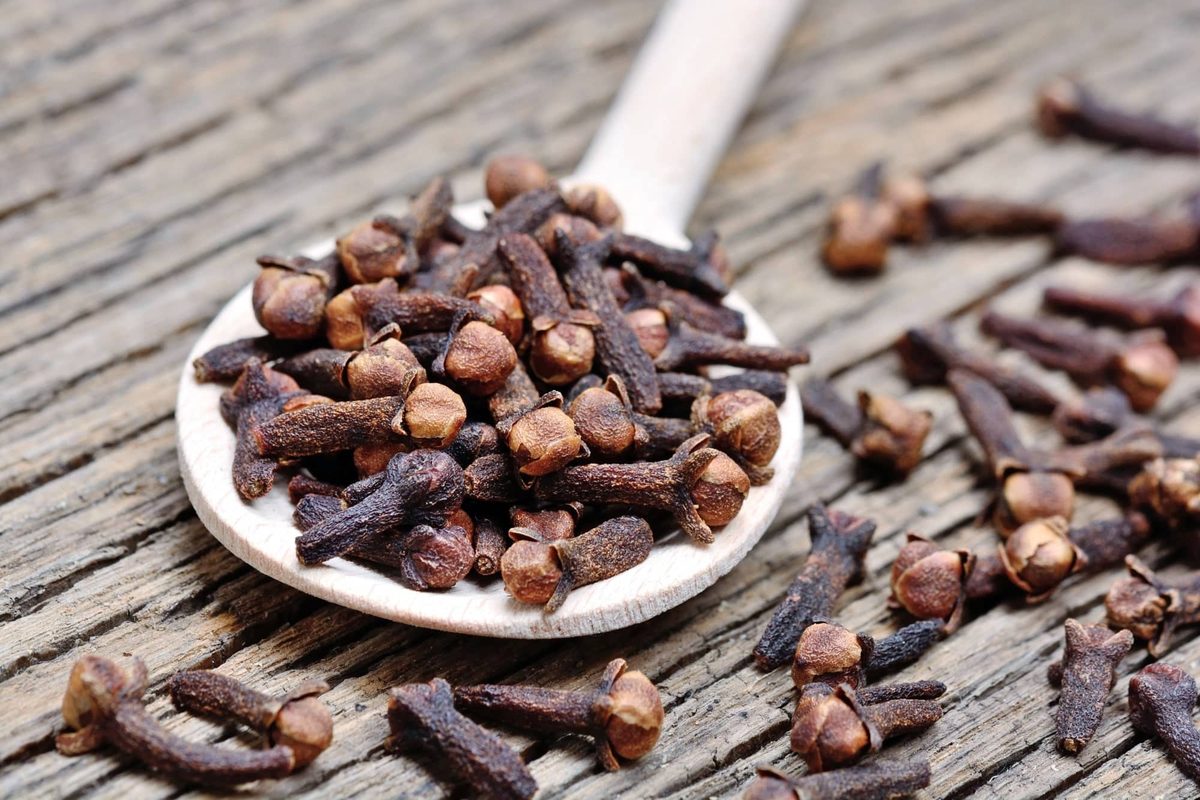
Cloves and cinnamon share a jar in many spice blends, but they come from different plant families and different plant parts. Cloves are the dried flower buds of Syzygium aromaticum, a tree of the myrtle family native to Indonesia’s Maluku islands.12 Cinnamon is the dried inner bark of Cinnamomum trees in the laurel family.34 Their flavor rests on different compounds: clove bud oil is 70 to 90% eugenol, while cinnamon bark oil is mostly cinnamaldehyde.256 There is one point of overlap. Ceylon cinnamon’s bark oil carries 5 to 18% eugenol, while cassia, the cinnamon most often sold in North America, has only traces.567
Side by side
| Cloves | Cinnamon | |
|---|---|---|
| Species | Syzygium aromaticum1 | Ceylon: Cinnamomum verum;4 Chinese cassia: C. aromaticum, often still cited as C. cassia8 |
| Family | Myrtaceae (myrtle family)1 | Lauraceae (laurel family)4 |
| Native range | Maluku, Indonesia1 | C. verum: Sri Lanka;4 C. aromaticum: southeast China to Vietnam8 |
| Plant | Shrub or tree of the wet tropics;1 Britannica gives an evergreen of about 25 to 40 feet9 | Trees; the spice is the inner bark3 |
| Part used | Flower bud, picked just before it opens and dried2 | Dried inner bark3 |
| What you buy | Whole buds or ground (common retail) | Sticks (quills) or ground; Ceylon bark is at most 0.5 cm thick and dull pale brown5 |
| Essential oil in the spice | 14 to 20% of the bud9 | No figure in the sources reviewed for this page |
| Leading oil compounds | Eugenol 70 to 90%, eugenyl acetate up to 17%2 | Ceylon: cinnamaldehyde 50 to 75%, eugenol 5 to 18%;5 Chinese cassia: cinnamaldehyde 70 to 95%, only traces of eugenol6 |
| Flavor | Britannica: strong in aroma, hot and pungent in taste;9 medicinal and faintly numbing, bitter in quantity (editorial) | Sweet, warm and woody (editorial); CBI calls Ceylon milder and finer than cassia10 |
| Typical uses | Meats and baked goods9 | Baked goods and sweets, hot drinks, mulled wine; garam masala and masala chai10 |
| Safety note | Clove oil, not the spice, carries an EU warning against use under 1811 | Coumarin in cassia;12 FDA lead alerts on specific ground cinnamon products13 |
| Cost | No dated, sourced price comparison found | No dated, sourced price comparison found |
The oil percentages come from different PROSEA entries for different spices. They show which compound leads each aroma, not how strong cloves are compared with cinnamon. For the individual spices, see cloves and cinnamon.
Bud and bark
A clove is a whole flower bud. PROSEA describes the harvest: the complete flower cluster is picked just before the first buds open, because picking early lowers the yield and picking late sharply lowers the oil content.2 What reaches the kitchen is the dried bud, used whole or ground.
Cinnamon is bark. The spice is the inner bark of the tree,3 and for Ceylon cinnamon PROSEA describes commercial bark no more than 0.5 cm thick, dull pale brown, with smaller pieces slid inside longer ones to build compound quills.5 Ceylon is the cinnamon the NIH calls “true,” but cassia is the type most commonly sold in North America.7 No source we opened describes retail cassia sticks; see Ceylon vs. cassia cinnamon.
Eugenol and cinnamaldehyde
Cloves. Britannica gives 14 to 20% essential oil in the buds.9 PROSEA puts eugenol at 70 to 90% of clove bud oil, with eugenyl acetate up to 17%,2 and a 2020 review gives eugenol as about 85 to 92% of clove oil.14 The same review notes that clove oil and eugenol have analgesic, anesthetic and antiseptic effects, which is why they are common in dentistry.14
Cinnamon is built on cinnamaldehyde, at 50 to 75% of Ceylon bark oil and 70 to 95% of Chinese cassia bark oil.56
Where they overlap. Ceylon bark oil also carries 5 to 18% eugenol, while Chinese cassia bark oil has only traces.56 So of the two cinnamons, Ceylon shares more with cloves. The other spice that does is allspice: PROSEA gives eugenol as 50 to 80% of allspice berry oil,15 and Britannica says allspice is so named because its flavor resembles a combination of cinnamon, nutmeg and cloves.16 See allspice vs. cloves.
A widely repeated description calls cloves camphoraceous and piney, with a eucalyptus note. The sources reviewed here do not describe cloves that way, and the main compounds they report are eugenol and eugenyl acetate,2 so this page does not repeat that description.
Where they meet
The two are partners more often than rivals:
- Chinese five-spice powder. Britannica lists fennel seed, cassia, cloves, star anise and Sichuan pepper.17 See Chinese five-spice powder.
- Garam masala. Great British Chefs lists cloves and cinnamon among the spices commonly used.18 See garam masala.
- Cincinnati chili. Saveur’s recipe uses cloves and cinnamon with allspice and nutmeg.19
- Pumpkin pie spice. Not always. McCormick’s lists cinnamon, ginger, nutmeg and allspice, with no cloves,20 so check any blend’s label.
Each also has its own jobs. Britannica says cloves flavor many foods, particularly meats and baked goods.9 Studding a ham with whole cloves and simmering them in mulled drinks are common kitchen practice. CBI notes that in Europe cinnamon goes mostly into baked goods and sweets, hot drinks, herbal infusions and mulled wine, and into Indian preparations such as garam masala and masala chai.10 By common practice it also goes into cinnamon rolls, cinnamon toast and oatmeal.
Safety
Cloves. We found no regulator that sets an amount at which cloves eaten in food become a concern. The line that matters is between the spice and clove oil. The European Medicines Agency’s monograph on clove oil, a traditional herbal medicine for minor mouth and throat inflammation and toothache, says its use in children and adolescents under 18 is not recommended.11 Clove oil is far more concentrated than the spice and does not belong in a recipe in place of ground cloves; that is our judgment. See cloves.
Cinnamon. Cassia can carry substantial coumarin. BfR puts the average in German monitoring at about 3 g per kg of cassia, and calculates that a 60 kg adult reaches the tolerable daily intake with about 2 g of cassia a day, a 15 kg child with about 0.5 g.12 That intake, 0.1 mg of coumarin per kg of body weight a day, is EFSA’s.21 Separately, a US FDA public health alert on ground cinnamon lists specific products with lead results from 2.03 to 7.68 parts per million.13 The cinnamon profile has the details.
Can one stand in for the other?
Not directly. Neither substitute page we reviewed lists the other spice on its own, and no source gives a ratio for a straight swap. The better routes are below, with each ratio labeled as on our substitute pages.
| If you are out of | Best route | Treatment | Starting amount |
|---|---|---|---|
| Cloves | Ground allspice, which shares eugenol | Attributed | 1 part per part of cloves: The Spice House says 1:1,22 and A Couple Cooks calls allspice a 1-for-1 substitute23 |
| Cloves, no allspice | Cinnamon with a little nutmeg | Method | The Spice House says the combination recreates the essence of cloves,22 but neither it nor any other source gives amounts. Start with about two parts cinnamon to one of nutmeg, slightly less in total than the cloves called for, and taste. |
| Cinnamon | Allspice or nutmeg | Attributed | 1/4 teaspoon per teaspoon of cinnamon: McCormick calls them “more powerful spices”,24 and The Spice House gives the same 1/4 for nutmeg and allspice25 |
| Cinnamon, only cloves on hand | Ground cloves | Method | No source gives a ratio. Cloves are the stronger spice in our judgment, so start with a pinch, about 1/8 of the cinnamon amount, in a spice mix or savory dish, and taste. Not for cinnamon-led recipes such as cinnamon rolls. |
Full rankings are on clove substitutes and cinnamon substitutes. For whole versus ground forms, see ground vs. whole cloves and ground cinnamon vs. cinnamon sticks.
What isn’t known
- No study compares the flavor strength of cloves and cinnamon. The Method amounts above are starting points.
- The oil figures come from separate entries and samples; no source analyzed both spices side by side.
- We found no essential-oil content figure for cinnamon bark in the sources reviewed, so the two spices’ oil content is not compared here.
- No dated, sourced retail price comparison was found.
- It is often said that whole cloves are studded into ham because they cut through fat. No source we found explains or tests that.
Related
- Cloves, cooking with cloves, clove substitutes and too much clove
- Cinnamon, Ceylon vs. cassia cinnamon, cinnamon substitutes and too much cinnamon
- Cinnamon vs. nutmeg, nutmeg vs. cloves, allspice vs. cloves and cloves vs. star anise
Footnotes
-
Syzygium aromaticum (L.) Merr. & L.M.Perry, Plants of the World Online, Royal Botanic Gardens, Kew. powo.science.kew.org · Reference work ↩ ↩2 ↩3 ↩4 ↩5
-
E.W.M. Verheij and C.H.A. Snijders, Syzygium aromaticum, Plant Resources of South-East Asia (PROSEA). uses.plantnet-project.org · Reference work ↩ ↩2 ↩3 ↩4 ↩5 ↩6 ↩7
-
Ranasinghe et al., “Medicinal properties of ‘true’ cinnamon (Cinnamomum zeylanicum): a systematic review”, 2013. link.springer.com · Peer-reviewed ↩ ↩2 ↩3 ↩4
-
Cinnamomum verum, Plants of the World Online, Royal Botanic Gardens, Kew. powo.science.kew.org · Reference work ↩ ↩2 ↩3 ↩4
-
Cinnamomum verum, PROSEA Handbook No. 13: Spices. prosea.prota4u.org · Reference work ↩ ↩2 ↩3 ↩4 ↩5 ↩6 ↩7
-
Cinnamomum (PROSEA Spices), Pl@ntUse. uses.plantnet-project.org · Reference work ↩ ↩2 ↩3 ↩4 ↩5
-
Cinnamon: Usefulness and Safety, NCCIH. nccih.nih.gov · Regulator ↩ ↩2
-
Cinnamomum aromaticum, Plants of the World Online, Royal Botanic Gardens, Kew. powo.science.kew.org · Reference work ↩ ↩2
-
“Clove”, Encyclopaedia Britannica, 2026. britannica.com · Reference work ↩ ↩2 ↩3 ↩4 ↩5 ↩6
-
“The European market potential for cinnamon”, CBI. cbi.eu · Reference work ↩ ↩2 ↩3
-
Community herbal monograph on Syzygium aromaticum, floris aetheroleum, European Medicines Agency, 2011. ema.europa.eu · Regulator ↩ ↩2
-
FAQ on coumarin in cinnamon and other foods, BfR. bfr.bund.de · Regulator ↩ ↩2
-
“More Ground Cinnamon Products Added to FDA Public Health Alert Due to Presence of Elevated Levels of Lead”, FDA. fda.gov · Regulator ↩ ↩2
-
Batiha et al., “Syzygium aromaticum L. (Myrtaceae): Traditional Uses, Bioactive Chemical Constituents, Pharmacological and Toxicological Activities”, Biomolecules, 2020. mdpi.com · Peer-reviewed ↩ ↩2
-
D. Sulistiarini, Pimenta dioica, Plant Resources of South-East Asia (PROSEA). uses.plantnet-project.org · Reference work ↩
-
“Allspice”, Encyclopaedia Britannica, 2026. britannica.com · Reference work ↩
-
Tony Hill, “Five-spice powder”, Encyclopaedia Britannica. britannica.com · Reference work ↩
-
“How to make garam masala”, Great British Chefs, 2025. greatbritishchefs.com · Publication ↩
-
“Cincinnati Chili”, Saveur. saveur.com · Publication ↩
-
McCormick Pumpkin Pie Spice, product page. mccormick.com · Merchant ↩
-
Coumarin in flavourings and other food ingredients with flavouring properties, EFSA AFC Panel, 2008. efsa.europa.eu · Regulator ↩
-
“Substitute for Cloves”, The Spice House, 2021. thespicehouse.com · Merchant ↩ ↩2
-
Sonja Overhiser, “Best Substitute for Cloves”, A Couple Cooks, 2026. acouplecooks.com · Publication ↩
-
“About Cinnamon: Uses, Pairings and Recipes”, McCormick, 2025. mccormick.com · Merchant ↩
-
“The 9 Best Cinnamon Substitutes”, The Spice House, 2018. thespicehouse.com · Merchant ↩