Cooking · Dish guide
The Best Seasonings for Clam Chowder: Pork, Aromatics, Thyme, Bay and Old Bay
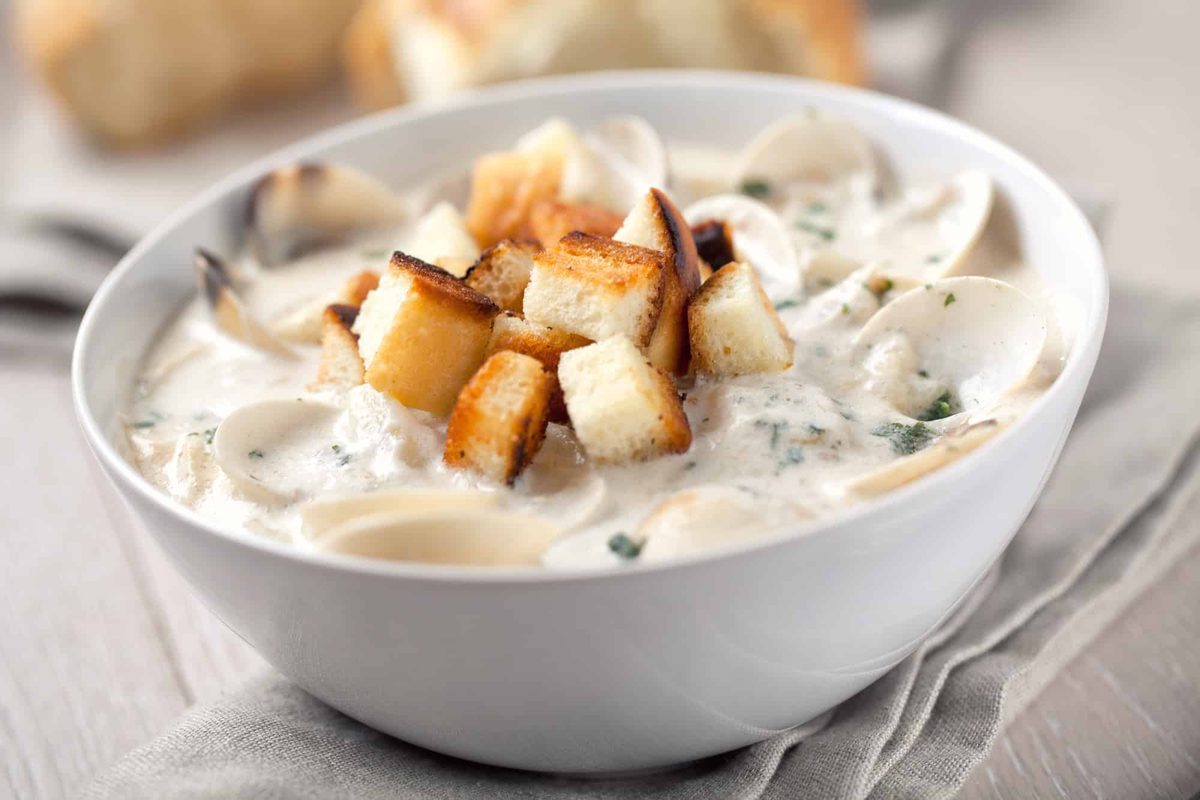
Clam chowder is not a heavily spiced soup. Most of its flavor comes from cured pork, onions, clams and their juice, and dairy, with a few herbs and spices in support: thyme, a bay leaf and black pepper in both modern recipes cited here, plus optional extras such as Old Bay, cayenne or celery seed. This page covers the job each one does and how the main styles differ. Quantities appear only where a named recipe gives them.
At a glance
| Seasoning | Job in the pot | Where it appears |
|---|---|---|
| Salt pork or bacon | Fat to cook the aromatics in; salty, cured base | Britannica’s standard New England list (salt pork); both recipes below123 |
| Onion | Sweet, savory base | Britannica’s standard list; both recipes123 |
| Celery (stalk or seed) | Green, savory depth | Both recipes; not in Britannica’s standard list123 |
| Clam juice | Briny backbone | Both recipes23 |
| Thyme | Herbal, slightly sharp note | Both recipes23 |
| Bay leaf | Subtle background | Both recipes23 |
| Black pepper | Gentle pungency | Both recipes, to taste23 |
| Cayenne, Old Bay, Worcestershire | Extra heat and complexity | One recipe (Hardy)2 |
What chowder is
Britannica defines chowder as a hearty North American soup usually made with fish or shellfish, especially clams, and traces the word to the French chaudière, “cauldron.”1 Its standard New England version contains fish or shellfish, salt pork, onions, potatoes and milk; Manhattan-style chowder uses tomatoes in place of the milk.1 Britannica also notes that 18th-century chowders often included “wine, spices, herbs, cider, and other flavourings,”1 so a seasoned chowder is not a modern departure.
The core seasonings and what each does
Salt pork or bacon: the cured base
Pork fat is where the aromatics cook. Britannica lists salt pork as standard in New England chowder.1 John Fink’s recipe for Foodwise calls for 2 ounces of pork fat or salt pork, cooked slowly until lightly crisp,3 while Ryan Hardy’s recipe in the James Beard Foundation archive starts with ½ pound of diced bacon.2 In our judgment, salt pork gives a cleaner pork flavor and smoked bacon adds smoke; both appear in recipes from established sources, so the choice is a matter of taste.
Onion and celery: the aromatic base
Onion is in Britannica’s standard list and in both recipes cited here; Fink specifies yellow onions.13 Celery is in both recipes (three stalks for Hardy, a whole head for Fink, who also adds a teaspoon of celery seed) but not in Britannica’s list,123 so it is common rather than defining. In our kitchen judgment, cooking both slowly in the pork fat before any liquid goes in softens their sharpness and gives the soup its savory base.
Clam juice: the briny backbone
Both recipes use clam juice as part of the liquid: 2½ cups of fresh or bottled juice for Hardy, 2 to 3 cups for Fink.23 It carries the sea flavor further than the chopped clams alone, and since bottled juice is salty, it is worth tasting before adding more salt (our advice, not a measured figure).
Thyme: the herbal note
Thyme appears in both recipes: 1 tablespoon of chopped fresh thyme in Hardy’s, ½ teaspoon of chopped leaves in Fink’s.23 The characteristic constituents of thyme oil are thymol and carvacrol,4 which give the herb its sharp, slightly medicinal edge. America’s Test Kitchen classes thyme as a hearty herb whose volatile flavor compounds are somewhat more heat-stable, so it can go in early.5 For more, see cooking with thyme and fresh vs. dried thyme; if it takes over, see too much thyme.
Bay leaf: subtle background
Each recipe uses one bay leaf.23 Take it out before serving: J. Kenji López-Alt compares eating a dried bay leaf to eating a fish bone.6 If you have none, see bay leaf substitutes.
Black pepper: gentle heat
Both recipes season with salt and freshly ground black pepper to taste at the end.23 Pepper’s flavor comes principally from piperine.7 If you would rather not have dark specks in a white soup, white pepper is an option (our suggestion; the recipes here use black). See white pepper vs. black pepper.
Optional extras
Old Bay seasoning
Old Bay is a Baltimore blend, not a traditional chowder ingredient, but Hardy’s recipe uses ½ teaspoon of it along with a pinch of cayenne and ½ teaspoon of Worcestershire sauce, added with the thyme, bay leaf and clams.2
McCormick’s label for Old Bay Classic Seafood Seasoning lists: “Celery Salt (Salt, Celery Seed), Spices (Including Red Pepper and Black Pepper), and Paprika.”8 The full spice list is not disclosed. According to Baltimore Heritage, the blend was created in 1939 by Gustav Brunn, a Jewish immigrant who had escaped Nazi Germany, at his Baltimore Spice Company across from the city’s wholesale fish market; it was named for the Old Bay steamship line, and the rights to the recipe were sold to McCormick in 1990.9 Brunn’s son recalled the blend including “the most unlikely things, including cinnamon and nutmeg and cloves.”9 Other spices often said to be in it are not confirmed by any source found.
Because the label lists paprika and red pepper,8 a heavy hand will tint a white chowder. In our judgment, a small amount, as in Hardy’s ½ teaspoon, seasons without much color change. For more on the blend, see Old Bay seasoning and Old Bay vs. Creole seasoning.
Other additions in the recipes
Fink’s recipe adds chopped oregano, leeks, smoked shrimp, lemon juice and chopped chives to finish.3 These are one cook’s choices, not part of a standard.
Two recipes side by side
| Recipe | Pork | Aromatics | Herbs and spices | Other seasoning |
|---|---|---|---|---|
| Ryan Hardy, James Beard Foundation archive2 | ½ lb bacon | 1½ onions, 3 celery stalks | 1 tbsp fresh thyme, 1 bay leaf, pinch cayenne, ½ tsp Old Bay, salt and pepper | ½ tsp Worcestershire, 2½ cups clam juice |
| John Fink, The Whole Beast, via Foodwise3 | 2 oz pork fat or salt pork | 3 yellow onions, 1 head celery, 2 leeks | 1 tsp celery seed, 1 bay leaf, ½ tsp thyme, ½ tsp oregano, salt and pepper, chives | 2 to 3 cups clam juice, 4 tbsp lemon juice |
These are the named cooks’ recipes, not a house standard.
When to add each seasoning
No source gives one rule, so this is method drawn from the recipes above:
- Pork: first, cooked until it gives up its fat.23
- Onion, celery: next, cooked in the pork fat.
- Thyme, bay, Old Bay, cayenne: with the liquid and clams, then simmered (Hardy).2
- Salt and pepper: at the end, to taste, since pork and clam juice both bring salt.23
Related
Footnotes
-
Chowder, Encyclopaedia Britannica. britannica.com · Reference work ↩ ↩2 ↩3 ↩4 ↩5 ↩6 ↩7 ↩8 ↩9
-
New England Clam Chowder, Ryan Hardy, James Beard Foundation recipe archive. archive.jamesbeard.org · Publication ↩ ↩2 ↩3 ↩4 ↩5 ↩6 ↩7 ↩8 ↩9 ↩10 ↩11 ↩12 ↩13 ↩14 ↩15 ↩16 ↩17 ↩18 ↩19
-
New England Clam Chowder, John Fink (The Whole Beast), Foodwise. foodwise.org · Publication ↩ ↩2 ↩3 ↩4 ↩5 ↩6 ↩7 ↩8 ↩9 ↩10 ↩11 ↩12 ↩13 ↩14 ↩15 ↩16 ↩17 ↩18
-
Thymus vulgaris (PROSEA), S.H. Widodo, via Pl@ntUse. uses.plantnet-project.org · Reference work ↩
-
Our Guide to Fresh Herbs, Liz Bomze, America’s Test Kitchen, 2019. americastestkitchen.com · Publication ↩
-
Bay leaves are an optional ingredient, David Leite with J. Kenji López-Alt, The Splendid Table, 2014. splendidtable.org · Publication ↩
-
Black pepper, Encyclopaedia Britannica. britannica.com · Reference work ↩
-
OLD BAY Classic Seafood Seasoning, product page, McCormick & Company. mccormick.com · Merchant ↩ ↩2
-
Gustav Brunn’s Baltimore Spice Company, Baltimore Heritage. explore.baltimoreheritage.org · Reference work ↩ ↩2