Spice Comparisons · Comparison
Fresh Thyme vs. Dried Thyme: Flavor, Conversions and When to Use Each
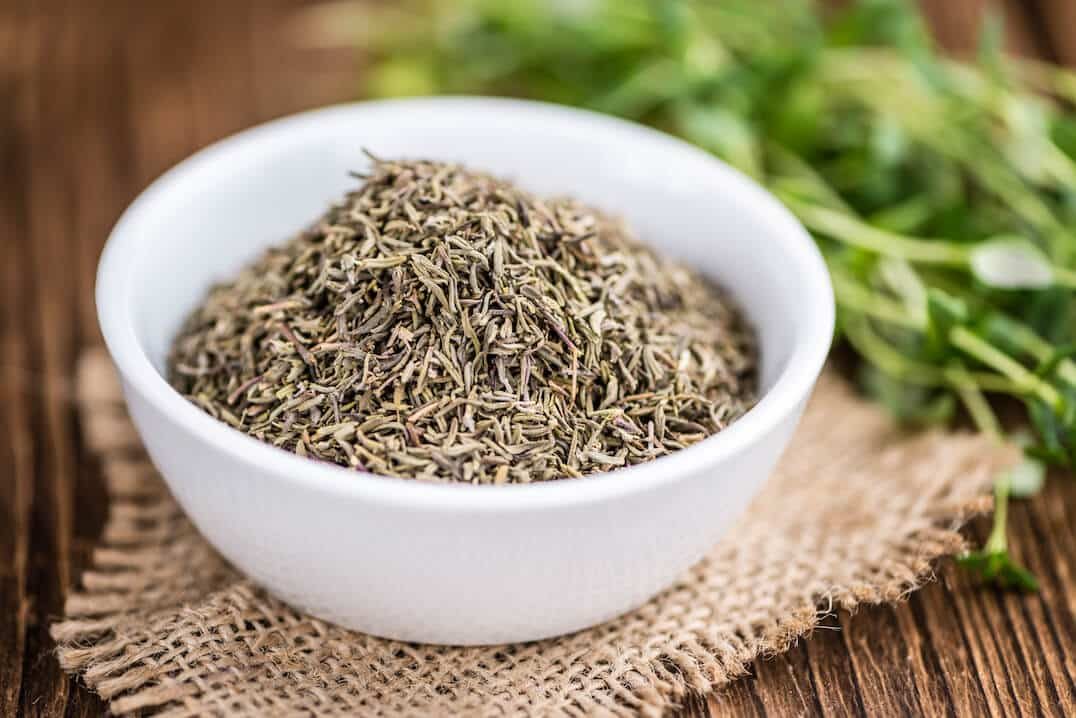
Fresh and dried thyme are the same herb, usually common thyme, Thymus vulgaris, a mint-family plant native to southwestern Europe and southeastern Italy.1 Thyme is one of the herbs that dries well: in America’s Test Kitchen’s tests, dried thyme fared reasonably well in long-cooked dishes with plenty of liquid.2 The differences that matter are how much to use, when to add it, and what drying takes out.
Side by side
| Fresh thyme | Dried thyme | |
|---|---|---|
| Plant | Thymus vulgaris (common thyme), family Lamiaceae1 | Same plant, dried leaves, sold whole-leaf or ground3 |
| Key compounds | PROSEA names thymol and carvacrol as the oil’s characteristic constituents;4 one 2023 analysis of common thyme oil found 42.44% thymol5 | Same compounds; gentle drying lost little volatile oil in one study, drying at 60°C significantly more6 |
| Water | 65.1 g per 100 g7 | 7.79 g per 100 g3 |
| Weight of 1 teaspoon | 0.8 g7 | 1.0 g leaves; 1.4 g ground3 |
| Vitamin C | 160 mg per 100 g7 | 50 mg per 100 g3 |
| Flavor (editorial) | Brighter and greener, with a faint lemony lift | Deeper and more savory, less bright |
| In cooking | A hearty herb: add early8 | Best in dishes cooked more than 20 minutes with a good amount of liquid2 |
| Storage | Refrigerate in its packaging or an open zipper-lock bag8 | Airtight and away from air, light, moisture and heat; one extension service gives 1 year for ground spices and herbs9 |
The USDA figures come from separate samples, not one batch measured before and after drying.
What drying does to thyme
America’s Test Kitchen puts thyme on its list of herbs worth keeping dried, with oregano, sage, rosemary and marjoram.10 It explains the split between herbs this way: the volatile flavor compounds in hearty herbs such as thyme are somewhat more heat-stable than those in delicate herbs.8 Even so, its tasters preferred fresh herbs in all but one application.2
A 1997 study of thyme and sage compared fresh herbs with freeze-dried and oven-dried samples. The amount of extracted volatiles dropped significantly only when the herbs were dried at 60°C, mostly through the loss of non-oxygenated monoterpenes.6 The headspace aroma of thyme changed in more complicated ways, with aroma compounds actually highest in the herb dried at 60°C.6 In short, drying changes thyme’s aroma but does not simply strip it.
Vitamins. USDA lists 160 mg of vitamin C per 100 g of fresh thyme and 50 mg per 100 g of dried.73 Correcting for water (our arithmetic), the dried sample carries roughly an eighth of the fresh sample’s vitamin C per gram of solids. Because the samples are separate, treat that as an indication, not a measured loss. At the teaspoon-or-so you use in a dish, neither form is a meaningful vitamin source.
How much dried thyme replaces fresh?
The sources agree more closely for thyme leaves than for ground thyme.
| Source | Fresh | Dried leaves | Ground |
|---|---|---|---|
| America’s Test Kitchen (tested) | 3 parts | 1 part2 | not given |
| The Spice House (thyme) | 3 parts | 1 part11 | not given |
| LSU AgCenter (all herbs) | 1 tablespoon, finely cut | 1 teaspoon crumbled12 | not given |
| University of Delaware (all herbs) | 2 to 3 teaspoons | 3/4 to 1 teaspoon crumbled13 | not given |
| NDSU Extension (all herbs) | 1 tablespoon | 1 teaspoon | 1/2 teaspoon14 |
| Penn State Extension (all herbs) | 1 tablespoon | 1 teaspoon | 1/4 teaspoon15 |
Dried leaves (Computed and Attributed): 1 teaspoon of dried thyme leaves per tablespoon of fresh leaves. America’s Test Kitchen found that 1 part dried to 3 parts fresh came closest to equal flavor,2 and every other source above lands at or near the same figure. USDA’s data point the same way. A tablespoon of fresh thyme weighs about 2.4 g, of which about 0.84 g is solids; a teaspoon of dried leaves holds about 0.92 g of solids (our arithmetic from USDA weights and water content).73 Equal solids are not equal flavor, since drying moves aroma compounds around,6 but the arithmetic and the tasting agree.
Ground thyme (Disputed): NDSU gives 1/2 teaspoon of ground herb per tablespoon of fresh,14 Penn State 1/4 teaspoon.15 By USDA weights, a teaspoon of ground thyme holds about 1.29 g of solids, so matching a tablespoon of fresh by solids would take about 2/3 teaspoon (our arithmetic),73 more than either source suggests. None of these figures was tasted. Our Method starting point: 1/4 teaspoon of ground thyme per tablespoon of fresh, then taste and add.
Sprigs. We found no published conversion from thyme sprigs to dried thyme. Sprig size varies too much for a reliable number; strip the leaves and measure them instead.
Old jars. The University of Delaware says to crush dried herbs first to release some of their oils.13 If your dried thyme smells faint, it will need more than the table suggests; no source puts a number on that.
When to add it
America’s Test Kitchen says to add hearty herbs like thyme early in cooking.8 The University of Delaware notes that extended cooking costs herbs flavor and advises adding them in the last 45 minutes of a long simmer.13 On that advice, thyme for a braise that cooks for hours can go in partway through rather than at the start. For most soups, stews and sauces, adding it with the liquid works. Thyme is also one of the three herbs in the classic bouquet garni, with parsley and a bay leaf, tied together and added to soups, stews, sauces and poaching liquids.16
Which to use
- Fresh for finishing, for roasting with meat or vegetables where the sprigs are visible, and for dishes cooked briefly. This is common practice.
- Dried for long-cooked soups, stews, beans and braises with liquid, which is where it performed well in testing,2 and in dry rubs and spice blends (common practice).
- Both forms are standard: PROSEA describes thyme as used fresh and dried as a condiment and culinary herb.4
What isn’t known
- No published conversion for sprigs of thyme, fresh or dried.
- The fresh-to-ground figure is disputed and untested.
- How long fresh thyme keeps in the refrigerator: the “about a week” often quoted has no traceable source.
- No sensory study compares fresh and dried thyme in the same dish beyond America’s Test Kitchen’s general herb tests.
Related
- Thyme, thyme substitutes and too much thyme
- Dried herbs vs. fresh: the general rules for every herb
- How to store thyme, can you freeze thyme?, cooking with thyme and thyme uses
- Fresh sage vs. dried, fresh oregano vs. dried and dried rosemary vs. fresh
- Lemon thyme and thyme vs. lemon thyme
Footnotes
-
Thymus vulgaris L., Plants of the World Online, Royal Botanic Gardens, Kew. powo.science.kew.org · Reference work ↩ ↩2
-
“Science: Substituting Dried Herbs for Fresh”, America’s Test Kitchen. americastestkitchen.com · Publication ↩ ↩2 ↩3 ↩4 ↩5 ↩6
-
Spices, thyme, dried, FDC ID 170938, USDA FoodData Central. fdc.nal.usda.gov · Regulator ↩ ↩2 ↩3 ↩4 ↩5 ↩6 ↩7
-
S.H. Widodo, Thymus vulgaris, Plant Resources of South-East Asia (PROSEA). uses.plantnet-project.org · Reference work ↩ ↩2
-
Dong et al., “Chemical Compositions of Essential Oil Extracted from Eight Thyme Species”, Plants, 2023. mdpi.com · Peer-reviewed ↩
-
Venskutonis, “Effect of drying on the volatile constituents of thyme and sage”, Food Chemistry, 1997 (abstract). agris.fao.org · Peer-reviewed ↩ ↩2 ↩3 ↩4
-
Thyme, fresh, FDC ID 173470, USDA FoodData Central. fdc.nal.usda.gov · Regulator ↩ ↩2 ↩3 ↩4 ↩5 ↩6
-
Liz Bomze, “Our Guide to Fresh Herbs”, America’s Test Kitchen, 2019. americastestkitchen.com · Publication ↩ ↩2 ↩3 ↩4
-
Anna Martin, “Add a Little Spice to Your Life! Part II”, University of California Cooperative Extension, 2002. ucanr.edu · Reference work ↩
-
Danielle Lapierre, “When You Should Actually Use Dried Herbs (and Which Ones to Avoid)”, America’s Test Kitchen, 2022. americastestkitchen.com · Publication ↩
-
“The 11 Best Thyme Substitutes”, The Spice House, 2018. thespicehouse.com · Merchant ↩
-
“Flavorful Herbs”, LSU AgCenter. lsuagcenter.com · Reference work ↩
-
“Using Herbs and Spices”, University of Delaware Cooperative Extension, 2025. udel.edu · Reference work ↩ ↩2 ↩3
-
Julie Garden-Robinson, Ingredient Substitutions (FN198), NDSU Extension, 2018. ksre.ksu.edu · Reference work ↩ ↩2
-
Stacy Reed, “Preserving Herbs by Drying”, Penn State Extension, 2024. extension.psu.edu · Reference work ↩ ↩2
-
“Bouquet garni”, Encyclopaedia Britannica. britannica.com · Reference work ↩