Seasonings · Profile
Old Bay Seasoning: What’s in It, Where It Came From, and How Hot and Salty It Is
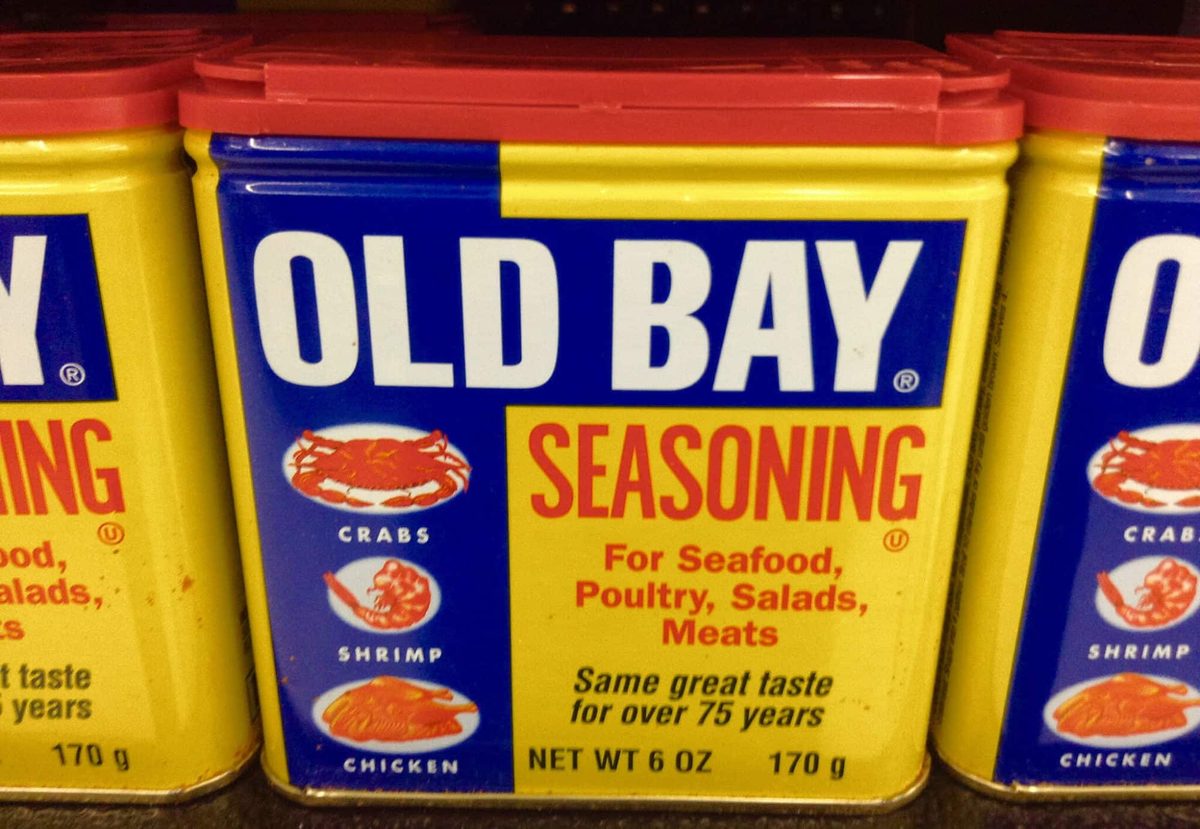
Old Bay is a seasoning of celery salt, paprika, red and black pepper and a list of other spices that McCormick does not publish in full.1 It was created in Baltimore in 1939 by Gustav Brunn, a Jewish spice merchant who had escaped Nazi Germany, for the city’s crab steamers, and it has been owned by McCormick since 1990.2 This page covers what the label says, the history, how salty and hot it is, and how to use it.
At a glance
| What it is | A seafood seasoning blend sold by McCormick1 |
| Label ingredients | Celery salt (salt, celery seed), spices including red and black pepper, and paprika1 |
| Number of spices | “18 herbs and spices” plus celery salt and paprika, per McCormick1 |
| Created | 1939, Baltimore, by Gustav Brunn2 |
| Named for | The Old Bay steamship line out of Baltimore2 |
| Sodium | 125 mg per 1/4 teaspoon (0.6 g); 85 mg in the 30% less sodium version34 |
| Heat | 1,000 to 1,500 Scoville heat units on Dave DeWitt’s heat scale5 |
| Allergen note | Contains celery, a labeled allergen in the EU16 |
Measured values
3 figures, sourced| Measure | Value | Scope | Source |
|---|---|---|---|
| Sodium Nutrient | 125 mg per 1/4 teaspoon (0.6 g) serving | Classic Old Bay, 16 oz, Nutrition Facts via retailer listing (5% Daily Value)Company's own figures. | shoprite.com |
| Sodium Nutrient | 85 mg per serving | Old Bay 30% Less Sodium version, Nutrition Facts via retailer listingCompany's own figures. | shoprite.com |
| Heat (pungency) Conventional range | 1,000 to 1,500 Scoville heat units | Old Bay as a product on Dave DeWitt's 2008 heat scaleA general rating, not a lab measurement of a particular tin. | fieryfoodscentral.com |
Each figure is quoted as its source states it, with the samples or standard it applies to. Where sources differ, both are shown; nothing is averaged. All measured values
What is in it
McCormick’s label lists only three items: celery salt (salt and celery seed), “spices (including red pepper and black pepper)”, and paprika.1 The company describes the blend as celery salt, 18 herbs and spices, and paprika,1 but does not name the other spices. Widely repeated lists of Old Bay’s ingredients, including bay leaf, cardamom, mustard, cloves, mace and ginger, are not confirmed by the label, which names only celery seed, red pepper, black pepper and paprika.
One hint comes from Brunn’s son, who told Baltimore Heritage that his father added small amounts of “the most unlikely things, including cinnamon and nutmeg and cloves.”2 That is family recollection of the original, not a published recipe.
The reduced-sodium version lists its ingredients differently, as spices (including paprika, celery seed, red pepper and black pepper) and salt.4 McCormick says it has the same flavor as the classic.4
History
Gustav Brunn was a spice merchant in Germany. Under the Nazis he was among those captured and sent to the Buchenwald camp; his family secured his release by paying 10,000 marks to a lawyer, and he left for the United States with his children.2 He brought little with him but insisted on taking his hand-crank spice grinder.2 The family arrived in Baltimore in 1939.2
In Baltimore, Brunn worked at McCormick until he was fired, which Baltimore Heritage attributes to his being Jewish.2 He then opened the Baltimore Spice Company, with a shop at 26 Market Place directly across from the wholesale fish market.2 The company developed a seasoning for crabs, and Brunn named it after the Old Bay steamship line.2
The blend was slow to sell at first; business picked up after Brunn handed out samples to the crab steamers.2 In 1990 the company sold the rights to the original recipe to McCormick.2
Dates. Baltimore Heritage says Brunn created Old Bay in 1939, and elsewhere in the same article that his company began developing a crab seasoning around 1940.2 McCormick calls Old Bay a kitchen staple since 1939.1 We use 1939.
We found no source for the claim that Brunn’s wife bribed camp guards, for the claim that he was dismissed from McCormick because he spoke no English, or for McCormick’s recipe being unchanged since 1939.
Flavor
Old Bay tastes salty and savory first, with celery seed’s green, slightly bitter note, a gentle pepper heat, and a warm background from the unnamed spices. That description is ours. Of the named ingredients:
- Paprika gives the red-orange color; capsanthin and capsorubin are the main red pigments, per the FAO/WHO expert committee’s paprika extract assessment.7
- Black pepper’s characteristic flavor comes mainly from piperine, according to Britannica.8
- Red pepper is, in our reading of the label, the main source of heat.
How hot is it? Dave DeWitt’s heat scale places Old Bay in the 1,000 to 1,500 Scoville band, alongside ancho and pasilla chiles.5 That is a general rating, not a lab measurement of a particular tin, but it puts Old Bay at the mild end of chile heat.
How it is used
McCormick sells Old Bay as a seafood seasoning and suggests it on fries and roasted vegetables, and on pizza, popcorn and burgers.1 It began as a seasoning for the crabs sold by Baltimore’s crab steamers.2 It also turns up in chowders: chef Ryan Hardy’s New England clam chowder for the James Beard Foundation adds Old Bay with the thyme, bay leaf and cayenne.9
Other common uses, such as rimming a Bloody Mary glass, seasoning potato chips and corn on the cob, or going into barbecue rubs, are kitchen practice rather than sourced findings. Because the first ingredient is celery salt, Old Bay seasons as well as flavors: when you add it, cut back on other salt. That is cooking judgment based on the label.1
Sodium and allergens
Sodium. A 1/4 teaspoon serving (0.6 g) of the classic blend carries 125 mg of sodium, 5% of the Daily Value, per its Nutrition Facts.3 The 30% less sodium version has 85 mg per serving.4 The WHO recommends that adults stay below 2,000 mg of sodium a day.10
Celery allergy. Celery seed is in the blend.1 Celery is one of the allergens listed in Annex II of the EU food information regulation.6 In the United States celery is not one of the major food allergens the FDA lists, so US labels need not flag it.11 Anyone with a celery allergy should avoid Old Bay.
Nutrition and health claims
At a quarter teaspoon, Old Bay supplies salt and flavor and almost nothing else. Claims that it provides meaningful vitamins, minerals or antioxidants, or that its ingredients help with arthritis, digestive problems or depression, are not supported by any source we reviewed, and this page makes no health claims for it.
Storage
Store it like other ground seasonings, tightly closed and away from heat and light. No shelf-life figure from a regulator or standards body was found.
Substitutes and comparisons
- Old Bay vs. Creole seasoning
- Creole seasoning and Cajun seasoning
- The named ingredients: celery salt, celery seeds, paprika, black pepper, cayenne pepper
- Spices often guessed to be in it: bay leaves, mustard powder, cardamom, nutmeg, cloves, cinnamon
- Dishes: clam chowder spices and hash brown spices
Footnotes
-
OLD BAY Classic Seafood Seasoning, McCormick & Company. mccormick.com · Merchant ↩ ↩2 ↩3 ↩4 ↩5 ↩6 ↩7 ↩8 ↩9 ↩10 ↩11
-
Francesca Cohen, “Gustav Brunn’s Baltimore Spice Company”, Explore Baltimore Heritage, 2022. explore.baltimoreheritage.org · Publication ↩ ↩2 ↩3 ↩4 ↩5 ↩6 ↩7 ↩8 ↩9 ↩10 ↩11 ↩12 ↩13 ↩14
-
Old Bay Seasoning, 16 oz, Nutrition Facts and ingredients via ShopRite. shoprite.com · Merchant ↩ ↩2
-
Old Bay 30% Less Sodium Seasoning, Nutrition Facts and description via ShopRite. shoprite.com · Merchant ↩ ↩2 ↩3 ↩4
-
Dave DeWitt, “Heat Scale Updated”, Fiery Foods & Barbecue Central, 2008. fieryfoodscentral.com · Publication ↩ ↩2
-
Regulation (EU) No 1169/2011, Annex II, EUR-Lex. eur-lex.europa.eu · Regulator ↩ ↩2
-
“Paprika extract”, Chemical and Technical Assessment, 77th JECFA, FAO/WHO. fao.org · Regulator ↩
-
“Black pepper”, Encyclopaedia Britannica. britannica.com · Reference work ↩
-
Ryan Hardy, “New England Clam Chowder”, James Beard Foundation recipe archive. archive.jamesbeard.org · Publication ↩
-
“Sodium reduction”, World Health Organization fact sheet, 2026. who.int · Regulator ↩
-
“Food Allergies”, U.S. Food and Drug Administration. fda.gov · Regulator ↩