Blog · Profile
Is Ginger Spicy? What Makes Ginger Hot, and How Cooking, Drying and Age Change It
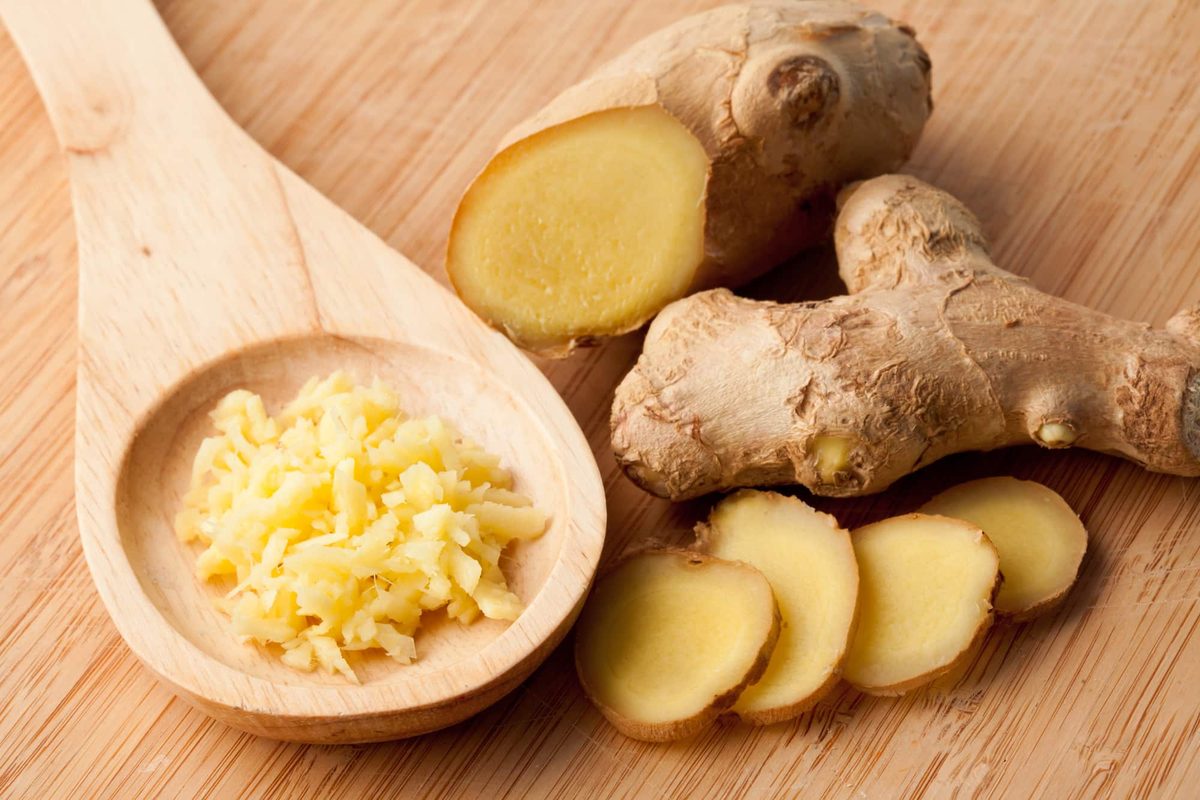
Yes, ginger is spicy, though not in the same way chiles are. Its burn comes from gingerols, shogaols and zingerone, compounds that a 2019 study found act on TRPV1, the same heat-sensing channel that capsaicin from chile peppers activates.1 Raw ginger, cooked ginger, dried ginger and young ginger all deliver that heat to different degrees, and on one point, whether heating ginger makes it hotter or milder, the sources disagree. This page goes through what is known.
At a glance
| Question | Short answer |
|---|---|
| Is ginger hot? | Yes: Kew calls gingerol, gingeridione and shogaol ginger’s pungent principles2 |
| Same as chile heat? | Same receptor (TRPV1), different compounds13 |
| Fresh vs. cooked or dried | Heat turns gingerols into shogaols and zingerone; sources disagree on whether that raises or lowers the burn456 |
| Young vs. mature | Young ginger is milder; mature ginger has more heat7 |
| How hot, in numbers? | No published Scoville-style measurement of ginger found |
What makes ginger hot
Kew’s Plants of the World Online names the pungent principles of ginger as gingerol, gingeridione and shogaol, all non-volatile phenolic compounds.2 Gernot Katzer’s Spice Pages likewise puts ginger’s pungency in a non-volatile resin and names zingerone, gingerols and shogaols as its compounds.6 Ginger’s aroma is a separate matter, covered on the ginger profile.
The chile connection
The old line that gingerol is “related to capsaicin” holds up, with a specific meaning. Yin and colleagues, writing in the British Journal of Pharmacology in 2019, describe ginger and chile as producing their pungency through a group of vanilloid compounds, and found that the potency of 6-shogaol, gingerol and zingerone depends on the same two residues in the TRPV1 channel that matter for capsaicin; computer modeling placed the ginger compounds in binding poses similar to capsaicin’s.1 Chile heat itself comes from capsaicinoids.3
Black pepper works on the same receptor: piperine activates human TRPV1 but is a much less potent activator than capsaicin in laboratory tests.8 No source we found compared ginger’s heat with chile’s on a common scale, so “much milder than capsaicin” remains a cook’s impression rather than a measured fact.
Raw, cooked and dried ginger: the sources disagree
Everyone agrees that heat changes ginger’s pungent compounds. As early as 1969, Connell and Sutherland reported that shogaol and zingerone appear to be absent from fresh ginger and are formed when alkali or heat acts on gingerol.4 A 2025 study of spray-dried ginger extract found the same chemistry at work: during thermal processing, 6-gingerol loses water to become 6-shogaol, which its authors describe as raising overall pungency, while zingerone rose as gingerols broke down.5
Where the sources part ways is what that does to the burn you taste:
| Source | What it says about heat and pungency |
|---|---|
| Warren-Walker et al., 2025 (spray-dried extract, lab)5 | Converting 6-gingerol to 6-shogaol increases ginger’s pungency |
| Gernot Katzer’s Spice Pages6 | Gingerols degrade over time to the milder shogaols; high gingerol content and good pungency indicate freshness |
| Katzer, on cooking6 | Cooking fresh ginger increases its pungency but decreases its freshness; frying chopped ginger gives way to a mellow, mild, rich flavor |
| Katzer, on dried ginger6 | Dried ginger tastes more aromatic than pungent and cannot substitute for fresh |
These are not the same experiment. The 2025 study measured an industrial drying process and did not taste the result against fresh ginger;5 Katzer is describing ginger as cooks use it.6 The widely repeated claim that drying “doubles” ginger’s heat could not be traced to any source we could open, and no source we found measured the heat of supermarket ground ginger against fresh.
In practice, the difference between fresh and ground ginger is large enough that they don’t swap one for one. See fresh ginger vs. ground ginger.
Does ginger get hotter as it ages?
On the plant, yes. Tasting Table describes young ginger, harvested about eight months after planting, as mild and delicate with an almost floral sweetness and soft, nearly translucent skin; mature ginger, usually harvested after a year, has a stronger taste, a “potent yet pleasant heat,” thicker skin and more fibrous flesh.7 Young ginger suits dishes that need only a hint of ginger heat.7
After harvest, Katzer treats strong pungency as a sign of freshness, because gingerols degrade over time.6 We found no measurement of how fast a knob of fresh ginger loses its bite in the refrigerator.
Can you tone down ginger’s heat?
- Use young ginger when you want ginger flavor with little burn.7
- Fry it. Katzer says chopped ginger fried in oil loses its hot, spicy taste to a mellow, mild flavor.6 Note that he also says fresh ginger that is cooked increases in pungency, so the method matters.6
- Dilute it. Adding more of the other ingredients lowers the concentration of ginger in each bite. That is simple dilution, not a chemical fix.
- Sweetness for bitterness. If over-browned ground ginger has turned a dish bitter, a laboratory study of taste mixtures found that sweeteners suppress bitterness.9 We found no source showing that sugar neutralizes ginger’s pungent compounds.
For a dish that has gone too far, see too much ginger.
Can ginger’s heat hurt?
NIH’s National Center for Complementary and Integrative Health lists side effects of ginger taken by mouth that include heartburn and mouth and throat irritation.10 Kew notes that ginger may cause allergic reactions when applied to the skin.2
Where ginger comes from
Ginger’s wild origin is uncertain: Kew gives its native range as the eastern Himalaya to south-central China and says it is possibly native to India.2 It reached the classical Mediterranean early; the Greek physician Dioscorides, writing between 50 and 70 CE, described it as warming and digestive.11 The full history is on the ginger profile.
Related
- Ginger: the full profile
- Cooking with ginger
- Fresh ginger vs. ground ginger
- Ginger substitutes
- Too much ginger
- How to store ginger
- Garlic vs. ginger, galangal vs. ginger, turmeric vs. ginger
- Other pungent spices: black pepper, cayenne pepper, horseradish
Footnotes
-
Yin et al., “Structural mechanisms underlying activation of TRPV1 channels by pungent compounds in gingers”, British Journal of Pharmacology, 2019. escholarship.org · Peer-reviewed ↩ ↩2 ↩3
-
Zingiber officinale Roscoe, Plants of the World Online, Royal Botanic Gardens, Kew. powo.science.kew.org · Reference work ↩ ↩2 ↩3 ↩4
-
Bosland and Walker, “Measuring Chile Pepper Heat”, New Mexico State University, 2010. pubs.nmsu.edu · Reference work ↩ ↩2
-
Connell and Sutherland, “A re-examination of gingerol, shogaol, and zingerone, the pungent principles of ginger”, Australian Journal of Chemistry, 1969. publish.csiro.au · Peer-reviewed ↩ ↩2
-
Warren-Walker et al., “Effect of Thermal Processing by Spray Drying on Key Ginger Compounds”, Metabolites, 2025. pmc.ncbi.nlm.nih.gov · Peer-reviewed ↩ ↩2 ↩3 ↩4
-
Ginger, Gernot Katzer’s Spice Pages. gernot-katzers-spice-pages.com · Reference work ↩ ↩2 ↩3 ↩4 ↩5 ↩6 ↩7 ↩8 ↩9
-
September Grace Mahino, “Young Ginger Vs Mature: What’s The Difference?”, Tasting Table, 2023. tastingtable.com · Publication ↩ ↩2 ↩3 ↩4
-
McNamara, Randall and Gunthorpe, “Effects of piperine, the pungent component of black pepper, at the human vanilloid receptor (TRPV1)”, British Journal of Pharmacology, 2005. pmc.ncbi.nlm.nih.gov · Peer-reviewed ↩
-
Green et al., “Taste Mixture Interactions: Suppression, Additivity, and the Predominance of Sweetness”, Physiology & Behavior, 2010. pmc.ncbi.nlm.nih.gov · Peer-reviewed ↩
-
“Ginger: Usefulness and Safety”, National Center for Complementary and Integrative Health, 2025. nccih.nih.gov · Regulator ↩
-
Jeff Koehler, “Spice Migrations: Ginger”, AramcoWorld, 2021. aramcoworld.com · Publication ↩