Spice Comparisons · Comparison
Garlic vs. Ginger: Unrelated Plants, Different Pungent Chemistry, Frequent Partners
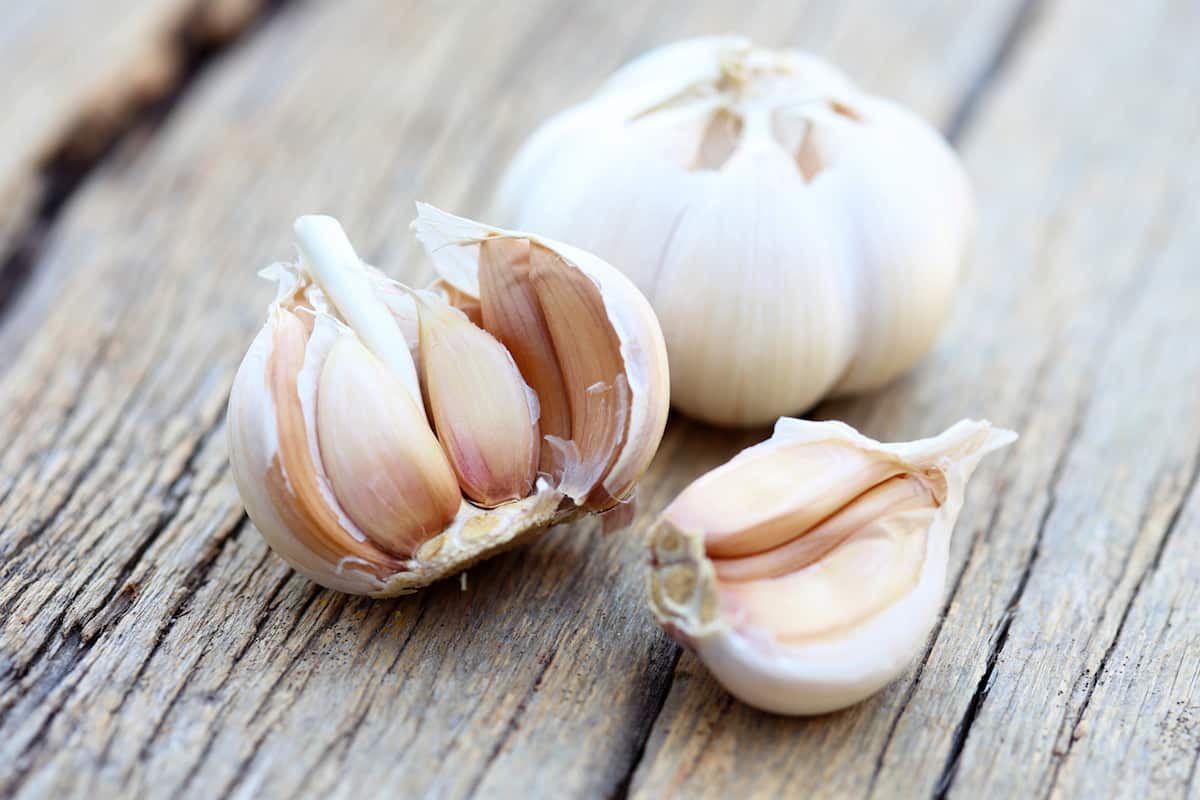
Garlic and ginger are unrelated plants that happen to share a lot of pans. Garlic is a bulb in the onion genus, family Amaryllidaceae;1 ginger is a rhizome in the Zingiberaceae, the family of turmeric and galangal.234 Their bite comes from different chemistry too. Garlic’s sharpness is made on the cutting board, when an enzyme turns alliin into allicin;5 ginger’s heat comes from gingerols and their dehydration products, shogaols.6 Neither can stand in for the other, which is exactly why so many recipes use both.
Side by side
| Garlic | Ginger | |
|---|---|---|
| Species | Allium sativum L.1 | Zingiber officinale Roscoe2 |
| Family | Amaryllidaceae, with onion (Allium cepa)17 | Zingiberaceae, with turmeric and galangal234 |
| Part used | Bulb, divided into cloves8 | Rhizome (underground stem)2 |
| Native range | Central Asia to northeastern Iran1 | Eastern Himalaya to south-central China2 |
| What makes it pungent | Allicin, formed when cutting lets alliinase reach alliin; it then breaks down into other sulfur compounds5 | Gingerols, non-volatile phenols, and shogaols, their dehydration products26 |
| Aroma oil | About 0.1% of the bulb, mainly diallyl disulfide, diallyl trisulfide and allyl propyl disulfide8 | Usually 1 to 3% of commercial dried ginger; α- and β-zingiberene among the usual compounds6 |
| What heat does | Inactivates the enzyme, so cooked garlic is milder59 | In an industrial drying study, 6-gingerol underwent dehydration;10 shogaols are gingerols’ dehydration products6 |
| India’s crop, 2024-25 (final) | 3,565,321 tonnes11 | 2,653,762 tonnes of fresh ginger11 |
| Forms sold | Fresh bulbs, peeled cloves, minced in jars, flakes, granulated, powder, salt | Fresh rhizome, dried and ground, preserved in syrup, pickled, oil and oleoresin26 |
| Sweet uses | Rare | Common: ginger ale and beer, preserved ginger, bakery products and desserts26 |
| Flavor (editorial) | Sulfurous and sharp raw; sweet and mellow cooked | Hot, bright and slightly citrusy fresh; warmer and duller ground |
| Price | No dated, sourced comparison found | No dated, sourced comparison found |
The two oil figures are not like for like: garlic’s is a share of the bulb, ginger’s a share of dried ginger. The production figures are comparable: both come from the same Spices Board table for the same year.11 For each on its own, see garlic and ginger.
Two kinds of pungency
Garlic’s is made when you cut it. Cutting or crushing releases the enzyme alliinase, which turns alliin into allicin; in crushed garlic the reaction is complete within 10 to 60 seconds.5 Heat inactivates the enzyme.5 That is why a whole clove roasted or simmered tastes mild and a raw minced one burns: America’s Test Kitchen found that heating whole cloves to 140°F or above took away much of the raw bite.9 Britannica sums up raw garlic as having a powerful onionlike aroma and pungent taste.8
Ginger’s is already there. Kew names the pungent principles as non-volatile phenolic compounds, starting with gingerol,2 and PROSEA attributes the pungent taste to the gingerols and to shogaols, which it describes as dehydration products of gingerols.6 Heat drives that change. In a 2025 study of spray-dried ginger extract, 6-gingerol underwent dehydration during thermal processing.10 That was an industrial drying process, not a home kitchen, so it doesn’t tell you how a stir-fry changes ginger’s heat. Ginger’s smell comes from its essential oil, and drying lowers the oil’s monoterpene content and raises its sesquiterpene content.6
In short, heat tames garlic by stopping the reaction that makes its bite, while in ginger heat turns one pungent compound into another. Those are different mechanisms, and nothing in these sources suggests one flavor can mimic the other.
How each is used
Garlic is overwhelmingly savory. PROSEA describes it as mainly a condiment for flavoring meat, fish and salads, fresh or dehydrated.12 The Woks of Life calls garlic a universal ingredient and a foundation for many of its recipes, and notes that most of its green vegetables are simply stir-fried with oil, garlic and salt.13 Minced garlic added to a hot pan too early can burn and turn acrid and bitter; ATK adds it after onions or other vegetables have softened.14
Ginger moves between savory and sweet. Kew notes that in Asia the fresh rhizome is an essential ingredient of many dishes, while the dried, powdered spice is more popular in European cooking.2 The Woks of Life says ginger is used extensively in Chinese cooking, and that Chinese or Indian groceries are good places to find it because both cuisines use a lot of it.13 Ginger oil flavors ginger beer and ginger ale.2 PROSEA notes that ground dried ginger is used worldwide in home cooking and in processed foods, especially bakery products and desserts.6 By common practice in Europe and North America, that means gingerbread, gingersnaps and spice cakes.
Together. Garlic and ginger are a standard pairing in Chinese stir-fries and marinades and in Indian cooking, where they are often pounded or blended into a paste. That is common kitchen practice; we found no reference source that documents the pairing as such. In our judgment it works because the two do different jobs: garlic adds sulfurous depth, ginger adds clean heat and brightness.
Can one stand in for the other?
No. Their pungency comes from different classes of compounds (sulfur compounds from an enzyme reaction in garlic, phenolic gingerols and shogaols in ginger),56 and we found no source that offers a ratio for swapping them. A widely repeated tip says that when a recipe calls for both and you are missing one, you can double the other. No source supports it, and in our judgment doubling garlic makes a dish harsher rather than more complete.
What to do instead (Method): if a recipe calls for both, make it with the one you have at its original amount and accept a simpler flavor. Then look for a substitute for the missing one that does its job:
- Missing ginger: ground ginger, galangal or crystallized ginger, depending on the dish. See ginger substitutes, galangal vs. ginger and fresh vs. ground ginger.
- Missing garlic: garlic powder, dried minced garlic or garlic scapes. See fresh garlic substitutes and garlic powder vs. garlic.
Safety
Garlic in oil. If you make garlic oil for a dressing or marinade, or a garlic-and-ginger paste stored under oil, the garlic rule applies. UC Agriculture and Natural Resources warns that garlic in oil provides an ideal environment for Clostridium botulinum, the bacterium that causes botulism. Do not store garlic in oil at room temperature; refrigerate it for no more than 4 days, or freeze it.15 Commercial garlic-in-oil products are made under strict guidelines that home kitchens can’t reproduce.15
Supplements, not seasoning. Most health research on both concerns supplements. NCCIH says garlic supplements may increase the risk of bleeding,16 and that the use of ginger supplements during pregnancy may be safe.17
Health claims
Ginger is often said to help digestion. NCCIH’s summary is narrower: research shows ginger may help with nausea and vomiting in pregnancy, ginger supplements might help symptoms of knee osteoarthritis, and most studies of ginger for motion sickness haven’t shown it to be helpful.17 For garlic, NCCIH finds that supplements may reduce total and LDL cholesterol a little in people with high cholesterol, and that eating garlic does not seem to reduce the risk of stomach cancer.16 Nothing here suggests either treats or prevents disease at cooking amounts.
What isn’t known
- No source compares the pungency of garlic and ginger on a common scale.
- No study we found measures how home cooking (as opposed to industrial drying) changes ginger’s gingerol and shogaol balance.
- No reference source documents the garlic and ginger pairing or a standard ratio for ginger-garlic paste; it appears here as common practice.
- No dated, sourced price comparison was found.
Related
- Garlic, garlic powder and fresh garlic substitutes
- Ginger, ginger substitutes, is ginger spicy? and cooking with ginger
- Fresh vs. ground ginger, galangal vs. ginger and turmeric vs. ginger
- Too much garlic, too much ginger and how to dry garlic
Footnotes
-
Allium sativum L., Plants of the World Online, Royal Botanic Gardens, Kew. powo.science.kew.org · Reference work ↩ ↩2 ↩3 ↩4
-
Zingiber officinale Roscoe, Plants of the World Online, Royal Botanic Gardens, Kew. powo.science.kew.org · Reference work ↩ ↩2 ↩3 ↩4 ↩5 ↩6 ↩7 ↩8 ↩9 ↩10 ↩11
-
Curcuma longa L., Plants of the World Online, Royal Botanic Gardens, Kew. powo.science.kew.org · Reference work ↩ ↩2
-
Alpinia galanga (L.) Willd., Plants of the World Online, Royal Botanic Gardens, Kew. powo.science.kew.org · Reference work ↩ ↩2
-
Garlic, Linus Pauling Institute Micronutrient Information Center, Oregon State University. lpi.oregonstate.edu · Reference work ↩ ↩2 ↩3 ↩4 ↩5 ↩6
-
H. Sutarno, E.A. Hadad and M. Brink, Zingiber officinale, Plant Resources of South-East Asia (PROSEA). uses.plantnet-project.org · Reference work ↩ ↩2 ↩3 ↩4 ↩5 ↩6 ↩7 ↩8 ↩9 ↩10
-
Allium cepa L., Plants of the World Online, Royal Botanic Gardens, Kew. powo.science.kew.org · Reference work ↩
-
“Garlic”, Encyclopaedia Britannica, 2026. britannica.com · Reference work ↩ ↩2 ↩3
-
Taking the Bite out of Garlic, America’s Test Kitchen. americastestkitchen.com · Publication ↩ ↩2
-
Warren-Walker et al., “Effect of Thermal Processing by Spray Drying on Key Ginger Compounds”, Metabolites, 2025. pmc.ncbi.nlm.nih.gov · Peer-reviewed ↩ ↩2
-
Spice wise area and production in India, 2021-22 to 2025-26, Spices Board India. indianspices.com · Regulator ↩ ↩2 ↩3
-
Q.P. van der Meer and Anggoro H. Permadi, Allium sativum, Plant Resources of South-East Asia (PROSEA). uses.plantnet-project.org · Reference work ↩
-
“Fresh Herbs & Aromatics Used in Chinese Cooking”, The Woks of Life, 2025. thewoksoflife.com · Publication ↩ ↩2
-
Liz Bomze, Why You Should Wait to Add Garlic, America’s Test Kitchen, 2023. americastestkitchen.com · Publication ↩
-
Linda J. Harris, Garlic: Safe Methods to Store, Preserve, and Enjoy, UC Agriculture and Natural Resources, 2016. ccfruitandnuts.ucanr.edu · Reference work ↩ ↩2
-
Garlic: Usefulness and Safety, National Center for Complementary and Integrative Health, 2025. nccih.nih.gov · Regulator ↩ ↩2
-
Ginger: Usefulness and Safety, National Center for Complementary and Integrative Health, 2025. nccih.nih.gov · Regulator ↩ ↩2