Spices · Profile
Rock Salt: Mined Salt, Food-Grade vs. Ice Cream and De-Icing Salt
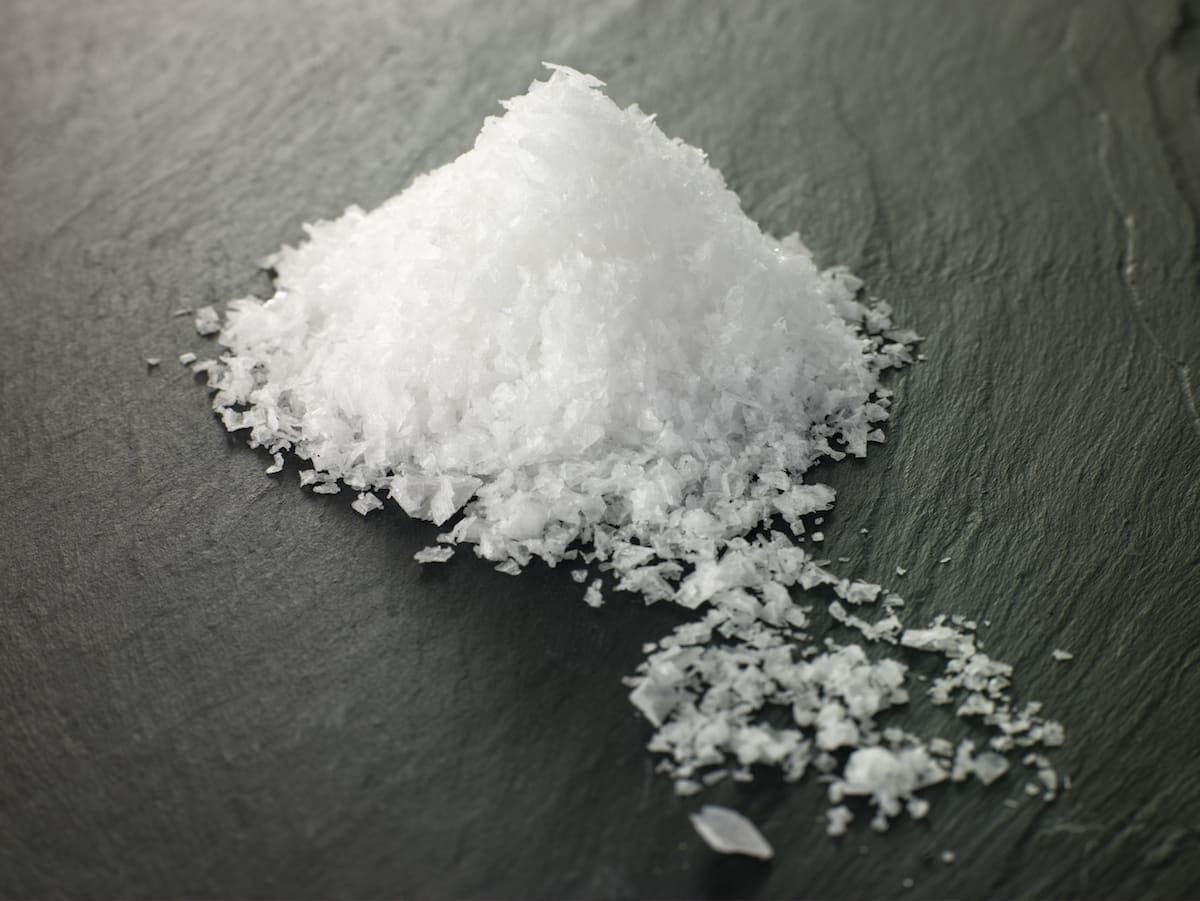
Rock salt is salt mined from underground deposits rather than made by evaporating seawater or brine. It is the same compound as every other cooking salt, sodium chloride, and the Codex food-grade standard treats salt from rock deposits, the sea and natural brine alike.1 The name causes one real problem: in an American hardware or grocery aisle, “rock salt” usually means a coarse salt sold for ice cream makers or for melting ice, and those bags are not food. This page covers what rock salt is, how to tell a food-grade one from the rest, and how to cook with it.
At a glance
| What it is | Sodium chloride mined from underground rock salt deposits1 |
| Share of US salt | 40% of US salt sold or used in 2024 was rock salt2 |
| Food-grade requirement | At least 97% sodium chloride on a dry basis, not counting additives (Codex)1 |
| Forms sold | Food grade: fine to coarse crystals, including pink salt from Pakistan.3 Non-food: coarse “ice cream salt” and de-icing salt4 |
| Iodine | Specialty salts such as Himalayan salt are not usually iodized5 |
| Sodium | Table salt, kosher salt and most sea salts are about 40% sodium; mined salt is the same compound67 |
Measured values
2 figures, sourced| Measure | Value | Scope | Source |
|---|---|---|---|
| Sodium chloride, minimum Limit | 97 %, dry basis, excluding additives | Codex CXS 150-1985 (rev. 2012), food-grade salt from any source | services.bis.gov.in |
| Sodium Nutrient | about 40 % by weight | Table salt, kosher salt and most sea salts (American Heart Association); the page states mined salt is the same compound | heart.org |
Each figure is quoted as its source states it, with the samples or standard it applies to. Where sources differ, both are shown; nothing is averaged. All measured values
What rock salt is
Salt comes from three kinds of source, and the Codex Alimentarius standard for food-grade salt names all three: the sea, underground rock salt deposits and natural brine.1 Whatever the source, food-grade salt must be at least 97% sodium chloride on a dry-matter basis, additives excluded.1 America’s Test Kitchen makes the same point from the kitchen side: salt is sodium chloride whatever its source, and the types differ in texture, shape and mineral content.7
Much of the fine salt in a shaker starts out as rock salt. The American Heart Association describes table salt as mined from salt deposits and processed to a fine texture, a process that removes other minerals.6 So “rock salt” in a cooking context mostly describes a source and, often, a coarse crystal, not a different substance.
Rock salt is a large part of the salt industry. In the United States in 2024, rock salt made up 40% of salt sold or used, against 42% salt in brine, 9% solar salt and 9% vacuum pan salt, and highway deicing took about 41% of all the salt consumed.2
Pink salt is rock salt
The best-known food-grade rock salt is the pink salt sold as Himalayan salt. It is mined in Pakistan, and its color comes from traces of iron oxide.3 Pakistan’s state-owned Pakistan Mineral Development Corporation says it extracts about 1.4 million tons of rock salt a year across its operations.8 One bylined account describes the deposits as laid down by ancient oceans some 250 million years ago; we did not find a primary geology source to confirm the date.9 For more, see Himalayan salt.
Food-grade rock salt vs. ice cream and de-icing salt
This is the part that matters for safety. Coarse rock salt sold for old-fashioned ice cream makers is not sold as food. Morton describes its Ice Cream Salt as large rock salt crystals that give gradual cooling in an ice cream maker or a cooler of drinks, and states plainly that it is not intended for consumption.4 The same product page lists melting ice and snow among its applications.4 De-icing rock salt is sold for driveways and roads, not kitchens.
The practical rule follows from that: use rock salt in food only when the package says it is food grade or edible, or lists a nutrition panel and is sold as a cooking salt. A bag labeled for ice cream makers, water softeners or ice melting is for the outside of the ice cream canister, never the custard. In an ice cream maker, the salt goes in the ice around the canister and never touches what you eat. This is a labeling rule, not a claim that every such bag contains something harmful; we found no regulator data on what non-food rock salt contains.
Flavor
Food-grade rock salt tastes like salt. ATK found that, once mixed into food, sea salt tasted no different from table salt, and that its tasters could not detect a difference in taste between iodized and noniodized salt.7 A widely repeated claim says noniodized rock salt avoids a bitterness that iodine gives table salt; ATK’s test does not support it. What changes with coarse rock salt is how slowly the big crystals dissolve and how they feel on the tongue, which is a matter of texture rather than taste.
Origin and history
Salt mining is ancient, but most of the specific stories told about rock salt (that it was used to preserve Egyptian mummies, served as Greek currency, or paid Roman soldiers) could not be traced to a source we could open, so they are left out. For two salt episodes that are well documented, the French salt tax and Gandhi’s Salt March, see table salt.
How rock salt is used
Cooking. Food-grade coarse rock salt works anywhere a coarse salt does: in pasta water, in a salt grinder, or packed around a whole fish or roast for salt-crust cooking. These are common kitchen uses rather than tested claims. Because coarse crystals pack loosely, a spoonful of rock salt holds less salt than a spoonful of table salt; we found no published grams-per-teaspoon figure for coarse rock salt, so weigh it or salt to taste. For recipes and techniques, see cooking with rock salt.
Ice cream and chilling. Non-food rock salt is mixed with ice to chill an ice cream maker or a cooler of drinks.4
Pickling. For pickles and canning, the National Center for Home Food Preservation recommends canning or pickling salt, and does not recommend flake salt because its density varies.10 A coarse rock salt is not the tested choice for home canning recipes; see pickling salt.
Buying and quality
Read the package before anything else: the words “food grade,” a nutrition panel and an ingredient list are what separate a cooking salt from an ice cream or de-icing salt.4 Among food-grade rock salts, choose by crystal size for the job. Color is a product of trace minerals; in pink salt, darker samples generally carried more minerals in one Australian study, but the amounts made no clinically significant contribution to nutrient intake.3
Storage
We found no shelf-life figure for rock salt from a regulator or standards body. Keep it dry and closed; that is common practice rather than a tested rule.
Safety and health
Sodium. Rock salt is not a lower-sodium salt. Table salt, kosher salt and most sea salts are about 40% sodium, and mined salt is the same compound.67 The FDA’s Daily Value for sodium is less than 2,300 mg a day.11 The WHO recommends adults keep sodium below 2,000 mg a day and names raised blood pressure as the main health effect of high intake.12 Claims that salt protects against infection or that low-salt diets cause type 2 diabetes appear in older writing; we found no regulator or systematic review supporting them.
Minerals. In the Australian study of pink salt, the extra minerals did not make a clinically significant contribution to nutrient intake.3 That study also found one pink salt, from Peru, with lead above the 2 mg/kg limit the authors applied; see Himalayan salt for the details.
Iodine. Specialty salts such as Himalayan salt are not usually iodized.5 If you rely on salt for iodine, use iodized salt; see iodized vs. non-iodized salt.
Microplastics. In a 2018 study of 39 salt brands, reported in a Greenpeace press release, the 9 rock salts tested had the lowest microplastic contamination of the three salt types, after sea salt and lake salt.13 That is one study of specific products, not the market.
Substitutes and comparisons
Any food-grade salt can replace rock salt by weight. By volume, crystal size decides the swap. See rock salt substitutes, and these comparisons:
If a dish has gone over, see too much salt.
Footnotes
-
Standard for Food Grade Salt, CXS 150-1985 (rev. 2012), Codex Alimentarius. services.bis.gov.in · Standard ↩ ↩2 ↩3 ↩4 ↩5
-
Wallace P. Bolen, Salt, Mineral Commodity Summaries 2025, U.S. Geological Survey. pubs.usgs.gov · Regulator ↩ ↩2
-
Fayet-Moore F et al., An Analysis of the Mineral Composition of Pink Salt Available in Australia, Foods, 2020. mdpi.com · Peer-reviewed ↩ ↩2 ↩3 ↩4
-
Morton Ice Cream Salt, product page, Morton Salt. mortonsalt.com · Merchant ↩ ↩2 ↩3 ↩4 ↩5
-
Iodine: Fact Sheet for Health Professionals, NIH Office of Dietary Supplements. ods.od.nih.gov · Regulator ↩ ↩2
-
Sodium Sources: Where Does All That Sodium Come From?, American Heart Association, 2025. heart.org · Reference work ↩ ↩2 ↩3
-
Salt Types and Measurements, America’s Test Kitchen. americastestkitchen.com · Publication ↩ ↩2 ↩3 ↩4
-
Pakistan Mineral Development Corporation, home page. pmdc.gov.pk · Merchant ↩
-
Harriet Hall, Pink Himalayan Sea Salt: An Update, Science-Based Medicine, 2017. sciencebasedmedicine.org · Publication ↩
-
Salts Used in Pickling, National Center for Home Food Preservation. nchfp.uga.edu · Reference work ↩
-
Sodium in Your Diet, U.S. Food and Drug Administration. fda.gov · Regulator ↩
-
Sodium reduction, World Health Organization fact sheet, 2026. who.int · Regulator ↩
-
Over 90% of sampled salt brands globally found to contain microplastics, Greenpeace International press release, 2018, on Kim J-S et al., Environmental Science & Technology, 2018. greenpeace.org · Publication ↩