Spice Comparisons · Comparison
Himalayan Salt vs. Table Salt: Sodium, Minerals and Iodine Compared
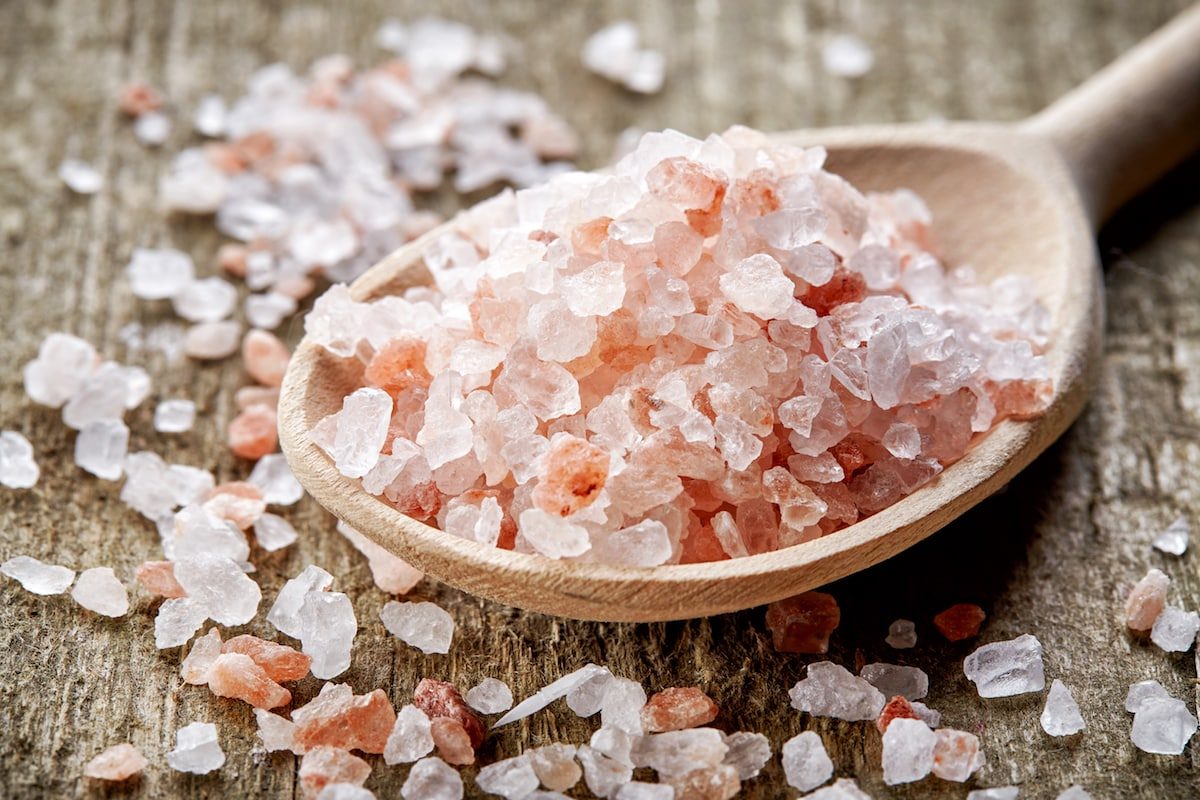
Himalayan salt and table salt are both mostly sodium chloride. Himalayan salt is rock salt mined in Pakistan, colored pink by traces of iron oxide,1 and sold with nothing added. Table salt is refined to a fine, even grain, usually carries an anticaking agent, and in iodized form supplies iodine.23 The measurable differences are small and run both ways: in a study of 31 pink salts, pink salt had about 8% less sodium than the white table salt tested and more calcium and other minerals, but not enough to matter at normal intakes.1 Iodine is the difference that does matter, and it favors iodized table salt.
Side by side
| Himalayan salt | Table salt | |
|---|---|---|
| What it is | Rock salt, mined; color from traces of iron oxide1 | Fine-grained sodium chloride, processed to an even texture that strips out other minerals4 |
| Where it comes from | Pakistan, for commercial pink salt; PMDC runs the Khewra mine15 | Mined from salt deposits, per the AHA;4 ATK describes crystals formed by rapid vacuum evaporation2 |
| Additives | Usually none; Morton’s coarse pink salt lists only salt6 | Usually an anticaking agent; Morton’s iodized salt adds calcium silicate, dextrose and potassium iodide23 |
| Iodine | Not usually iodized7 | US iodized salt: 45 mcg per gram7 |
| Sodium per ¼ teaspoon (Morton labels, 1.5 g each) | 570 mg (coarse Himalayan)6 | 590 mg (iodized)3 |
| Grams per teaspoon | No independent figure; Morton coarse label 1.5 g per ¼ teaspoon6 | About 6 g (ATK); Morton label 1.5 g per ¼ teaspoon83 |
| Flavor (editorial) | Salty; a hard crunch when coarse | Salty; dissolves fast |
| Price | No dated, sourced comparison found | No dated, sourced comparison found |
What’s measurably different
Two studies measured pink salt and a table salt in the same laboratory. They used different samples and methods, so their numbers are shown separately.
Australia, 2020. Flavia Fayet-Moore and colleagues bought 31 pink salts in Sydney, Canberra and Coffs Harbour in June 2018 and compared them with one iodized white table salt.1
| Fayet-Moore et al. 2020 | Pink salt (31 samples) | White table salt (1 sample) |
|---|---|---|
| Sodium (paper’s units) | 394,717.96 | 427,636.27 |
| Calcium (same basis) | 2,695.09 | 393.28 |
| Also higher in pink salt | Iron, magnesium, manganese, potassium | |
| Lead | One sample, the only one from Peru, had 2.59 mg/kg, over the 2 mg/kg limit the authors applied and 130 times the white control |
Source: Fayet-Moore et al.1
That works out to roughly 8% less sodium in pink salt (our arithmetic). Even so, a 5 g teaspoon of pink salt made no clinically significant contribution to nutrient intake except sodium, and the authors calculated that it would take more than 30 g a day, about six teaspoons, for the minerals to matter, at which point the extra sodium would counteract any benefit.1 The control was a single salt, so the comparison shows the direction of the difference rather than a precise gap.
Switzerland, 2016. The Swiss Federal Food Safety and Veterinary Office analyzed 25 salts, including four Himalaya salts and one Swiss iodized table salt whose label lists salt, iodide and an anticaking agent.9
| Swiss FSVO 2016 | Himalaya salt (4 samples) | Swiss iodized table salt (1 sample) |
|---|---|---|
| Sodium, % | 37.7 to 38.2 | Not analyzed |
| Iodine | Below 20 µg/kg in all four | Fortified at 25 mg/kg (the stated level, not a measurement) |
| Iron, g/kg | 0.09 to 0.37 | Not reported |
| Aluminum, µg/kg | 21,864 to 44,654 | 811 |
Source: FSVO report, Tables 1 to 3 and Appendix 2.9
The report says the iron in these salts is mainly present as insoluble iron oxide.9 It also found that specialty salts generally carry more contaminants than standard salts, though most contaminants did not reach even 1% of tolerable intake levels. The highest levels of nickel, lead, arsenic and aluminum, up to 32% of tolerable intake for someone eating 5 or 9 g of salt a day, were in Himalaya, kala namak and bamboo salts, and the report puts the Himalaya levels down to natural contamination.9 Its conclusion: specialty salts do not possess any advantages over standard salts.9
The “84 minerals” claim
Pink salt is often sold as containing 84 trace minerals. Harriet Hall of Science-Based Medicine traces that figure to marketing and points out that such lists include poisons such as mercury, arsenic, lead and thallium.10 The Australian study measured 25 elements.1
Sodium: less than it sounds
A teaspoon of coarse pink salt can hold less sodium than a teaspoon of table salt, but only because fewer large crystals fit in the spoon.4 Weight for weight the gap is small: Morton’s own labels give 570 mg of sodium in 1.5 g of its coarse Himalayan salt and 590 mg in 1.5 g of its iodized table salt.63 The American Heart Association says total sodium intake is what matters most for heart health.4 The FDA’s Daily Value is less than 2,300 mg of sodium a day, about a teaspoon of table salt,11 and the WHO, which names raised blood pressure as the main effect of high sodium intake, recommends adults stay under 2,000 mg.12 Switching to pink salt is not a way to eat less sodium; using less salt is.
Iodine: the difference that matters
Iodized table salt in the United States contains 45 mcg of iodine per gram.7 Morton’s iodized label gives 68 mcg in a ¼ teaspoon,3 close to half the adult recommended intake of 150 mcg a day (our arithmetic).7 The NIH Office of Dietary Supplements lists Himalayan salt among specialty salts that are not usually iodized,7 and the Swiss Himalaya samples were all below 20 µg/kg,9 more than 2,000 times lower than US iodized salt (our arithmetic).
The ODS says the general US population gets enough iodine, but that many pregnant women may not.7 Most salt in American diets comes from processed foods, which almost always use noniodized salt.7 If you replace iodized table salt with pink salt at home, you lose that source. See iodized vs. non-iodized salt.
In the kitchen
America’s Test Kitchen makes table salt the default for most cooking because it dissolves easily.2 ATK’s tasters also found no detectable difference in taste between iodized and noniodized salt.2 We found no taste test of Himalayan salt against table salt; claims that it tastes “earthier” or milder are untested.
- Table salt for doughs, batters, brines and anything measured by the spoon.
- Coarse Himalayan salt in a grinder, or as a finishing salt where the crunch and the pink color show: steak, fish, eggs, salads.
- Fine Himalayan salt works anywhere table salt does.
Those uses are kitchen judgment. Himalayan salt is also sold in blocks for cooking and serving; see cooking with Himalayan salt. We found no published testing of how blocks conduct heat or how much salt they pass to food.
Can one stand in for the other?
Yes, as long as you keep track of iodine.
| Swap | Starting amount | Treatment |
|---|---|---|
| Either, measured into a recipe by weight | The same weight | Computed |
| Morton Himalayan (fine or coarse) for Morton table salt, by the teaspoon | Teaspoon for teaspoon | Attributed (Morton products only) |
| Another brand’s coarse pink salt for table salt, by volume | The same volume, then taste and add | Method |
| Table salt for another brand’s coarse pink salt, by volume | About ¾ of the volume, then taste | Method |
| Table salt for coarse pink salt, for finishing | Not a good swap; use a flaky or coarse salt instead | Method |
How these were worked out. By weight: the Codex standard requires food-grade salt, whether from rock deposits, the sea or brine, to be at least 97% sodium chloride on a dry basis.13 By volume: Morton’s chart treats a teaspoon of its table salt as equal to a teaspoon of its fine or coarse Himalayan salt, and its labels give 1.5 g per ¼ teaspoon for both.1463 The chart applies only between Morton products, and at larger volumes it gives 1 cup of table salt as equal to 1 cup plus 2 tablespoons of coarse Himalayan salt,14 so for big batches, weigh. Other brands grind differently and publish no weights that we found, so those rows start on the low side.
What isn’t known
- No published taste test of Himalayan salt against table salt.
- No sodium figure for the Swiss table salt sample, so the Swiss table can’t compare sodium.
- The Australian comparison rests on one white table salt.
- No grams-per-teaspoon figure for pink salt outside Morton’s label.
- No testing of salt-block heat conduction or salt transfer; no dated price data.
Related
- Himalayan salt and table salt, the full profiles
- Iodized vs. non-iodized salt and sea salt vs. iodized salt
- Himalayan salt vs. sea salt, kosher salt vs. Himalayan salt and fleur de sel vs. Himalayan salt
- Rock salt vs. table salt, Celtic sea salt vs. table salt and kosher salt vs. table salt
- The best salt for cooking and too much salt
Footnotes
-
Fayet-Moore F et al., An Analysis of the Mineral Composition of Pink Salt Available in Australia, Foods, 2020. mdpi.com · Peer-reviewed ↩ ↩2 ↩3 ↩4 ↩5 ↩6 ↩7 ↩8
-
Salt Types and Measurements, America’s Test Kitchen. americastestkitchen.com · Publication ↩ ↩2 ↩3 ↩4 ↩5
-
Morton Iodized Table Salt, product page, Morton Salt. mortonsalt.com · Merchant ↩ ↩2 ↩3 ↩4 ↩5 ↩6 ↩7
-
Sodium Sources: Where Does All That Sodium Come From?, American Heart Association, 2025. heart.org · Reference work ↩ ↩2 ↩3 ↩4
-
Pakistan Mineral Development Corporation, home page. pmdc.gov.pk · Merchant ↩
-
Morton Coarse Himalayan Pink Salt, product page, Morton Salt. mortonsalt.com · Merchant ↩ ↩2 ↩3 ↩4 ↩5
-
Iodine: Fact Sheet for Health Professionals, NIH Office of Dietary Supplements. ods.od.nih.gov · Regulator ↩ ↩2 ↩3 ↩4 ↩5 ↩6 ↩7
-
Kate Shannon Levine, The Best Kosher Salt, America’s Test Kitchen, 2019. americastestkitchen.com · Publication ↩
-
Esther Infanger and Max Haldimann, Report on the composition of prevalent salt varieties, Swiss Federal Food Safety and Veterinary Office, 2016. warwick.ac.uk · Regulator ↩ ↩2 ↩3 ↩4 ↩5 ↩6
-
Harriet Hall, Pink Himalayan Sea Salt: An Update, Science-Based Medicine, 2017. sciencebasedmedicine.org · Publication ↩
-
Sodium in Your Diet, U.S. Food and Drug Administration. fda.gov · Regulator ↩
-
Sodium reduction, World Health Organization fact sheet, 2026. who.int · Regulator ↩
-
Standard for Food Grade Salt, CXS 150-1985 (rev. 2012), Codex Alimentarius. services.bis.gov.in · Standard ↩
-
Salt Conversion Chart, Morton Salt. mortonsalt.com · Merchant ↩ ↩2