Cooking · Dish guide
Good Stuffing Spices: Sage, Thyme and the Savory Base That Seasons Bread Stuffing
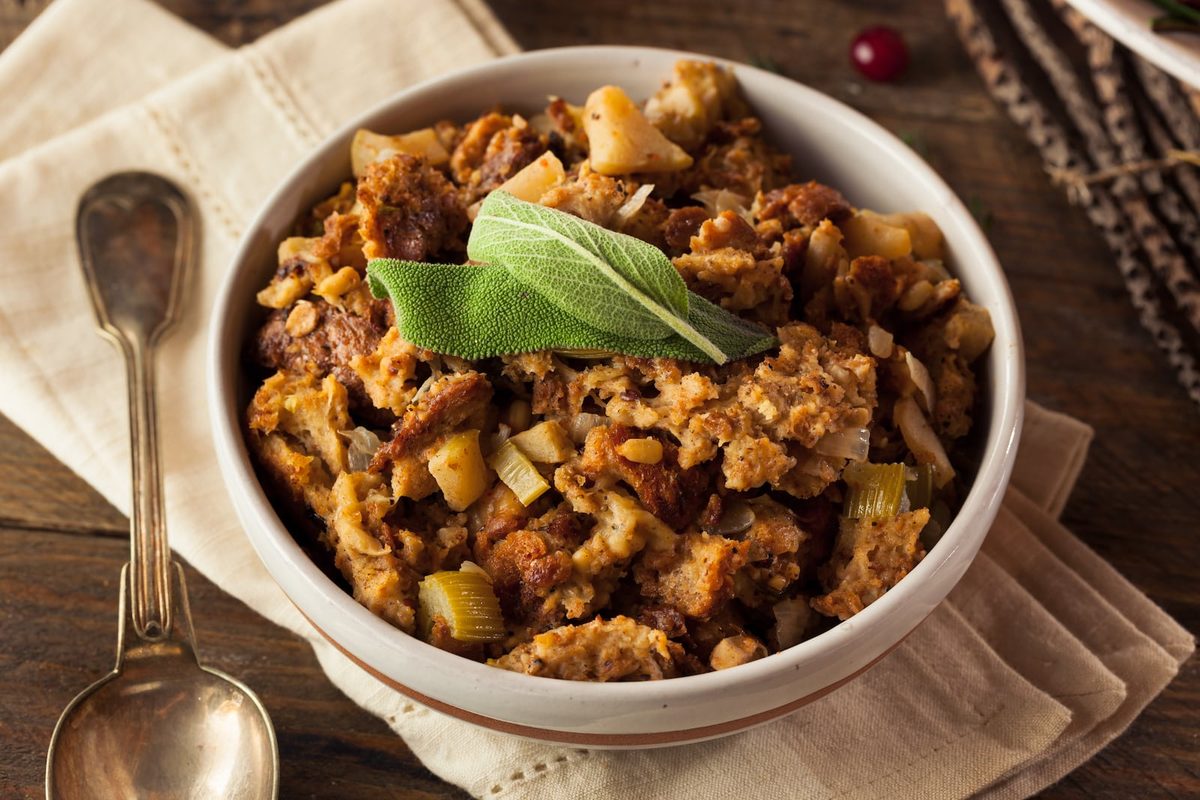
Bread stuffing is mostly bread and fat, so its seasoning does a lot of work. The pattern across recipes is steady: a savory base of onion and celery cooked in butter, one or two strong herbs (sage and thyme above all), parsley, and black pepper. Yankee Magazine describes the New England style as “quite lightly seasoned,” with sage and thyme the dominant herbs.1 This page covers what each seasoning does, how three named recipes differ, how poultry seasoning fits in, and the food-safety temperature that matters more than any herb.
At a glance
| Seasoning | Job in the stuffing | Notes |
|---|---|---|
| Onion | Sweet, savory base | Cooked in butter first in the extension recipe2 |
| Celery | Savory, green note | All three recipes below213 |
| Sage | The signature herb; strong | PROSEA lists stuffings among its main spice uses4 |
| Thyme | Sharp, savory herbal note | Co-dominant with sage in New England style1 |
| Poultry seasoning | Sage, thyme and more in one jar | Used in two of the three recipes21 |
| Parsley | Fresh, green finish and color | All three recipes213 |
| Black pepper | Mild heat | All three recipes213 |
| Winter savory | Peppery herb; alternative to poultry seasoning | Offered by the Illinois recipe2 |
Three recipes side by side
| Illinois Extension (10 servings)2 | Yankee Magazine, New England style1 | Chris Kimball / America’s Test Kitchen, via NPR3 | |
|---|---|---|---|
| Bread | 4 cups day-old cubes | 12 cups cubes | 4 cups cooked grain, cornbread or bread cubes |
| Onion | 1/2 cup chopped | 1 large, diced | 1 1/2 cups chopped, plus scallions or chives |
| Celery | 1/2 cup chopped | 3 stalks, plus minced leaves | 1/2 cup chopped |
| Herbs | 2 tsp winter savory or poultry seasoning | 2 tsp poultry seasoning, more or less | 2 tbsp fresh sage, thyme or oregano, or 1 1/2 tsp dried |
| Parsley | 3 tbsp fresh or 1 tbsp dried | 1/3 cup minced | 1/4 cup chopped |
| Pepper | 1/8 tsp | To taste | Freshly ground, to taste |
These are the publishers’ own recipes, not a house standard. NPR’s version notes that a basic country stuffing was often made from little more than stale bread, salt pork, an egg, water, sage, salt and pepper.3 Everything else is elaboration.
The core seasonings and what each one does
Sage: the signature
Sage (Salvia officinalis) is the herb most tied to stuffing. PROSEA lists sausages and stuffings first among its uses as a spice, and attributes sage’s strong, characteristic smell to compounds called thujones.4 It is a strong herb: the University of Delaware’s extension guide warns that its flavor can be “extremely objectionable” if too much is used.5 Sage and rosemary are close relatives; Kew now places rosemary in the same genus, as Salvia rosmarinus.6
Fresh, rubbed and ground sage all work. The Delaware guide’s general rule is that dried herbs are stronger than fresh, with 3/4 to 1 teaspoon of dried crumbled herb equal to 2 to 3 teaspoons of fresh.5 The NPR recipe uses 2 tablespoons fresh or 1 1/2 teaspoons dried.3 See fresh vs. dried sage, cooking with sage and too much sage.
Thyme: sage’s partner
Thyme’s sharp, savory character comes from its oil, whose characteristic constituents are thymol and carvacrol.7 America’s Test Kitchen classes it as a hearty herb to add early in cooking,8 which suits a stuffing that bakes for 35 to 45 minutes in the Illinois recipe.2 The NPR recipe treats sage, thyme and oregano as interchangeable,3 while New England style uses sage and thyme together.1 See fresh vs. dried thyme and too much thyme.
Poultry seasoning: sage and thyme in one jar
Two of the three recipes above use poultry seasoning instead of individual herbs.21 There is no single formula. McCormick Culinary’s blend lists thyme, sage, marjoram, rosemary, black pepper and nutmeg;9 since US labels list ingredients in descending order by weight, thyme is the largest part of that blend.10 Bell’s Seasoning, the New England brand, is a blend of rosemary, oregano, sage, ginger, marjoram, thyme and pepper.11 The Hagley Museum dates Bell’s blend to 1867.12 Because blends differ, two stuffings made with “2 teaspoons poultry seasoning” can taste quite different. See poultry seasoning and poultry seasoning substitutes.
Onion and celery: the savory base
Every recipe here uses onion and celery.213 The Illinois recipe cooks them with the parsley in butter for 5 minutes, then adds the herb and cooks until the onions are soft.2 Yankee’s version adds minced celery leaves as well as the stalks.1 Onion powder, celery seeds or celery salt can back up the fresh vegetables, though none of these recipes calls for them.
Parsley: color and a fresh finish
In stuffing, parsley mostly brings color and a fresh note. PROSEA notes that the fresh leaves of curly parsley are commonly used for garnishing and seasoning.13 The LSU AgCenter groups parsley with delicate herbs that lose flavor under prolonged heat and are best added at the end.14 The Illinois recipe gives 3 tablespoons fresh or 1 tablespoon dried.2 See fresh vs. dried parsley.
Black pepper
Pepper’s bite comes principally from piperine.15 All three recipes use it, from a measured 1/8 teaspoon to “freshly ground, to taste.”23 Grinding it fresh is a common preference rather than something these sources test. See cracked vs. ground black pepper.
When to add the herbs
| Advice | Source |
|---|---|
| Cook the dried herb with the onion and celery in butter before mixing with the bread | Illinois Extension2 |
| Hearty herbs such as sage and thyme go in early | America’s Test Kitchen8 |
| Delicate herbs such as parsley go in at the end | LSU AgCenter14 |
A practical starting point (Method, not a measured rule): bloom dried sage, thyme or poultry seasoning in the butter with the vegetables, and stir in fresh parsley just before the stuffing goes into the oven.
Food safety: 165°F
The USDA Food Safety and Inspection Service recommends cooking stuffing separately, in a casserole, for safety and even doneness, and checking that it reaches 165°F on a food thermometer.16 If stuffing goes inside the bird, the center of the stuffing has to reach that temperature too.162 FSIS also says not to prepare stuffing ahead: the dry and wet ingredients can be prepared and chilled separately, then combined just before cooking.16
Related
- Spices for turkey and turkey gravy spices
- Thanksgiving herbs and spices
- Cranberry sauce spices
- Rosemary vs. sage and sage substitutes
- The master list of herbs and spices
Footnotes
-
“Bread Stuffing”, Yankee Magazine, 2007. newengland.com · Publication ↩ ↩2 ↩3 ↩4 ↩5 ↩6 ↩7 ↩8 ↩9 ↩10 ↩11
-
“Savory Bread Stuffing”, University of Illinois Extension. extension.illinois.edu · Reference work ↩ ↩2 ↩3 ↩4 ↩5 ↩6 ↩7 ↩8 ↩9 ↩10 ↩11 ↩12 ↩13 ↩14 ↩15
-
“Poultry Stuffing”, recipe from Chris Kimball and America’s Test Kitchen, NPR. npr.org · Publication ↩ ↩2 ↩3 ↩4 ↩5 ↩6 ↩7 ↩8 ↩9
-
U.A. Dasuki, “Salvia officinalis”, PROSEA. uses.plantnet-project.org · Reference work ↩ ↩2
-
“Using Herbs and Spices”, University of Delaware Cooperative Extension, revised 2025. udel.edu · Reference work ↩ ↩2
-
“Salvia rosmarinus Spenn.”, Plants of the World Online, Royal Botanic Gardens, Kew. powo.science.kew.org · Reference work ↩
-
S.H. Widodo, “Thymus vulgaris”, PROSEA. uses.plantnet-project.org · Reference work ↩
-
Liz Bomze, “Our Guide to Fresh Herbs”, America’s Test Kitchen, 2019. americastestkitchen.com · Publication ↩ ↩2
-
“Poultry Seasoning, 12 oz”, McCormick Culinary. mccormick.com · Merchant ↩
-
21 CFR 101.4, Food; designation of ingredients. ecfr.gov · Regulator ↩
-
Aimee Tucker, “Bell’s Seasoning: A New England Thanksgiving Classic”, Yankee Magazine, 2021. newengland.com · Publication ↩
-
Chris Cascio, “A Seasoning for the Holiday Season”, Hagley Museum and Library, 2025. hagley.org · Reference work ↩
-
Ipor and Oyen, “Petroselinum crispum”, PROSEA. uses.plantnet-project.org · Reference work ↩
-
“Flavorful Herbs”, LSU AgCenter. lsuagcenter.com · Reference work ↩ ↩2
-
“Black pepper”, Encyclopaedia Britannica. britannica.com · Reference work ↩
-
“Stuffing and Food Safety”, USDA Food Safety and Inspection Service, 2013. fsis.usda.gov · Regulator ↩ ↩2 ↩3