Spice Comparisons · Comparison
Rosemary vs. Thyme: Piney and Strong vs. Savory and Medium
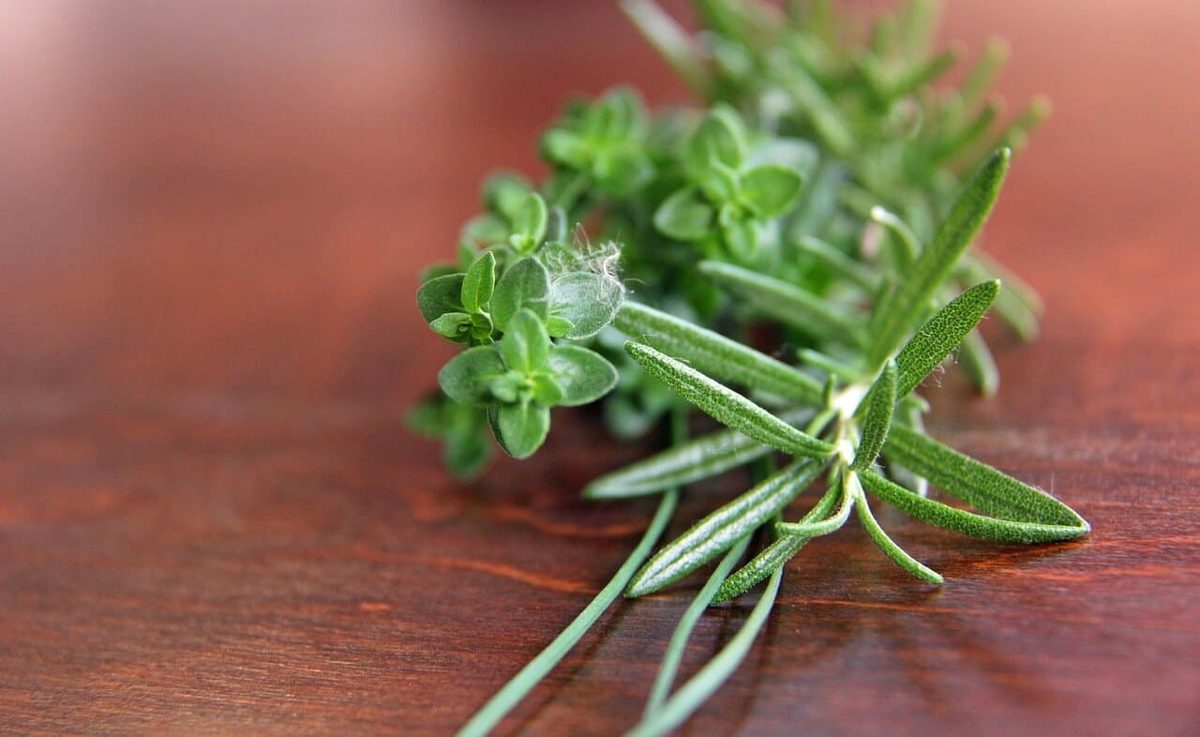
Rosemary and thyme are both woody mint-family herbs that go into the pot early, but they are built on different chemistry and differ in strength. Rosemary oil is led by α-pinene and 1,8-cineole, with camphor and borneol behind them;12 most thyme oils are led by thymol.34 The University of Delaware’s extension service puts rosemary among the strong herbs and thyme among the medium ones,5 which is why thyme can usually replace rosemary at an equal amount and rosemary should replace thyme only at a reduced one.
Side by side
| Rosemary | Thyme (common) | |
|---|---|---|
| Species | Salvia rosmarinus, formerly Rosmarinus officinalis6 | Thymus vulgaris7 |
| Family | Lamiaceae (mint family)8 | Lamiaceae7 |
| Native range | The Mediterranean (Kew)6 | Southwestern Europe and southeastern Italy (Kew)7 |
| Plant | Evergreen shrub, usually 0.6–2 m (2–6.5 feet)8 | Small evergreen subshrub, 10–30 cm, occasionally to 50 cm3 |
| Leaves | Opposite, linear, 1–5 cm long and 1–2 mm wide81 | Opposite, linear to elliptical, 3–8 mm long3 |
| Key compounds | α-pinene, 1,8-cineole, camphor, borneol12 | Thymol and carvacrol, usually thymol-led34 |
| Oil in the dried leaf | 1–2%1 | No comparable figure found for the leaf |
| Flavor (editorial) | Piney, resinous, camphor-edged | Savory, sharp, slightly medicinal |
| Strength | Strong herb (University of Delaware)5 | Medium-strength herb5 |
| When to add | Early; a hearty herb9 | Early; a hearty herb9 |
| Typical uses | Meats, vegetables, soups; baking, infused oils, herbal teas8 | Butter, cheese, fish, meat, sauces, soups, stews, stuffings3 |
| Cost | No dated, sourced price comparison found | No dated, sourced price comparison found |
The flavor row is our description. Britannica describes rosemary’s leaves as having a pungent, slightly bitter taste,8 and PROSEA links rosemary’s warm, piny note to α-pinene.1
The chemistry, sample by sample
Each figure belongs to the oil it was measured on. They come from different studies and describe distilled oils, not dried leaf, so they should not be merged.
| Herb and sample | Main compounds | Source |
|---|---|---|
| Rosemary oils from plants collected in six countries | α-pinene 13.5–37.7%, 1,8-cineole 16.1–29.3%, camphor 0.7–7.0% | Satyal et al. 20172 |
| One Spanish rosemary oil of the camphor type | Camphor 35.3% | PROSEA1 |
| Common thyme oil in a 2023 study of eight thyme species | Thymol 42.44%, carvacrol 2.28% | Dong et al. 20234 |
The 2017 rosemary study found at least five chemotypes,2 and PROSEA reports thyme chemotypes in which thymol and carvacrol are both below 5%.3 Still, the usual pattern is clear: the two herbs share no lead compound. That is why one never tastes like the other, even though they are often used together.
The differences that change a dish
Strength
The University of Delaware groups rosemary with bay, sage and mustard among the strong herbs, and thyme with oregano and mint among the medium ones.5 Of that strong group, it warns that the flavor “can be extremely objectionable” if too much is used.5 A Couple Cooks calls thyme much milder than rosemary.10 In practice, rosemary needs a lighter hand.
Cooking
America’s Test Kitchen classes both as hearty herbs to add early, because their flavor compounds are somewhat more heat-stable.9 In ATK’s dried-versus-fresh tests, dried rosemary and dried thyme both held up reasonably well in dishes with more than 20 minutes of cooking and a good amount of liquid.11 LSU AgCenter likewise lists both among the less delicate herbs.12
Texture
Rosemary’s leaves are needle-like, up to 5 cm long and only 1–2 mm wide;1 thyme’s are 3–8 mm.3 Thyme leaves can go into a dish whole, while rosemary is usually chopped fine or used as a sprig and removed (editorial).
They often go together
McCormick’s culinary poultry seasoning lists thyme, sage, marjoram, rosemary, black pepper and nutmeg, in that order,13 and US labels list ingredients in descending order by weight,14 so that blend carries more thyme than rosemary. In the Label Rouge recipe for herbes de Provence as reported by the French trade press, rosemary makes up 26% and thyme 19%.15
Nutrition
| Dried herb, per 100 g | Rosemary | Thyme |
|---|---|---|
| Iron | 29.2 mg | 124 mg |
| Calcium | 1,280 mg | 1,890 mg |
| Vitamin C | 61.2 mg | 50.0 mg |
| Dietary fiber | 42.6 g | 37.0 g |
| Vitamin A (RAE) | 156 µg | 190 µg |
| Weight of 1 tsp | 1.2 g | 1.0 g (leaves) |
Source: USDA FoodData Central.1617 Thyme is richer in iron and calcium; rosemary in vitamin C and fiber. Neither is a clear winner. At seasoning amounts, our arithmetic against the FDA’s 18 mg Daily Value for iron:18 a teaspoon of dried thyme supplies about 1.2 mg of iron (7% DV), and a teaspoon of dried rosemary about 0.35 mg (2%). Nothing else either herb provides in a teaspoon is meaningful.
Can one stand in for the other?
One direction works much better than the other.
- Thyme in place of rosemary (Attributed). The Spice House calls thyme the closest all-purpose swap and says to use fresh thyme in the same amount as fresh rosemary.19 A Couple Cooks agrees on equal parts, fresh or dried, in cooked dishes, while noting that thyme’s flavor is much milder.10 The dish will taste of thyme, not rosemary (editorial). See rosemary substitutes.
- Rosemary in place of thyme (Method). The Spice House lists rosemary among its thyme substitutes,20 but no source gives an amount. Because rosemary is the stronger herb,5 start with half the thyme amount, finely chopped, and add more after tasting. See thyme substitutes.
- Fresh and dried. For either herb, ATK’s tests found 1 part dried to 3 parts fresh came closest to equal flavor (Computed, a general rule for herbs).11 See dried rosemary vs. fresh and fresh thyme vs. dried.
Safety
Both herbs appear on the European Medicines Agency’s list of plants containing thujone in variable amounts.21 That statement concerns herbal medicines and gives no figure for either culinary herb. This page makes no claim that either herb treats or prevents any condition.
What isn’t known
- No measurement compares the flavor strength of rosemary and thyme; the half-amount starting point is Method.
- We found no source for a thyme blend with tarragon or savory as a rosemary replacement.
- Rosemary’s lemon note, often mentioned, is not explained by any compound in the sources reviewed here.
Related
- Profiles: rosemary, thyme, sage, lemon thyme
- Substitutes: rosemary substitutes, thyme substitutes
- Comparisons: rosemary vs. sage, tarragon vs. rosemary, tarragon vs. thyme, oregano vs. thyme, thyme vs. lemon thyme
- Poultry seasoning, herbes de Provence, thyme uses, rosemary uses, too much rosemary?, too much thyme?
Footnotes
-
C.C. de Guzman, Rosmarinus officinalis, Plant Resources of South-East Asia (PROSEA). uses.plantnet-project.org · Reference work ↩ ↩2 ↩3 ↩4 ↩5 ↩6 ↩7
-
Satyal et al., “Chemotypic Characterization and Biological Activity of Rosmarinus officinalis”, Foods, 2017. mdpi.com · Peer-reviewed ↩ ↩2 ↩3 ↩4
-
S.H. Widodo, Thymus vulgaris, Plant Resources of South-East Asia (PROSEA). uses.plantnet-project.org · Reference work ↩ ↩2 ↩3 ↩4 ↩5 ↩6 ↩7
-
Dong et al., “Chemical Compositions of Essential Oil Extracted from Eight Thyme Species and Potential Biological Functions”, Plants, 2023. mdpi.com · Peer-reviewed ↩ ↩2 ↩3
-
“Using Herbs and Spices”, University of Delaware Cooperative Extension, 2025. udel.edu · Reference work ↩ ↩2 ↩3 ↩4 ↩5 ↩6
-
Salvia rosmarinus Spenn., Plants of the World Online, Royal Botanic Gardens, Kew. powo.science.kew.org · Reference work ↩ ↩2
-
Thymus vulgaris L., Plants of the World Online, Royal Botanic Gardens, Kew. powo.science.kew.org · Reference work ↩ ↩2 ↩3
-
Anoushka Pant, “Rosemary”, Encyclopaedia Britannica, 2026. britannica.com · Reference work ↩ ↩2 ↩3 ↩4 ↩5
-
Liz Bomze, “Our Guide to Fresh Herbs”, America’s Test Kitchen, 2019. americastestkitchen.com · Publication ↩ ↩2 ↩3
-
Sonja Overhiser, “Best Substitute for Rosemary”, A Couple Cooks, 2026. acouplecooks.com · Publication ↩ ↩2
-
“Science: Substituting Dried Herbs for Fresh”, America’s Test Kitchen. americastestkitchen.com · Publication ↩ ↩2
-
“Flavorful Herbs”, LSU AgCenter. lsuagcenter.com · Reference work ↩
-
McCormick Culinary Poultry Seasoning, product page, McCormick & Company. mccormick.com · Merchant ↩
-
21 CFR 101.4, US Food and Drug Administration. ecfr.gov · Regulator ↩
-
Sylvie Carriat, “Les vraies herbes de Provence raniment la flamme”, Réussir Les Marchés, 2008. reussir.fr · Publication ↩
-
Spices, thyme, dried (FDC 170938), USDA FoodData Central. fdc.nal.usda.gov · Regulator ↩
-
Spices, rosemary, dried (FDC 171333), USDA FoodData Central. fdc.nal.usda.gov · Regulator ↩
-
Daily Value on the Nutrition and Supplement Facts Labels, U.S. Food and Drug Administration. fda.gov · Regulator ↩
-
“The 8 Best Substitutes for Rosemary”, The Spice House, 2024. thespicehouse.com · Merchant ↩
-
“The 11 Best Thyme Substitutes”, The Spice House, 2018. thespicehouse.com · Merchant ↩
-
Public statement on herbal medicinal products containing thujone, European Medicines Agency, 2012. ema.europa.eu · Regulator ↩