Spice Comparisons · Comparison
Cumin Seeds vs. Ground Cumin: Shelf Life, Cooking and How to Swap Them
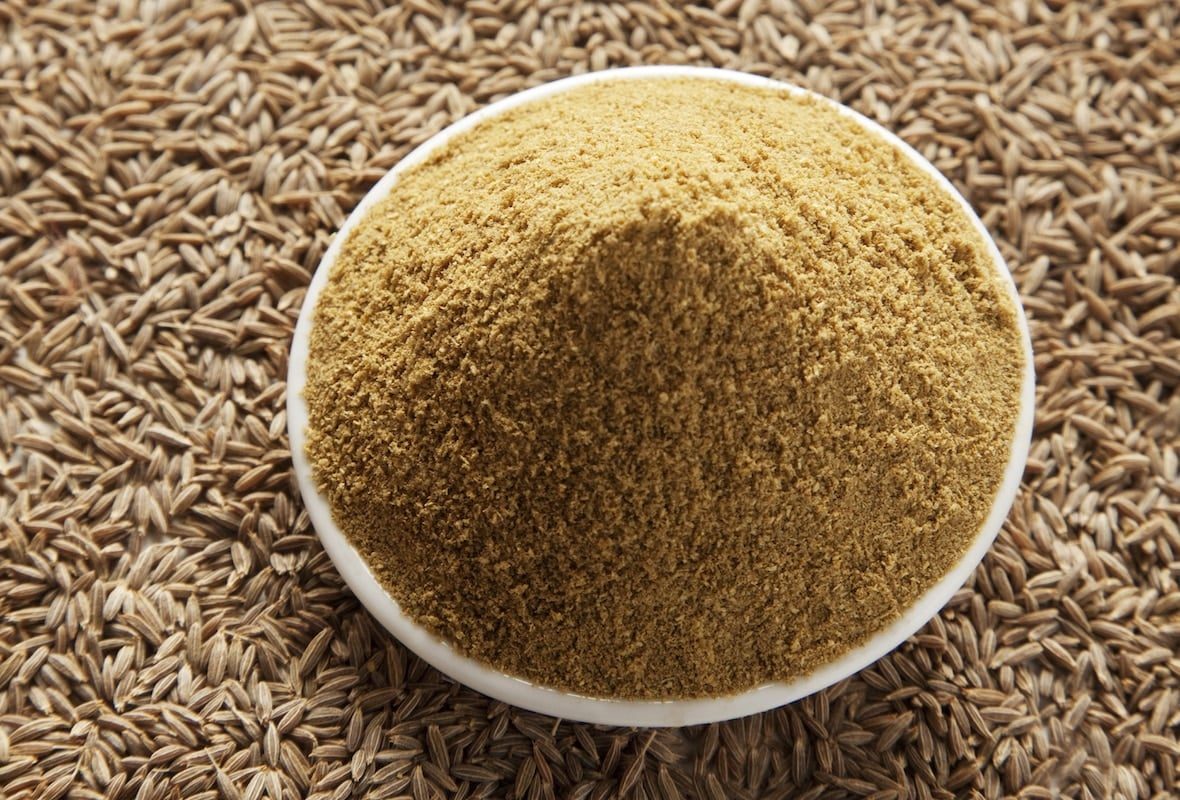
Cumin seeds and ground cumin are the same spice: the dried fruit of Cuminum cyminum, a parsley-family plant, either left whole or milled.12 The differences that matter in the kitchen are how long each keeps its aroma, how each behaves in hot oil, and how much of one replaces the other. Whole seed holds its aroma longer and suits tempering in oil; ground cumin blends evenly into rubs and sauces but fades sooner and scorches faster. By volume, McCormick gives 1 teaspoon of seeds as equal to 1¼ teaspoons of ground cumin.3
Side by side
| Cumin seeds (whole) | Ground cumin | |
|---|---|---|
| Species and family | Cuminum cyminum, Apiaceae1 | Same plant, milled |
| What it is | The dried fruit, sold as “seed”: a thin, yellowish-brown oval about 6 mm long2 | The same fruit, ground to a powder |
| Where the aroma lives | An essential oil, 2.5 to 4.5 percent of the seed;2 cuminaldehyde is its most important constituent, at 20 to 72 percent of the oil across the literature PROSEA summarizes4 | The same oil. No measured figure for retail ground cumin was found |
| Moisture limit (Codex CXS 327-2017) | 10 percent maximum5 | 10 percent maximum (the same cap covers whole, cracked and ground)5 |
| Volume equivalent | 1 teaspoon | 1¼ teaspoons (McCormick, a volume figure, not a strength figure)3 |
| Named shelf-life windows | 2 years (UC Cooperative Extension, America’s Test Kitchen); 3 to 4 years for whole spices (McCormick)678 | 1 year (UC Cooperative Extension, America’s Test Kitchen); 2 to 4 years, with cumin named (McCormick)678 |
| In hot oil | The classic start of an Indian tempering9 | Burns fairly quickly (America’s Test Kitchen)10 |
| 2015 US peanut warnings | The US spice trade body knew of no reports of peanut protein in retail whole cumin11 | The FDA’s consumer advice covered products containing ground cumin or cumin powder11 |
| Flavor (editorial) | Toasted or fried, nutty and rounded; whole seeds give small bursts of flavor | Even, background warmth spread through the dish |
The shelf-life row shows a disagreement, not a range to split. The sources are the University of California Cooperative Extension, America’s Test Kitchen and McCormick, and they disagree by years. All of them give whole spices an equal or longer window than ground ones. For the general picture, see how long spices last.
Why ground cumin fades sooner
Cumin’s smell comes from a volatile oil in the seed.24 Tasting Table puts the general case for whole spices plainly: pre-ground spices begin to lose flavor and aroma almost as soon as they have been ground.12 That is a food writer’s statement about spices in general, not a measurement on cumin. America’s Test Kitchen gives the same practical advice: buy spices whole when you can and grind them just before using.7 PROSEA, the Southeast Asian plant-resources handbook, notes that whole cumin fruits keep well for a long time if stored dry.4
How fast ground cumin loses its oil compared with whole seed is a number we could not find. No study we reviewed measured it, and the shelf-life windows above are category rules of thumb, not cumin measurements.
How the seed is ground also matters. In an Iranian study, cumin ground cryogenically (chilled with liquid nitrogen) had 16.3 percent more volatile oil and 7 percent more cuminaldehyde than conventionally ground cumin.13 That is an industrial process, not a kitchen technique, but it shows that milling itself costs some aroma. In a separate laboratory study of Turkish seed, grinding the seed before distillation had a pronounced effect on the composition of the oil obtained.14
In the pan
Whole seeds in hot fat. In Indian tempering (tadka), whole or ground spices are heated in hot oil or ghee and the flavored fat goes into the dish; NPR’s guide adds whole cumin seeds first and the chopped garlic after.9 The same guide is blunt about the risk: there is no way to save a burned tadka.9 Whole seeds can also be scattered over a finished dish after frying, where they add texture; that is common practice rather than a sourced rule.
Whole seeds, dry-toasted. Tasting Table says most whole spices reach their full flavor potential after time warming in a skillet, names cumin among them, and suggests a pan over medium heat with the seeds in a single layer. It warns that spices can turn bitter quickly if they burn.12 Toast first, then grind, if you want toasted ground cumin.
Ground cumin. Ground spices can be bloomed in fat too. America’s Test Kitchen says blooming takes anywhere from 30 seconds to several minutes, warns that ground spices burn fairly quickly and leave a scorched flavor, and says that simply dumping powdered spices into the pot gives a curry or chili with a bland, musty flavor.10 With ground cumin, use moderate heat and have the next ingredient ready.
Where each works best
These are cooking judgments, not sourced rules.
- Whole: tempering oil for dals, rice dishes and vegetables; long braises where the seeds soften; garnishes where you want the seed to show.
- Ground: spice rubs, marinades, dressings and anything that needs the flavor spread evenly. Britannica calls cumin an essential ingredient in many mixed spices, chutneys, and chili and curry powders,2 and The Spice House calls chili and tacos “very cumin-forward.”15
Can one stand in for the other?
Yes, with two adjustments: amount and timing.
Amount (Computed). McCormick’s conversion is 1 teaspoon of cumin seeds = 1¼ teaspoons of ground cumin.3 That describes volume: the powder takes up more room than the seed it came from. It says nothing about strength. The Spice House advises using slightly less ground spice than whole, because ground releases its flavor faster.15 It gives a direction, not a number, so if your ground cumin is fresh, start at or below a 1:1 swap and add the rest after tasting.
Timing. Ground cumin in place of seeds in a tempering should go into the fat last and only briefly, since it burns faster than seed.10 Seeds in place of ground cumin are best ground first; a spice grinder or a mortar and pestle both work, and McCormick notes that grinding your own lets you skip the storage stage entirely.3
For other swaps, see cumin substitutes.
Safety: why the form mattered in the 2015 peanut warnings
In February 2015 the FDA advised people highly allergic to peanuts to consider avoiding certain products that contained ground cumin or cumin powder.11 Testing of recalled products later found cumin containing up to 5,000 parts per million of peanut.16 The American Spice Trade Association said at the time that it was not aware of any reports of peanut protein in whole cumin sold at retail.11 How the peanut got into the ground cumin is disputed; the cumin profile sets out both explanations.
What isn’t known
- No published measurement of how quickly ground cumin loses its volatile oil compared with whole seed under home storage.
- The shelf-life windows are rules of thumb for whole and ground spices in general, and the named sources disagree by years.
- No study compares the flavor strength of freshly ground and pre-ground cumin, so the ground-for-whole amount is a volume conversion plus a direction, not a tested ratio.
Related
- Cumin, cumin uses and cumin substitutes
- Too much cumin? How to rescue a dish.
- Caraway seeds vs. cumin, coriander vs. cumin, fennel seeds vs. cumin seeds, cumin vs. curry powder
- Other whole-vs-ground comparisons: cardamom pods vs. seeds, ground cinnamon vs. cinnamon sticks
Footnotes
-
Cuminum cyminum L., Plants of the World Online, Royal Botanic Gardens, Kew. powo.science.kew.org · Reference work ↩ ↩2
-
“Cumin”, Encyclopaedia Britannica. britannica.com · Reference work ↩ ↩2 ↩3 ↩4 ↩5
-
“How to Grind Your Own Spices, Plus Spice Conversions for Your Favorite Seasonings”, McCormick. mccormick.com · Merchant ↩ ↩2 ↩3 ↩4
-
P.C.M. Jansen, Cuminum cyminum, Plant Resources of South-East Asia (PROSEA). uses.plantnet-project.org · Reference work ↩ ↩2 ↩3
-
Standard for Cumin, CXS 327-2017, Codex Alimentarius. fao.org · Standard ↩ ↩2
-
Anna Martin, “Add a Little Spice to Your Life! Part II”, University of California Cooperative Extension, 2002. ucanr.edu · Reference work ↩ ↩2
-
“Keeping Spices and Dried Herbs Fresher Longer”, America’s Test Kitchen. americastestkitchen.com · Publication ↩ ↩2 ↩3
-
“How Long Do Spices Last?”, McCormick, 2025. mccormick.com · Merchant ↩ ↩2
-
Monica Bhide, “The Crackling Spices of Indian Tempering”, NPR, 2011. npr.org · Publication ↩ ↩2 ↩3
-
“How to Bloom Spices”, America’s Test Kitchen, 2023. americastestkitchen.com · Publication ↩ ↩2 ↩3
-
ASTA statement on FDA consumer advice on ground cumin with undeclared peanuts, American Spice Trade Association, 2015. astaspice.org · Standard ↩ ↩2 ↩3 ↩4
-
Hope Ngo, “Why You Should Start Toasting Your Spices”, Tasting Table, 2016. tastingtable.com · Publication ↩ ↩2
-
“Preparation of Standardized Powders of Cumin and Fenugreek Seeds by Cryogrinding Technology”, Iranian Research Organization for Science and Technology, 2016. jift.irost.ir · Peer-reviewed ↩
-
Baser, Kurkcuoglu and Ozek, “Composition of the Turkish cumin seed oil”, Journal of Essential Oil Research, 1992. agris.fao.org · Peer-reviewed ↩
-
“Cumin Substitute”, The Spice House, 2017. thespicehouse.com · Merchant ↩ ↩2
-
Ishani Nath, “Special Report: Investigating Motive and Spice Safety in the Big Peanut-Tainted Cumin Recalls”, Allergic Living, 2016. allergicliving.com · Publication ↩