Spice Comparisons · Comparison
Tellicherry vs. Black Pepper: A Grade of the Same Berry, Not a Different Spice
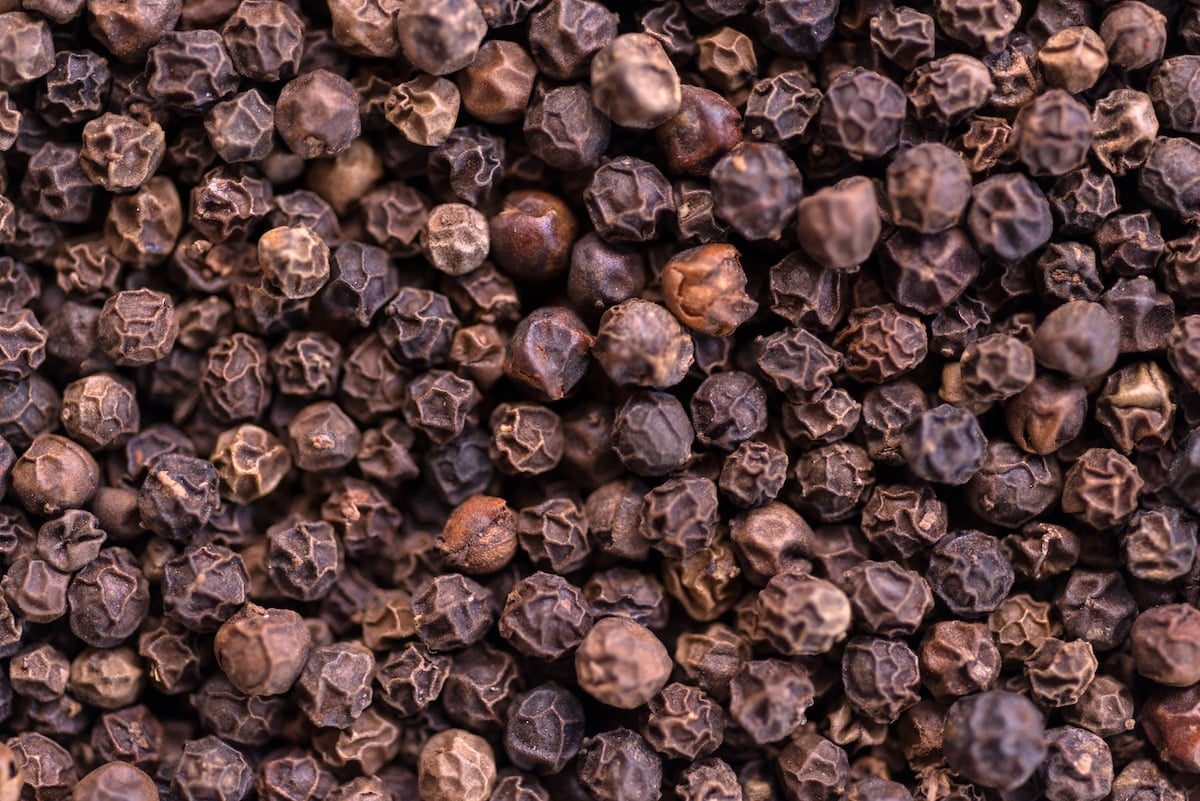
Tellicherry pepper is black pepper. It comes from the same vine, Piper nigrum, and the name is a trade grade: an origin on India’s Malabar Coast and a size, the larger berries sorted out of the crop.123 So the real comparison is between a named, sorted, whole-berry grade and whatever black pepper is in your jar. The bigger flavor difference usually comes from something else entirely: whether the pepper was ground a minute ago or months ago.3
Side by side
| Tellicherry pepper | Black pepper (generic) | |
|---|---|---|
| Plant | Piper nigrum2 | Piper nigrum1 |
| Family | Piperaceae1 | Piperaceae1 |
| What the name means | An origin and grade name; McCormick Science Institute lists it among pepper grades identified by geographic origin2 | Any dried Piper nigrum berry with its outer layer intact, from any origin4 |
| Origin | India; named for Tellicherry, now Thalassery, a port in northern Kerala25 | Grown widely; Vietnam heads McCormick Science Institute’s 2022 list of producers, followed by Indonesia, Brazil and India2 |
| Berry size | Larger than typical peppercorns (Katzer); one seller defines its “Special Extra Bold” grade as at least 4.75 mm across36 | Mixed sizes unless sorted (our observation) |
| Forms | Sold whole | Whole, cracked or ground |
| Pungent compound | Piperine, as in all black pepper; no study found compares Tellicherry with smaller berries | Piperine, 4.9–7.7% of black pepper (PROSEA)7 |
| Quality standard | No international grade by that name; Codex does not mention it4 | Codex Grades I to III, set by density, light berries, volatile oil and piperine4 |
| Flavor (editorial) | Strongly aromatic, resinous and citrusy, with a hard bite, in a good lot | Depends on the lot and, above all, on freshness |
| Price | No dated, sourced retail comparison found | No dated, sourced retail comparison found |
What the Tellicherry label means
There is no single official definition that covers every bag. What the sources show:
| Source | What it says |
|---|---|
| Katzer’s Spice Pages | “The most important Indian grades are Malabar and Tellicherry”; Malabar is regular black pepper, and Tellicherry corns are larger than typical3 |
| McCormick Science Institute | One of the “various grades/varieties of pepper identified by their geographic origin”; Tellicherry is from India2 |
| Pure Indian Foods (a merchant, on its own product) | TGSEB, “Tellicherry Garbled Special Extra Bold”; Special Extra Bold means a minimum diameter of 4.75 mm; single origin, Malabar Coast, Kerala6 |
| Codex CXS 326-2017 | Three grades for whole black pepper; no origin names4 |
| Indian Standard IS 1798:2010 | The 2010 revision removed the grading of whole black pepper into grades8 |
India’s older grade names come from the Pepper Grading and Marking Rules of 1969, which a 2002 export-inspection document still cites.9 We could not open the rules themselves, so official sieve sizes for each Tellicherry grade are not given here. A widely repeated figure says any peppercorn over 4.25 mm counts as Tellicherry, wherever it was grown; we found no source for either the number or the origin-free definition. Treat 4.75 mm as one seller’s definition for one grade.
Spice writers quoted by AramcoWorld ask for grades by full name, such as Malabar Garbled No. 1 and Malabar Garbled Extra Bold.10 The full grade code and a stated growing region tell you more than the word “Tellicherry” alone.
Does Tellicherry taste different?
It has the reputation. McCormick Science Institute says Tellicherry is “widely considered to be the highest quality and most flavorful variety of black pepper,”2 and Katzer says Indian black peppers, especially the Tellicherry grade, are very aromatic and pungent.3 Pure Indian Foods describes its own lot as having “a citrus-forward brightness.”6 Those are opinions and a seller’s description, not measurements.
We found no study comparing the piperine or aroma of Tellicherry-grade berries with smaller berries or with other origins. A widely repeated explanation says the larger berries were left longer on the vine and so developed more complex flavor; no source we opened supports it. What the chemistry does show is that the bite comes from piperine and the aroma from a small amount of essential oil, in Tellicherry as in any black pepper.117
The difference that matters more: whole vs. ground
Comparing whole Tellicherry with a jar of pre-ground pepper mixes two differences, grade and freshness. Katzer says few spices deteriorate as quickly as ground pepper, and that black pepper can lose its aroma fully; he recommends a pepper mill.3 Heat fades in the pot too: in a 1992 study of spices boiled in curry for 15 to 30 minutes, 50 to 60 percent of the piperine was lost.12 In our judgment, freshly ground ordinary black peppercorns will usually beat old pre-ground pepper by more than Tellicherry beats fresh ordinary peppercorns, though no taste test we found measures either gap.
Can one stand in for the other?
Yes. They are the same spice. The amounts below come from our Tellicherry pepper substitutes and black pepper substitutes pages and keep their labels: Computed has a measurable basis, Method is our starting point where no published number exists.
| Swap | Starting amount | Treatment |
|---|---|---|
| Other whole black peppercorns for Tellicherry, freshly ground | Same amount, then taste | Method |
| Ground black pepper for ground Tellicherry | Same amount, then taste | Method |
| Ground pepper where a recipe measures whole peppercorns | 1 teaspoon whole = 1 1/2 teaspoons ground (volume only) | Computed (McCormick conversion) |
McCormick’s whole-to-ground figure is a volume conversion: ground pepper takes up more room than the berries it came from.13 It says nothing about strength, so taste before adding the full amount of an old jar.
When to use which
These are cooking judgments. Tellicherry earns its price where pepper is the point and is ground at the last moment: at the table, over steak, eggs and pasta, in cacio e pepe, or cracked for a pepper crust. In long-simmered dishes, rubs with many spices, or anywhere the pepper is ground in advance, the grade matters less and ordinary whole black pepper does the job. Large berries may not feed evenly through a small or cheap grinder.
What isn’t known
- No study compares piperine or aroma in Tellicherry-grade berries with smaller berries or other origins.
- The official sieve sizes in India’s 1969 grading rules could not be checked; the 4.25 mm figure is untraced.
- No taste test compares Tellicherry with ordinary black pepper ground at the same time.
- No dated retail price comparison.
Related
- Tellicherry pepper, Tellicherry pepper substitutes
- Black pepper, black pepper substitutes, cracked vs. ground black pepper, too much pepper
- Malabar pepper, Lampong pepper, Kampot pepper
- White pepper vs. black pepper, peppercorn medley vs. black pepper, long pepper vs. black pepper
Footnotes
-
Piper nigrum L., Plants of the World Online and Kew Species Profiles, Royal Botanic Gardens, Kew. powo.science.kew.org · Reference work ↩ ↩2 ↩3 ↩4
-
“Black Pepper”, McCormick Science Institute. mccormickscienceinstitute.com · Merchant ↩ ↩2 ↩3 ↩4 ↩5 ↩6 ↩7
-
Gernot Katzer, “Pepper (Piper nigrum L.)”, Gernot Katzer’s Spice Pages. gernot-katzers-spice-pages.com · Reference work ↩ ↩2 ↩3 ↩4 ↩5 ↩6
-
Standard for Black, White and Green Peppers (CXS 326-2017), Codex Alimentarius Commission. fao.org · Standard ↩ ↩2 ↩3 ↩4
-
“Thalassery”, Encyclopaedia Britannica. britannica.com · Reference work ↩
-
Tellicherry Special Extra Bold Peppercorns (product page), Pure Indian Foods. pureindianfoods.com · Merchant ↩ ↩2 ↩3
-
Piper nigrum, Plant Resources of South-East Asia (PROSEA). uses.plantnet-project.org · Reference work ↩ ↩2
-
IS 1798:2010, Black Pepper, Whole and Ground, Specification, Bureau of Indian Standards. law.resource.org · Standard ↩
-
Certification of Black Pepper (2002), Export Inspection Council of India. eicindia.gov.in · Regulator ↩
-
Jeff Koehler, “Spice Migrations: Pepper”, AramcoWorld, 2021. aramcoworld.com · Publication ↩
-
“Black pepper”, Encyclopaedia Britannica. britannica.com · Reference work ↩
-
Srinivasan, Sambaiah and Chandrasekhara, “Loss of active principles of common spices during domestic cooking”, Food Chemistry, 1992. agris.fao.org · Peer-reviewed ↩
-
“How to Grind Your Own Spices, Plus Spice Conversions”, McCormick, 2025. mccormick.com · Merchant ↩