Spice Comparisons · Comparison
Basil vs. Parsley: The Lead Herb and the Supporting One
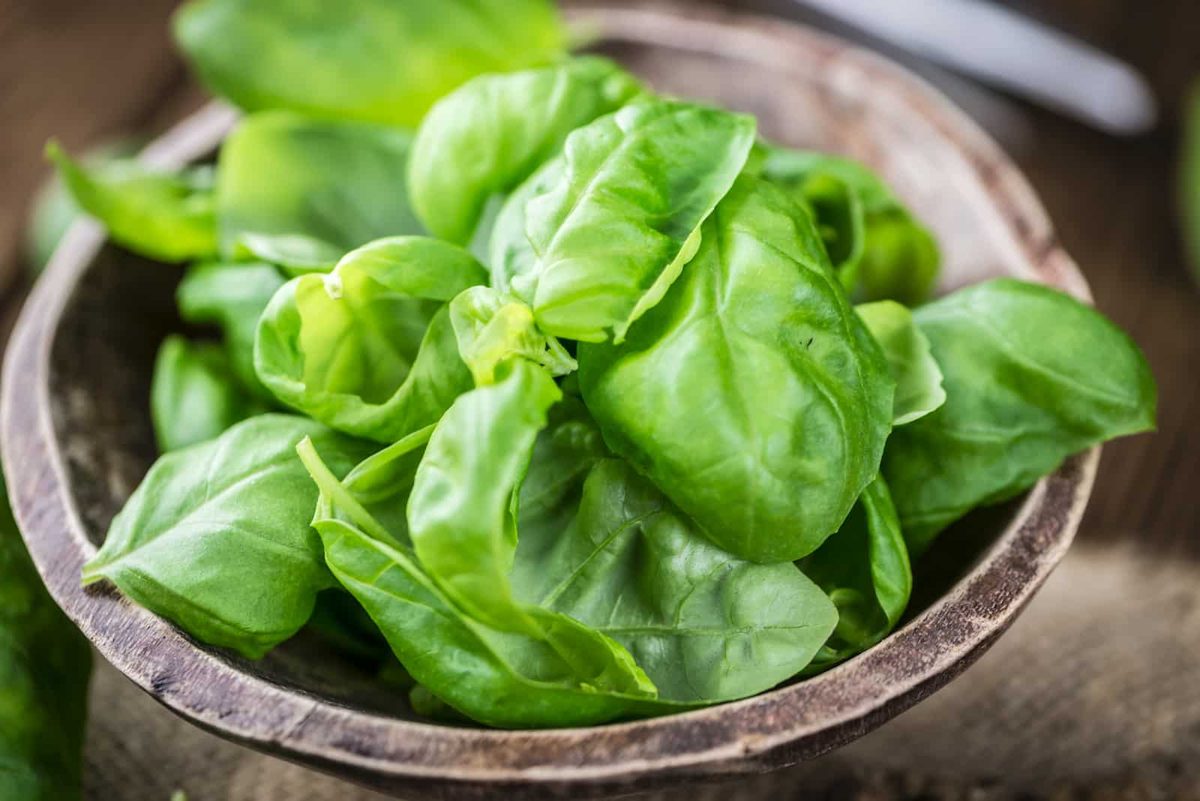
Basil and parsley are both green leaves that finish a dish, but they come from different plant families and carry very different amounts and kinds of aroma. Basil oil is built on methyl chavicol (estragole), a sweet-spicy compound,1 while parsley’s small amount of leaf oil is led by compounds such as 1,3,8-p-menthatriene, limonene and myristicin, and its flavor runs warm and slightly bitter.2 Basil is the flavor of a dish; parsley more often supports one.
Side by side
| Basil (sweet basil) | Parsley | |
|---|---|---|
| Species | Ocimum basilicum3 | Petroselinum crispum4 |
| Family | Mint family (Lamiaceae)5 | Carrot or parsley family (Apiaceae)6 |
| Native range | Tropical and subtropical Asia to northern Australia (Kew)3 | Northwest Africa and the Balkan Peninsula (Kew)4 |
| Growth | Annual herb5 | Biennial: leaves in the first season, flowers in the second6 |
| Leaf | Glossy, oval, smooth or slightly toothed, often cupped5 | Deep green and tender, either flat or deeply frilled6 |
| Main types | Many; at least six chemotypes, including Thai and lemon types1 | Curly-leaved, flat-leaved and turnip-rooted (Hamburg)2 |
| Key aroma compounds | Methyl chavicol (estragole): 53.3% in one French-type oil1 | Leaf oil: 1,3,8-p-menthatriene, limonene and myristicin (see below)2 |
| Flavor | Sweet, green and spicy, with anise and clove notes (editorial) | Warm, but slightly burning and bitter (PROSEA, of the herb oil)2 |
| Fresh or dried | Better fresh; much weaker dried7 | Better fresh; much weaker dried7 |
| Typical uses | Pesto, pizza, pasta, Thai cooking1 | Fish, meats, soups, sauces and salads; garnish62 |
| Safety notes | Estragole: BfR names basil pesto among foods that may contain high amounts8 | Can affect warfarin; MedlinePlus advises steady amounts9 |
| Cost | No dated, sourced price comparison found | No dated, sourced price comparison found |
For other members of each family, oregano is in the mint family with basil, and cilantro is in the parsley family.1011
How much aroma, and from what
The oil figures below come from different works and are not measured on the same basis, so they show direction rather than a precise ratio.
| Herb and sample | Essential oil content | Main compounds |
|---|---|---|
| Basil (PROSEA) | About 1.5%, basis not stated1 | Methyl chavicol 53.3% in a French-type oil1 |
| Flat-leaved parsley, fresh herb (PROSEA) | 0.04%2 | 1,3,8-p-menthatriene 20.0%, limonene 18.0%, myristicin 9.1% (German sample)2 |
| Curly-leaved parsley, fresh herb (PROSEA) | 0.07–0.15%2 | Myristicin 32.0%, 1,3,8-p-menthatriene 20.0%, limonene 14.0% (German sample)2 |
Britannica gives a much lower figure for basil, 0.1%, also without a stated basis, so the basil oil content itself is disputed.5 Even so, the sources agree on the compounds: basil and parsley share no lead compound, and neither tastes like the other.
PROSEA also says flat-leaved parsley is stronger flavored than curly,2 the reverse of what the oil-content figures alone might suggest. PROSEA does not explain why.
The differences that change a dish
Role
In our judgment basil leads and parsley supports. A handful of basil defines a pesto or a tomato salad; a handful of parsley brightens a stew, a sauce or a plate of fish without taking it over. Britannica lists parsley with fish, meats, soups, sauces and salads,6 and PROSEA notes that curly-leaved parsley is commonly used for garnishing and seasoning.2
Fresh, dried and heat
A widely repeated claim says dried basil is worth using while dried parsley is not. America’s Test Kitchen puts both in the same group of herbs that are much weaker in flavor when dried,7 and its tests describe delicate herbs, basil and parsley among them, as more volatile.12 LSU AgCenter lists both among the delicate herbs best added in the last minute or two of cooking.13 For long-simmered dishes, the University of Delaware’s gentler rule is to add herbs during the last 45 minutes.14 See dried basil vs. fresh and fresh parsley vs. dried.
Which parsley
PROSEA describes three cultivated groups: curly-leaved parsley with compact branches and curled leaf blades, flat-leaved parsley with more open branches and flat leaf blades, and turnip-rooted parsley, a more robust plant with long fern-like leaves.2 For cooking, flat-leaved is the stronger-flavored of the leaf types.2 See Italian parsley vs. curly parsley.
Can one stand in for the other?
For looks, sometimes; for flavor, rarely. Neither direction has a published ratio, so both are Method.
- Basil in place of parsley. The parsley substitutes page suggests starting with about half the parsley amount and tasting, and keeping basil to Italian dishes where it already belongs. A chiffonade of basil gives a similar green finish, but basil will stand out where parsley would blend in (editorial).
- Parsley in place of basil. Parsley adds color and a fresh, slightly bitter note but none of basil’s sweetness or anise. In a tomato sauce or salad, start with the same amount and accept a different dish; in pesto, a parsley version is a different sauce rather than a stand-in (editorial).
Safety notes
Neither herb is a concern at normal kitchen amounts, but each has one point worth knowing:
- Parsley and warfarin. MedlinePlus lists parsley among foods that can affect warfarin; its advice is not to avoid these foods but to keep amounts small and steady.9 Britannica warns that parsley seed oil, or large amounts of other parsley preparations, can cause serious reactions; that concerns concentrated preparations, not leaves in cooking.6
- Basil and estragole. Germany’s BfR names basil-containing pesto among foods that may contain high amounts of estragole and related compounds.8 The basil profile covers what regulators have concluded.
What isn’t known
- No study compares the flavor strength of basil and parsley, so the swap amounts above are starting points.
- Basil’s essential oil content is reported as about 1.5% by PROSEA and 0.1% by Britannica, neither with a stated basis.15
- The often-repeated description of flat-leaf parsley leaves as “rosettes” could not be traced to a source.
Related
- Profiles: basil, parsley, cilantro
- Parsley substitutes
- Comparisons: cilantro vs. parsley, oregano vs. parsley, chervil vs. parsley, flat-leaf vs. Italian parsley, basil vs. oregano, basil vs. cilantro
- Cooking with basil, how to store basil, how to store parsley
Footnotes
-
N.O. Aguilar, Pham Truong Thi Tho and L.P.A. Oyen, Ocimum basilicum, Plant Resources of South-East Asia (PROSEA). uses.plantnet-project.org · Reference work ↩ ↩2 ↩3 ↩4 ↩5 ↩6 ↩7
-
I.B. Ipor and L.P.A. Oyen, Petroselinum crispum, Plant Resources of South-East Asia (PROSEA). uses.plantnet-project.org · Reference work ↩ ↩2 ↩3 ↩4 ↩5 ↩6 ↩7 ↩8 ↩9 ↩10 ↩11 ↩12 ↩13
-
Ocimum basilicum L., Plants of the World Online, Royal Botanic Gardens, Kew. powo.science.kew.org · Reference work ↩ ↩2
-
Petroselinum crispum, Plants of the World Online, Royal Botanic Gardens, Kew. powo.science.kew.org · Reference work ↩ ↩2
-
“Basil”, Encyclopaedia Britannica, 2026. britannica.com · Reference work ↩ ↩2 ↩3 ↩4 ↩5
-
“Parsley”, Encyclopaedia Britannica. britannica.com · Reference work ↩ ↩2 ↩3 ↩4 ↩5 ↩6
-
Danielle Lapierre, “When You Should Actually Use Dried Herbs (and Which Ones to Avoid)”, America’s Test Kitchen, 2022. americastestkitchen.com · Publication ↩ ↩2 ↩3
-
“Alkenylbenzenes in food: how large is the health risk?”, BfR Communication No. 22/2022. bfr.bund.de · Regulator ↩ ↩2
-
“Taking warfarin”, MedlinePlus, U.S. National Library of Medicine. medlineplus.gov · Regulator ↩ ↩2
-
Anoushka Pant, “Oregano”, Encyclopaedia Britannica, 2026. britannica.com · Reference work ↩
-
“Coriander”, Encyclopaedia Britannica. britannica.com · Reference work ↩
-
“Science: Substituting Dried Herbs for Fresh”, America’s Test Kitchen. americastestkitchen.com · Publication ↩
-
“Flavorful Herbs”, LSU AgCenter. lsuagcenter.com · Reference work ↩
-
“Using Herbs and Spices”, University of Delaware Cooperative Extension, 2025. udel.edu · Reference work ↩