Spice Substitutes · Substitutes
Maldon Salt Substitutes, for Finishing and for Measuring
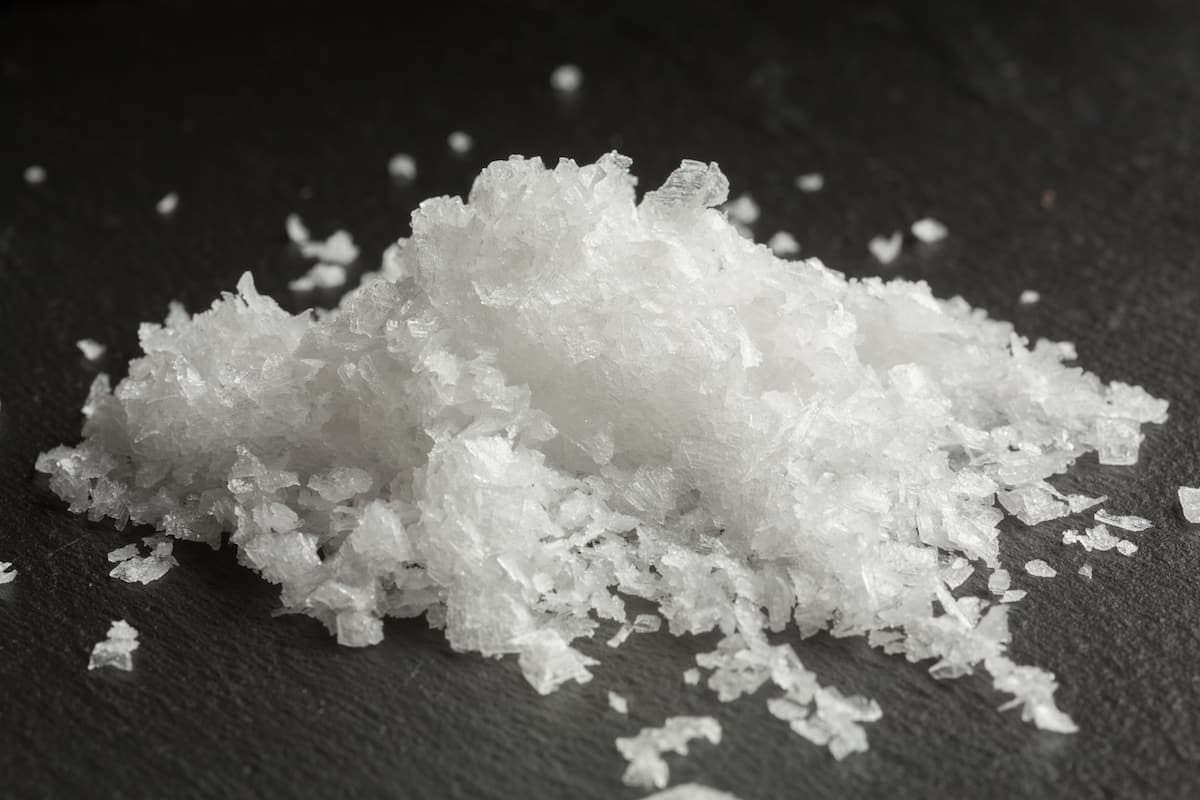
Maldon is a flaky sea salt made in the town of Maldon, in Essex in southeastern England.12 Its maker brings seawater to “a galloping boil,” then lowers the heat until salt forms on the surface, where surface tension shapes each crystal into a thin pyramid.1 Chemically it is ordinary salt: America’s Test Kitchen notes that salt is sodium chloride whatever its source, and that sea salts vary in color but only slightly in flavor.3 So a Maldon substitute is about two things. If the flakes are going on top of the food, you want a salt that crunches the same way. If they are measured into a recipe and dissolve, you only need the same amount of salt, and that is harder to judge than it sounds.
Quick answer
| What Maldon is doing | Best substitute | Starting amount | Treatment |
|---|---|---|---|
| Finishing: flakes on steak, vegetables, eggs, bread | Another flaky sea salt, such as Anglesey sea salt | By the pinch, to taste | Method |
| Finishing, with what’s in the pantry | Diamond Crystal kosher salt | By the pinch, to taste | Method |
| Finishing sweets (caramel, chocolate, cookies) | Another flaky sea salt or fleur de sel | A few flakes per piece | Method |
| Measured into a recipe that gives grams | Any food-grade salt | The same weight | Computed |
| Measured into a recipe by the spoon | Table salt, Morton kosher or Diamond Crystal | ½, ⅔ or an equal volume, then taste | Method |
How the ratios on this page are labeled
- Computed: based on a measurable physical relationship, with the source named.
- Attributed: a named source publishes this ratio. We quote it as theirs.
- Disputed: named sources give different answers to the same swap. We show each one and do not average them.
- Method: we found no published ratio. We give a direction and a cautious starting point, and say so.
We found no published weight for a teaspoon of Maldon salt, from its maker or anyone else, and no measured comparison of how salty it tastes against another salt. Most amounts here are therefore Method starting points.
What makes Maldon different
Maldon is mostly about texture. Its maker describes the flakes’ “fresh intensity and clean taste,”4 which is the producer’s own description. Foodism, reporting from the saltworks, notes that the crystal’s thin pyramid shape affects how its flavor comes across.1 In practice the flakes give a light crunch and then dissolve, so the saltiness arrives in small bursts; that description is ours. ATK recommends sea salts as finishing salts, scattered on food just before serving, rather than for cooking, where their texture is lost.3
If Maldon is finishing a dish
1. Another flaky sea salt
Any salt sold as flakes will do the same job. Anglesey sea salt, from the Menai Strait in Wales, is one with a published specification: its protected-origin rules describe it as crystalline white, flat, soft flakes.5 Flatter, softer flakes than Maldon’s pyramids give a gentler crunch; that comparison is our observation. Store-brand flaky sea salts vary from crisp to brittle.
Ratio (Method): By the pinch, as you would use Maldon, and taste. Crush larger flakes between your fingers for a finer sprinkle.
2. Fleur de sel
Fleur de sel also forms at the top of the brine. Under the specification for Guérande, on France’s Atlantic coast, it forms as crystals floating in sheets on the surface of the salt pans and is skimmed off by hand.6 It is not dried like a flake: the specification allows up to 12% moisture.6 Expect finer, damp crystals that cling and dissolve a little more slowly, rather than Maldon’s dry, crisp flakes. That contrast is our observation.
Ratio (Method): By the pinch, to taste. It suits sweets and delicate fish especially well, in our judgment.
3. Diamond Crystal kosher salt
If the pantry holds only kosher salt, Diamond Crystal is the closer of the two big US brands. ATK describes it as made by the Alberger process, in which brine is heated and stirred in open containers so that hollow, pyramid-shaped crystals form, and its tasters preferred its “delicate and fleeting crunch.”7 Morton’s kosher salt is pressed through rollers into thin, hard flakes, and ATK’s tasters found its grains harder.7
Ratio (Method): By the pinch, to taste. With Morton, use a lighter hand: ATK weighs a teaspoon of Morton at 4.8 grams against 2.8 grams for Diamond Crystal, so the same pinch carries more salt.7
4. Coarse sea salt or coarse Himalayan pink salt
These give a harder, chunkier crunch, which suits a steak better than a salad. Himalayan pink salt is mined rock salt, not sea salt; its color comes from traces of iron oxide.8
Ratio (Method): By the pinch, fewer crystals than you would use of Maldon, because each piece is a bigger hit of salt. That is our kitchen judgment.
If Maldon is measured into a recipe
Some recipes, often for bread, focaccia or cookies, measure Maldon into the dough. Once it dissolves, the shape of the flake no longer matters.
By weight (Computed): Use the same weight of any food-grade salt. The Codex standard for food-grade salt requires at least 97% sodium chloride on a dry basis, whatever the source,9 so equal weights carry close to the same amount of salt.
By volume (Method): This is where Maldon swaps go wrong. Flakes pack loosely, so a teaspoon of flake salt holds less salt than a teaspoon of fine salt: the American Heart Association notes that large-crystal salts have less sodium per teaspoon simply because fewer crystals fit.10 Home-canning guidance from the National Center for Home Food Preservation does not recommend flake salt at all, because its density varies.11 With no published weight for Maldon, start with:
| Per 1 teaspoon Maldon | Starting amount | Why |
|---|---|---|
| Table salt | About ½ teaspoon | Table salt is the densest common salt, about 6 g per teaspoon (ATK)7 |
| Morton kosher salt | About ⅔ teaspoon | The same amount of salt as ½ teaspoon table salt, by ATK’s weights (4.8 g per teaspoon)7 |
| Diamond Crystal kosher salt | About 1 teaspoon | The same again, by ATK’s weights (2.8 g per teaspoon)7 |
The three rows hold the same amount of salt as each other. The anchor, half a teaspoon of table salt, is our cautious starting point, not a measurement of Maldon. Taste where you can, and add more.
Notes for every swap
- Sodium. Table salt, kosher salt and most sea salts are all about 40% sodium,10 so swapping one salt for another does not change sodium intake unless you use less.
- Iodine. Noniodized sea salt provides virtually no iodine, and the NIH Office of Dietary Supplements lists sea salt, kosher salt, Himalayan salt and fleur de sel among specialty salts that are not usually iodized.12 Swapping Maldon for iodized table salt in a recipe adds iodine; it does not change the taste, since ATK’s tasters found no detectable difference between iodized and noniodized salt.3
- Dissolving. Kosher salt is much coarser than table salt and dissolves more slowly, Tufts notes.13 In a quick dough, a fine salt mixes in more evenly; that is common baking practice.
What isn’t known
- No published weight per teaspoon was found for Maldon, so every volume swap on this page is a starting point.
- No sensory test comparing Maldon with other flaky salts, fleur de sel or kosher salt as a finishing salt was found.
- Maldon’s maker does not publish a composition analysis, and Maldon was not among the salts in the analyses we reviewed.
Related
- Maldon sea salt, Maldon salt vs. kosher salt and fleur de sel vs. Maldon salt
- Fleur de sel, Anglesey sea salt, kosher salt, Himalayan salt, smoked sea salt and sea salt
- Fleur de sel substitutes, sea salt substitutes and kosher salt substitutes
- Cooking with sea salt and the best salt for cooking
- Overdid it? See too much sea salt.
Footnotes
-
Clare Finney, Clear as crystal: the decades-old traditions of Maldon sea salt, Foodism, 2018. foodism.co.uk · Publication ↩ ↩2 ↩3
-
Maldon, Encyclopaedia Britannica. britannica.com · Reference work ↩
-
Salt Types and Measurements, America’s Test Kitchen. americastestkitchen.com · Publication ↩ ↩2 ↩3
-
About Us, Maldon Salt (the producer’s own account). maldonsalt.com · Merchant ↩
-
Anglesey Sea Salt / Halen Môn, PDO product specification, DEFRA. assets.publishing.service.gov.uk · Regulator ↩
-
Cahier des charges de l’IGP Sel de Guérande / Fleur de sel de Guérande, French Ministry of Agriculture, 2025. info.agriculture.gouv.fr · Regulator ↩ ↩2
-
Kate Shannon Levine, The Best Kosher Salt, America’s Test Kitchen, 2019. americastestkitchen.com · Publication ↩ ↩2 ↩3 ↩4 ↩5 ↩6
-
Fayet-Moore F et al., An Analysis of the Mineral Composition of Pink Salt Available in Australia, Foods, 2020. mdpi.com · Peer-reviewed ↩
-
Standard for Food Grade Salt, CXS 150-1985 (rev. 2012), Codex Alimentarius. services.bis.gov.in · Standard ↩
-
Sodium Sources: Where Does All That Sodium Come From?, American Heart Association, 2025. heart.org · Reference work ↩ ↩2
-
Salts Used in Pickling, National Center for Home Food Preservation. nchfp.uga.edu · Reference work ↩
-
Iodine: Fact Sheet for Health Professionals, NIH Office of Dietary Supplements. ods.od.nih.gov · Regulator ↩
-
What’s the difference between kosher salt and other salt?, Tufts Health & Nutrition Letter, 2013 (updated 2019). nutritionletter.tufts.edu · Publication ↩