Spice Comparisons · Comparison
Fleur de Sel vs. Sea Salt: One Hand-Skimmed Sea Salt Against the Rest
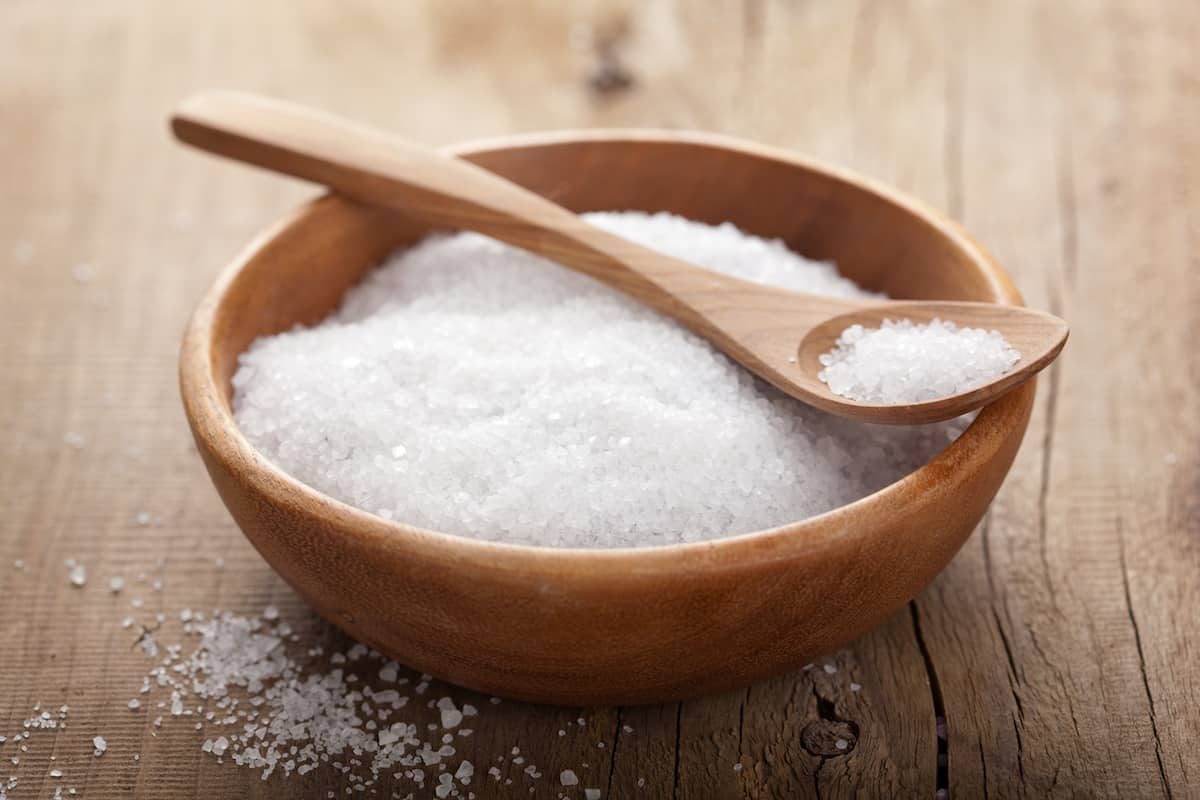
Fleur de sel is not an alternative to sea salt; it is one kind of sea salt. Sea salt is whatever is left behind when seawater evaporates.1 Fleur de sel is a particular part of that process: the thin layer of crystals that forms on the surface of the brine in shallow salt pans and is skimmed off by hand.2 So the useful comparison is between that hand-skimmed, slightly damp finishing salt and the ordinary sea salts on the shelf, fine or coarse. A Swiss government laboratory that measured both found them close in composition: 36.9% to 38.8% sodium for four fleur de sel samples, 38.9% to 40.7% for seven sea salts.3 What separates them in the kitchen is texture.
Side by side
| Fleur de sel | Sea salt (general) | |
|---|---|---|
| What it is | Crystals that form in floating sheets on the surface of the salt pan, skimmed by hand2 | Salt left behind when seawater evaporates1 |
| How it’s made | Shallow pans, wind and sun (Guérande specification)2 | Varies by product: Morton’s fine sea salt is evaporated by the sun;4 Maldon’s flakes form in boiled seawater5 |
| Moisture | Up to 12% (Guérande)2 | No general figure published |
| Additives | None allowed (Guérande)2 | Usually none; Morton’s fine sea salt lists sea salt as its only ingredient4 |
| Sodium (Swiss survey) | 36.9% to 38.8% (4 samples)3 | 38.9% to 40.7% (7 samples)3 |
| Iodine | Not usually iodized6 | Not usually iodized6 |
| Weight per teaspoon | No published figure found | Morton fine sea salt label: 1.4 g per ¼ teaspoon.4 Coarse and flaky sea salts: no published figure found |
| Main job | Finishing7 | Fine: everyday cooking. Coarse and flaky: finishing7 |
| Flavor (editorial) | Salty; fine, damp crystals with a brief crunch | Salty; fine sea salt behaves like table salt, coarse sea salt crunches |
| Price | No dated, sourced comparison found | No dated, sourced comparison found |
What makes fleur de sel different
The best-documented fleur de sel comes from Guérande, on France’s Atlantic coast, where the name is a protected geographical indication with a published specification.2 Two salts come out of the same pans there. Gray salt (sel gris) crystallizes on the clay bottom of the shallow basins and is gray from fine clay particles; fleur de sel forms as crystals floating in sheets on the surface of the brine, only when there is wind and sun, and is skimmed off by hand.2 The specification allows fleur de sel up to 12% moisture and less than 0.20% insoluble matter, against up to 1% for gray salt, and allows no additives.2
A common description says fleur de sel is seawater evaporated over clay beds. At Guérande, the salt that forms on the clay is the gray salt. Fleur de sel never touches the bottom.2
Fleur de sel is also made outside Guérande. The four samples in the Swiss survey were labeled as from the Camargue in southern France (two), Greece (one) and an undeclared origin (one).3 The Guérande rules describe only Guérande’s salt.
Measured side by side
A May 2016 report from Switzerland’s Federal Food Safety and Veterinary Office (FSVO) analyzed 25 salts, bought from local retailers or online, in one project.3 Because both kinds of salt were measured in the same project, the figures can be set side by side. They describe these 11 samples only.
| Measured (Swiss FSVO, 2016) | Fleur de sel (4 samples) | Sea salt (7 samples) |
|---|---|---|
| Sodium, % | 36.9 to 38.8 | 38.9 to 40.7 |
| Potassium, g/kg | 1.1 to 2.2 in three samples; below 0.05 in one | Below 0.05 in six; 1.2 in one |
| Iodine, µg/kg | 21 to 61.7 | Below 20, or not detected, in four; 28 to 54 in three |
All figures from the FSVO report’s Tables 1 and 2.3
What that shows:
- Fleur de sel ran slightly lower in sodium. Every fleur de sel sample was lower in sodium than every sea salt sample, though the closest pair (38.8% and 38.9%) are almost level. The report doesn’t explain why in the tables we read, and we found no analysis that does.
- The extra potassium is small. 2.2 g/kg is 0.22% of the salt by weight (our arithmetic).
- Neither is an iodine source. The highest figure, 61.7 µg/kg, compares with 45 micrograms per gram, or 45,000 µg/kg, in US iodized salt.6
- The overall verdict. The FSVO concluded that specialty salts “do not possess any advantages over standard salts.”3
The American Heart Association makes the same point in general terms: sea salt may carry trace minerals such as magnesium, potassium and calcium, but total sodium intake is what matters for heart health.1
Texture is the real difference
America’s Test Kitchen found that sea salts vary in color but only slightly in flavor, and that sea salt tastes no different from table salt once mixed into food.7 It recommends sea salts as finishing salts.7 So the question is crystal size and shape:
- Fleur de sel: fine, flaky, slightly damp crystals that clump a little and crunch briefly. That description is ours.
- Flaky sea salts such as Maldon: thin pyramid flakes that form on the surface of heated brine, shaped by surface tension.5 Maldon is dried with hot air after harvest.5
- Coarse sea salt: hard, chunky crystals, suited to grinders and crusts.
- Fine sea salt: dissolves like table salt; Morton’s chart treats a teaspoon of its fine sea salt as equal to a teaspoon of its table salt.8
It is widely said that fleur de sel’s moisture keeps its saltiness on the tongue longer than dry salts. We found no test of it.
In the kitchen
These are kitchen judgments, not tested rules:
- Fleur de sel for finishing: sliced steak, grilled fish, shellfish, tomatoes, eggs, caramels and chocolate.
- Flaky sea salt for the same jobs when you want a larger, crisper flake.
- Coarse sea salt for crusts, grinders and salting pasta water.
- Fine sea salt for everything measured: doughs, batters, brines and sauces.
Can one stand in for the other?
Yes. For more options, see fleur de sel substitutes and sea salt substitutes.
| Swap | Starting amount | Treatment |
|---|---|---|
| Flaky or coarse sea salt in place of fleur de sel, for finishing | By the pinch, to taste; crush coarse crystals | Method |
| Fleur de sel in place of flaky sea salt, for finishing | By the pinch, to taste | Method |
| Either, measured into a recipe by weight | No more than the same weight | Computed (upper limit) |
| Fine sea salt in place of fleur de sel, measured by volume | Start with about half the volume, then taste | Method |
| Fleur de sel in place of fine sea salt, measured by volume | Weigh it if you can; otherwise start under the volume called for and taste | Method |
How these were worked out. By weight: the Codex standard requires food-grade salt to be at least 97% sodium chloride on a dry basis,9 and fleur de sel may hold up to 12% moisture,2 so a gram of fleur de sel cannot carry more salt than a gram of dry sea salt. The Swiss sodium figures point the same way.3 By volume: there is no published weight for a teaspoon of fleur de sel. Morton’s chart puts its fine sea salt level with table salt,8 so the fine-sea-salt starting point borrows the table-salt treatment from our fleur de sel substitute page. Fine sea salt carries more salt per spoonful than coarse or flaky salt only because more crystals fit in the spoon.1
A common warning says fleur de sel shouldn’t go into baked goods because it won’t dissolve evenly. We found no test of it. Measured by weight into a dough or batter, any salt dissolves; by volume, the risk is getting the amount wrong.
Health notes
- Sodium. The AHA says table salt and most sea salts are about 40% sodium.1 The Swiss figures for fleur de sel were a little lower, but not enough to make it a low-sodium salt.3
- Iodine. The NIH Office of Dietary Supplements lists sea salt and fleur de sel among specialty salts that are not usually iodized, and says noniodized sea salt provides virtually no iodine.6 If you rely on salt for iodine, see sea salt vs. iodized salt.
What isn’t known
- No published weight per teaspoon for fleur de sel, or for coarse and flaky sea salts.
- No composition analysis of Guérande fleur de sel; the Swiss samples came from other regions.
- No explanation found for the slightly lower sodium in the Swiss fleur de sel samples.
- No test of whether fleur de sel’s moisture changes how long its saltiness lasts.
- No dated, sourced price comparison.
Related
- Fleur de sel and sea salt, the full profiles
- Fleur de sel substitutes and sea salt substitutes
- Fleur de sel vs. Maldon salt, fleur de sel vs. kosher salt and fleur de sel vs. Himalayan salt
- Table salt vs. sea salt and kosher salt vs. sea salt
- Celtic sea salt, Maldon sea salt and cooking with sea salt
Footnotes
-
Sodium Sources: Where Does All That Sodium Come From?, American Heart Association, 2025. heart.org · Reference work ↩ ↩2 ↩3 ↩4 ↩5
-
Cahier des charges de l’IGP Sel de Guérande / Fleur de sel de Guérande, French Ministry of Agriculture, 2025. info.agriculture.gouv.fr · Regulator ↩ ↩2 ↩3 ↩4 ↩5 ↩6 ↩7 ↩8 ↩9 ↩10
-
Esther Infanger and Max Haldimann, Report on the composition of prevalent salt varieties, Swiss Federal Food Safety and Veterinary Office, 2016. warwick.ac.uk · Regulator ↩ ↩2 ↩3 ↩4 ↩5 ↩6 ↩7 ↩8 ↩9
-
Morton Fine Sea Salt, product page, Morton Salt. mortonsalt.com · Merchant ↩ ↩2 ↩3
-
Clare Finney, Clear as crystal: the decades-old traditions of Maldon sea salt, Foodism, 2018. foodism.co.uk · Publication ↩ ↩2 ↩3
-
Iodine: Fact Sheet for Health Professionals, NIH Office of Dietary Supplements. ods.od.nih.gov · Regulator ↩ ↩2 ↩3 ↩4
-
Salt Types and Measurements, America’s Test Kitchen. americastestkitchen.com · Publication ↩ ↩2 ↩3 ↩4
-
Salt Conversion Chart, Morton Salt. mortonsalt.com · Merchant ↩ ↩2
-
Standard for Food Grade Salt, CXS 150-1985 (rev. 2012), Codex Alimentarius. services.bis.gov.in · Standard ↩