Spices · Profile
Celtic Sea Salt: The Brand, the Gray Salt Behind It, and How to Use It
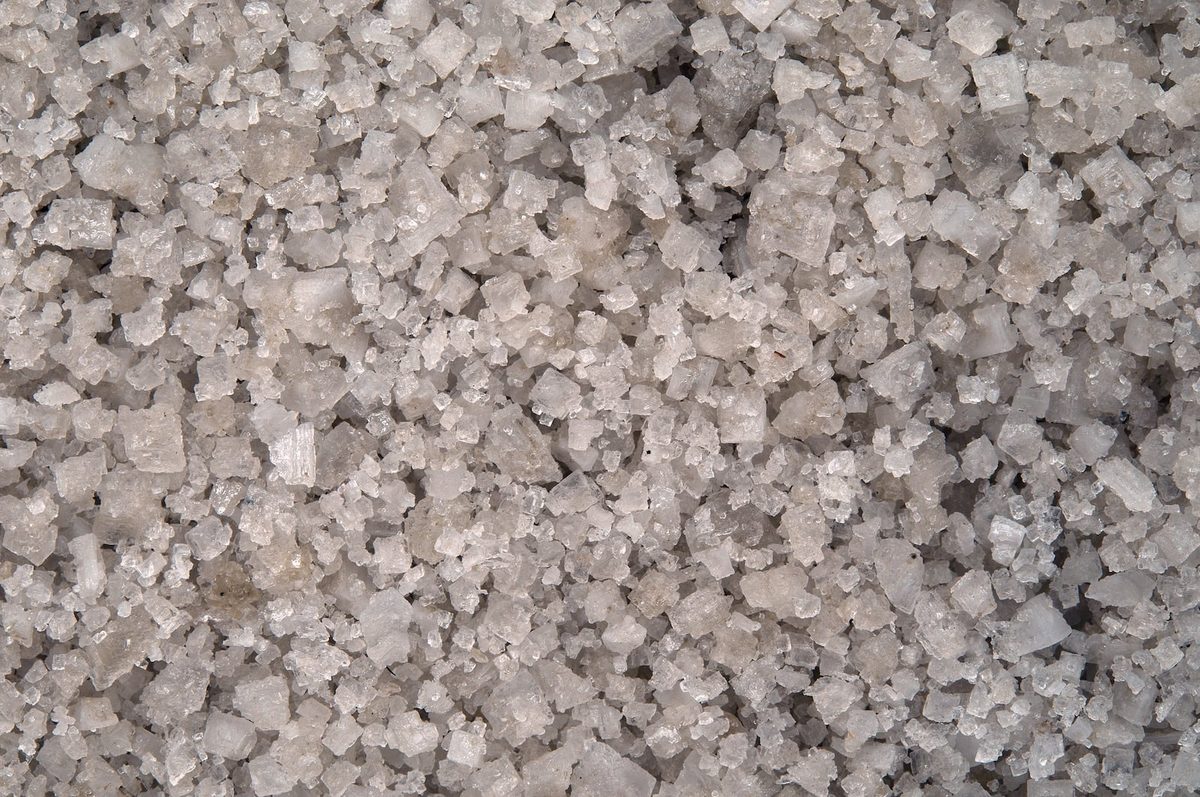
Celtic Sea Salt is a brand name before it is a type of salt. The company says it was founded in 1976 by Dr. Jacques Delangre, who coined the word “Celtic” for it.12 One of its products, Light Grey Celtic, is a moist gray sea salt of the kind French producers call sel gris, gray salt. This page covers what the brand says about its salt, how gray salt is made in Guérande, a French producing area with a detailed official specification, how to cook with it, and what the mineral and sodium claims are worth.
At a glance
| What it is | A brand of hand-harvested sea salt; its Light Grey Celtic is a moist gray salt12 |
| Name | Coined by the brand’s founder, Jacques Delangre; brand founded 197612 |
| Where the brand’s salt comes from | Its pages we read name Spain for two other products, but not a location for Light Grey Celtic2 |
| Gray salt in Guérande | Crystallizes on the clay bottom of the salt pan; gray from fine clay particles3 |
| Moisture | Up to 12% for Guérande gray salt3 |
| Additives | Prohibited for Guérande salt, which is also not washed3 |
| Sodium | Most sea salts are about 40% sodium, like table salt4 |
| Iodine | No iodine added; the brand reports about 0.2 ppm naturally present2 |
Measured values
5 figures, sourced| Measure | Value | Scope | Source |
|---|---|---|---|
| Moisture, maximum Limit | up to 12 % | Guérande gray salt, PGI specification | info.agriculture.gouv.fr |
| Insoluble matter, maximum Limit | up to 1 % | Guérande gray salt, PGI specification | info.agriculture.gouv.fr |
| Sodium Nutrient | about 40 % | most sea salts generally (American Heart Association) | heart.org |
| Iodine | about 0.2 ppm | Celtic Sea Salt, brand-reported natural traceCompany's own figure | celticseasalt.com |
| Lead | about 0.68 µg per serving | Celtic Sea Salt, brand-reported typical contentCompany's own figure; no independent test found | celticseasalt.com |
Each figure is quoted as its source states it, with the samples or standard it applies to. Where sources differ, both are shown; nothing is averaged. All measured values
The brand and the name
Celtic Sea Salt says it was founded in 1976 by Dr. Jacques Delangre and that the name refers to a hand-harvesting method it dates back to the Celts and Mayans.1 Its FAQ says Delangre coined “Celtic” to honor the origin of those methods.2 That is the company’s account of its name. We found no historical source showing that the Celts harvested sea salt this way, so the Celtic link is best read as branding.
On harvest location, the brand’s FAQ says its salt is hand-harvested from ocean waters and that the gray color of Light Grey Celtic comes from coastal salt beds, some more than 1,000 years old.2 The two places it names, Villena and Catalonia in Spain, are for its river salt and its pink cave salt.2 We did not find a statement on those pages of where Light Grey Celtic itself is harvested. If origin matters to you, check the package.
How gray salt is made: the Guérande example
A well-documented gray salt comes from Guérande, on France’s Atlantic coast, where salt is protected by a European geographical indication registered in 2012.5 The protected area lies in two French départements, Loire-Atlantique and Morbihan.3 Its official specification describes the process in detail:3
- Where it forms. Gray salt forms as crystals on the clay bottom of the final pans, called œillets. Fleur de sel, by contrast, forms as crystals floating in sheets on the surface of the same pans and is skimmed off separately.
- Who harvests it and how. The harvester, the paludier, gathers gray salt by hand from the brine using a las, a tool with a handle about 5 meters long.
- When. Harvest runs roughly from mid-June to mid-September and is daily whenever the weather allows.
- Draining. The salt drains for several hours on a raised platform at the edge of the pan, then is wheeled to a storage area on the embankments.
- What is allowed. The salt is not washed, and additives are prohibited. Gray salt may contain up to 12% moisture and up to 1% insoluble matter.
The color comes from those insolubles, which the specification describes as fine particles of clay.3 The earliest written record of salt pans in the Guérande area dates from 15 December 854, in the Cartulary of Redon.3
A widely repeated claim says gray salt is fleur de sel that has sunk to the bottom of the pan. The Guérande specification describes the two as forming in different places in the pan and harvested separately; it does not describe one turning into the other.3 For the surface salt, see fleur de sel.
Flavor and texture
The Guérande rules allow gray salt up to 12% moisture.3 In the kitchen it feels damp, tends to clump and has a firm crunch; that is a cook’s description. The brand attributes its salt’s moisture to brine (“mother liquor”) left in the salt, and says moisture varies with climate and mineral content.2
On taste, America’s Test Kitchen found that sea salts vary in color but only slightly in flavor, and that they taste no different from table salt once mixed into food.6 Any brinier or more mineral taste in gray salt is most noticeable when the crystals are eaten whole on the surface of food. That is a cook’s observation, not a measured result.
How to use it
As a finishing salt. America’s Test Kitchen recommends sea salts as finishing salts, scattered on food just before serving.6 Coarse gray salt works on steak, roast vegetables, tomatoes and salads, where the crystals stay intact.
In cooking. In pasta water, soups, stews and brines the crystals dissolve, and America’s Test Kitchen notes that salt in its most basic form is sodium chloride whatever its source.6 Because its crystals are large and damp, a spoonful holds a different amount of salt than a spoonful of table salt. We found no published weight per teaspoon for gray salt, so season to taste or weigh it.
Grinding. The brand says its salt can be dried gently with low heat if it is too damp to grind, and advises against metal containers and grinders.2 That is the company’s guidance.
Buying and quality
What the label can tell you: the producer, the origin, whether it is protected (such as Sel de Guérande), and whether anything besides salt is listed. Guérande salt may contain no additives.3 For other gray salts, the ingredient list is the check.
Storage
The brand calls salt nature’s original preservative, says expiration dates are printed at some retailers’ request, and suggests plastic, glass, ceramic or wood containers.2 We found no shelf-life study for gray salt. Keep it covered; that is common practice rather than a tested rule.
Minerals, sodium and iodine
Minerals. The brand says its salt contains more than 70 trace minerals and elements.1 The American Heart Association says sea salt may contain trace levels of minerals such as magnesium, potassium and calcium, and that for heart health it is total sodium intake that matters most.4 We found no independent analysis of Celtic Sea Salt’s mineral content, so claims that it is a meaningful source of iron or calcium are not supported here.
Sodium. Table salt, kosher salt and most sea salts are about 40% sodium; a sea salt can show less sodium per teaspoon simply because fewer large crystals fit in the spoon.4 Moist gray salt is not a low-sodium salt by any source we found. The FDA’s Daily Value for sodium is less than 2,300 mg a day,7 and the World Health Organization recommends adults stay below 2,000 mg a day, with raised blood pressure the main health effect of high intake.8
Iodine. The brand says no iodine is added and that a natural trace of about 0.2 ppm is present.2 The NIH Office of Dietary Supplements notes that specialty salts such as sea salt are not usually iodized.9 If you rely on salt for iodine, use iodized salt as well; see iodized vs. non-iodized salt.
Lead. The brand reports a typical lead content of about 0.68 micrograms per serving and says each lot is tested for heavy metals.2 That is the company’s own figure; we found no independent test.
Substitutes and comparisons
- Celtic salt substitutes
- Celtic sea salt vs. table salt
- Celtic salt vs. Himalayan salt
- Fleur de sel, sea salt, kosher salt and table salt
- Cooking with sea salt and the best salt for cooking
- Too much sea salt
Footnotes
-
About Celtic Sea Salt, Celtic Sea Salt (Selina Naturally). celticseasalt.com · Merchant ↩ ↩2 ↩3 ↩4 ↩5
-
FAQs, Celtic Sea Salt (Selina Naturally). celticseasalt.com · Merchant ↩ ↩2 ↩3 ↩4 ↩5 ↩6 ↩7 ↩8 ↩9 ↩10 ↩11 ↩12 ↩13
-
Cahier des charges de l’IGP Sel de Guérande / Fleur de sel de Guérande, French Ministry of Agriculture, 2025. info.agriculture.gouv.fr · Regulator ↩ ↩2 ↩3 ↩4 ↩5 ↩6 ↩7 ↩8 ↩9 ↩10
-
Sodium Sources: Where Does All That Sodium Come From?, American Heart Association, 2025. heart.org · Reference work ↩ ↩2 ↩3
-
Sel de Guérande ou Fleur de sel de Guérande, IGP product record, INAO. inao.gouv.fr · Regulator ↩
-
Salt Types and Measurements, America’s Test Kitchen. americastestkitchen.com · Publication ↩ ↩2 ↩3
-
Sodium in Your Diet, U.S. Food and Drug Administration. fda.gov · Regulator ↩
-
Sodium reduction, World Health Organization, 2026. who.int · Regulator ↩
-
Iodine: Fact Sheet for Health Professionals, NIH Office of Dietary Supplements. ods.od.nih.gov · Regulator ↩