Spice Comparisons · Comparison
Fleur de Sel vs. Maldon Salt: Two Finishing Salts That Form on the Surface of Brine
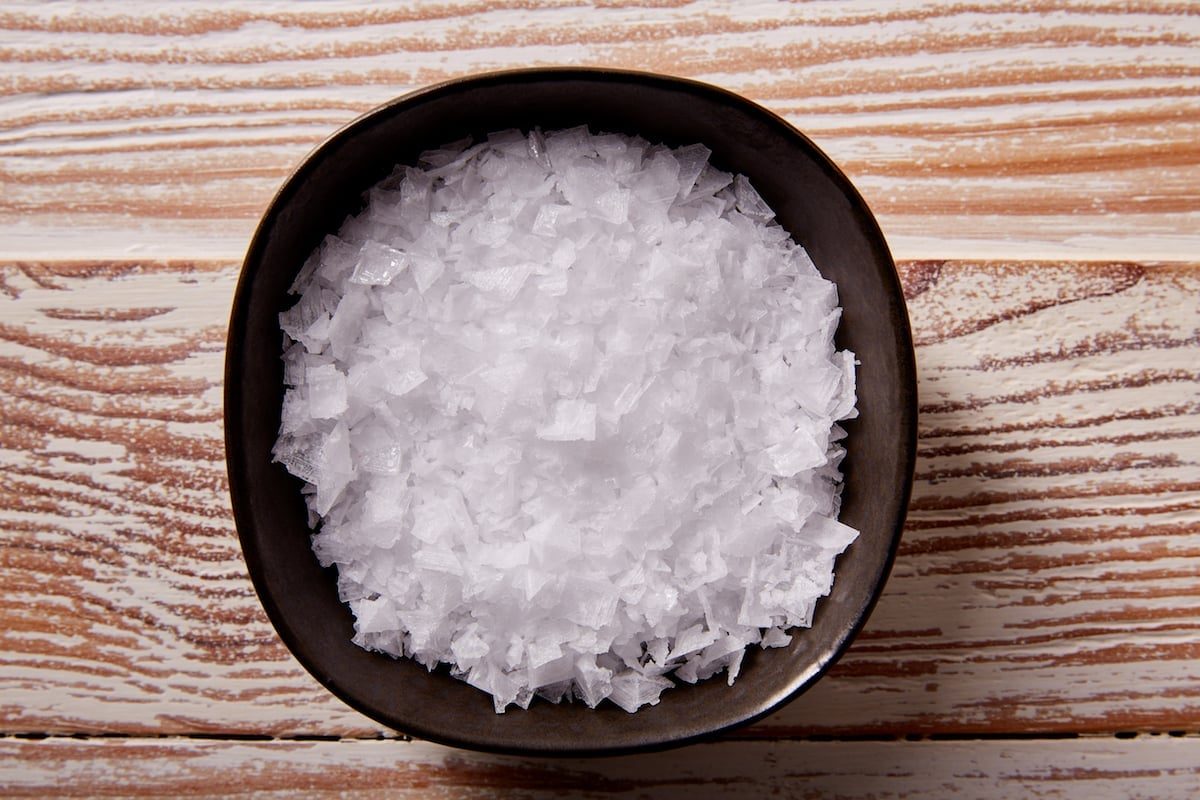
Fleur de sel and Maldon are the two best-known flaky finishing salts, and they have more in common than their reputations suggest. Both crystallize on the surface of brine and both are gathered by hand.12 The difference is the heat source. Fleur de sel forms in shallow salt pans under sun and wind;1 Maldon forms when seawater is boiled and then held at a lower temperature until crystals appear on the surface.2 That produces two different crystals: fine, damp flakes from the pans, and dry pyramid flakes from the boiling pans in Essex. Neither has been shown to taste different from other salt once it dissolves.3
Side by side
| Fleur de sel | Maldon salt | |
|---|---|---|
| Where | Best documented at Guérande, on France’s Atlantic coast, a protected geographical indication with a published specification1 | Maldon, Essex, on the Blackwater estuary in southeastern England4 |
| How the crystals form | In floating sheets on the surface of shallow pans, in wind and sun1 | Seawater, collected according to the lunar cycle, is brought to “a galloping boil,” then cooled until crystals form on the surface; surface tension shapes them into pyramids2 |
| Harvest | Skimmed by hand1 | Raked by hand; Foodism calls it “a hand drawn, handmade product”2 |
| After harvest | Up to 12% moisture allowed (Guérande)1 | Dried with hot air in a purpose-built machine2; no moisture figure published |
| Color | White, sometimes faintly pink (Guérande)1 | No published description found |
| Additives | None allowed (Guérande)1 | None, according to the producer2 |
| Producer | Salt workers (paludiers) within the protected area (Guérande)1 | One company, trading as Maldon Salt since 188225 |
| Measured composition | Four fleur de sel samples in a Swiss survey: 36.9% to 38.8% sodium (none from Guérande)6 | Not in that survey; no published analysis found |
| Iodine | Not usually iodized7 | Not stated by the maker; noniodized sea salt provides virtually no iodine7 |
| Weight per teaspoon | No published figure found | No published figure found |
| Flavor (editorial) | Salty; fine, damp crystals with a brief crunch | Salty; thin, crisp flakes that shatter |
| Price | No dated, sourced comparison found | No dated, sourced comparison found |
Same surface, different heat
Fleur de sel. In Guérande’s salt marshes, two salts come out of the same pans. Gray salt crystallizes on the clay bottom. Fleur de sel forms as crystals floating in sheets on the surface of the brine, only in favorable weather with wind and sun, and is skimmed off by hand.1 The specification allows up to 12% moisture, requires less than 0.20% insoluble matter and forbids additives.1
Maldon. According to Clare Finney’s 2018 account in Foodism, seawater is still taken according to the lunar cycle. It is brought to “a galloping boil,” then the temperature is reduced until salt crystals start to form on the surface. The surface tension of the water shapes each growing crystal into a pyramid, and the crystals are raked out by hand.2 They are then dried with hot air in a bespoke machine.2 The producer says nothing is added to the salt and nothing taken away.2 Maldon’s own account describes four generations of the family hand-harvesting the “naturally formed pyramid crystals.”5
So the old picture of fleur de sel as hand-harvested and Maldon as industrial doesn’t fit: both are raked or skimmed by hand. The real difference is that one salt is made by the weather and the other over heat. Foodism adds that salt made by evaporating seawater in the sun does not form Maldon’s pyramid shape.2
Color and minerals
A common description has fleur de sel gray from its minerals and Maldon white. At Guérande, the gray salt is the other product of the pans, sel gris, and its color comes from fine clay particles.1 Fleur de sel itself is white, sometimes faintly pink, a tint the specification attributes to the alga Dunaliella salina.1
Nor is there evidence that fleur de sel keeps more minerals than Maldon. No published analysis of Maldon was found, so the comparison can’t be made. What does exist is a 2016 Swiss government survey of 25 salts that included four fleur de sel samples (from the Camargue, Greece and an undeclared origin, none from Guérande). They were 36.9% to 38.8% sodium.6 The survey’s conclusion was that specialty salts “do not possess any advantages over standard salts.”6 The American Heart Association notes that sea salt minerals are present in trace amounts and that total sodium is what matters for heart health.8
Moisture, texture and flavor
This is the difference a cook can feel. Guérande fleur de sel may hold up to 12% water;1 Maldon is dried with hot air after harvest.2 Fleur de sel crystals tend to clump slightly and feel damp, while Maldon flakes are dry, crisp and break easily between the fingers. That description is editorial, not a measurement.
It is widely said that fleur de sel’s moisture slows how fast it dissolves, so its saltiness lingers, while Maldon’s dry flakes disappear quickly. We found no test of either half of that claim. The producer says Maldon’s pyramid shape spreads the flavor over the tongue so it is “not as hard and intense as regular salt”;2 that is the maker’s description. America’s Test Kitchen’s finding is the useful baseline: sea salts vary in color but only slightly in flavor, and taste no different from table salt once mixed into food.3
In the kitchen
ATK recommends sea salts as finishing salts,3 and that is where both of these belong. In our judgment:
- Fleur de sel suits food where small, damp crystals can sit without bouncing off: sliced steak, fish, tomatoes, eggs, caramels and chocolate.
- Maldon gives a bigger, louder crunch and is easy to crush to any size between the fingers, which makes it the more adaptable of the two for bread, salads and roasted vegetables.
- In cooking, both dissolve, and the texture you paid for is gone.
Can one stand in for the other?
Yes. Each is the first choice when the other runs out; our fleur de sel substitute page ranks Maldon first, and our Maldon salt substitute page covers the reverse.
| Swap | Starting amount | Treatment |
|---|---|---|
| Maldon in place of fleur de sel, for finishing | By the pinch, to taste; crush the flakes for a finer sprinkle | Method |
| Fleur de sel in place of Maldon, for finishing | By the pinch, to taste | Method |
| Either, measured into a recipe by weight | No more than the same weight | Computed (upper limit) |
| Either, measured by volume | Weigh it if you can; otherwise start low and taste | Method |
How these were worked out. No published weight per teaspoon exists for either salt that we found, so there is no basis for a measured volume swap. By weight, the Codex standard requires food-grade salt to be at least 97% sodium chloride on a dry basis,9 and fleur de sel may hold up to 12% moisture,1 so a gram of fleur de sel carries no more salt than a gram of dried Maldon. Whether to use a little less fleur de sel than Maldon on a finished dish is a matter of taste; no measurement settles it.
Health notes
- Sodium. The AHA says table salt and most sea salts are about 40% sodium; a flaky salt holds less sodium per teaspoon only because fewer crystals fit in the spoon.8
- Iodine. The NIH Office of Dietary Supplements lists fleur de sel among specialty salts that are not usually iodized, and says noniodized sea salt provides virtually no iodine.7 If you rely on salt for iodine, see iodized vs. non-iodized salt.
What isn’t known
- No published weight per teaspoon for either salt.
- No laboratory analysis of Maldon salt, and none of Guérande fleur de sel; the Swiss fleur de sel samples came from other regions.
- No moisture figure for Maldon after drying.
- No test of how fast either salt dissolves or how long its saltiness lasts on the tongue.
- No dated, sourced price comparison.
Related
- Fleur de sel and Maldon sea salt, the full profiles
- Fleur de sel substitutes and Maldon salt substitutes
- Fleur de sel vs. sea salt, fleur de sel vs. kosher salt and fleur de sel vs. Himalayan salt
- Maldon salt vs. kosher salt
- Anglesey sea salt, cooking with sea salt and the best salt for cooking
Footnotes
-
Cahier des charges de l’IGP Sel de Guérande / Fleur de sel de Guérande, French Ministry of Agriculture, 2025. info.agriculture.gouv.fr · Regulator ↩ ↩2 ↩3 ↩4 ↩5 ↩6 ↩7 ↩8 ↩9 ↩10 ↩11 ↩12 ↩13 ↩14 ↩15
-
Clare Finney, Clear as crystal: the decades-old traditions of Maldon sea salt, Foodism, 2018. foodism.co.uk · Publication ↩ ↩2 ↩3 ↩4 ↩5 ↩6 ↩7 ↩8 ↩9 ↩10 ↩11 ↩12 ↩13
-
Salt Types and Measurements, America’s Test Kitchen. americastestkitchen.com · Publication ↩ ↩2 ↩3
-
Kenneth Pletcher, Maldon, Encyclopaedia Britannica. britannica.com · Reference work ↩
-
About Us, Maldon Salt (the producer’s own account). maldonsalt.com · Merchant ↩ ↩2
-
Esther Infanger and Max Haldimann, Report on the composition of prevalent salt varieties, Swiss Federal Food Safety and Veterinary Office, 2016. warwick.ac.uk · Regulator ↩ ↩2 ↩3
-
Iodine: Fact Sheet for Health Professionals, NIH Office of Dietary Supplements. ods.od.nih.gov · Regulator ↩ ↩2 ↩3
-
Sodium Sources: Where Does All That Sodium Come From?, American Heart Association, 2025. heart.org · Reference work ↩ ↩2
-
Standard for Food Grade Salt, CXS 150-1985 (rev. 2012), Codex Alimentarius. services.bis.gov.in · Standard ↩