Spice Comparisons · Comparison
Fleur de Sel vs. Kosher Salt: A Finishing Salt and a Cooking Salt Compared
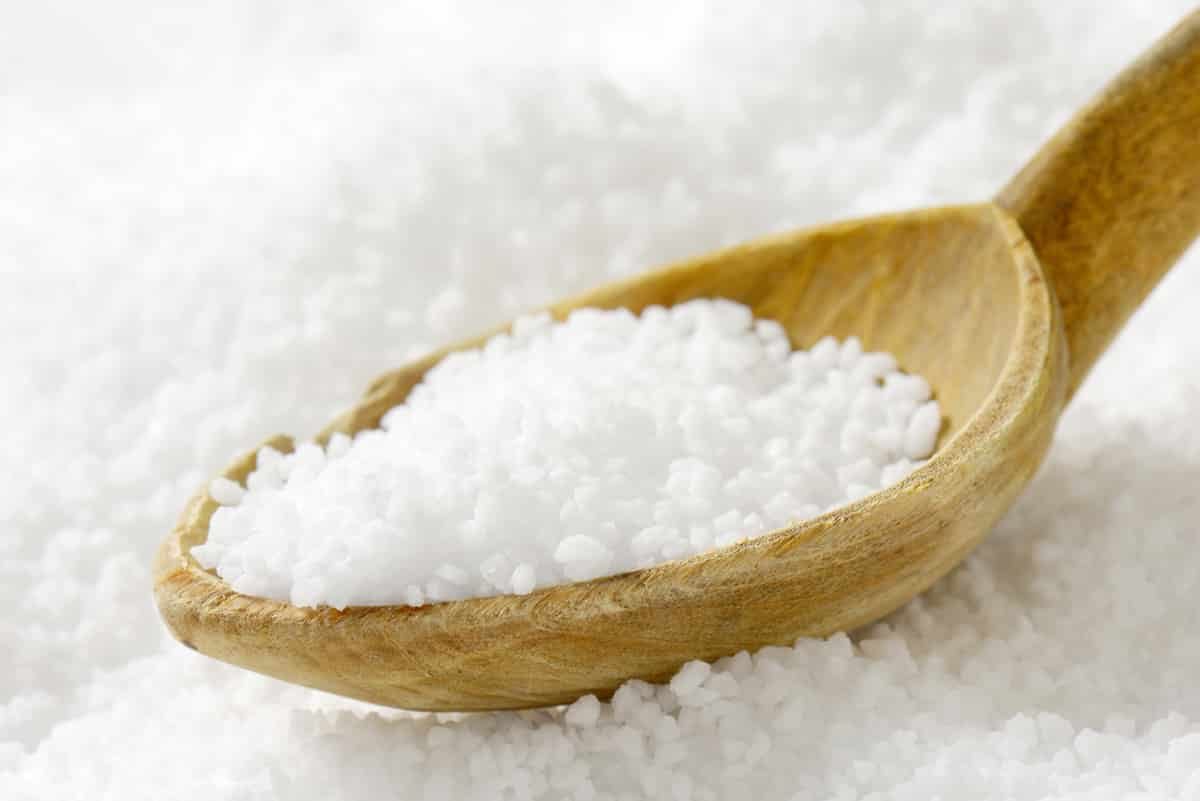
Fleur de sel is a finishing salt: the thin layer of crystals that forms on the surface of the brine in seawater salt pans, skimmed off by hand.1 Kosher salt is a coarse-grained everyday cooking salt, named for its traditional use in koshering meat.23 Both are sodium chloride, and America’s Test Kitchen found no flavor difference worth shopping for between salts once they are mixed into food.2 The differences that change a dish are the crystal, the moisture, and how much salt a spoonful carries. On that last point, “kosher salt” is two different products: a teaspoon of Morton kosher salt weighs 4.8 grams and a teaspoon of Diamond Crystal 2.8 grams.4
Side by side
| Fleur de sel | Kosher salt | |
|---|---|---|
| What it is | Sea salt; crystals that form in floating sheets on the surface of the salt pan1 | Coarse-grained sodium chloride, named for koshering meat23 |
| How it’s made | Forms in sun and wind; skimmed by hand (Guérande specification)1 | Diamond Crystal: brine heated and stirred in open pans, forming hollow pyramid crystals. Morton: brine evaporated in vacuum evaporators, then pressed flat between rollers4 |
| Moisture | Up to 12% (Guérande specification)1 | No published figure found |
| Additives | None allowed (Guérande)1 | Morton: yellow prussiate of soda, an anticaking agent.5 Diamond Crystal: none, per ATK4 |
| Iodine | Not usually iodized6 | Not usually iodized6 |
| Weight per teaspoon | No published figure found | Morton 4.8 g; Diamond Crystal 2.8 g (ATK)4 |
| Sodium | 36.9% to 38.8% in four samples analyzed in Switzerland (none from Guérande)7 | About 40%, the AHA’s general figure for table, kosher and most sea salts8 |
| Main job | Finishing: scattered on food just before serving2 | Seasoning and cooking; ATK’s first choice for seasoning meat2 |
| Flavor (editorial) | Salty; fine, damp crystals with a brief crunch | Salty; Diamond Crystal crisp and light, Morton harder |
| Price | No dated, sourced comparison found | No dated, sourced comparison found |
The sodium row sets a laboratory measurement of four products beside a general figure from the AHA. They are not the same kind of number, and no laboratory analysis of either kosher brand was found.
How each one is made
Fleur de sel. The best-documented fleur de sel comes from Guérande, on France’s Atlantic coast, where it is a protected geographical indication with a published specification. Two salts come from the same pans: gray salt crystallizes on the clay bottom, while fleur de sel forms as crystals floating in sheets on the surface, only when there is wind and sun, and is skimmed off by hand.1 Under the specification it can hold up to 12% moisture and may contain no additives.1 Fleur de sel is made in other places too, under their own rules.
Kosher salt. It is not a mined salt with special processing, as is sometimes said. ATK describes both big US brands as made from brine. Diamond Crystal uses the Alberger process, heating and agitating brine in open containers so that hollow, pyramid-shaped crystals form on the surface. Morton’s brine goes into vacuum evaporators, and the salt is then pressed through rollers into large, thin flakes.4 The name comes from use, not manufacture: the coarse grains were used to draw blood from meat, as Jewish dietary law requires.32
Texture, not flavor
ATK’s tasters found that sea salts vary in color but only slightly in flavor, and that sea salt tastes no different from table salt once mixed into food.2 In its kosher salt test, broths seasoned with equal weights of Morton and Diamond Crystal tasted the same; on buttered bread, tasters preferred Diamond Crystal’s “delicate and fleeting crunch.”4 So the case for either salt is how it handles and how it sits on food.
- Fleur de sel is fine, flaky and damp. It goes on at the end, on steak, fish, tomatoes, eggs or caramel. That is how ATK recommends using sea salts.2
- Kosher salt is easy to pinch and spread, which is why ATK’s testers reach for it to season meat.2 Its coarse grains dissolve more slowly than table salt.3
Two claims about the difference don’t hold up as stated. One says fleur de sel dissolves on the tongue faster because it contains magnesium chloride and calcium chloride. We found no source for that mechanism. The Swiss survey, the one laboratory analysis of fleur de sel we found, could not quantify magnesium in any salt it tested.7 The other says that because neither salt is iodized, neither has the bitter note some people taste in iodized salt. ATK’s tasters found no detectable taste difference between iodized and noniodized salt.2
Measuring: where the swap goes wrong
Salt is measured by the spoon in most home recipes, and a spoon holds very different weights of different salts.
| Salt | Grams per teaspoon | Source |
|---|---|---|
| Table salt | About 6 g, regardless of brand | ATK4 |
| Morton kosher | 4.8 g | ATK4 |
| Diamond Crystal kosher | 2.8 g (rounded to 3 g in a later ATK article) | ATK49 |
| Fleur de sel | No published figure found |
Even the kosher conversions disagree. This is the disagreement as published on our kosher salt page:
| Swap for 1 teaspoon of table salt | Morton kosher | Diamond Crystal | Source |
|---|---|---|---|
| ATK’s rule of thumb | 1½ teaspoons | 2 teaspoons | ATK2 |
| Morton’s chart (Morton products only) | 1¼ teaspoons | not covered | Morton10 |
| Computed from ATK’s gram weights | 1¼ teaspoons | about 2⅛ teaspoons | ATK4 |
We publish the disagreement rather than pick one (treatment: Disputed). ATK itself recommends weighing salt.9 With fleur de sel there is nothing to convert from at all, which is why the swaps below give starting points rather than ratios.
Pickling
A claim that circulates says both salts work for pickling without affecting fermentation. The National Center for Home Food Preservation recommends canning or pickling salt.11 It says flake salt varies in density and is not recommended,11 and it lists an anticaking agent or other additives in the salt as a cause of cloudy brine.11 Morton’s kosher salt contains an anticaking agent.5 The center also notes that pickles can be made safely with iodized or noniodized table salt.11 See pickling salt vs. kosher salt for that comparison.
Can one stand in for the other?
For finishing, yes. For measured cooking, by weight. These treatments follow our fleur de sel substitute and kosher salt substitute pages.
| Swap | Starting amount | Treatment |
|---|---|---|
| Diamond Crystal in place of fleur de sel, for finishing | By the pinch, to taste | Method |
| Morton kosher in place of fleur de sel, for finishing | By the pinch, with a lighter hand: a pinch carries more salt | Method |
| Fleur de sel in place of kosher salt, for finishing | By the pinch, to taste | Method |
| Either, measured into a recipe by weight | No more than the same weight | Computed (upper limit) |
| Kosher salt in place of fleur de sel, measured by volume | Diamond Crystal: start at the same volume. Morton: start at about three quarters. Then taste | Method |
| Fleur de sel in place of kosher salt, measured by volume | Weigh it if you can; otherwise start well under the volume called for and taste | Method |
How these were worked out. By weight: the Codex standard requires food-grade salt to be at least 97% sodium chloride on a dry basis,12 and Guérande fleur de sel may hold up to 12% moisture,1 so a gram of fleur de sel cannot carry more salt than a gram of dry kosher salt. By volume: no one publishes a gram figure for a teaspoon of fleur de sel, so these are cautious starting points. Diamond Crystal is the lightest salt by the spoon in ATK’s figures, which makes it the safest to start at equal volume; Morton weighs 4.8 g a teaspoon against Diamond Crystal’s 2.8 g.4
Health notes
- Sodium. The AHA says table salt, kosher salt and most sea salts are about 40% sodium, and a coarse salt holds less sodium per teaspoon only because fewer crystals fit in the spoon.8
- Iodine. The NIH Office of Dietary Supplements lists both fleur de sel and kosher salt among specialty salts that are not usually iodized.6 If you cook only with these and rely on salt for iodine, see iodized vs. non-iodized salt.
What isn’t known
- No published weight per teaspoon for fleur de sel was found.
- No laboratory analysis of Guérande fleur de sel, or of either kosher brand, was found.
- No test of how fast either salt dissolves on the tongue was found.
- No dated, sourced price comparison was found.
Related
- Fleur de sel and kosher salt, the full profiles
- Fleur de sel substitutes and kosher salt substitutes
- Fleur de sel vs. Maldon salt, fleur de sel vs. sea salt and fleur de sel vs. Himalayan salt
- Maldon salt vs. kosher salt, kosher salt vs. sea salt and kosher salt vs. table salt
- Cooking with kosher salt and too much salt
Footnotes
-
Cahier des charges de l’IGP Sel de Guérande / Fleur de sel de Guérande, French Ministry of Agriculture, 2025. info.agriculture.gouv.fr · Regulator ↩ ↩2 ↩3 ↩4 ↩5 ↩6 ↩7 ↩8
-
Salt Types and Measurements, America’s Test Kitchen. americastestkitchen.com · Publication ↩ ↩2 ↩3 ↩4 ↩5 ↩6 ↩7 ↩8 ↩9 ↩10 ↩11
-
What’s the difference between kosher salt and other salt?, Tufts Health & Nutrition Letter, 2013 (updated 2019). nutritionletter.tufts.edu · Publication ↩ ↩2 ↩3 ↩4
-
Kate Shannon Levine, The Best Kosher Salt, America’s Test Kitchen, 2019. americastestkitchen.com · Publication ↩ ↩2 ↩3 ↩4 ↩5 ↩6 ↩7 ↩8 ↩9 ↩10 ↩11
-
Morton Kosher Salt Flakes, product page, Morton Salt. mortonsalt.com · Merchant ↩ ↩2
-
Iodine: Fact Sheet for Health Professionals, NIH Office of Dietary Supplements. ods.od.nih.gov · Regulator ↩ ↩2 ↩3
-
Esther Infanger and Max Haldimann, Report on the composition of prevalent salt varieties, Swiss Federal Food Safety and Veterinary Office, 2016. warwick.ac.uk · Regulator ↩ ↩2
-
Sodium Sources: Where Does All That Sodium Come From?, American Heart Association, 2025. heart.org · Reference work ↩ ↩2
-
Eden Faithfull, The Wrong Brand of Kosher Salt Could Ruin Your Dinner, America’s Test Kitchen, 2022. americastestkitchen.com · Publication ↩ ↩2
-
Salt Conversion Chart, Morton Salt. mortonsalt.com · Merchant ↩
-
Salts Used in Pickling, National Center for Home Food Preservation. nchfp.uga.edu · Reference work ↩ ↩2 ↩3 ↩4
-
Standard for Food Grade Salt, CXS 150-1985 (rev. 2012), Codex Alimentarius. services.bis.gov.in · Standard ↩