Spice Comparisons · Comparison
Dried Rosemary vs. Fresh: Strength, Flavor and When to Use Each
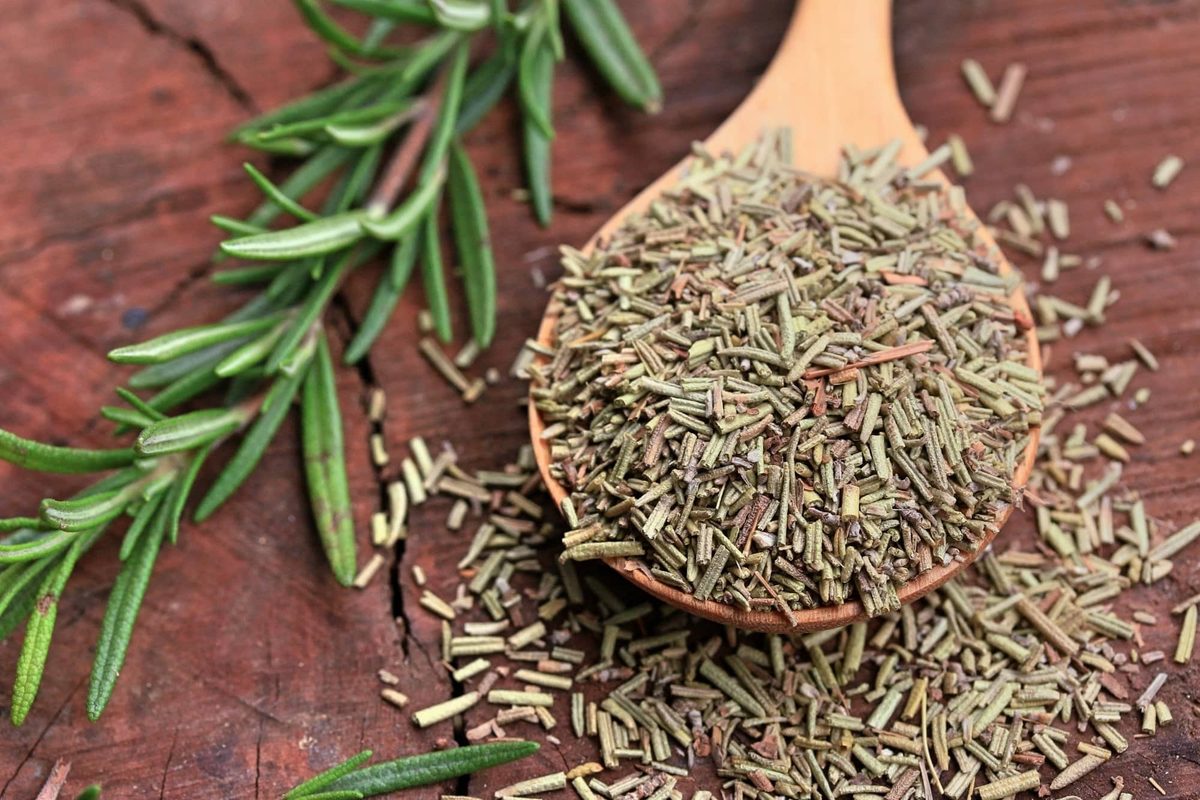
Dried and fresh rosemary are the same leaf of Salvia rosmarinus, an evergreen Mediterranean shrub in the mint family.12 The difference that matters in the kitchen is strength: measured by volume, dried rosemary is about three times as strong, so 1 teaspoon of dried stands in for 1 tablespoon of fresh.345 Rosemary is also one of the few herbs that America’s Test Kitchen found holds up reasonably well dried, as long as the dish cooks for a while in liquid.3
Side by side
| Fresh rosemary | Dried rosemary | |
|---|---|---|
| Plant | Salvia rosmarinus Spenn., formerly Rosmarinus officinalis L.1 | The same plant |
| Family | Lamiaceae (mint family)1 | Same |
| Native range | The Mediterranean1 | Same |
| Part used | Leaves, fresh2 | Leaves, dried2 |
| Key aroma compounds | α-pinene, 1,8-cineole, camphor and borneol in the leaf oil67 | The same compounds; how much survives depends on how the leaves were dried (see below)89 |
| Essential oil | No published figure found for the fresh leaf | 1–2% of the dried leaf6 |
| Strength by volume | 3 parts | 1 part3 |
| Flavor (editorial) | Bright, green and resinous | Still clearly rosemary, with a woodier, flatter top note |
| Texture (editorial) | Soft needles that chop fine | Brittle needles that stay hard in short cooking |
| Best for | Finishing, quick sauces, grilling (editorial); fresh won almost every ATK tasting3 | Braises, stews and soups that cook more than 20 minutes with plenty of liquid3 |
| Regulation | No herb-specific limit found | The EU caps pyrrolizidine alkaloids in dried herbs, rosemary included, at 400 µg/kg10 |
The flavor and texture rows are our description, not measurements. For the plant itself, see rosemary.
What drying does to rosemary
PROSEA traces rosemary’s smell to compounds in its essential oil, linking the warm, piny note to α-pinene and the pungent, camphor-like note to borneol, and puts the oil at 1–2% of the dried leaf.6 How much of those compounds survives drying depends on heat. Two Italian studies dried rosemary leaves under controlled conditions and measured the volatile compounds afterward:
| Study (scope) | What they found |
|---|---|
| Di Cesare et al. 2001: leaves dried in normal air at 50 °C, or in dried air at 30 °C | At 50 °C, linalool disappeared from the leaves, and borneol, camphor, eucalyptol and α-pinene fell below their levels in fresh leaves. At 30 °C, all the characteristic compounds stayed close to fresh.8 |
| Piga et al. 2007: Sardinian rosemary and thyme, oven-dried at several temperatures and air speeds | Losses of volatile compounds depended on drying temperature and time. For rosemary, 38 °C with low air flow worked best and prevented the decrease in volatile compounds.9 |
Both studies report the makeup of the oil, not how the herb tastes in a dish, and neither tested a supermarket jar. Since a jar’s label won’t usually say how the leaves were dried, the practical check is the same for any jar: crush a few needles and smell them.
Rosemary oil also varies with the plant before any drying happens. A 2017 study of oils from plants collected in six countries, from Australia to Yemen, found α-pinene at 13.5–37.7% and 1,8-cineole at 16.1–29.3%, and at least five chemotypes.7
How much to use
Ratio (Computed): The sources agree that dried herbs are about three times as strong as fresh by volume.
| Source | Fresh | Dried, crumbled | Ground or powdered |
|---|---|---|---|
| NDSU Extension (herbs in general) | 1 tablespoon | 1 teaspoon | 1/2 teaspoon4 |
| Penn State Extension (herbs in general) | 1 tablespoon | 1 teaspoon | 1/4 teaspoon5 |
| LSU AgCenter (herbs in general) | 1 tablespoon | 1 teaspoon | not given11 |
| University of Delaware Extension (herbs in general) | 2 to 3 teaspoons | 3/4 to 1 teaspoon | not given12 |
| America’s Test Kitchen, tasting test | 3 parts | 1 part | not given3 |
| The Spice House (for rosemary) | 1 tablespoon | 1 teaspoon | not given13 |
| A Couple Cooks (for rosemary in a cooked dish) | 1 tablespoon | 1 teaspoon | not given14 |
ATK’s test found that 1 part dried to 3 parts fresh came closest to equal strength.3 Penn State gives the dried amount as about a quarter to a third of the fresh.5 Delaware’s guide suggests crushing dried herbs first to release some of their oils.12
Ground rosemary (Disputed): NDSU puts 1 tablespoon of fresh herbs at 1/2 teaspoon ground; Penn State says 1/4 teaspoon powdered.45 That is a twofold gap, neither figure was measured on rosemary, and neither source says how it was reached. Start with the smaller amount and taste.
When to use each
Dried rosemary belongs in dishes that cook long and wet. In ATK’s tests, dried rosemary, sage and thyme did reasonably well in dishes with fairly long cooking times (more than 20 minutes) and a good amount of liquid, alongside oregano.3 ATK’s Danielle Lapierre lists rosemary among the herbs worth keeping dried.15 Stews, braised lamb, bean soups and tomato sauces fit that description.
Fresh rosemary is better wherever the herb is barely cooked. In ATK’s tests, tasters preferred fresh herbs to dried in all but one application.3 By kitchen judgment, that means fresh for grilled lamb or pork, roast potatoes, focaccia, herb butter and oily fish.
Timing. ATK groups rosemary with the hearty herbs that go in early, noting that their flavor compounds are somewhat more heat-stable than those of tender herbs,16 and LSU AgCenter also classes rosemary among the less delicate herbs.11 Delaware’s general advice for long simmering points the other way: add herbs in the last 45 minutes.12 Neither tested rosemary specifically. A workable approach is whole sprigs early for a background note and chopped leaves late for a sharper one.
Texture. Dried needles stay hard and splintery in a quick dish (editorial). Crumble them between your fingers, grind them, or tie fresh sprigs into a bouquet garni that comes out before serving. Delaware’s guide also warns that strong herbs such as rosemary can be “extremely objectionable” if overused,12 which matters more with the concentrated dried form. If a dish has gone over, see too much rosemary.
Can one stand in for the other?
Yes, in most cooked dishes.
- Dried for fresh: 1 teaspoon dried per tablespoon of fresh (Computed, from the table above). Give it time in liquid. For a garnish or a raw preparation, dried is a poor swap.
- Fresh for dried: 1 tablespoon fresh per teaspoon of dried (Computed). Chop it finely or use whole sprigs you can remove.
If you have neither, rosemary substitutes ranks thyme, sage and other herbs by the job rosemary is doing.
What isn’t known
- No study we found compares fresh and dried rosemary in the same cooked dish. The 1-to-3 ratio is a general herb rule, tested by ATK across herbs; The Spice House and A Couple Cooks state it for rosemary without saying how they reached it.31314
- The drying studies report compound percentages under laboratory drying, not the conditions behind any retail jar.
- No published essential-oil figure for fresh rosemary leaf was found, so the oil content of fresh and dried leaves cannot be compared on this page.
- We found no shelf-life figure for dried rosemary from a regulator or extension service. See how to store rosemary and how to dry rosemary.
Related
- Dried herbs vs. fresh: the general rules for every herb.
- Rosemary, rosemary substitutes, rosemary uses and cooking with rosemary
- Can you freeze rosemary?
- Fresh thyme vs. dried, fresh sage vs. dried sage and fresh oregano vs. dried: the other hardy herbs.
- Rosemary vs. thyme, rosemary vs. sage, rosemary vs. lavender and tarragon vs. rosemary
Footnotes
-
Salvia rosmarinus Spenn., Plants of the World Online, Royal Botanic Gardens, Kew. powo.science.kew.org · Reference work ↩ ↩2 ↩3 ↩4
-
“Rosemary”, Encyclopaedia Britannica. britannica.com · Reference work ↩ ↩2 ↩3
-
“Science: Substituting Dried Herbs for Fresh”, America’s Test Kitchen. americastestkitchen.com · Publication ↩ ↩2 ↩3 ↩4 ↩5 ↩6 ↩7 ↩8 ↩9 ↩10
-
Julie Garden-Robinson, Ingredient Substitutions (FN198), NDSU Extension, 2018. ksre.ksu.edu · Reference work ↩ ↩2 ↩3
-
Stacy Reed, “Preserving Herbs by Drying”, Penn State Extension, 2024. extension.psu.edu · Reference work ↩ ↩2 ↩3 ↩4
-
C.C. de Guzman, Rosmarinus officinalis, Plant Resources of South-East Asia (PROSEA). uses.plantnet-project.org · Reference work ↩ ↩2 ↩3
-
Satyal et al., “Chemotypic Characterization and Biological Activity of Rosmarinus officinalis”, Foods, 2017. mdpi.com · Peer-reviewed ↩ ↩2
-
Di Cesare et al., “Study of the volatile composition of the raw and dried rosemary”, Industrie Alimentari, 2001 (abstract). agris.fao.org · Peer-reviewed ↩ ↩2
-
Piga et al., “Influence of Different Drying Parameters on the Composition of Volatile Compounds of Thyme and Rosemary Cultivated in Sardinia”, 2007. iris.uniss.it · Peer-reviewed ↩ ↩2
-
Commission Regulation (EU) 2023/915, Annex I, section 2.4. eur-lex.europa.eu · Regulator ↩
-
“Flavorful Herbs”, LSU AgCenter. lsuagcenter.com · Reference work ↩ ↩2
-
“Using Herbs and Spices”, University of Delaware Cooperative Extension, 2025. udel.edu · Reference work ↩ ↩2 ↩3 ↩4
-
“The 8 Best Substitutes for Rosemary”, The Spice House, 2024. thespicehouse.com · Merchant ↩ ↩2
-
Sonja Overhiser, “Best Substitute for Rosemary”, A Couple Cooks. acouplecooks.com · Publication ↩ ↩2
-
Danielle Lapierre, “When You Should Actually Use Dried Herbs (and Which Ones to Avoid)”, America’s Test Kitchen, 2022. americastestkitchen.com · Publication ↩
-
Liz Bomze, “Our Guide to Fresh Herbs”, America’s Test Kitchen, 2019. americastestkitchen.com · Publication ↩