Spice Comparisons · Comparison
Fresh Oregano vs. Dried: One of the Few Herbs That Dries Well
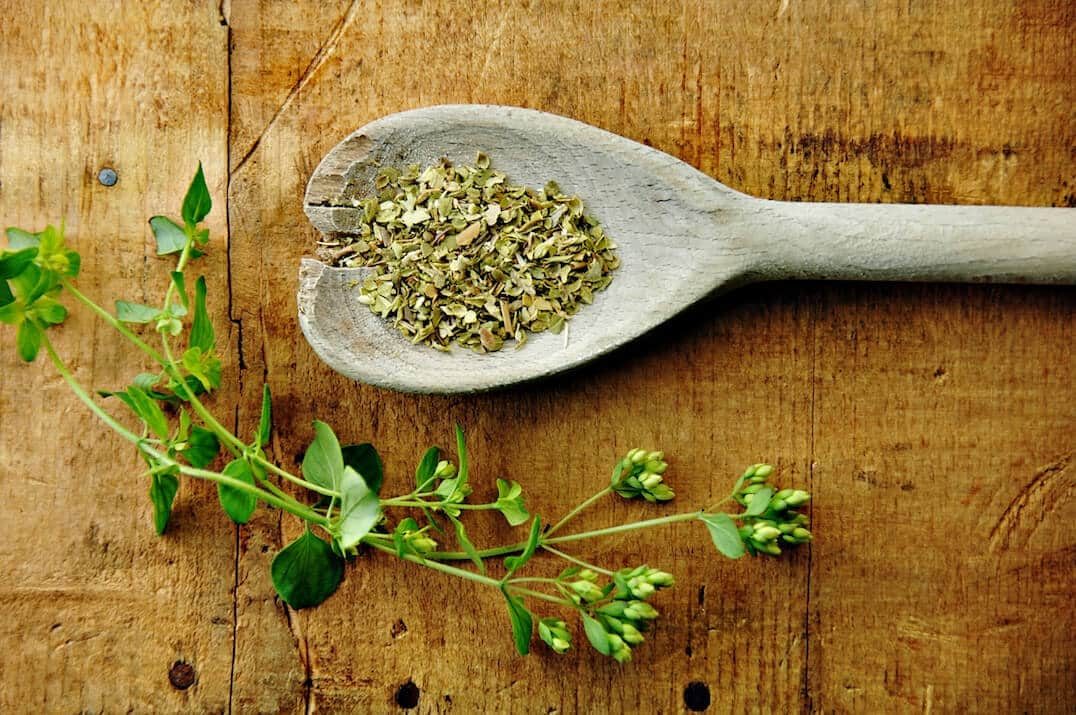
Fresh and dried oregano are the same herb, mostly Origanum vulgare and its close relatives in the mint family.12 Unlike basil or parsley, oregano is one of the herbs that America’s Test Kitchen found holds up well dried, and dried is about three times as strong as fresh by volume, so 1 teaspoon dried replaces 1 tablespoon fresh.345 Fresh oregano’s advantage is a greener, softer flavor and its color; dried oregano’s is convenience in long-cooked dishes.
Side by side
| Fresh oregano | Dried oregano | |
|---|---|---|
| Plant | Origanum vulgare L. and related Origanum species16 | The same; the Codex standard for dried oregano covers Origanum species except marjoram7 |
| Family | Lamiaceae (mint family)2 | Lamiaceae; Mexican oregano belongs to Verbenaceae2 |
| Native range | Macaronesia to China (Kew)1 | Same |
| Part used | Leaves and tender stems | Dried leaves, sold whole, crushed or ground |
| Key aroma compounds | Carvacrol and thymol, together about 78–85% of the essential oil6 | Same compounds; in one study the carvacrol share of the oil rose after drying (see below)8 |
| Strength by volume | 3 parts | 1 part3 |
| Flavor | Strong aroma and a warm, pungent taste (Britannica, for the culinary oreganos);2 fresh reads greener and softer (editorial) | Earthier and more concentrated (editorial) |
| Best for | Finishing, salads, quick sauces, garnish (editorial) | Tomato sauces, braises and long-cooked dishes3 |
| Adulteration | No survey found | EU testing found 48% of oregano samples suspicious, mostly from olive leaves9 |
| Regulation | No herb-specific limit found | The EU caps pyrrolizidine alkaloids in dried oregano at 1,000 µg/kg, more than the 400 µg/kg allowed for most dried herbs10 |
For the plant, its chemistry and its history, see oregano.
What drying does to oregano
Oregano’s bite comes from phenols in its essential oil. A 2020 review puts carvacrol and thymol at about 78 to 85 percent of oregano oil.6
A 2022 Italian study dried oregano several ways (in shade, in a static oven, with three microwave treatments and with an osmotic treatment) and compared the oils with oil from the fresh plant.8
- Carvacrol was the main compound in every sample, at 56.2 to 81.4% of the oil.8
- After drying, the shares of carvacrol, isoborneol and linalool rose significantly, while p-cymene, γ-terpinene and α-pinene fell.8
- Oil yields and composition varied with the drying method; microwave and shade drying gave the highest yields.8
These are percentages of the oil, not absolute amounts in a teaspoon, and the study did not run a taste test. They fit ATK’s kitchen finding: in its tests, dried oregano, rosemary, sage and thyme fared reasonably well in dishes with fairly long cooking times (more than 20 minutes) and a good amount of liquid.3 ATK’s Danielle Lapierre lists oregano first among the herbs worth using dried.11
How much to use
Ratio (Computed): The sources agree on about 1 part dried to 3 parts fresh.
| Source | Fresh | Dried | Ground |
|---|---|---|---|
| America’s Test Kitchen, tasting test | 3 parts | 1 part3 | not given |
| ATK, Danielle Lapierre | 3 parts | 1 part (“one-third the amount”)11 | not given |
| The Spice House (for oregano) | 1 tablespoon | 1 teaspoon5 | not given |
| A Couple Cooks (for oregano) | 1 tablespoon | 1 teaspoon12 | not given |
| NDSU Extension (herbs in general) | 1 tablespoon | 1 teaspoon | 1/2 teaspoon4 |
| Penn State Extension (herbs in general) | 1 tablespoon | 1 teaspoon | 1/4 teaspoon13 |
| LSU AgCenter (herbs in general) | 1 tablespoon | 1 teaspoon14 | not given |
| University of Delaware (herbs in general) | 2 to 3 teaspoons | 3/4 to 1 teaspoon15 | not given |
Ground oregano (Disputed): NDSU and Penn State disagree twofold on how much ground herb equals a tablespoon of fresh, and neither says how its figure was reached.413 Start with 1/4 teaspoon ground per tablespoon of fresh and taste.
Delaware’s guide suggests crushing dried herbs first to release some of their oils.15 Rubbing dried oregano between your palms as it goes into the pot does the same job (editorial).
When to use each
Dried oregano is the default for cooked dishes. Britannica calls oregano essential in Italian pizza and pasta sauces, Greek salads and gyros,2 and dried oregano does well in sauces and braises that simmer.3 ATK groups oregano with the hearty herbs that go in early,16 and LSU AgCenter classes it among the less delicate herbs.14 The University of Delaware rates oregano a medium-strength herb rather than a dominant one, with a starting amount of 1 to 2 teaspoons for six servings.15
Fresh oregano suits uses where its leaves stay visible or barely cooked: scattered over pizza or roasted vegetables after cooking, chopped into salsa verde or a Greek salad, or steeped in olive oil (editorial). Even for oregano, ATK’s tasters preferred fresh herbs to dried in all but one application.3
Mexican oregano is a different plant. Most “Mexican oregano” is Lippia, which Britannica places in a different family, Verbenaceae.2 ATK found it stronger than the Mediterranean type, with a hint of menthol.17 It is sold almost entirely dried, so a fresh-for-dried swap with it is rarely an option (editorial). See Mexican oregano vs. oregano.
Buying dried oregano
Dried oregano is where quality problems concentrate. In the European Commission’s 2019–2021 coordinated control plan on herb and spice fraud, 48% of oregano samples were suspected of adulteration, in most cases with olive leaves.9 An international Codex standard sets quality requirements for dried oregano.7 Buying whole or crushed leaf rather than fine powder makes foreign leaves easier to spot; that is a practical suggestion, not a tested method. With fresh oregano, what you see is what you get.
The EU’s pyrrolizidine alkaloid limit for dried oregano, 1,000 µg/kg, is also higher than the 400 µg/kg allowed for most other dried herbs.10
Can one stand in for the other?
Yes, in either direction, more readily than for most herbs.
- Dried for fresh: 1 teaspoon dried per tablespoon of fresh (Computed). Best in anything that simmers; weakest as a raw garnish.
- Fresh for dried: 1 tablespoon fresh per teaspoon of dried (Computed). Add it a little later than you would dried, by kitchen judgment.
If you have neither, oregano substitutes ranks marjoram, thyme, basil and others by the job oregano is doing.
What isn’t known
- No study we found compares fresh and dried oregano in the same dish beyond ATK’s general herb tests.
- The 2022 drying study reports oil composition, not flavor, and does not give oil yields for fresh versus dried material in its abstract.8
- No published shelf-life figure for dried oregano from a regulator or standards body was found.
- A widely repeated claim says fresh oregano is healthier than dried. We found no source comparing the nutrients in the two at the amounts cooks use.
Related
- Dried herbs vs. fresh: the general rules for every herb.
- Oregano, oregano substitutes, oregano uses and cooking with oregano
- How to dry oregano, can you freeze oregano? and too much oregano?
- Marjoram vs. oregano, oregano vs. thyme and Mexican oregano vs. oregano
- Dried rosemary vs. fresh, fresh thyme vs. dried and fresh sage vs. dried sage: the other hardy herbs.
Footnotes
-
Origanum vulgare L., Plants of the World Online, Royal Botanic Gardens, Kew. powo.science.kew.org · Reference work ↩ ↩2 ↩3
-
Anoushka Pant, “Oregano”, Encyclopaedia Britannica. britannica.com · Reference work ↩ ↩2 ↩3 ↩4 ↩5 ↩6
-
“Science: Substituting Dried Herbs for Fresh”, America’s Test Kitchen. americastestkitchen.com · Publication ↩ ↩2 ↩3 ↩4 ↩5 ↩6 ↩7
-
Julie Garden-Robinson, Ingredient Substitutions (FN198), NDSU Extension, 2018. ksre.ksu.edu · Reference work ↩ ↩2 ↩3
-
“The 8 Best Oregano Substitutes”, The Spice House, 2018. thespicehouse.com · Merchant ↩ ↩2
-
Lombrea et al., “A Recent Insight Regarding the Phytochemistry and Bioactivity of Origanum vulgare L. Essential Oil”, Int. J. Mol. Sci., 2020. mdpi.com · Peer-reviewed ↩ ↩2 ↩3
-
Standard for Dried Oregano, CXS 342-2021, Codex Alimentarius. fao.org · Standard ↩ ↩2
-
Caputo et al., “Impact of drying methods on the yield and chemistry of Origanum vulgare L. essential oil”, Scientific Reports, 2022 (abstract). doaj.org · Peer-reviewed ↩ ↩2 ↩3 ↩4 ↩5 ↩6
-
Herbs and spices (2019-2021): EU coordinated action, European Commission. food.ec.europa.eu · Regulator ↩ ↩2
-
Commission Regulation (EU) 2023/915, Annex I, section 2.4. eur-lex.europa.eu · Regulator ↩ ↩2
-
Danielle Lapierre, “When You Should Actually Use Dried Herbs (and Which Ones to Avoid)”, America’s Test Kitchen, 2022. americastestkitchen.com · Publication ↩ ↩2
-
Sonja Overhiser, “Best Oregano Substitute”, A Couple Cooks. acouplecooks.com · Publication ↩
-
Stacy Reed, “Preserving Herbs by Drying”, Penn State Extension, 2024. extension.psu.edu · Reference work ↩ ↩2
-
“Flavorful Herbs”, LSU AgCenter. lsuagcenter.com · Reference work ↩ ↩2
-
“Using Herbs and Spices”, University of Delaware Cooperative Extension, 2025. udel.edu · Reference work ↩ ↩2 ↩3
-
Liz Bomze, “Our Guide to Fresh Herbs”, America’s Test Kitchen, 2019. americastestkitchen.com · Publication ↩
-
“Oregano: Mediterranean and Mexican”, America’s Test Kitchen. americastestkitchen.com · Publication ↩