Cooking · Uses
Herbes de Provence Uses: Roasts, Braises, Vegetables, Cheese and More
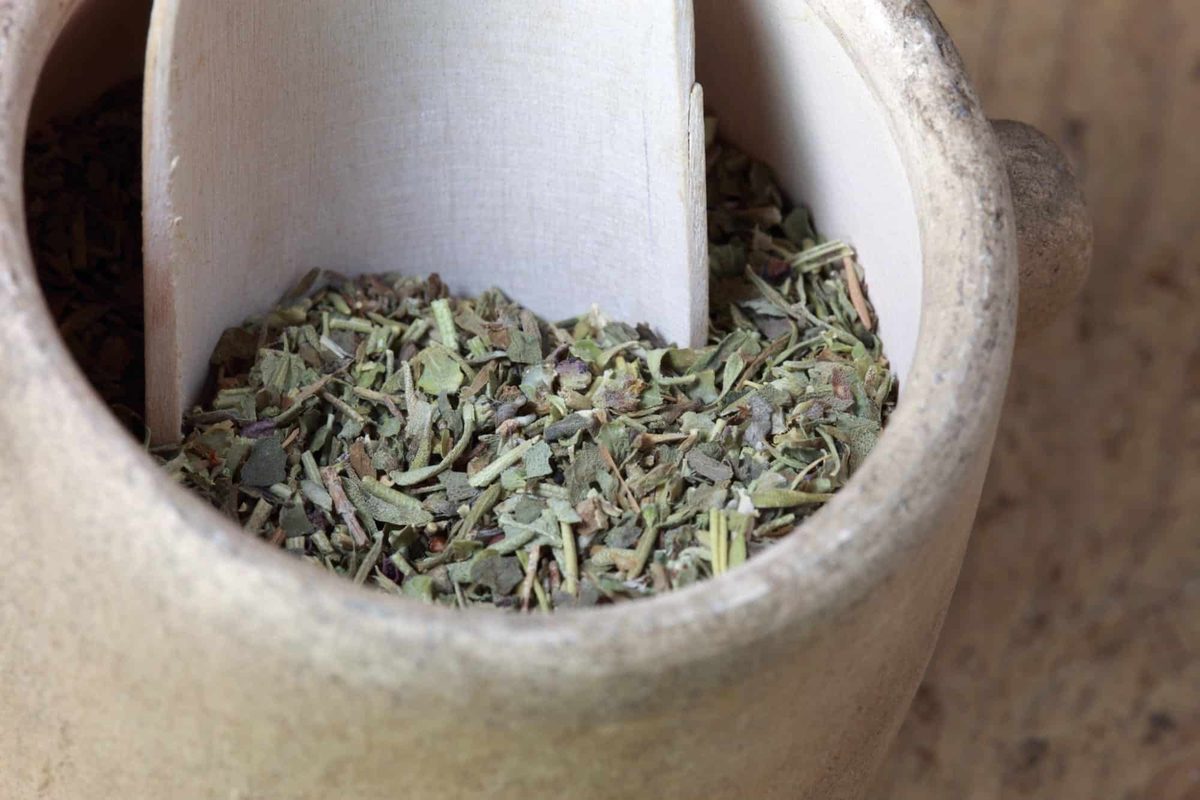
Herbes de Provence is a blend of dried, mostly woody Mediterranean herbs named for the south of France, though most of the herbs sold under the name are not grown there.1 It works wherever thyme and rosemary would: roasts, braises, vegetables and anything cooked in olive oil. This page is a list of what to use it in, each with a named recipe. For when to add it and how much to use in general, see cooking with herbes de Provence; for what is in it, see the herbes de Provence profile.
At a glance
| Use it in | Named example | Amount in that recipe |
|---|---|---|
| Meat, general | The Spice House starting point2 | 1 to 2 teaspoons per pound |
| Braised chicken | ATK Classic Chicken Provençal, serves 43 | 1 teaspoon, optional, alongside fresh herbs |
| Ratatouille | Herb Society of America blog4 | 3 tablespoons |
| Roasted potatoes | Giada De Laurentiis, Food Network, serves 4 to 65 | 1 tablespoon with 1/3 cup olive oil |
| Goat cheese log | Cook’s Country, serves 10 to 156 | 3 tablespoons, as a coating |
| Grilled fish and lamb, roast chicken, beef stew | The Takeout; Herb Society writer74 | No amounts given |
These are Attributed amounts from individual recipes. They range widely because some recipes use the blend as the main seasoning and others as a background note.
Check your jar first
What a use tastes like depends on the blend. The French Label Rouge recipe is thyme, rosemary, savory and oregano, with no lavender;8 Ducros’s version is rosemary, savory and oregano at 27% each and thyme at 19%, which is all herbs and no salt.9 Commercial blends elsewhere may add marjoram, fennel seed, basil, mint, tarragon or culinary lavender.7 Leah Kaplan of The Takeout writes that lavender was added to appease tourists;7 that is her account rather than documented history.
As a rule of thumb (ours): a lavender blend suits roast chicken, lamb and vegetables in modest amounts, and is easy to overdo in sauces and dressings; a thyme-and-savory blend is the safer all-purpose choice. The Spice House suggests leaving lavender out of a homemade blend, or using a very small pinch of lemon zest instead.2 Most blends contain no salt, so season separately unless the label lists it (our advice; the Ducros blend above is a salt-free example).9
Roast and grilled meat and fish
The Takeout recommends the blend for grilling fish and marinating meat.7 Beth Schreibman-Gehring, writing for the Herb Society of America, uses it on grilled fish and lamb, and blends it into butter with a little garlic to tuck under the skin of a roasting chicken.4 The Spice House’s starting point for meat is 1 to 2 teaspoons of the blend per pound.2
For a rub, mix the blend with olive oil, salt and pepper and spread it over the meat before cooking (common practice). Pork chops and pork loin take it as well as lamb and chicken (our suggestion). See spices for lamb and good spices for chicken.
Braises, stews and soups
Long, moist cooking suits a dried blend of woody herbs: America’s Test Kitchen found that dried rosemary, sage and thyme fared reasonably well in dishes cooked more than 20 minutes with a good amount of liquid.10 ATK’s Classic Chicken Provençal stirs in an optional teaspoon of the blend with the broth, tomatoes and fresh herbs before braising;3 Schreibman-Gehring calls the blend integral to her beef stew.4 White bean soups, lentils and tomato-based stews are natural extensions (our suggestions). Timing details are on cooking with herbes de Provence.
Ratatouille and roasted vegetables
Ratatouille. Schreibman-Gehring adds three tablespoons of the blend to her ratatouille after the vegetables are cooked, simmers it gently for about two and a half hours, and stirs in fresh basil at the end.4
Roasted vegetables. The Takeout recommends the blend for roasting vegetables.7 Giada De Laurentiis’s roasted potatoes toss 24 ounces of small potatoes with sliced onion, 1/3 cup of olive oil, 1 tablespoon of herbes de Provence and a teaspoon of kosher salt, then roast at 450°F for 25 to 35 minutes, with the herbs on from the start.5 Eggplant, zucchini, squash, carrots and tomatoes take the same treatment (our suggestion). See eggplant spices.
Goat cheese and soft cheese
Cook’s Country’s goat cheese log blends goat cheese and cream cheese with olive oil, garlic and pepper, freezes it until firm, then rolls it in 3 tablespoons of herbes de Provence to coat and finishes it with a drizzle of oil.6 The same coating works on a round of fresh chèvre or stirred into fromage blanc or ricotta for a spread (our suggestions).
Oils, dressings and dips
A spoonful of the blend in olive oil makes a quick dip for bread, and a pinch crushed between your fingers seasons a vinaigrette; give it a few minutes in the oil or vinegar to soften (common practice). If you make a flavored oil ahead, Oregon State University Extension’s guidance for oil seasoned with dried herbs is to refrigerate it and use it within 4 days, or freeze it.11
Pizza, flatbread and bread
Oregano is one of the four Label Rouge herbs,8 so the blend sits comfortably on pizza: a pinch in tomato sauce, or over a white pizza with goat cheese (our suggestions). Brushing focaccia or flatbread with olive oil and a sprinkle of the blend before baking, or kneading a teaspoon into a loaf, are common home uses; no source checked here gives tested amounts (our suggestions). See good spices for pizza.
Fresh instead of dried
You can make the blend from fresh herbs for quick-cooking dishes and finishing. The Spice House says to use roughly three times as much fresh as dried,2 and ATK’s tests with single herbs found 1 part dried to 3 parts fresh came closest, with tasters preferring fresh in all but one application.10 Add fresh herbs later in cooking than the dried blend (common practice).
Not yet measured
- A general per-serving amount; the figures above are individual recipes.
- How blends with and without lavender compare in specific dishes.
- Tested amounts for bread, pizza or vinaigrette.
Related
- Herbes de Provence and cooking with herbes de Provence
- Herbes de Provence substitutes and herbes de Provence vs. Italian seasoning
- Lavender and cooking with lavender
- French spices and fines herbes
- Thyme uses, rosemary uses and summer savory uses
Footnotes
-
Sylvie Carriat, Les vraies herbes de Provence raniment la flamme, Réussir Les Marchés, 2008. reussir.fr · Publication ↩
-
Herbes De Provence Substitute, The Spice House, 2017. thespicehouse.com · Merchant ↩ ↩2 ↩3 ↩4
-
Classic Chicken Provençal, Cook’s Illustrated, America’s Test Kitchen, 2007. americastestkitchen.com · Publication ↩ ↩2
-
Beth Schreibman-Gehring, Herbes de Provence Essential to Ratatouille, The Herb Society of America Blog, 2019. blog.herbsociety.org · Publication ↩ ↩2 ↩3 ↩4 ↩5
-
Giada De Laurentiis, Herbes De Provence Roasted Potatoes, Food Network. foodnetwork.com · Publication ↩ ↩2
-
Goat Cheese Log with Herbes de Provence, Cook’s Country, America’s Test Kitchen, 2017. americastestkitchen.com · Publication ↩ ↩2
-
Leah Kaplan, What Is Herbs De Provence, Really?, The Takeout, 2025. thetakeout.com · Publication ↩ ↩2 ↩3 ↩4 ↩5
-
Cahier des charges du Label Rouge LA 02/03 « Herbes de Provence », modification request, INAO, 2014. extranet.inao.gouv.fr · Regulator ↩ ↩2
-
Provencal herbs red label 78g, product specification, McCormick for Chefs (Ducros), 2025. mccormickforchefs.com · Merchant ↩ ↩2
-
Science: Substituting Dried Herbs for Fresh, America’s Test Kitchen. americastestkitchen.com · Publication ↩ ↩2
-
Raab and Woodburn, Herbs and vegetables in oil (SP 50-701), Oregon State University Extension Service, 2025. extension.oregonstate.edu · Reference work ↩