Spice Comparisons · Comparison
Herbes de Provence vs. Italian Seasoning: What Differs in the Jar and When to Swap
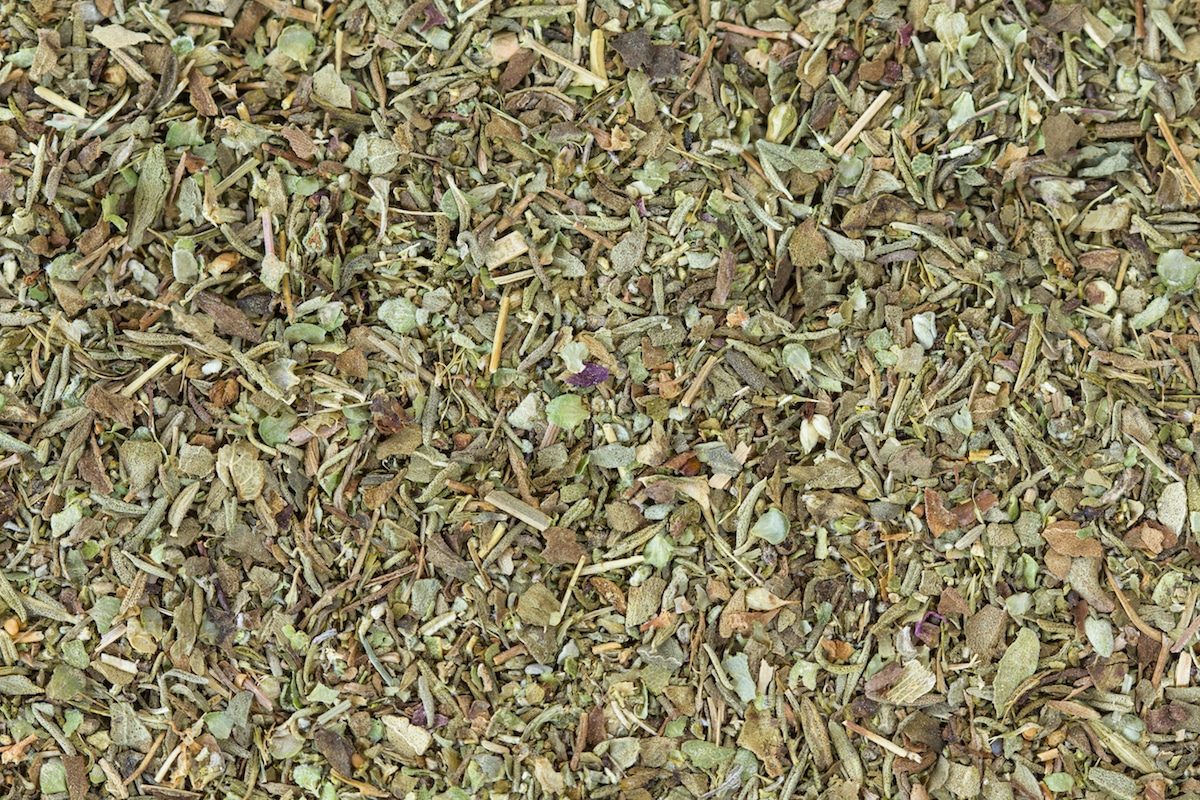
Both are jars of dried Mediterranean herbs, and they share thyme, rosemary and oregano. The difference is in the supporting cast: herbes de Provence is built on savory and thyme, sometimes with lavender or fennel, while Italian seasoning adds basil, marjoram and sage.12345 Neither has a fixed recipe outside France’s Label Rouge version of herbes de Provence, so the label on your jar matters more than the name on the front.13
Side by side
| Herbes de Provence | Italian seasoning | |
|---|---|---|
| What it is | A blend of dried, cut herb leaves1 | A blend of dried green herb leaves3 |
| Fixed recipe? | Only the French Label Rouge blend (LA 02/03): thyme, rosemary, savory and oregano, with basil in the original version1 | No. The USDA purchasing specification names five herbs as a minimum3 |
| Core herbs | Label Rouge, per Ducros’s 2025 sheet: rosemary, savory and oregano at 27% each, thyme at 19%6 | USDA minimum list: thyme, rosemary, sage, oregano and basil3 |
| Other herbs often added | Marjoram, fennel seed, basil, mint, tarragon; some blends add bay, chervil or lavender (The Takeout)2 | Marjoram (first-listed in McCormick’s); savory in McCormick’s45 |
| Lavender | Not in the Label Rouge blend; added to some commercial blends12 | Not in either brand checked or in the USDA list345 |
| Where the name points | Provence, but Label Rouge producers say most herbs sold under the name do not come from there7 | Italy, but probably an American product8 |
| Key aroma compounds (from the herbs’ oils) | Thymol and carvacrol (thyme, savory, oregano); pinene and 1,8-cineole (rosemary)9101112 | Thymol and carvacrol (oregano, thyme); pinene and cineole (rosemary); methyl chavicol (basil); sabinene hydrate (marjoram); thujones (sage)1012131415 |
| Flavor (editorial) | Resinous and savory, peppery from the savory; floral if lavender is in | Greener and a little sweeter from basil and marjoram, with sage’s musky depth |
| Typical uses | Grilled fish, marinated meat, roast vegetables (The Takeout)2 | Pasta, meats and soups (America’s Test Kitchen)16 |
| Price | No dated, sourced comparison found | No dated, sourced comparison found |
For each blend in depth, see herbes de Provence and Italian seasoning.
The herbs that set them apart
Savory is the herbes de Provence herb. It makes up about a quarter of the Label Rouge blend.16 A 2018 review of summer savory gives carvacrol at 11 to 67 percent of its oil across studies,9 the same phenol family that leads oregano and thyme oils.1011 So savory deepens the thyme-and-oregano note rather than adding a new one; that reading is ours. The USDA list for Italian seasoning has no savory,3 though McCormick’s version includes it.4
Basil, marjoram and sage are the Italian seasoning herbs. Basil and sage are on the USDA list, and both brands checked include marjoram and sage.345 They bring compounds that herbes de Provence mostly lacks: methyl chavicol in basil (53.3 percent in one French-type oil, per PROSEA),14 cis-sabinene hydrate, credited with marjoram’s sweet note,13 and the thujones that PROSEA says give sage its strong smell.15 Basil does turn up in herbes de Provence, at 3 percent in the original Label Rouge recipe and in some commercial blends,12 but it is a minor player. Sage appears in neither the Label Rouge recipe nor The Takeout’s list of common additions.12
Lavender is optional, and only on one side. The Label Rouge blend has none.1 The Takeout’s Leah Kaplan writes that it was added to appeal to tourists; that is her account, not a documented history.2 The Spice House singles out lavender as the key ingredient behind the blend’s distinctive flavor.17 Either way, a blend with lavender tastes noticeably floral, and one without it is much closer to Italian seasoning (our judgment).
Proportions differ even between jars of the same name. US labels list ingredients in descending order by weight.18 McCormick’s Italian seasoning lists marjoram first; Simply Organic’s lists oregano first.45 America’s Test Kitchen’s homemade version leads with oregano and thyme.16 For herbes de Provence, the Label Rouge recipe is rosemary-, savory- and oregano-heavy,6 while The Spice House’s own mix uses more thyme and savory than anything else.17
Where each one comes from
Herbes de Provence is named for the region of southeastern France, but the herbs in most jars are not Provençal. Label Rouge producers told the trade paper Réussir in 2008 that herbs sold as “de Provence” generally do not come from the region, and put genuine Provençal herbs at about 5 percent of the French market.7 The Takeout credits Julia Child with bringing the blend into American kitchens by the 1960s and Ducros with selling it packaged by the 1970s.2
Italian seasoning has a vaguer history. Tasting Table calls it “more than likely an American invention” and says a bottle labeled Italian seasoning would be hard to find in Italy, where cooks are more likely to use fresh herbs.8 It adds that traditional recipes do not call for a mix of dried herbs in equal measure.8
Can one stand in for the other?
Yes, for most everyday cooking. The two treatments below come from the herbes de Provence substitutes and Italian seasoning substitutes pages.
| Swap | Starting amount | Treatment |
|---|---|---|
| Italian seasoning for herbes de Provence | 1 to 1 | Attributed: The Takeout says the two “can typically be a 1-to-1 substitute”2 |
| Herbes de Provence for Italian seasoning | 1 to 1, ideally a blend without lavender | Attributed (same source);2 the lavender advice is ours |
- Italian seasoning in a French dish. The Spice House says it works in a pinch but lacks lavender and savory, so the flavor will be different.17 A pinch of thyme or savory moves it closer (our judgment, based on the shared phenols above).
- Herbes de Provence in an Italian dish. Check the label for lavender. In a tomato sauce or on pizza, a floral, lavender-heavy blend is the one case where we would not swap. A small pinch of basil or marjoram, if you have it, brings the blend closer.
- No published taste test compares the two blends, so the 1-to-1 figure is a writer’s rule of thumb, not a measurement.
When to use which
The Takeout recommends herbes de Provence for grilling fish, marinating meat and roasting vegetables.2 By common practice it also goes into ratatouille, stews and vinaigrettes. Dried woody herbs like these are usually added early so they soften, which is also common practice rather than a tested rule.
America’s Test Kitchen calls its Italian seasoning ideal for pasta, meats and soups.16 By common practice it suits Italian-American tomato sauces, meatballs, pizza, garlic bread and dry rubs. When one herb should lead a dish, single herbs give more control than either blend; see Italian spices.
What isn’t known
- No sensory study compares herbes de Provence with Italian seasoning.
- Brands do not publish proportions beyond ingredient order, and herbes de Provence outside the Label Rouge has no fixed recipe.
- The final approved text of the current Label Rouge specification could not be opened; the 2014 text and Ducros’s 2025 sheet differ slightly on rosemary, savory, oregano and basil.16
- No dated price comparison was found.
Related
- Herbes de Provence, herbes de Provence uses and cooking with herbes de Provence
- Italian seasoning, Italian seasoning substitutes and herbes de Provence substitutes
- Marjoram vs. oregano, basil vs. oregano, rosemary vs. lavender and summer savory vs. winter savory
- Fines herbes and bouquet garni
Footnotes
-
Cahier des charges du Label Rouge LA 02/03 « Herbes de Provence », modification request, INAO, 2014. extranet.inao.gouv.fr · Regulator ↩ ↩2 ↩3 ↩4 ↩5 ↩6 ↩7 ↩8 ↩9 ↩10
-
Leah Kaplan, “What Is Herbs De Provence, Really?”, The Takeout, 2025. thetakeout.com · Publication ↩ ↩2 ↩3 ↩4 ↩5 ↩6 ↩7 ↩8 ↩9 ↩10 ↩11
-
Commercial Item Description A-A-20001C, Spices and Spice Blends, USDA Agricultural Marketing Service, 2023. ams.usda.gov · Regulator ↩ ↩2 ↩3 ↩4 ↩5 ↩6 ↩7 ↩8
-
McCormick Italian Seasoning, ingredients, via Giant Food Stores. giantfoodstores.com · Merchant ↩ ↩2 ↩3 ↩4 ↩5 ↩6
-
Simply Organic Italian Seasoning, ingredients, via Giant Food Stores. giantfoodstores.com · Merchant ↩ ↩2 ↩3 ↩4 ↩5
-
“Provencal herbs red label 78g”, product specification, McCormick for Chefs (Ducros), 2025. mccormickforchefs.com · Merchant ↩ ↩2 ↩3 ↩4
-
Sylvie Carriat, “Les vraies herbes de Provence raniment la flamme”, Réussir Les Marchés, 2008. reussir.fr · Publication ↩ ↩2
-
Zoë Lourey-Christianson, “Why Italian Seasoning Isn’t A Thing In Italy”, Tasting Table, 2024. tastingtable.com · Publication ↩ ↩2 ↩3
-
Fierascu et al., “Phytochemical Profile and Biological Activities of Satureja hortensis L.”, Molecules, 2018. mdpi.com · Peer-reviewed ↩ ↩2
-
Lombrea et al., “A Recent Insight Regarding the Phytochemistry and Bioactivity of Origanum vulgare L. Essential Oil”, International Journal of Molecular Sciences, 2020. mdpi.com · Peer-reviewed ↩ ↩2 ↩3
-
Dong et al., “Chemical Compositions of Essential Oil Extracted from Eight Thyme Species”, Plants, 2023. mdpi.com · Peer-reviewed ↩ ↩2
-
Satyal et al., “Chemotypic Characterization and Biological Activity of Rosmarinus officinalis”, Foods, 2017. mdpi.com · Peer-reviewed ↩ ↩2
-
Kakouri et al., “Origanum majorana Essential Oil: A Review of Its Chemical Profile and Pesticide Activity”, Life, 2022. mdpi.com · Peer-reviewed ↩ ↩2
-
Aguilar, Pham and Oyen, Ocimum basilicum, Plant Resources of South-East Asia (PROSEA). uses.plantnet-project.org · Reference work ↩ ↩2
-
Dasuki, Salvia officinalis, Plant Resources of South-East Asia (PROSEA). uses.plantnet-project.org · Reference work ↩ ↩2
-
“Homemade Italian Seasoning”, America’s Test Kitchen, 2017. americastestkitchen.com · Publication ↩ ↩2 ↩3
-
“Herbes De Provence Substitute”, The Spice House, 2017. thespicehouse.com · Merchant ↩ ↩2 ↩3
-
21 CFR 101.4, Food; designation of ingredients. ecfr.gov · Regulator ↩